
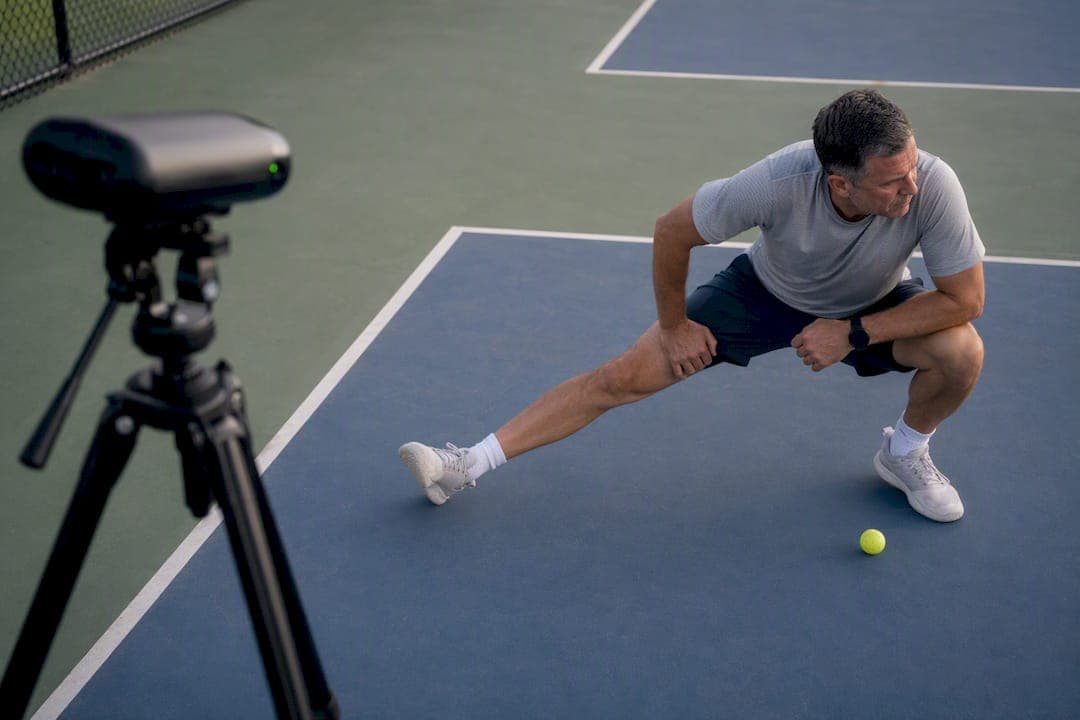
AI in sports training uses computer vision, wearable sensors, and predictive machine learning to turn raw movement into coaching intelligence. It gives athletes and coaches three things traditional training can't: precise technique metrics pulled from video instead of a coach's eye, early warnings on injury risk before pain shows up, and training plans that adjust as performance and recovery data change. None of that works well if the system runs slow or hides its reasoning, so latency and explainability matter as much as the underlying model.
TL;DR:
- AI tools that connect biomechanics, injury prediction, workload management, and real-time feedback outperform those focusing on only one pillar, offering more comprehensive insights.
- Explainability is critical for injury prevention models, requiring systems to identify specific biomechanical causes behind risk scores rather than just giving percentage-based assessments.
- Latency below 40 milliseconds is essential for effective real-time corrections, favoring locally processed edge computing over cloud-only systems despite higher setup costs.
- Combining wearable sensors with motion capture provides a more complete picture of technique and recovery, but current platforms often remain disconnected, limiting actionable analysis.
- Future advancements will involve faster processing, deeper data integration, and transparent reasoning to enhance athlete safety and performance optimization.
Table of Contents
- What Is AI in Sports Training? The Four Core Pillars
- How Does AI Improve Performance Analysis?
- Can AI Predict and Prevent Sports Injuries?
- What Does Personalized, Adaptive AI Coaching Look Like?
- Why Does Latency Matter for Real-Time AI Feedback?
- What Are the Risks and Ethical Limits of AI Coaching?
- How Do You Evaluate and Trial an AI Training Tool?
- How Does AI Support Mental and Psychological Training?
- Where Has AI Already Worked in Real Sports?
- What's Next for AI in Athletic Training?
- How Do Wearables and Motion Capture Fit Together?
- Play On Pickle's Take on Movement-Signature Analysis
- Try AI-Powered Injury Prevention for Your Own Game
- Sources
What Is AI in Sports Training? The Four Core Pillars
AI in sports training breaks down into four functional pillars, and most tools on the market focus on one or two rather than all four. The Olympic World Library's review of AI in sport frames the field around exactly this structure: biomechanical movement optimization, predictive injury assessment, personalized workload management, and real-time feedback.
- Biomechanics: computer vision and pose estimation turn video into joint angles, velocities, and force estimates.
- Injury prediction: predictive models combine movement quality with training load to flag rising risk before an injury happens.
- Workload management: algorithms track accumulated stress across sessions and adjust volume or intensity automatically.
- Real-time feedback: sensors and cameras deliver in-session cues fast enough to correct a movement while it's still happening.
These pillars rarely operate in isolation. A serve-motion analysis (biomechanics) becomes far more useful when it's cross-referenced against how many reps that shoulder has logged that week (workload), which is exactly how modern injury-risk models get built.
How Does AI Improve Performance Analysis?
Pose estimation is the engine behind most performance gains. A camera or phone captures movement, and computer vision maps dozens of body points frame by frame, converting a swing or stride into hard numbers: joint angle at contact, hip rotation speed, weight transfer timing.
Individually, those numbers are just data. Combined, they form what's often called a movement signature, a composite fingerprint of how a specific athlete moves under specific conditions. Two players with identical serve speeds can have completely different signatures, one loading through the hip, another compensating through the shoulder, and that difference predicts very different long-term outcomes.
What coaches actually get out of this:
- Error flags that isolate the exact phase of motion where a fault occurs, not just "your backswing is off."
- Trend charts showing whether a fix from three weeks ago actually held under fatigue.
- Side-by-side comparisons against an athlete's own baseline rather than a generic ideal.
That last point matters. George Mason University's overview of AI in sports analytics describes coaches using near real-time physiological and tactical data to make in-game decisions, but the tools coaches actually stick with are the ones that translate numbers into a specific correction, not another chart to interpret.
Can AI Predict and Prevent Sports Injuries?
Injury prediction models work by fusing three data streams: movement quality, training load, and recovery status. When hip drop increases while weekly volume climbs and sleep quality drops, the combination raises a flag well before pain shows up. That's the theory. The practice depends entirely on whether the system tells you why.

This is where explainable AI, or XAI, separates useful tools from expensive guesswork. A risk score alone ("72% elevated risk") is close to useless. A system built on explainable outputs tells you the specific biomechanical culprit, asymmetric hip drop, excessive knee valgus, a shortened stride on one side, so a coach or physical therapist can actually act on it. Narrative reviews of AI in sport point to exactly this gap: promising predictive accuracy undermined by opaque reasoning.
The workflow that actually reduces injuries follows four steps:
- Detect: continuous monitoring flags a deviation from the athlete's baseline movement pattern.
- Explain: the system names the specific stress point driving the risk score.
- Prescribe: a targeted corrective exercise or load adjustment addresses that exact issue.
- Monitor: follow-up sessions confirm whether the correction is holding under game conditions.
Pro Tip: Ask any injury-prevention tool one question before trusting it: "What specific movement is driving this risk score?" If the answer is a percentage and nothing else, keep looking.
What Does Personalized, Adaptive AI Coaching Look Like?
Static training plans assume every athlete adapts the same way. Closed-loop AI systems don't make that assumption. They pull in performance metrics, fatigue markers, and even psychological readiness from the last session and adjust the next one accordingly, rather than running everyone through a fixed template regardless of how they responded.
Practically, that means:
- A plan that reduces volume automatically after a session flagged for poor movement quality under fatigue.
- Progression that accelerates for an athlete recovering faster than average, instead of holding them to a generic timeline.
- Recovery days inserted based on actual readiness signals, not just a calendar.
This kind of dynamic adjustment produces different long-term outcomes than static programming, according to closed-loop adaptive training research. One controlled study of an AI-driven adaptive training system found measurable gains in both fitness and technical accuracy over a 12-week intervention, evidence that adaptation beats rigidity when the goal is skill acquisition and injury reduction together.
Why Does Latency Matter for Real-Time AI Feedback?
Latency is the delay between a movement happening and feedback reaching the athlete. For in-motion corrections, anything above roughly 30 to 40 milliseconds starts to feel disconnected from the movement it's correcting, arriving too late to be useful mid-swing or mid-stride.
Edge-cloud AI systems that process video locally before sending only the essential data to the cloud have hit average feedback latencies around 32 milliseconds, squarely inside that effective window. Pure cloud processing tends to lag behind because every frame has to travel round-trip before feedback returns.
That speed comes with trade-offs. Edge processing needs more onboard computing power, which usually means a pricier camera setup or a phone with a decent processor. Portability often costs accuracy: a lightweight phone-based system will lag a fixed multi-camera rig on precision, even if it wins on convenience and price.
What Are the Risks and Ethical Limits of AI Coaching?
Not every product labeled "AI-powered" deserves the term. Experts warn against AI-washing, tools that repackage basic statistics with AI branding and no real predictive modeling behind them. The narrative review published in the Journal of Sports Sciences flags this directly, alongside concerns about algorithmic bias in training data and inconsistent data governance across platforms.
Before trusting any system with your training data or injury history, check for:
- Published validation against real outcomes, not just marketing claims.
- Explainable outputs rather than black-box risk scores.
- Clear data retention and deletion policies.
- Explicit consent for how your movement data gets stored, shared, or used to train other models.
How Do You Evaluate and Trial an AI Training Tool?
Run any new tool through a short, structured trial before committing money or trust to it.
- Check latency claims. Ask for real feedback speed, not marketing language, and compare against the 30 to 40 millisecond benchmark.
- Demand explainability. Confirm the system names specific biomechanical issues, not just scores.
- Look for validation. Published studies or case data beat unverified testimonials every time.
- Test portability versus setup cost. Decide whether you need a full camera rig or a phone will do.
- Run a 2 to 4 week trial. Log baseline movement metrics, follow the prescribed corrections, and re-test.
- Bring in a clinician if pain is already present. AI tools flag risk; they don't replace a diagnosis.
Pro Tip: Track one specific metric across your trial period, not five. A single movement signature tracked weekly tells you more than a dashboard full of numbers you never look at twice.
How Does AI Support Mental and Psychological Training?
Physical readiness and mental readiness aren't separate systems, even though most training tools treat them that way. AI is starting to close that gap by tracking psychological state alongside physical data instead of leaving it to a pre-game questionnaire nobody fills out honestly.
Some systems now pull in subjective readiness scores, sleep quality, and even voice or facial cues during check-ins to estimate stress and motivation levels, then feed that into training load decisions. An athlete showing physical readiness but poor sleep and low motivation scores might get a technical session instead of a high-intensity one, a call a coach might miss without the data.
This matters because psychological state affects movement quality directly. Fatigue and anxiety change how an athlete loads a joint, often in ways that look identical to a physical breakdown on camera but stem from a mental state instead. The Olympic AI Agenda explicitly frames responsible AI deployment around this integration, treating psychological safeguarding as part of athlete welfare rather than a separate wellness add-on.
The practical upside is training that adapts to the whole athlete, not just the visible metrics. A system that only tracks joint angles will keep prescribing the same corrective drill to an athlete whose real problem is pre-competition anxiety showing up as tension in the shoulder. Closing that loop, physical plus psychological signals feeding one adaptive plan, is where the field is heading, even if most consumer tools haven't caught up yet.
Where Has AI Already Worked in Real Sports?
Team sports adopted AI-driven analytics early, and the results show up in how coaching decisions get made mid-game. George Mason University's coverage of AI in sports analytics describes coaches using near real-time physiological and tactical data streams to inform substitutions and tactical shifts, decisions that used to rely purely on a coach's read of visible fatigue.
Individual and racket sports have followed a different path, focused less on tactics and more on technique refinement and injury prevention. Pose estimation systems built for tennis and golf swings gave amateur athletes access to biomechanical feedback that used to require a sports science lab. Running platforms use similar computer vision to flag overstriding or asymmetric loading long before it becomes shin splints or a stress fracture.
The common thread across successful applications isn't the sport. It's whether the tool converts raw movement data into a specific, actionable correction. Systems that stop at a chart or a percentage tend to get abandoned within weeks. The ones that survive tell an athlete exactly what to fix and show whether the fix worked in the next session, closing the loop between data and behavior change.
Pickleball sits in an interesting spot here. The sport's explosive growth has outpaced the physical conditioning habits of the people playing it, mostly recreational athletes in their 40s, 50s, and beyond who never trained the specific movement patterns the game demands. Movement-signature analysis, originally built for professional-level biomechanics, is proving just as valuable for catching overuse patterns in players who've never had access to that kind of assessment before.
What's Next for AI in Athletic Training?
Expect three shifts over the next few years, each building on limitations the field is actively working through right now.
First, latency keeps dropping as edge processing gets cheaper. The 32 millisecond benchmark already achievable in lab settings will become standard in consumer devices as chip costs fall, pushing real-time correction from a premium feature into a baseline expectation.
Second, explainability requirements will tighten, partly from user demand and partly from regulatory pressure in safety-critical domains like youth sports. Systems that currently get away with opaque risk scores won't survive as buyers get more sophisticated about demanding specific biomechanical explanations instead of a number.
Third, integration deepens across previously separate data streams: wearables, motion capture, and psychological readiness tools converging into single platforms rather than staying siloed apps that never talk to each other. That convergence is already visible in specialized platforms building toward integrated psychological and physiological readiness tracking, an approach NextGen Coxing's work on coxswain training technology reflects in a different sport entirely, rowing, where mental state and physical output are treated as one signal rather than two.
The direction is clear even if the timeline isn't fixed: less fragmented data, faster feedback loops, and systems required to show their reasoning rather than just their conclusions.
How Do Wearables and Motion Capture Fit Together?
No single sensor tells the whole story. Motion capture and computer vision excel at technique, catching the angle of a knee or the timing of a hip rotation with precision a wearable can't match on its own. Wearables excel at continuity, tracking heart rate variability, sleep, and cumulative load across weeks that a single video session never sees.
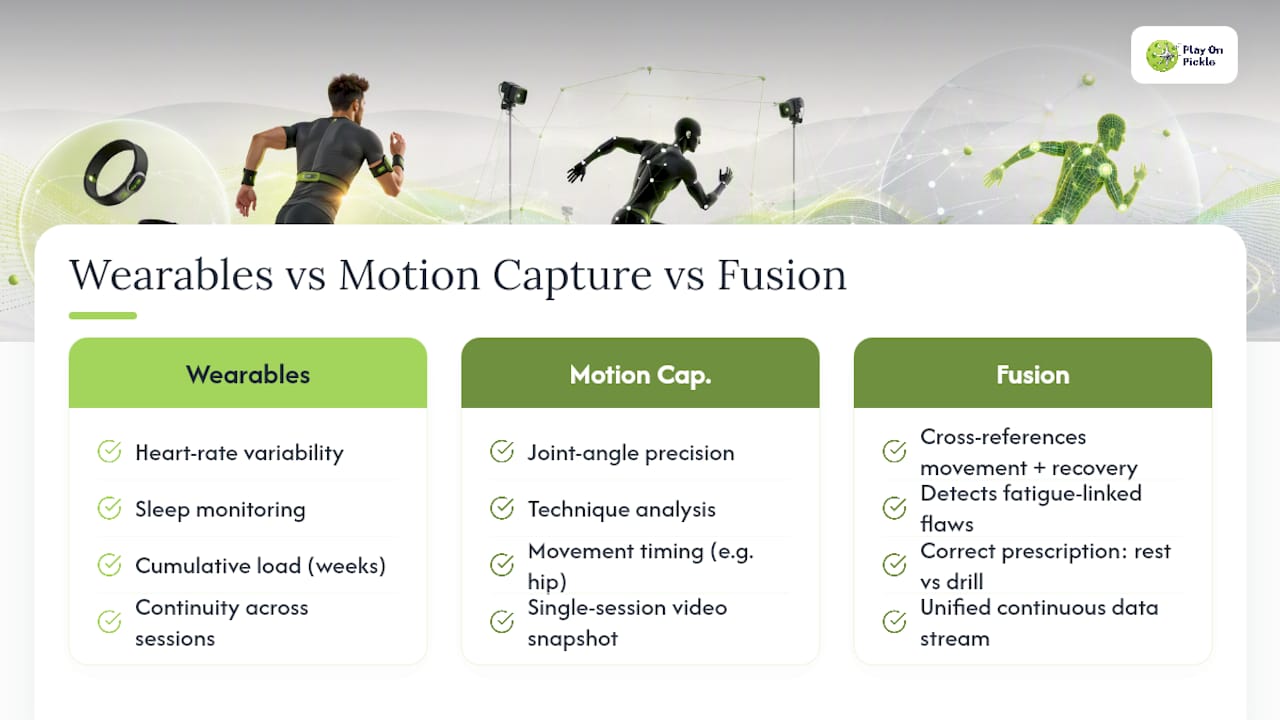
The most useful systems fuse both. A camera-based movement signature gets cross-referenced against wearable-reported fatigue and recovery data, so a technique flaw that shows up only when an athlete is under-recovered doesn't get misread as a permanent mechanical fault. That distinction changes what gets prescribed: a rest day instead of a technical drill, or vice versa.
Integration isn't seamless yet. Most wearables and vision systems still run on separate platforms with no shared data pipeline, which means coaches end up manually cross-referencing two dashboards instead of getting one unified read. That's a real gap in the current market, and it's the reason platforms built around a single continuous data stream, rather than a patchwork of disconnected apps, tend to produce more actionable output per session.
The practical takeaway for anyone shopping for tools: ask whether the system pulls in load and recovery context alongside movement data, or whether it's judging your technique in a vacuum. A biomechanical flaw that appears the same on camera can mean two completely different things depending on what your body has been through that week.
Play On Pickle's Take on Movement-Signature Analysis
Pickleball's injury problem isn't dramatic collisions, it's cumulative overuse in players who never trained the sport's specific demands. Applying movement-signature analysis, the same biomechanics-plus-workload approach covered above, to something as specific as a player's swing mechanics shows how the core pillars work outside elite sport entirely. Real cases, including how Jeff Webb's injury unfolded, make the detect-explain-prescribe workflow concrete rather than theoretical.
— Drona
Try AI-Powered Injury Prevention for Your Own Game
Everything this article covered, pose estimation, movement signatures, explainable risk flags, closed-loop adjustment, is exactly what Play On Pickle built specifically for pickleball players instead of adapting from another sport. You upload video from your own phone, no lab or dedicated camera rig required, and the system maps your movement against known stress patterns tied to common pickleball injuries like pickle elbow.
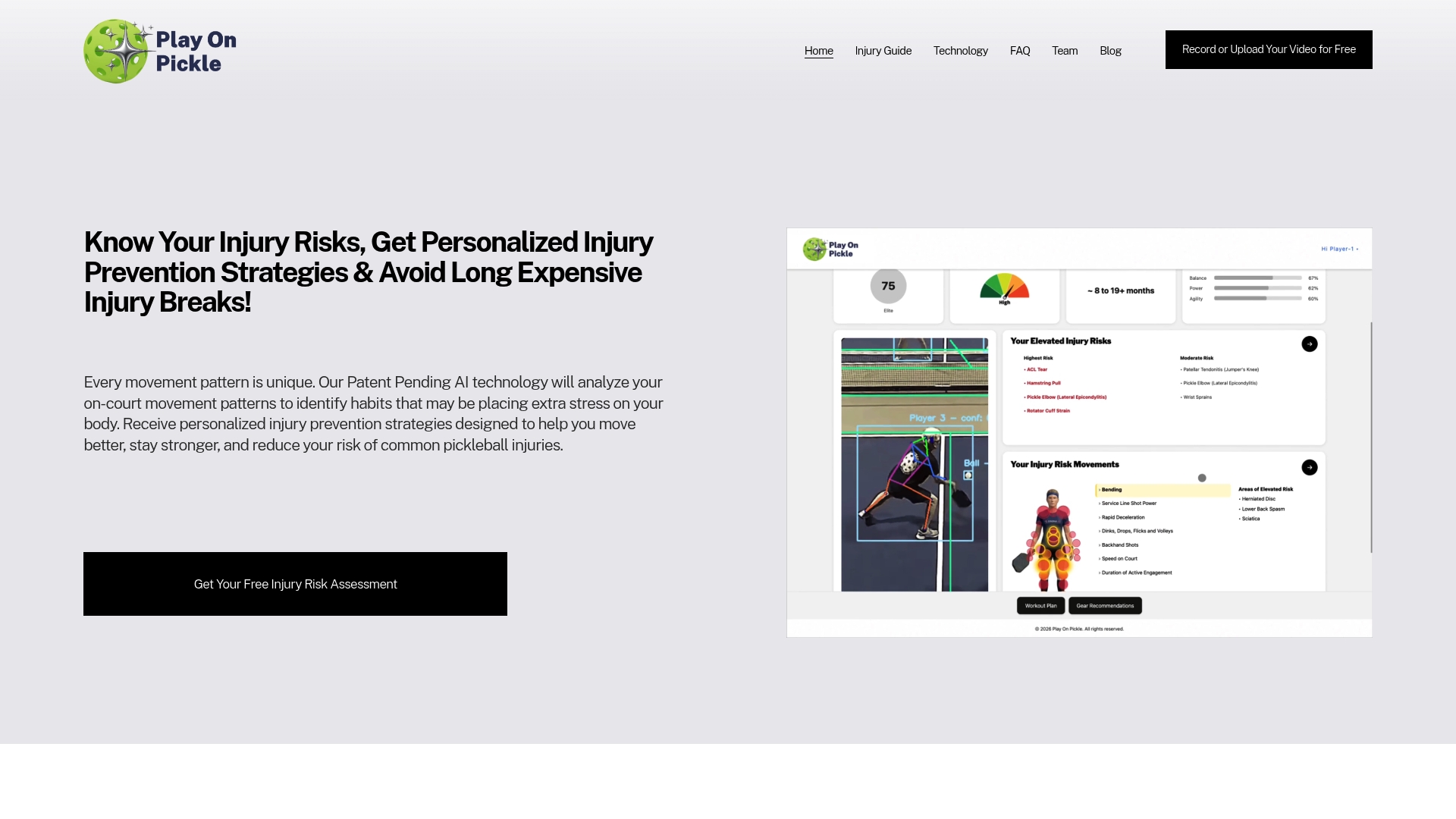
A first session identifies your specific biomechanical stress points and returns a short list of targeted exercises built around what your body actually needs, not a generic warmup routine. The free trial gets you that initial assessment before any subscription commitment, and current promotions include a free tripod to make video capture easier from the first session. If overuse injuries or plateaued technique have been holding your game back, start your trial at Play On Pickle and see what your own movement signature reveals.
Sources
- Zoom in — AI in sport (Olympic World Library)
- Artificial intelligence in sport: A narrative review of applications, challenges and future trends (Tandfonline)
- Artificial intelligence driven personalized adaptive training system for individual differences in competitive sports (Discover Artificial Intelligence, 2026)
Recommended
- Why Your "Movement Signature" Matters More Than Your Rating — Play On Pickle - Smart Pickleball Fitness
- What Jeff Webb’s Injury Reminds Us About Movement Science — Play On Pickle - Smart Pickleball Fitness
- Pickle Elbow, FOOSH… — Play On Pickle - Smart Pickleball Fitness
- The Dink Movie — Play On Pickle - Smart Pickleball Fitness