
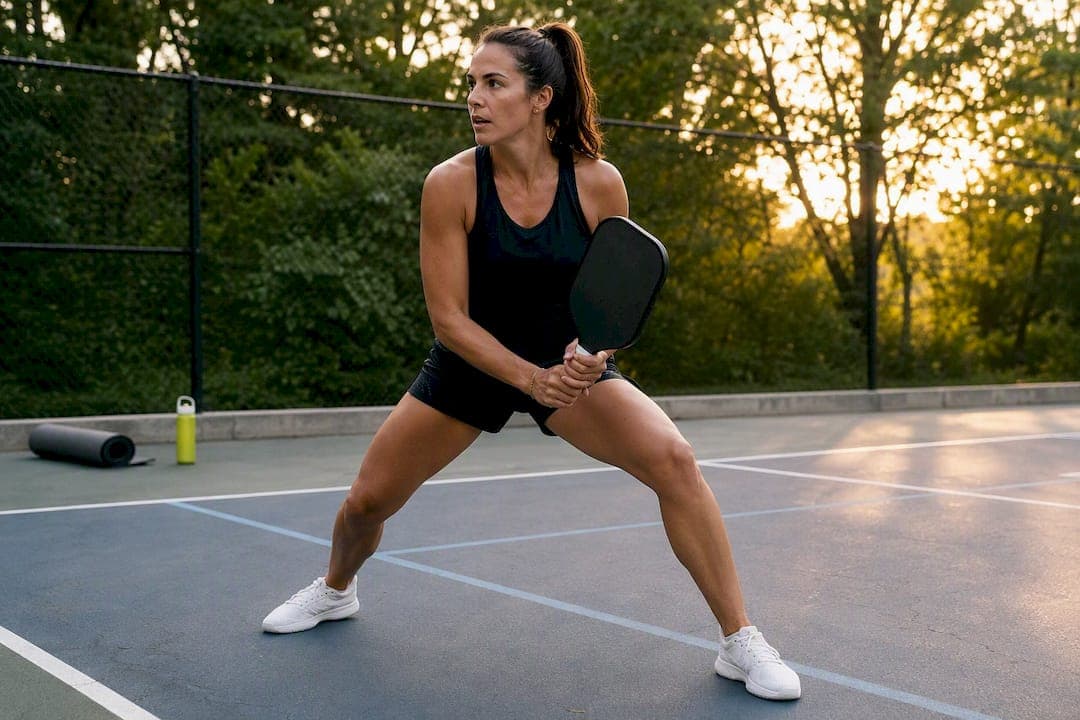
AI pickleball training uses video movement analysis to map how your body actually moves on court, flag joint-angle asymmetries and overload patterns, and turn those findings into a short, personalized exercise plan that lowers your odds of getting hurt. It catches problems your eyes and even your coach's eyes tend to miss: a shoulder that rotates 8 degrees less on your backhand side, a knee that tracks inward on every lateral shuffle. You get a risk score and a handful of specific corrective moves instead of generic "stretch more" advice.
The immediate payoff is speed. Instead of waiting for pain to tell you something is wrong, you see the imbalance on a screen weeks before it turns into pickle elbow or a rotator cuff flare.
- Record a 30-second clip of your dinks, volleys, or serve from a side angle.
- Get a stress-point map showing where your mechanics deviate from a safe range.
- Follow 2 to 4 targeted exercises built around your specific asymmetries.
- Recheck in a few weeks to confirm the correction is working.
Playonpickle built its assessment around exactly this workflow, using patented computer vision to turn a phone video into a personalized injury-prevention strategy.
Key Takeaways
AI pickleball training works by turning ordinary video into measurable joint-angle data, catching overuse risk weeks before pain forces you off the court.
| Point | Details |
|---|---|
| Overuse injuries dominate | 41% of upper-extremity injuries in a 1,758-player study were chronic overuse, not sudden trauma. |
| AI accuracy is competitive | Video-based models report up to 92.3% classification accuracy for joint-angle asymmetry detection. |
| New and frequent players benefit most | Under-5-year players and high-frequency players see the biggest gains from early screening. |
| Pair AI with clinicians | Escalate to a physical therapist for any moderate or high-risk flag, or acute pain. |
| Playonpickle delivers a full workflow | A free trial gives you a risk score, stress-point map, and personalized exercises from one video upload. |
Table of Contents
- How AI Pickleball Analysis Reads Your Movement From Video
- What Do Injury Studies Say About Pickleball Risk?
- What Does a Personalized AI Assessment Actually Give You?
- Which Exercises Do AI Systems Typically Prescribe?
- How Do You Capture Video AI Can Actually Use?
- What Can't AI Movement Analysis Do Yet?
- Turning AI Feedback Into Actual Practice Time
- How Do Players Actually Respond to AI Feedback?
- AI Analysis vs. Traditional Coaching: What Each One Actually Sees
- What Happens to Your Video Data?
- Why Cautious Optimism Beats Blind Trust in AI Assessments
- Try Playonpickle's Free Assessment Before Your Next Overuse Injury
- Selected Research Behind This Guide
- Frequently Asked Questions
- Sources
How AI Pickleball Analysis Reads Your Movement From Video
The process starts with pose estimation, a computer vision technique that converts raw video into a skeleton of keypoints, tracking your shoulders, elbows, hips, and knees frame by frame, often at around 60 frames per second. From those keypoints, the software calculates joint angles throughout your swing, split step, and lunge, then compares them against ranges associated with safe, efficient movement.
Three markers matter most in pickleball movement analysis. Joint-angle asymmetry compares your left and right sides during identical movements, like your split step before a return. Angular velocity spikes flag sudden, uncontrolled acceleration through a joint, the kind of motion that precedes a strain. Muscle-load imbalance estimates infer which side of your body is absorbing more force based on movement patterns, even without a wearable sensor attached.
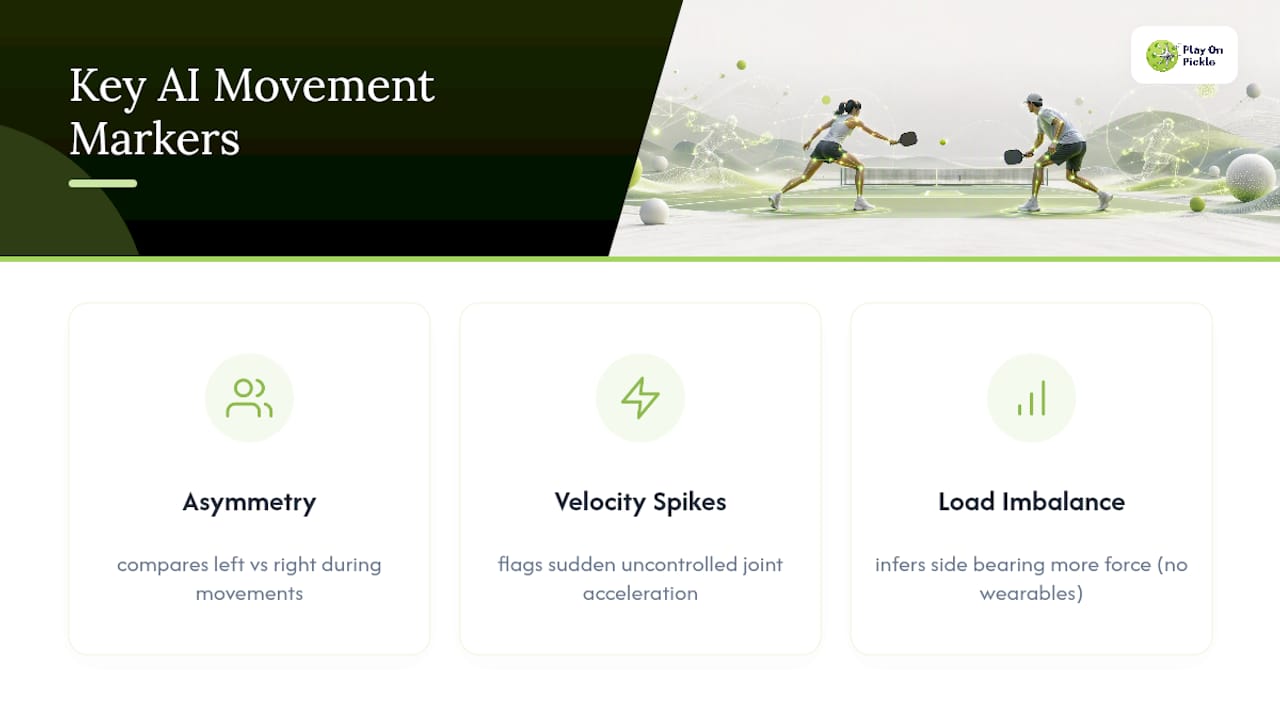
The output isn't a raw data dump. You get a risk classification (low, moderate, high), a visual heatmap showing where stress concentrates in your body, and a prioritized list of exercises addressing the biggest issue first.
The accuracy behind these systems has improved fast. One recent AI model processing video at roughly 60 frames per second reported classification accuracy up to 92.3% for detecting biomechanical markers like joint-angle asymmetry. That number sits close to what hybrid sensor-based systems achieve in lab settings, where a combined IMU and sEMG framework hits 92.3% accuracy with sub-200 millisecond feedback during real-time field testing. Video-only analysis won't fully replace a motion-capture lab, but it gets close enough to be genuinely useful for recreational and competitive players who will never set foot in one.
What Do Injury Studies Say About Pickleball Risk?
Pickleball injuries are common enough that "eventually" isn't a fair way to describe your odds. A nationwide study of 1,758 players found a 68.5% 12-month prevalence for any injury complaint, with 39% reporting at least one upper-extremity injury.
That pattern is exactly what AI movement analysis is built to catch, because overuse injuries announce themselves biomechanically long before they announce themselves as pain.
A scoping review of AI applications in sports biomechanics found convolutional neural network assessments agreeing closely with expert evaluators, with computer-vision measurements closely approximating marker-based motion capture in some studies. Integrated AI feedback systems were associated with notable reductions in reinjury rates in the synthesized research.
That review is a meaningful signal, not proof that any single app will cut your personal injury risk by a fixed percentage. It shows the underlying technology holds up against expert judgment and gold-standard lab equipment across the sports science literature it examined.
Three groups tend to see the biggest gains from this kind of assessment:
- New players (under 5 years of experience), who often move inefficiently before muscle memory catches up.
- High-frequency players, since more reps means more exposure to any existing asymmetry.
- Players with a known imbalance, like a dominant-side shoulder issue or a previous ankle sprain.
What Does a Personalized AI Assessment Actually Give You?
An assessment starts simple: you upload short video clips from one or two angles, then answer a brief history questionnaire covering past injuries, weekly play frequency, and any current discomfort. That's the entire input side.
The output is where it gets useful. Here's what a typical report includes:
- A risk score summarizing your overall injury likelihood based on detected movement patterns.
- A stress-point map showing exactly which joints or muscle groups are absorbing excess load.
- Flagged asymmetries, listed by severity, so you know which one to fix first.
- A prioritized exercise plan, usually 3 to 5 movements targeting your specific findings.
- A recommended reassessment window, typically every 4 to 8 weeks depending on how aggressively you're training.
Understanding your movement signature matters more here than knowing your DUPR rating, because two 4.0 players can carry completely different injury risk profiles depending on how their bodies move under load.
Pro Tip: Bring your risk report to a physical therapist or athletic trainer if anything is flagged as moderate or high. The AI identifies the pattern; a clinician can confirm the diagnosis and adjust the exercise plan for any pre-existing condition it doesn't know about.
Which Exercises Do AI Systems Typically Prescribe?
Most flagged issues trace back to a handful of joints, and the fixes are shorter than you'd expect. A proper warm-up alone changes your odds: players who skip structured warm-ups face meaningfully higher injury risk, with high-frequency players showing a relative risk around 1.5 times higher for upper-extremity injury.
A 5 to 10 minute dynamic warm-up covers most of the base:
- Arm circles and band pull-aparts to prime the rotator cuff before overhead swings.
- Lateral lunges with a reach to activate the hips and ankles for side-to-side movement.
- Wrist flexor and extensor stretches to prep the forearm for repetitive paddle contact.
Beyond warm-up, corrective progressions target the specific joint an assessment flags:
- Shoulder deficits: external rotation with a resistance band, progressing to overhead scaption as control improves.
- Wrist and elbow overload: eccentric wrist curls, a direct countermeasure to the repetitive strain behind pickle elbow.
- Ankle instability: single-leg balance progressing to lateral hops once static balance holds for 30 seconds.
- Hip and glute weakness: clamshells advancing to lateral band walks, addressing the knee-tracking issues that show up in split-step video.
The difference between AI personalization and a generic printout is dosage. A generic program gives everyone the same three sets of ten. An AI-adjusted plan raises or lowers intensity, frequency, and progression speed based on how severe your specific asymmetry measured, and it changes the prescription again at your next reassessment.
How Do You Capture Video AI Can Actually Use?
Bad video in means bad analysis out, so setup matters more than most players assume.
- Position your phone on a tripod, roughly waist height, 10 to 12 feet back, capturing a side or three-quarter angle.
- Shoot in good lighting with a plain background so pose estimation doesn't lose track of your limbs against clutter.
- Capture a shot list: a few dinks, a few volleys, and a serve, each clip running 20 to 30 seconds.
- Upload every 2 weeks during active training, or immediately if new pain shows up after a schedule change.
Pro Tip: If you ramp up from twice a week to daily play, reassess before symptoms appear rather than after. Load management works best as prevention, not damage control.
Watch two numbers over time: your asymmetry percentage and your overall risk score. A shrinking asymmetry percentage means your corrective exercises are working; a flat or rising risk score despite following the plan is your cue to loop in a clinician.
What Can't AI Movement Analysis Do Yet?
AI movement analysis is a screening tool, not a diagnostic replacement. Model accuracy depends heavily on video quality, and sport-specific validation for pickleball specifically is still catching up to research done on running and jumping sports. Small sample sizes in some underlying studies limit how confidently results generalize across every body type and skill level.
Common failure modes include poor camera angles, one limb blocked by your own body during a swing, or filming at a distance too far for keypoint tracking to stay accurate. Fix these before trusting a report.
See a clinician immediately, regardless of what any AI report shows, if you experience:
- Sudden, sharp pain during play
- Visible swelling or suspected fracture
- Loss of range of motion or joint stability
- Symptoms that worsen despite following a corrective plan
Turning AI Feedback Into Actual Practice Time
A risk report that sits unread on your phone doesn't prevent anything. The players who benefit most treat their exercise plan the way they'd treat a serve drill: scheduled, not optional. That usually means slotting the 5 to 10 minute warm-up before every practice session and running the 2 to 3 corrective exercises on non-playing days, rather than trying to squeeze everything in right before you step on court.
Coaches running group sessions can fold this in without disrupting drill time. If three players on a team show the same flagged asymmetry, like limited shoulder external rotation, that becomes a shared 5-minute block at the start of practice instead of an individual homework assignment nobody does. Reassessment timing also matters for integration. Running a new video capture right before a tournament tells you almost nothing useful, since you won't have time to act on new findings. Capturing video during a normal training week, then adjusting drills over the following month, gives the corrective work time to actually change your movement pattern.
The practical shift is treating movement quality as a drill category, alongside dinking accuracy and third-shot drops, not as a separate wellness task disconnected from your actual game. Players who log their corrective exercises the same way they log practice reps tend to stick with the plan longer, which is where most of the injury-reduction benefit actually comes from.
How Do Players Actually Respond to AI Feedback?
Most players' first reaction to a stress-point map is surprise, not confirmation. The shoulder asymmetry rarely matches what someone expected. A player who assumed their knee was the weak link often finds the actual imbalance sitting in their hip rotation instead, invisible during play but obvious once it's mapped.
That surprise factor is part of why adherence tends to run higher with objective feedback than with a coach simply saying "work on your mobility." Seeing a specific number attached to a specific joint gives players something concrete to track, and tracking a shrinking asymmetry percentage over a few weeks creates its own motivation loop. Players report back in, watch the number move, and adjust effort accordingly.
The adjustment period isn't instant, though. Most players need one or two reassessment cycles before they trust the tool enough to change training habits based on it alone, rather than treating the first report as a novelty. Coaches who review reports alongside players, rather than handing over a PDF and moving on, tend to see faster buy-in, since the coach can translate a risk score into language that connects to something the player already noticed on court, like a nagging ache after long rallies.
AI Analysis vs. Traditional Coaching: What Each One Actually Sees
Traditional coaching is exceptional at correcting technique. A coach watching your third-shot drop live can adjust your paddle angle in real time, something no video analysis tool does today. But coaching observation is limited by the human eye's frame rate. Subtle asymmetries measured in single-digit degrees, or micro-hesitations lasting a fraction of a second, are difficult for even an experienced eye to catch reliably across dozens of reps.
AI movement analysis fills that specific gap rather than replacing the coach. It measures what happens between the visible technique flaws, the underlying joint mechanics producing the strain that eventually shows up as an injury rather than a missed shot. A coach might notice you're "favoring" one side; an AI assessment quantifies exactly which joint and by how much.
The two approaches work best paired, not chosen between. A coach handles shot mechanics, strategy, and in-the-moment feedback. An AI assessment handles the objective, repeatable measurement of movement quality over time, catching drift that happens too gradually for a coach to spot across weekly sessions. Neither replaces a strength coach or physical therapist when an injury has already occurred.
What Happens to Your Video Data?
Uploading video of yourself for analysis raises a fair question: where does that footage go, and who sees it? Reputable platforms process video for pose estimation, extracting keypoint data and joint angles, without needing to store or share the raw footage indefinitely or identify you by name to any third party.
Look for a few specifics before trusting any platform with your movement data. Does the provider state clearly whether video is deleted after processing or retained for model improvement? Is your biomechanical data tied to your identity, or can you use the service pseudonymously? Does the platform sell aggregated data to third parties, and does its policy say so plainly rather than burying it in dense legal language?
The ethical stakes go beyond storage. Movement data can reveal health information, like an existing injury or a physical limitation, that a player might not want visible to a coach, team, or facility without consent. Any platform handling this kind of assessment should give you control over who sees your individual report, separate from any aggregate or team-level data a coach or facility might access. Transparency here isn't a nice-to-have feature. It's the baseline for a tool asking you to hand over footage of your own body.
Why Cautious Optimism Beats Blind Trust in AI Assessments
Playonpickle exists because pickleball injuries are largely preventable and largely invisible until they aren't. Computer vision gives players and coaches an objective read on stress points that no amount of watching film casually will surface. Treat every risk score as a strong lead worth investigating, not a medical verdict, and pair the data with a clinician's judgment whenever something flagged feels serious.
Try Playonpickle's Free Assessment Before Your Next Overuse Injury
Physical therapy after an overuse injury costs far more, in money and missed court time, than catching the same imbalance early. Playonpickle's free trial gets you a full movement assessment from a short video upload, no clinic visit required, so you find out about a shoulder or elbow issue while it's still a simple fix.
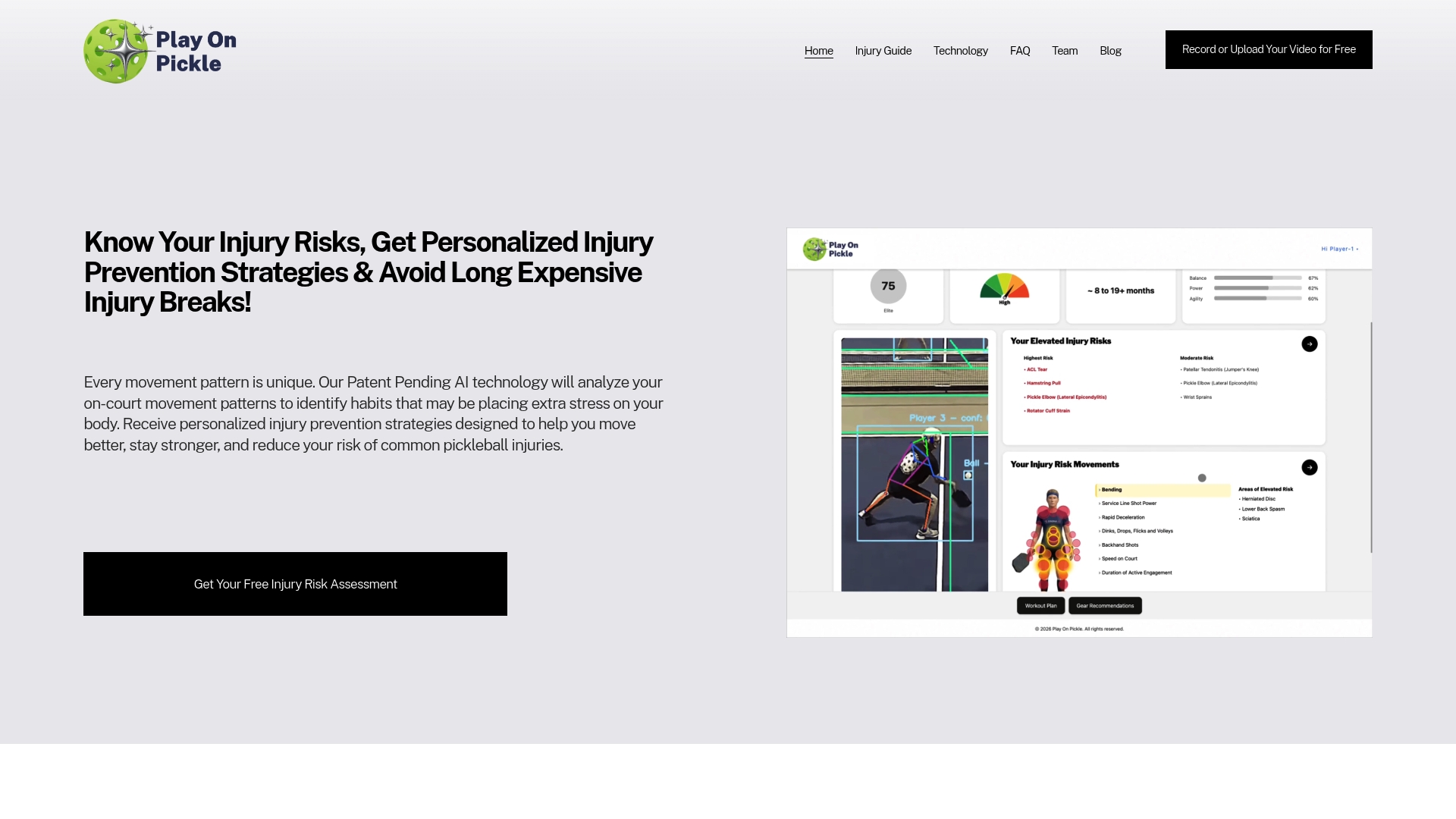
The subscription unlocks ongoing reassessments, so your exercise plan updates as your movement changes rather than going stale after one report. Every plan includes a risk report, a set of exercises matched to your specific stress points, and a recommended recheck timeline. Pricing and trial limits are laid out clearly before you commit to anything, no surprise charges buried in fine print. Head to Playonpickle and upload your first clip today. You will know within minutes whether your shoulder or knee needs attention before it turns into weeks off the court.
Selected Research Behind This Guide
- Understanding Injury Patterns and Predictors in Pickleball Players
- Artificial Intelligence in Sports Biomechanics: A Scoping Review
- Real-time wearable biomechanics framework for sports injury prevention
- New AI model could enhance digital coaching and rehabilitation
- Pickleball-related injuries presenting to clinical settings
- Play duration, frequency, and warm-up evidence
- Systematic review: AI applications in ACL injury prediction
Frequently Asked Questions
Is AI pickleball training accurate enough to trust over a coach's eye? AI movement analysis and coaching answer different questions. Coaches read technique and strategy in real time; AI measures joint angles and asymmetries too subtle for the human eye to catch consistently. Models report accuracy up to 92.3% for detecting these markers, but the two work best together, not as a substitute for each other.
How often should I record video for reassessment? Every 4 to 8 weeks during regular training covers most players. Reassess sooner, within a week or two, if you ramp up play frequency sharply or notice new discomfort after a session.
Can AI movement analysis diagnose an existing injury? No. It screens for risk patterns and stress points before an injury develops or worsens. Any flagged issue, especially anything rated moderate or high risk, needs a physical therapist or physician for actual diagnosis.
Does AI pickleball training work for recreational players, or only competitive ones? Recreational players often benefit more, since they're less likely to have formal strength training or a coach monitoring movement quality. New players under 5 years of experience show elevated injury risk, making early screening particularly valuable for that group.
What video angle gives the best results? A side or three-quarter angle from a stationary tripod, roughly waist height and 10 to 12 feet back, gives pose estimation software the clearest view of joint movement during dinks, volleys, and serves.
This article is general information, not a substitute for advice from a qualified doctor. Consult a qualified healthcare professional about your own circumstances before acting on anything here.
Sources
- Understanding Injury Patterns and Predictors in Pickleball Players: A Nationwide Study of 1,758 Participants
- Artificial Intelligence in Sports Biomechanics: A Scoping Review
- Real-time wearable biomechanics framework for sports injury prevention and rehabilitation optimization
- New AI model could enhance digital coaching and rehabilitation
- Pickleball-related injuries presenting to clinical settings: epidemiology and trends
Recommended
- Blog | Improve Your Game Now — Play On Pickle - Smart Pickleball Fitness
- Celebrate National Pickleball Day: Play Harder, Move Smarter, and Stay Injury-Free — Play On Pickle - Smart Pickleball Fitness
- Pickle Elbow, FOOSH… — Play On Pickle - Smart Pickleball Fitness
- The Dink Movie — Play On Pickle - Smart Pickleball Fitness