
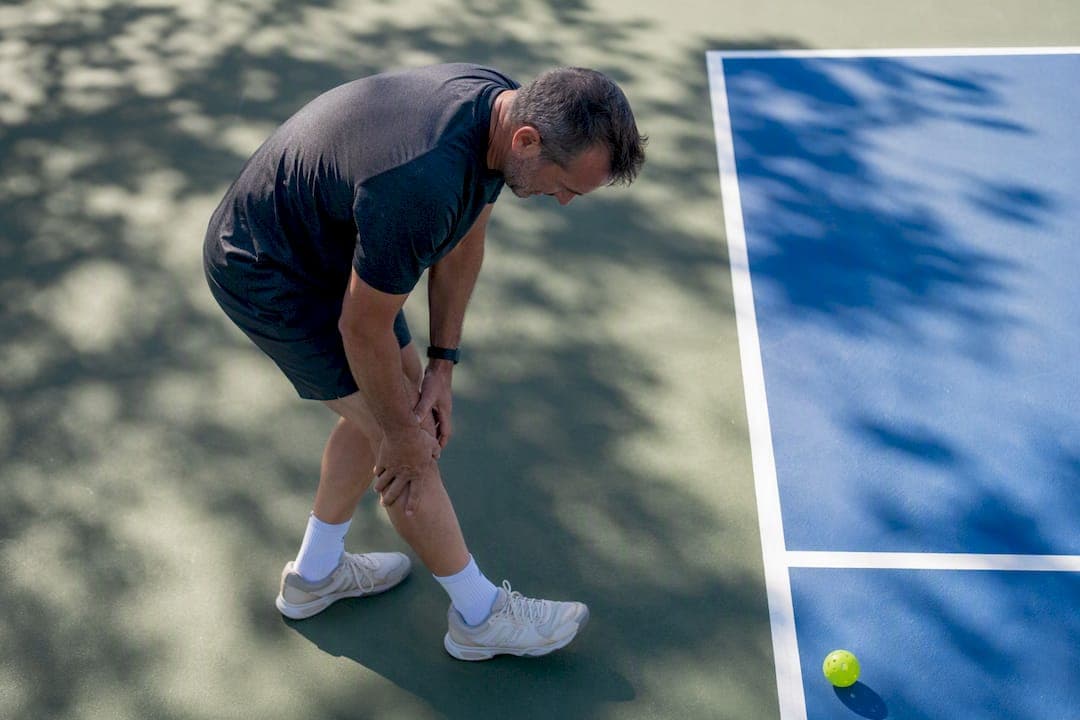
Most pain after pickleball is delayed-onset muscle soreness, or DOMS, the dull, achy tightness that shows up 12 to 48 hours after a hard session and fades within 2 to 5 days. It gets better with light movement, not worse. Sharp, stabbing, swelling, or pain that limits how you walk or grip your paddle are a different story.
Do this first:
- Rest or modify play for 24 to 48 hours instead of pushing through.
- Ice any joint that's swollen or hot, 10 to 20 minutes at a time.
- Log the symptom: where it hurts, when it started, what movement triggers it.
- Run the next-morning test: if the pain is worse, not better, the next day, treat it as an injury, not soreness.
Key Takeaways
Most pain after pickleball is DOMS that peaks within two days and fades within five, but sharp, swelling, or function-limiting pain signals an injury that needs evaluation, not rest alone.
| Point | Details |
|---|---|
| Know the DOMS timeline | Expect soreness to peak at 24 to 48 hours and resolve within 2 to 5 days. |
| Run the next-morning test | Pain that's worse the next day, not better, means treat it as an injury. |
| Watch for red flags | Inability to bear weight, deformity, large swelling, or numbness needs prompt care. |
| Ramp volume gradually | Sudden jumps in play frequency are a leading cause of tendon overload injuries. |
| Rehab must mimic the sport | Generic strength work without lateral and rotational drills invites recurring injury. |
Table of Contents
- Why Pickleball Causes Soreness and Overuse Injuries
- DOMS or Injury? A 48 to 72 Hour Decision Framework
- Common Pickleball Pain by Body Area
- What to Do in the First 48 to 72 Hours
- How to Prevent Pickleball Pain and Rehab Safely
- Where Movement Analysis Fits Into Prevention
- What the Evidence Actually Says About Pickleball Pain
- Sources
Why Pickleball Causes Soreness and Overuse Injuries
Pickleball asks your body to do things jogging or cycling never does: stop hard, lunge low, twist your trunk, and snap your wrist and forearm through a dink or a drive, all in a space smaller than a tennis court. That stop-start lateral pattern loads your Achilles tendon, hip stabilizers, and rotator cuff differently than steady-state cardio, and tendons adapt far slower than muscles do.
Most overuse pain traces back to a handful of habits:
- Jumping from once a week to daily open play without a ramp-up period.
- Skipping a dynamic warm-up and going straight into competitive points.
- Weak glutes, core, or scapular stabilizers that force your elbow or shoulder to absorb load they weren't built for.
- Worn-out or flat-soled shoes that don't support lateral cutting.
- A grip or swing habit that overloads the forearm on every shot.
Clinicians report a real spike in overuse strains tied specifically to how fast recreational players increase intensity or frequency. Players over 40 are especially prone to tendon problems because tendon tissue loses elasticity with age, even when muscle strength is fine.
Pro Tip: Track your weekly play volume the same way you'd track mileage in running. Rapid increases in weekly games are a common tipping point for tendon flare-ups.
DOMS or Injury? A 48 to 72 Hour Decision Framework
DOMS follows a predictable arc: soreness builds over the first day, peaks around 24 to 48 hours, and clears within five days. It feels like a dull ache across broad muscle areas, not a sharp or pinpoint pain.
Run through this checklist before your next session:
- Note the pain quality. Dull and diffuse points to DOMS; sharp, localized, or stabbing points to injury.
- Watch for swelling, night pain, or numbness/tingling. Any of these means DOMS is off the table.
- Do the next-morning test. Pain that improves with gentle movement is soreness; pain that's the same or worse is not.
- Try single-leg balance and light loading. If a joint buckles, gives way, or sharply worsens under light stress, stop and get it checked.
- Track duration. Pain still present past 10 to 14 days needs a professional look, regardless of how it started.
Common Pickleball Pain by Body Area
Where it hurts tells you a lot about what's actually going on.
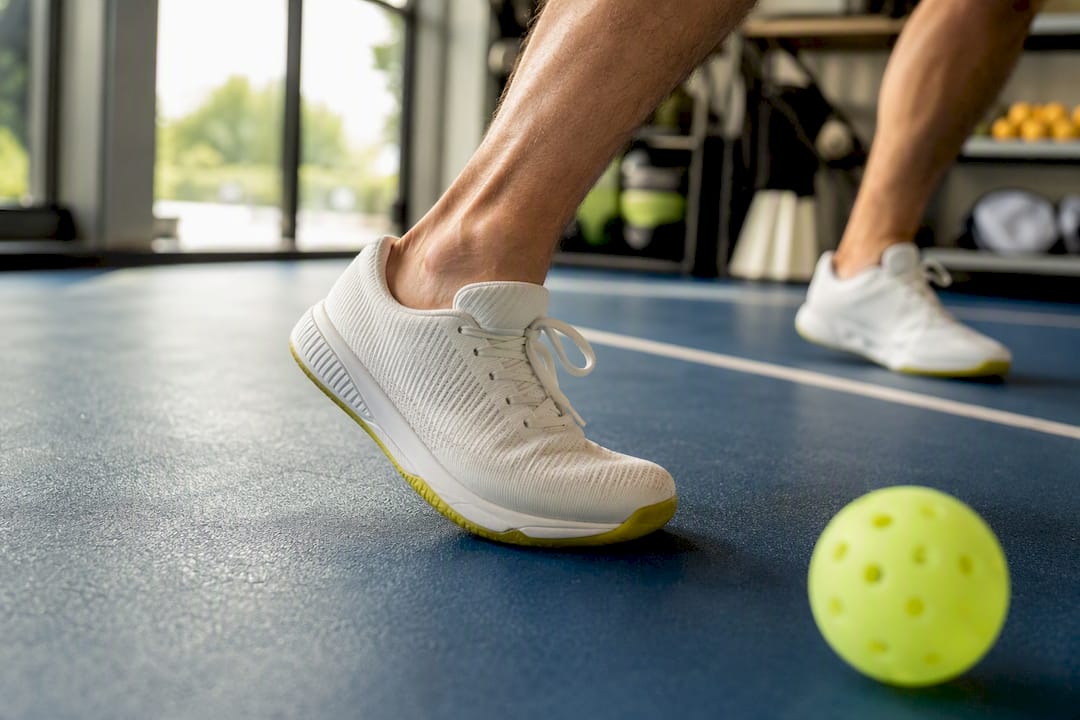
Heel, Achilles, and plantar fasciitis. Morning stiffness in the heel or arch that eases as you walk is classic plantar fasciitis. Pain higher up, right above the heel bone, points to Achilles tendinopathy, which builds gradually from repeated tendon overload and can take weeks to months to fully resolve.
Elbow. "Pickleball elbow" mimics tennis elbow: pain on the outside of the forearm that worsens with gripping, shaking hands, or lifting a coffee cup.
Shoulder. A deep ache that worsens on overhead shots and disrupts sleep suggests tendinopathy or impingement rather than simple fatigue.
Knee. Pain tied to a twisting motion, paired with swelling or a catching or locking sensation, points toward meniscus or ligament irritation rather than muscle soreness.
Ankle. Immediate swelling and an inability to bear weight after a rolled ankle is an acute sprain, not something to walk off.
Low back and SI joint. Rotational pain during serves or lunges often traces back to weak glutes and core muscles forcing the spine to compensate.
| Area | Likely Cause | Typical Timeline |
|---|---|---|
| Heel/Achilles | Tendon overload | Weeks to months |
| Elbow | Grip-related tendinopathy | Weeks with graded loading |
| Shoulder | Impingement/tendinopathy | Weeks to months |
| Knee | Twisting/meniscus irritation | Days to weeks, longer if surgical |
| Ankle | Acute sprain | weeks to months |
| Low back/SI | Rotational overload, weak core | Days to a few weeks |
What to Do in the First 48 to 72 Hours
Immediate care matters more than most players realize, and it's simpler than it sounds.
- Relative rest. Cut volume or skip a session rather than pushing through pain.
- Ice any swollen or hot joint for 10 to 20 minutes, several times a day.
- Compress and elevate a swollen ankle or knee to control fluid buildup.
- Avoid aggressive stretching into painful end-range; gentle, pain-free mobility is fine.
- Use OTC anti-inflammatories like ibuprofen briefly if needed, following label dosing, and stop if pain doesn't improve within a few days.
Seek care right away if you can't bear weight, notice visible deformity, have significant swelling, feel numbness or tingling, or heard or felt a pop. A sudden pop with weakness pushing off the ground is a classic sign of an Achilles rupture and needs urgent evaluation, not a wait-and-see approach.
Pro Tip: A physical therapist is your best first call for gradual overload issues like tendinopathy. Primary care handles initial triage for anything unclear, and orthopedics gets involved when a rupture or unstable joint is suspected.
How to Prevent Pickleball Pain and Rehab Safely
Prevention and rehab run on the same principle: load your body a little more than yesterday, never a lot more.
- Warm up dynamically, not statically. Leg swings, walking lunges, arm circles, and a few practice serves beat standing toe touches every time. Save static stretching for after you play.
- Ramp volume gradually. If you're jumping from one session a week to three, do it over a month, not overnight.
- Add targeted strength work: eccentric heel drops for Achilles resilience, rotator cuff and scapular sets for the shoulder, forearm eccentric holds for the elbow, and glute/hip control drills for the knee and low back.
- Check your shoes. Court shoes built for lateral movement outperform running shoes, which are built to go straight.
- Confirm readiness before full-speed return using the next-morning test, single-leg balance, and pain-free sport-specific drills.
A few habits carry outsized impact:
- Rotate playing surfaces and partners to avoid repeating the exact same stress pattern every session.
- Build in a rest day between back-to-back competitive sessions during a volume increase.
- Reassess footwear every season, since worn tread quietly increases lateral instability.
Rehab literature backs this up directly: recovery that skips sport-specific reconditioning, meaning drills that mimic actual lateral deceleration and rotational control, tends to produce recurring injuries rather than lasting fixes. Generic gym strength doesn't automatically transfer to the court.
For deeper reading on grip-related forearm pain, pickle elbow breaks down the mechanics and fixes in more detail.
Where Movement Analysis Fits Into Prevention
Playonpickle uses patented computer vision to scan your on-court movement and flag where stress is concentrating, whether that's a knee collapsing on lateral cuts or a shoulder overworking on overheads.
- Screen your movement pattern from uploaded video.
- Get exercises targeted at your specific stress points, not generic drills.
- Track progress over time to confirm the plan is actually working.
That workflow mirrors what physical therapists already prioritize: sport-specific strengthening for deceleration and rotational control, not isolated gym lifts. Use it alongside PT, not instead of it, when pain is already present.
Reconditioning that mimics the actual demands of the sport, lateral deceleration and rotational core control, is what prevents recurring injury. Generic strength training alone often isn't enough.
What the Evidence Actually Says About Pickleball Pain
The conventional advice, "rest it and see," gets half the picture right and misses the more important half: what you do after the pain fades matters more than the rest itself. Players who nurse a sore elbow for a week and then return to the exact same grip, the exact same volume spike, and the exact same absent warm-up are just buying time before the next flare.
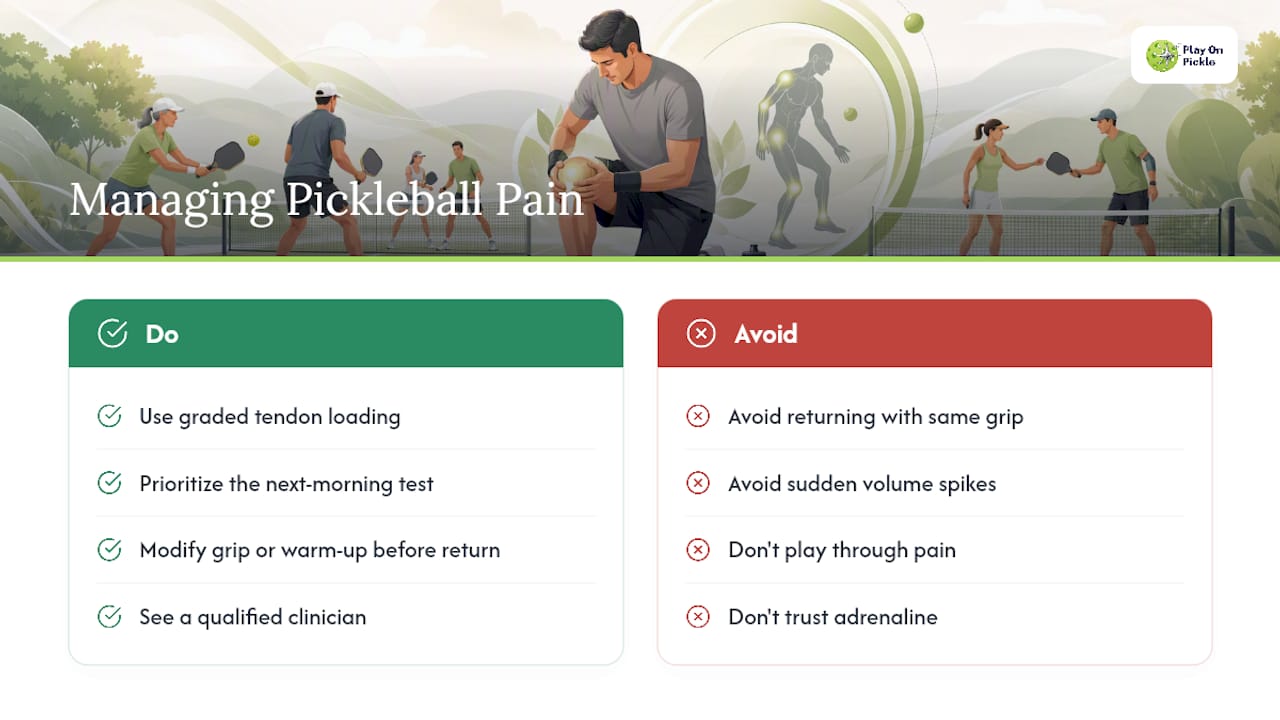
The 40-plus recreational player deserves more credit and more caution than most guides give. Credit, because plenty of tendon issues respond well to graded loading and don't require months on the sideline. Caution, because tendon tissue doesn't forgive sudden volume the way muscle does, and "playing through it" is how tendinopathy becomes rupture.
If you take one thing from this, prioritize the next-morning test over how you feel in the moment. Adrenaline lies. The next morning doesn't.
— Drona
This article is general information, not a substitute for advice from a qualified doctor. Consult a qualified healthcare professional about your own circumstances before acting on anything here.
Sources
- Physical therapy evidence on sport-specific rehabilitation (Springer, 2025)
- What doctors want patients to know about preventing pickleball (AMA)
- The top 5 pickleball injuries: symptoms, prevention and when to see a doctor — MetroHealth Be SimplyWell
- Pickleball injuries: physical therapy insights — Physitrack
Recommended
- Blog | Improve Your Game Now — Play On Pickle - Smart Pickleball Fitness
- Celebrate National Pickleball Day: Play Harder, Move Smarter, and Stay Injury-Free — Play On Pickle - Smart Pickleball Fitness
- Pickle Elbow, FOOSH… — Play On Pickle - Smart Pickleball Fitness
- The Dink Movie — Play On Pickle - Smart Pickleball Fitness