
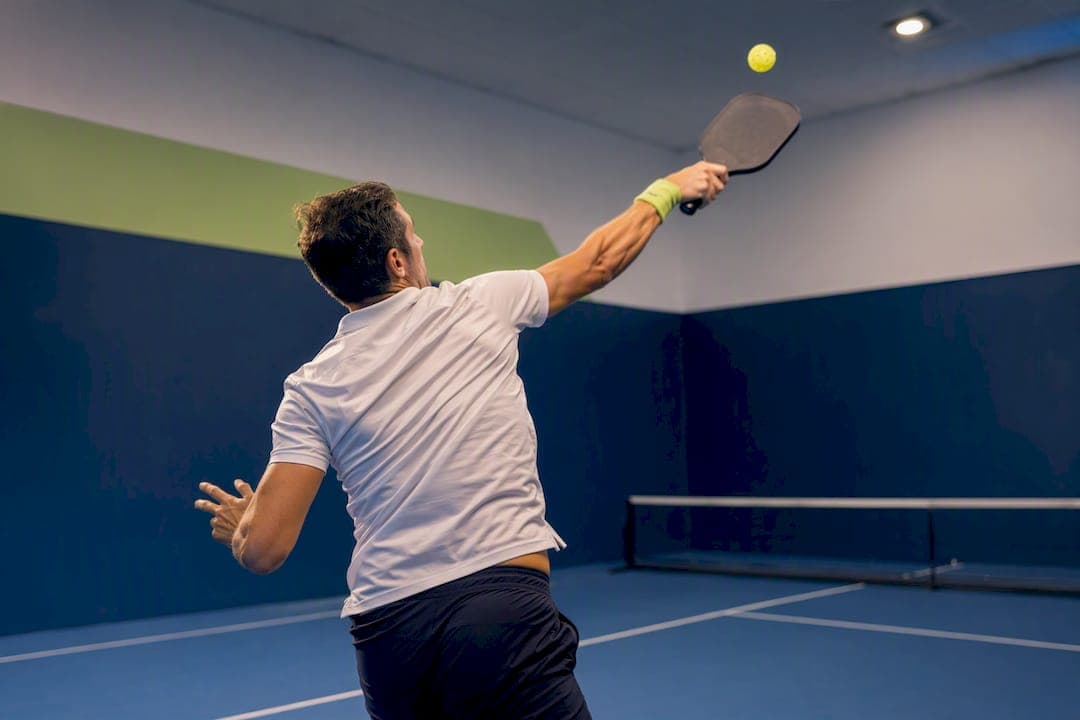
The single most important habit in pickleball biomechanics is driving every shot from the ground up: feet and hips first, then trunk, then arm. This sequencing keeps your elbow and shoulder from absorbing forces they were never built to handle alone, and it gives you far more control over pace and placement. The sections below break that habit into shot-specific cues, a short warmup, and three drills you can run before your next game.
TL;DR:
- Proper sequencing from feet and hips through the trunk to the arm is crucial for generating power and reducing joint stress during all pickleball shots.
- Overhead shots produce the highest impact forces, making leg drive and trunk rotation essential to prevent elbow and shoulder overload.
- Consistent warmups and drills focusing on hip-turn, split-step timing, and controlled dinking significantly improve biomechanics and injury prevention.
- Most injuries arise from common faults such as arm-only swings, flat-footed landings, and poor scapular control, which can be corrected with targeted small adjustments.
- Personalized motion analysis and video feedback help identify individual fault patterns, allowing for tailored exercises that reduce injury risk and enhance performance.
Table of Contents
- What Is Pickleball Biomechanics, and Why the Kinetic Chain Matters
- How the Kinetic Chain Shows Up in Groundstrokes, Dinks, Volleys, and Overheads
- Footwork That Actually Reduces Joint Stress
- The Movement Faults Behind Pickleball's Most Common Injuries
- A Six-Minute Warmup and Three Drills to Build Better Mechanics
- What Motion Analysis Reveals About Your Personal Fault Patterns
- Your Six-Point Mechanics Checklist Before Next Game
- A Coach's Note on Small Fixes and Big Payoffs
- A Faster Way to Find Your Own Fault Patterns
- Where to Go Deeper on Pickleball Movement Science
- Sources
What Is Pickleball Biomechanics, and Why the Kinetic Chain Matters
Pickleball biomechanics is the study of how your body generates, transfers, and absorbs force during play, from the ground reaction under your feet to the paddle face at contact. The concept that ties it all together is the kinetic chain: a sequence where energy created by your legs and hips passes through your trunk and into your arm and paddle. When that sequence works in order, your arm becomes a delivery mechanism instead of the sole engine.
The chain runs in four stages: foundation, transfer, acceleration, and impact. Your stance sets the foundation. Hip rotation and weight shift transfer force upward. Your trunk accelerates that force. Your arm and paddle deliver it at impact. Skip a stage, most commonly by locking your hips and swinging with an isolated arm, and you lose power while increasing joint stress.
A few cues make this concrete on the court:
- Set your feet shoulder-width apart before the ball arrives, not after.
- Turn your hips toward the sideline before your shoulders rotate.
- Shift weight from your back foot to your front foot as you swing, not before.
- Practice the sequence in slow motion, shadow swinging without a ball, so your body learns the order before speed gets added.
Pro Tip: Stand in front of a mirror and shadow-swing a forehand at quarter speed. If your shoulders and hips rotate at the exact same moment instead of hips first, you're skipping the transfer stage.
Impact accelerations vary sharply by stroke. Research on stroke impact accelerations found the smash produces the highest forces of any pickleball shot, well above the forehand, backhand, and serve. That single data point explains why overhead technique deserves more attention than most beginners give it.
How the Kinetic Chain Shows Up in Groundstrokes, Dinks, Volleys, and Overheads
Every stroke in pickleball uses the same chain, but the emphasis shifts depending on what the shot needs to accomplish.
Groundstrokes rely on a longer swing arc and full hip and trunk rotation. Your weight should finish on your front foot, not your back one, and the paddle face should trail your body rotation rather than lead it.
Dinks flip the priority. Instead of big rotation, you need a stable lower body and soft, continuous control through the wrist. A kinematic analysis comparing high-level and beginner players found that advanced players bend more at the femur during dinks and keep their wrist moving after contact, while beginners tend to stop the wrist abruptly and stay upright. That extra knee bend absorbs pace instead of fighting it.
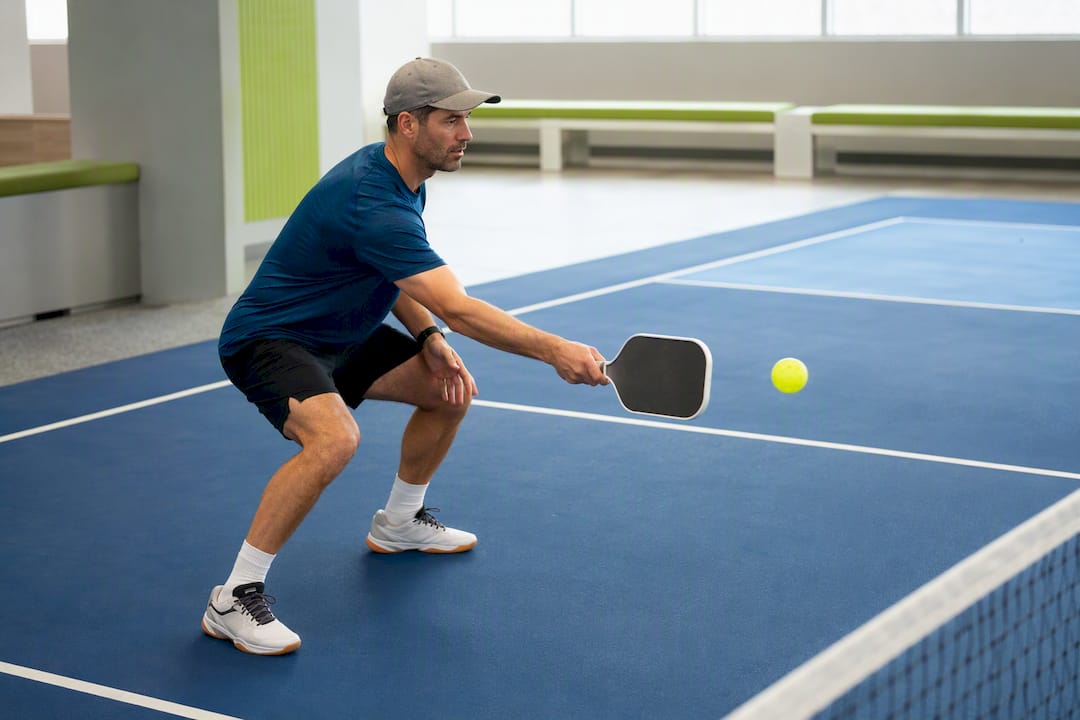
Volleys happen fast, so the swing has to shrink. Brace through your core to stabilize your trunk, keep the backswing short, and decelerate the paddle quickly after contact so you're ready for the next ball.
Overheads demand the most leg drive of any shot, and for good reason given how much force a smash generates. Push up through your legs, rotate your trunk, then extend your arm in a controlled arc rather than snapping it. A rigid, arm-only overhead is exactly the pattern that overloads the elbow and shoulder over repeated points.
- Groundstrokes: rotate hips and trunk, transfer weight forward.
- Dinks: flex the knees, keep the wrist alive through contact.
- Volleys: shorten the swing, brace the core, decelerate fast.
- Overheads: drive with the legs before you extend the arm.
Footwork That Actually Reduces Joint Stress
Good footwork in pickleball starts before the ball ever reaches you. The split step, a small hop timed to your opponent's contact, loads your legs so you can push off explosively in any direction. The rule of thumb is simple: feet first, swing second. If your feet are still settling when you start your backswing, you're borrowing power from your arm that should have come from your legs.
Movement toward the ball breaks into two categories. The initiation step is your first explosive push toward the shot. Covering steps and braking steps bring you back to a ready position afterward, and how you decelerate matters as much as how you accelerate. Landing flat-footed or on a stiff leg sends impact straight up through the ankle and knee instead of absorbing it gradually.
- Time your split step to your opponent's paddle contact, not to the ball's flight.
- Push off with your first step angled toward the ball's path, not straight ahead.
- Land braking steps on your forefoot with a slightly bent knee to absorb force gradually.
- Keep your center of gravity low and centered between your feet, especially at the kitchen line.
That third point carries real weight early in a session. Comparative research on ankle and Achilles loads in racket sports found more at-risk Achilles tendon movements per ankle during the early portion of pickleball play than during tennis, suggesting the first few minutes on court put unusually high acute load on the lower leg before your tissues have adjusted.
The Movement Faults Behind Pickleball's Most Common Injuries
Most pickleball injuries trace back to a predictable set of biomechanical breakdowns, not bad luck.
Elbow pain, often called pickle elbow, usually stems from a rigid, arm-dominant swing where the lower body disengages and the forearm absorbs repeated impact alone. A 2026 preprint using markerless motion capture identified three specific patterns in novice players tied to this condition: Rigid Arm Swing, Constricted Flexion, and Kinematic Lag, all linked to lateral epicondylalgia. You can read more about the mechanics behind pickle elbow here.
Shoulder injuries tend to follow a similar pattern: poor scapular control combined with arm-only power on overheads and drives, rather than sharing the load with the legs and trunk.
- Elbow: rigid arm swing with little hip or trunk contribution.
- Shoulder: weak scapular positioning plus overhead strokes powered by the arm alone.
- Achilles and ankle: abrupt deceleration and flat-footed landings during early-session movement.
- Knee: sudden direction changes without a bent, absorbing landing.
Red flags worth respecting: sharp pain on the outside of the elbow that lingers past a day, shoulder pain that limits reaching overhead, or ankle swelling after play. Any of those warrants rest and a professional assessment before you play again.
A Six-Minute Warmup and Three Drills to Build Better Mechanics
Better biomechanics gets trained, not willed into existence mid-match. Run this before you play.
- Warmup (6 minutes): Hip circles and walking lunges for mobility, glute bridges and dead bugs for core and glute activation, and ankle circles plus calf raises to prep the lower leg for those early-game Achilles loads.
- Drill 1, split-step ladder: Bounce a light split step every two seconds, reacting to a partner's random pointing cue, to sharpen first-step timing.
- Drill 2, hip-turn shadow swings: Shadow swing forehands and backhands with no ball, exaggerating the hip turn before the shoulders move, ten reps each side.
- Drill 3, controlled dink progression: Dink against a wall or partner focusing only on femur flexion and keeping the wrist moving through contact, building on what advanced dink mechanics actually look like.
Pro Tip: Older or less mobile players should shorten lunge depth in the warmup and slow the split-step ladder's tempo. The pattern matters more than the speed.
What Motion Analysis Reveals About Your Personal Fault Patterns
Coaching cues help, but they're generic. Motion analysis research shows why personalized feedback matters more. The same markerless capture study used unsupervised clustering to sort novice players into distinct fault categories rather than treating "bad form" as one problem. Separately, SimTK and OpenSim modeling work shows that small joint-angle changes measurably shift how much load a joint absorbs, which is why tiny technique adjustments can matter more than they seem to.
What this research translates to in practice:
- A specific fault label instead of a vague "keep your arm loose."
- Exercises prioritized by which joint is absorbing the most excess load.
- Load-management cues that tell you when to scale back reps, not just how to move.
Your Six-Point Mechanics Checklist Before Next Game
Print this mentally before you walk on court:
- Drive every shot from the ground up: feet, hips, trunk, then arm.
- Time your split step to your opponent's contact, not the ball's flight.
- Flex your knees on dinks and keep your wrist moving through contact.
- Land braking steps on a bent, forefoot-first landing.
- Run the six-minute warmup before you swing at full speed.
- Use video, even a phone clip, to check whether your hips actually lead your shoulders.
| Focus Area | What to Check | Quick Fix |
|---|---|---|
| Kinetic chain | Hips move before shoulders | Slow-motion shadow swings |
| Footwork | Split step timed to opponent's contact | Split-step ladder drill |
| Dinks | Knee bend and wrist continuity | Wall dink progression |
| Landing mechanics | Forefoot contact, bent knee | Braking step reps |
Two drills, five to ten minutes total, cover most of it: the hip-turn shadow swing and the split-step ladder. Run both before you pick up a real ball.
A Coach's Note on Small Fixes and Big Payoffs
Watching enough recreational players reveals the same handful of fault patterns over and over: locked hips, arm-only overheads, flat-footed stops. None of these require a full swing overhaul. They require one honest look at your own movement, which is exactly what tracking your movement signature is built to surface. Small sequencing fixes, practiced consistently, tend to outperform any single piece of equipment or technique tip.
— Drona
A Faster Way to Find Your Own Fault Patterns
Reading about kinetic chains helps, but seeing your own swing is what actually changes it. Playonpickle analyzes a video you upload of your own play and flags the specific stress points in your swing, whether that's a locked hip on your forehand or an arm-only overhead, then builds a personalized set of simple exercises around what it finds.

Instead of guessing which cue from this article applies to you, the AI-driven analysis points to your actual movement pattern and matches it to targeted drills you can fit into a normal warmup. Play On Pickle's landing page walks through the free trial and current starter offer, including the tripod promotion for new sign-ups. If you've been playing through nagging elbow or shoulder discomfort, start your free trial and get a personalized read on what's actually driving it.
Where to Go Deeper on Pickleball Movement Science
For readers who want the primary research behind these cues, the study on stroke impact accelerations documents why the smash carries the highest forces of any shot. The kinematic analysis of high-level versus beginner players breaks down the dink-specific femur and wrist patterns referenced above. For the injury side, the markerless motion-capture preprint and the SimTK/OpenSim project page both offer open technical detail on how joint loading gets modeled. For a real-world case tying an injury back to movement faults, see what Jeff Webb's injury reminds us about staying game-ready.
Sources
- Study on stroke impact accelerations
- Comparative study on ankle/Achilles loads in racket sports
- Kinematic analysis comparing high-level and beginner pickleball players
- Automated diagnosis of upper-limb kinetic chain deficiencies in amateur pickleball players
- Biomechanics of Pickleball: Motion Capture & OpenSim