
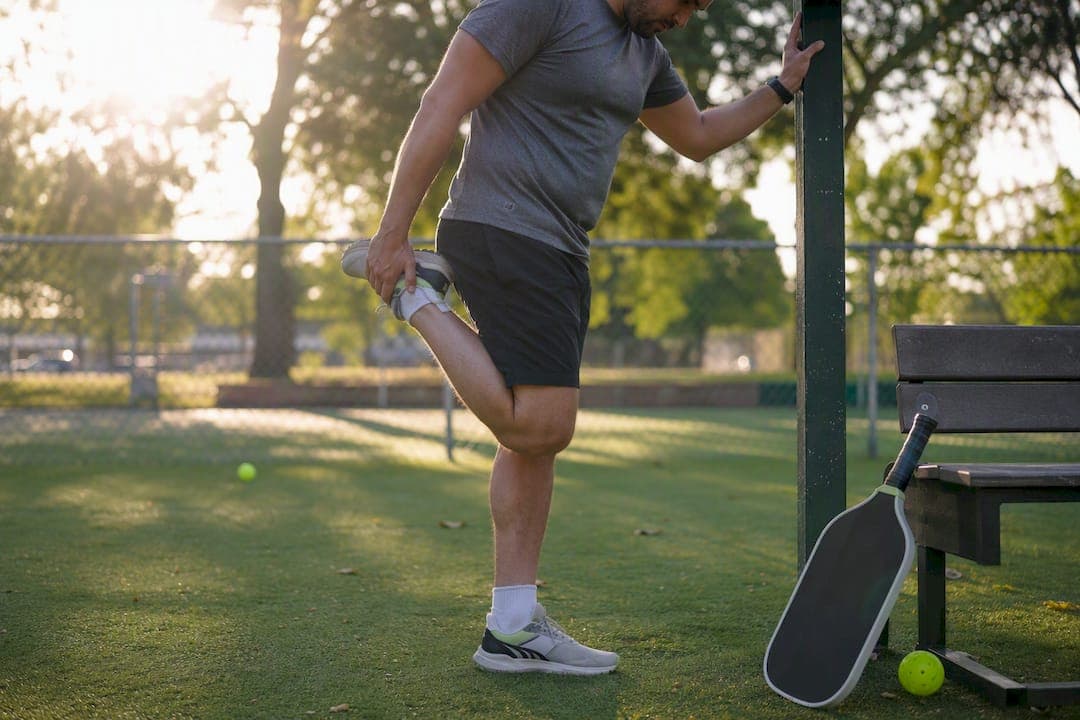
If you just felt a sudden, sharp pain in the back of your lower leg during a match, sometimes described as being kicked or hit from behind, you're probably dealing with a calf strain: a tear in the gastrocnemius or soleus muscle fibers. Stop playing immediately. Do not try to walk it off or finish the game.
Get off the court, avoid putting weight on the leg if it hurts to do so, and start basic RICE care: rest, ice for 15 to 20 minutes, gentle compression, and elevation above heart level when you can.
Most calf strains are manageable with rest and a structured rehab plan. But a small number of injuries mimic something far more serious.
- Seek urgent care immediately if: you heard or felt an audible sound, inability to push off with your foot, a visible gap or dent in the muscle, or significant swelling and bruising shortly after injury.
Quick fact: Skipping proper rehab after a calf strain raises your re-injury risk to 20 to 30 percent, according to Harvard Health Publishing. Don't rush back.
Key Takeaways
Most pickleball calf strains stem from staying upright during the backward-to-forward court transition, and consistent eccentric calf strengthening is the single most effective defense against both the initial injury and re-injury.
| Point | Details |
|---|---|
| Stop at the first sharp pain | Continuing to play on a strained calf raises the risk of turning a mild tear into a severe one. |
| Know the red flags | An audible pop, inability to push off, or a positive Thompson test means urgent medical evaluation, not home rehab. |
| Respect the grading system | Grade 1 injuries heal in 1 to 3 weeks, Grade 2 in 3 to 6 weeks, and skipping rehab raises re-injury risk to 20 to 30 percent. |
| Train the eccentric phase | Slow, controlled calf raises done twice weekly build the tendon resilience that prevents most strains. |
| Use objective return tests | Pain-free walking, 10 single-leg heel raises, and 30 seconds of lateral shuffle should all pass before full-speed play resumes. |
Table of Contents
- Understanding Pickleball Calf Strain: Muscle vs. Tendon Injuries
- What Pickleball Movements Actually Cause Calf Strains
- Calf Strain Symptoms and When You Need Urgent Care
- Grade 1 to 3: How Severe Is Your Calf Strain?
- First Aid: The First 48 to 72 Hours After a Calf Injury
- Rehab and Exercises for a Faster, Safer Recovery
- Preventing Calf Injuries in Pickleball: Habits That Actually Work
- Return-to-Play Checklist: Are You Ready for Pickleball Again?
- How AI Movement Analysis Supports Calf Injury Prevention
- Eating and Supplementing to Support Calf Muscle Healing
- Staying Motivated When a Calf Injury Sidelines You
- Why the Backward Step Matters More Than the Serve
- Sources
Understanding Pickleball Calf Strain: Muscle vs. Tendon Injuries
A calf strain and an Achilles tendon injury feel similar at first but come from different structures, and knowing the difference changes how you treat it. The calf itself is made of two muscles: the gastrocnemius, the larger, more superficial muscle that crosses the knee, and the soleus, a deeper muscle that works only at the ankle. Both connect to the Achilles tendon, which anchors into the heel bone.
A muscle strain is a tear within the muscle fibers themselves, usually higher up in the calf, near where the gastrocnemius narrows into its tendon. Achilles tendinopathy is a different animal: overuse irritation of the tendon, often felt lower, closer to the heel, that builds gradually rather than striking suddenly. A full Achilles rupture is the most serious version. It often produces a distinct popping sensation and leaves the person unable to push off at all.
- Gastrocnemius strains: sudden onset, often mid-calf, tied to explosive pushes.
- Soleus strains: deeper, achier, easier to mistake for cramping.
- Achilles tendon problems: pain concentrated near the heel, sometimes with stiffness that's worse in the morning.
A useful mental picture: the gastrocnemius and soleus form an upside-down "V" that funnels into the Achilles tendon like two roads merging into one highway.
What Pickleball Movements Actually Cause Calf Strains
Pickleball looks gentle from the sideline. The court is small, the ball is light, and nobody's sprinting forty yards. That's exactly why the injury mechanism catches so many players off guard.
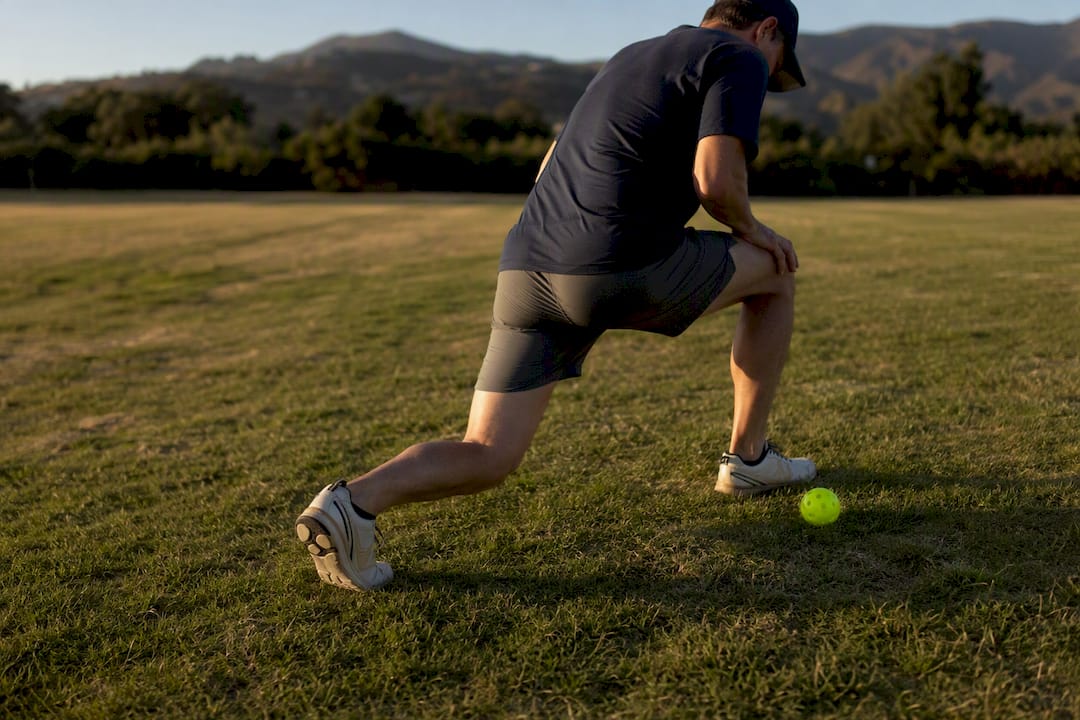
The real culprit is a specific movement pattern: retreating for a lob or overhead, then snapping forward again while staying upright rather than hinging at the hips. That backward-to-forward transition stretches the calf under load right before demanding it fire explosively, and Stanford Medicine's sports medicine team identifies this exact pattern as the primary mechanical driver behind pickleball calf and Achilles injuries. Staying vertical during that transition, instead of bending forward from the hips, forces significantly more eccentric stress onto a calf that's already stretched thin.
A few patterns show up again and again on pickleball courts:
- Staying tall and stiff-legged when scrambling backward, instead of hinging at the hips.
- Weak glute and hip engagement, which shifts load down to the calf and Achilles.
- Sudden jumps in weekly play volume, like adding three extra sessions during a tournament week.
- Lateral shuffles and quick direction changes that demand explosive push-off from a cold or fatigued calf.
Footwear matters more than most players think. Running shoes are built for forward motion in a straight line, not the lateral cutting and pivoting pickleball demands. Court shoes with lateral stability and a low heel-to-toe drop keep the ankle better supported during those quick direction changes. Worn-out soles, especially ones that have lost their tread pattern, reduce traction and force compensatory movements that stress the calf even more.
Pro Tip: Film yourself moving backward for a lob during practice. If your torso stays bolt upright the whole time instead of leaning forward from the hips, that's the exact pattern that tears calves.
Calf Strain Symptoms and When You Need Urgent Care
Ordinary post-match soreness feels like a dull ache that eases up within a day or two, and it doesn't stop you from walking normally. A strain feels different from the first second.
- Sharp, localized pain at the moment of injury, often in the mid-calf or just above the heel.
- Immediate tightness or cramping that doesn't release with stretching.
- Difficulty pushing off the injured leg when walking, especially going up on your toes.
- Swelling or bruising that develops over the following hours, sometimes tracking down toward the ankle.
Those four symptoms point to a strain. A different, more urgent set of signs points to something worse: an audible pop at the moment of injury, a visible gap or divot you can feel in the muscle, complete inability to bear weight, or a positive result on the Thompson test, where squeezing the calf while lying face down produces no movement in the foot.
Clinicians use that exact maneuver, the Thompson test, to check for a ruptured Achilles tendon, and a normal foot should flex when the calf is squeezed. Absence of that motion means the tendon has likely torn completely and needs same-day evaluation.
Before you see a clinician, note the exact moment the pain started, what movement you were doing, and whether you heard or felt a pop. That detail speeds up diagnosis considerably.
Grade 1 to 3: How Severe Is Your Calf Strain?
Doctors classify calf strains into three grades, and the grade you land on determines how long you're realistically looking at before you're back on the court.
- Grade 1 (mild): Microscopic tearing in the muscle fibers. Walking is uncomfortable but possible. Recovery typically runs 1 to 3 weeks.
- Grade 2 (moderate): A partial tear with more noticeable pain, swelling, and a limp. Recovery generally takes 3 to 6 weeks.
- Grade 3 (severe): A complete tear or full rupture, often with an audible pop and inability to push off. Recovery stretches into months and sometimes requires surgical repair, particularly for a fully ruptured Achilles tendon.
Muscle strains and tendon ruptures don't follow the same recovery clock even at similar severity. A Grade 2 muscle strain might have you jogging lightly in a month. A ruptured Achilles, by contrast, often means a walking boot for six to eight weeks followed by months of progressive rehab, and severe cases may need surgery before rehab even starts.
The number that should stick with you: skipping structured rehab carries a 20 to 30 percent chance of re-straining the same calf. That's not a small risk, and it's almost entirely avoidable with the right loading program.
First Aid: The First 48 to 72 Hours After a Calf Injury
What you do in the first three days shapes how the rest of your recovery goes. Rushing this window is where a lot of players turn a two-week injury into a two-month one.
- Stop and protect. Get off the court immediately and avoid any weight-bearing that causes sharp pain.
- Ice the area for 15 to 20 minutes every two to three hours during the first 48 hours.
- Apply compression with an elastic bandage, snug but not tight enough to numb the foot.
- Elevate the leg above heart level whenever you're sitting or lying down.
- Use crutches or a walking boot if putting weight down causes significant pain, especially for suspected Grade 2 or 3 injuries.
- Get immediate medical attention for an audible pop, a positive Thompson test, or total loss of push-off strength.
For mild strains, controlled weight-bearing as tolerated is usually fine after the first day or two. For anything that feels like a complete tear, a walking boot protects the tendon while it heals and prevents the kind of over-stretching that delays recovery.
Pro Tip: Skip the temptation to test the leg by walking on your toes right after the injury. That exact motion is what a clinician uses diagnostically, and doing it yourself on a partial tear can turn it into a complete one.
Rehab and Exercises for a Faster, Safer Recovery
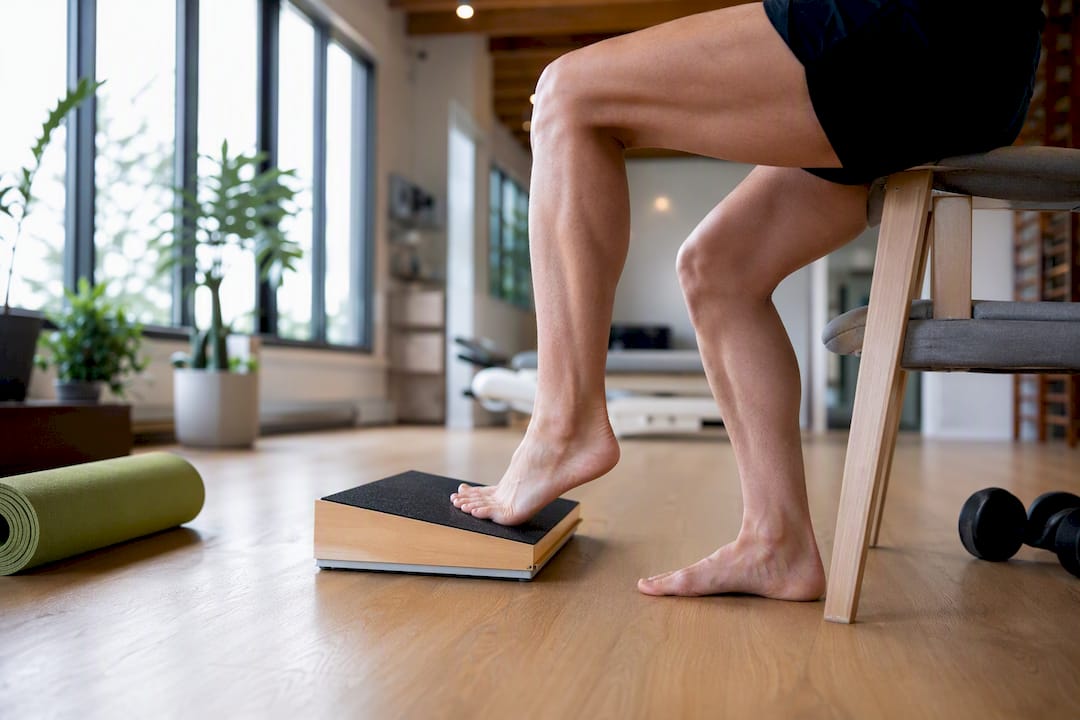
Recovery isn't about waiting for pain to disappear. It's a structured progression, and progressive strengthening with eccentric loading is the cornerstone of successful recovery according to sports medicine clinics that treat these injuries regularly.
- Early phase (days 1 to 7): Gentle range-of-motion work, ankle circles, and pain-free isometric holds. Push into mild discomfort, never sharp pain.
- Eccentric calf raise phase (weeks 2 to 4): Stand on a step, rise up on both feet, shift weight to the injured leg, then lower slowly over 3 to 4 seconds. Do 3 sets of 10 to 15 reps daily. Progress from bent-knee raises (targeting the soleus) to straight-leg raises (targeting the gastrocnemius) as tolerance improves.
- Strength and control phase (weeks 4 to 6): Add single-leg balance work, slow tempo raises with added weight, and light plyometrics like small hops once you can do 15 pain-free single-leg raises.
- Sport-specific phase: Reintroduce lateral shuffles, split steps, and the backward-forward transition that caused the injury in the first place, but at reduced speed before building back to full intensity.
Eccentric loading works because it strengthens the muscle-tendon unit specifically in the lengthened position where strains happen, and it's consistently identified as the highest-leverage exercise for tendon health in both rehab and prevention contexts.
If pain plateaus past four weeks despite consistent loading, or if a Grade 2 or 3 injury isn't improving on schedule, ask about diagnostic imaging. Ultrasound is quick and good at spotting muscle tears and fluid collections; MRI gives a more detailed picture for complex or non-healing injuries and helps rule out complications before considering options like PRP injections or a referral to a sports medicine specialist.
Pro Tip: Slow the lowering phase of your calf raise down to a four-second count. Most players rush the eccentric portion, which is exactly the part doing the strengthening work.
Preventing Calf Injuries in Pickleball: Habits That Actually Work
Prevention beats rehab every time, and most of it comes down to five minutes before you play and two short sessions a week after.
- Dynamic warm-up (5 minutes): Brisk walk or light jog for a minute, then leg swings, walking lunges, and a set of light calf raises to wake up the tissue without sapping power.
- Skip static stretching before play. Static stretching temporarily reduces muscle power output, which leaves the calf less prepared for the explosive, sudden movements pickleball demands. Save long holds for after you're done playing.
- Maintenance eccentric routine: Twice weekly, 3 sets of 10 to 15 slow calf raises, keeps the tendon resilient even when you're not actively rehabbing anything.
- Footwear check: Look for lateral stability, a low heel-to-toe drop, and a sole designed for court surfaces rather than road running. Worn tread is a quiet risk factor most players ignore.
Watch your weekly volume, too. Jumping from two sessions a week to five during a tournament stretch is a common trigger, and older players or those returning from a layoff are especially vulnerable to this kind of sudden load spike. Community-reported tools like calf sleeves and foam rolling can help with comfort, though they work best paired with actual strengthening rather than as a substitute for it, per practical guidance from Pickleball Union. Early warning signs worth respecting: persistent tightness the next morning, or calf fatigue that shows up earlier in a session than it used to. For more on gear that supports safer play, Playonpickle's guide to pickleball fitness and essential gear covers footwear selection in more depth.
Return-to-Play Checklist: Are You Ready for Pickleball Again?
Pain fading isn't the same as being ready. Use objective tests instead of guessing, since objective return-to-play milestones measurably lower re-injury rates compared to returning based on how the leg feels alone.
- Pain-free walking for at least 20 minutes on a flat surface.
- 10 single-leg heel raises on the injured side with the same control as the uninjured leg.
- 30 seconds of controlled lateral shuffling without pain or compensation.
- Sport-specific drills at 50 percent intensity, including the backward-to-forward transition, before any full-speed play.
A conservative four-week ramp looks like this: week one, walking and light cycling only. Week two, add the eccentric raise progression and light lateral shuffles. Week three, sport-specific drills at half speed, no live play. Week four, short doubles sets at reduced intensity, watching closely for any return of tightness or pain the next morning.
If pain returns at any stage, drop back one phase rather than pushing through. That single habit does more to prevent a second, worse injury than almost anything else on this list.
How AI Movement Analysis Supports Calf Injury Prevention
Most recreational players never get their movement patterns actually assessed. They rely on how something feels, which is exactly how a bad habit like staying upright during that backward-forward transition goes unnoticed for years.
Playonpickle takes a different approach. Its computer vision technology analyzes uploaded video of your play to flag specific stress points, including the biomechanical patterns tied to calf and Achilles injuries, then builds a personalized set of exercises around what it finds.
- Upload gameplay footage for an AI-driven movement assessment.
- Receive a breakdown of stress points specific to your own mechanics.
- Get a tailored exercise plan built around those findings.
- Track progress over time as movement patterns improve.
A player who stays upright during backward retreats and a player who hinges naturally at the hips can have identical soreness after a match. Only a movement assessment catches which one is accumulating risk.
Eating and Supplementing to Support Calf Muscle Healing
Muscle repair is a biological process, and what you eat during recovery has a real effect on how fast that process moves along.
Protein intake matters most. Muscle tissue rebuilds from amino acids, and recovering athletes generally benefit from spreading protein across meals rather than loading it all at dinner, aiming for a source of protein at breakfast, lunch, and dinner alongside snacks. Lean meats, eggs, Greek yogurt, and legumes all work.
Hydration plays a bigger role in muscle recovery than most players assume. Dehydrated tissue is stiffer and less pliable, which can slow the return of normal range of motion during the early rehab phase.
Anti-inflammatory foods like fatty fish, berries, and leafy greens support the body's natural healing response without interfering with the muscle-building phase that follows the first few days. Some players turn to supplements like omega-3 fish oil or collagen peptides, and while the evidence behind them is more mixed than protein's role, they're generally low-risk additions if you're already eating well otherwise.
Skip the alcohol during the acute phase. It's dehydrating, it interferes with sleep quality, and sleep is when most of the actual tissue repair happens. A calf strain isn't an excuse to stop moving entirely, either. Gentle, pain-free movement of the rest of the body keeps circulation up and tends to make the whole recovery feel less stagnant.
Staying Motivated When a Calf Injury Sidelines You
Getting benched by a calf strain messes with more than your legs. Missing your regular game, watching your group play without you, and worrying about losing the skill you've built can genuinely weigh on you, and that frustration is normal.
The mental side of injury recovery deserves as much attention as the physical side. Players who stay engaged with the sport in some capacity, even from the sideline, tend to have an easier time both mentally and physically once they're cleared to return.
A few things help. Set small, weekly rehab goals instead of fixating on the return date, since progress you can measure week to week feels a lot more encouraging than staring at a calendar. Stay connected to your playing group by watching matches or helping with logistics rather than disappearing entirely. Treat rehab sessions like practice, not a chore. Consistency there is what actually gets you back faster.
Frustration usually spikes hardest around the two-week mark, right when early pain has faded but full strength hasn't returned yet. That gap between feeling better and being ready is exactly where most re-injuries happen. Knowing that gap exists ahead of time makes it a lot easier to be patient through it.
Why the Backward Step Matters More Than the Serve
Recreational players spend an enormous amount of energy worrying about their serve, their dink accuracy, and their third-shot drop. Almost none of them think about how they retreat for a lob. That's backward.
The research is fairly consistent on this point: the injury happens on the way back to the net, not on the way to the ball. A player who hinges at the hips during that backward scramble is doing something fundamentally different, biomechanically, than a player who stays bolt upright. Most instructional content in this sport ignores that distinction entirely, focused instead on shot technique.
The conventional advice to "stretch before you play" is also worth pushing back on. Static stretching feels productive, but the evidence points the other way for pre-play prep. Dynamic movement and eccentric strength work do more to protect the calf than a toe-touch ever will.
If there's one priority for a recreational player reading this, it's building a twice-weekly eccentric calf raise habit before an injury forces the issue, not after. Rehab works. Prevention works better, and it costs a fraction of the time.
— Drona
Sources
- What to do if you get "tennis leg" — Harvard Health Publishing
- Thompson test for Achilles tendon rupture — Cleveland Clinic
- Fear, loathing and pickleball? How to avoid serious injuries — Stanford Medicine
- Calf injury after pickleball: Causes, symptoms, treatment & recovery — MSMC Musculoskeletal & Sports Medicine Clinic
This article is general information, not a substitute for advice from a qualified doctor. Consult a qualified healthcare professional about your own circumstances before acting on anything here.
Recommended
- Play On Pickle - Smart Pickleball Fitness | Enhance Play, Prevent Injuries
- What Jeff Webb’s Injury Reminds Us About Movement Science — Play On Pickle - Smart Pickleball Fitness
- Pickle Elbow, FOOSH… — Play On Pickle - Smart Pickleball Fitness
- Blog | Improve Your Game Now — Play On Pickle - Smart Pickleball Fitness