
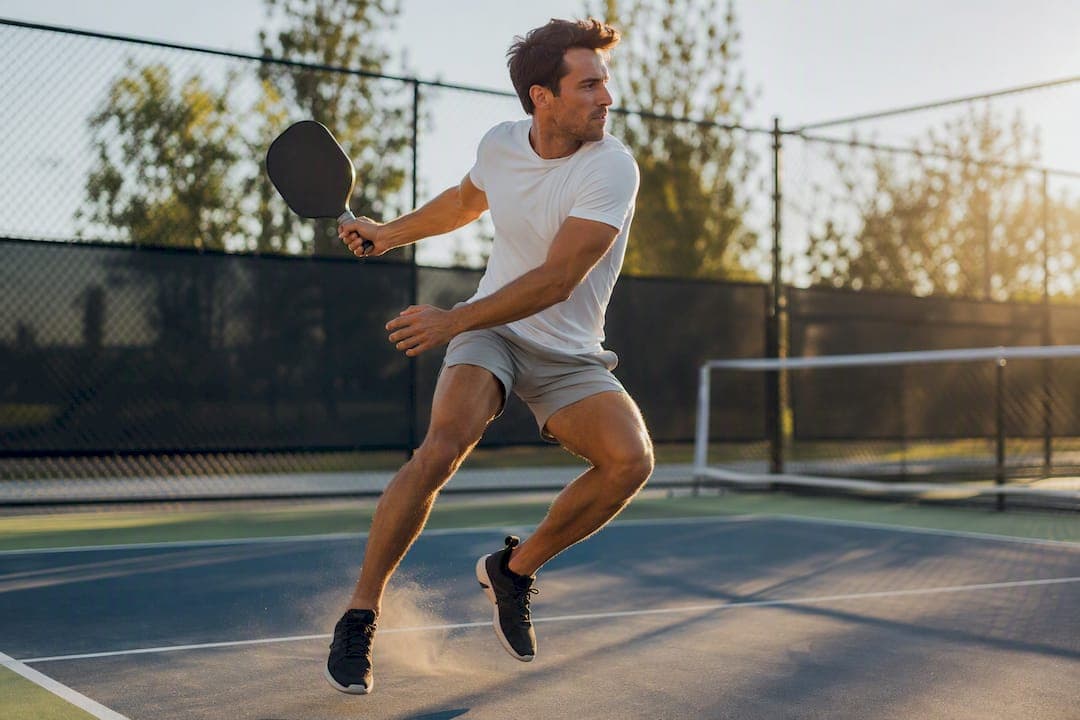
Pickleball conditioning prioritizes movement quality first, then two weekly strength sessions plus a sport-specific repeated-effort circuit. Do this, and you'll move faster and cut your injury risk. The order matters: chase power or endurance before your joints and stabilizers can handle it, and you're training toward a strain, not a win.
Here's the minimal weekly prescription:
- Two strength sessions, 30 to 45 minutes each, hitting legs, hips, core, and shoulders
- One 20 minute repeated-effort circuit that mimics rally bursts
- A 5 to 10 minute dynamic warm-up before every single time you step on the court
A quick reality check: rallies in pickleball run remarkably short, and that changes everything about how you should train. The American College of Sports Medicine's research on intermittent sports backs a repeated-effort model over marathon-style cardio, and Playonpickle's own movement-analysis work shows that targeted, individualized exercise selection reduces injury risk more than generic routines.
TL;DR:
- Repeated-effort circuit training is more effective than long-duration cardio because pickleball rallies are short and involve quick recoveries.
- Strength training twice a week, focusing on legs, hips, core, and shoulders, improves movement and reduces injury risk for players of all levels and ages.
- Consistent dynamic warm-ups before each session significantly lower the chance of injury and improve early match performance.
- Older and beginner players should emphasize balance, stability, and controlled movement before progressing to high-impact plyometrics and explosive drills.
- Personalized exercise recommendations based on movement analysis can identify individual weaknesses, helping players prevent injuries and optimize performance.
Table of Contents
- Why Pickleball Conditioning Needs a Different Approach
- What Are the Best Speed Drills for Pickleball?
- How Do You Build Pickleball Endurance Without Long Cardio?
- Strength and Power Training for Pickleball Players
- Agility, Balance, and Injury Prevention on the Court
- A Simple Warm-Up and Recovery Routine
- A 2-Day Pickleball Conditioning Program You Can Follow
- Flexibility and Cool-Down Routines for Pickleball Players
- Adjusting Pickleball Conditioning by Age and Skill Level
- Why Movement Analysis Changes How You Choose Exercises
- Get a Conditioning Plan Built Around Your Own Movement
- Key Takeaways
- Sources
Why Pickleball Conditioning Needs a Different Approach
Most new players assume cardio fitness wins matches. It doesn't. Pickleball rallies are short and are typically followed by brief rest periods before the next point starts.
Training that mirrors this pattern, short, intense efforts followed by brief recovery, transfers to the court far better than steady-state jogging or long bike rides, according to physiological research on intermittent sport demands.
That's the whole argument for repeated-effort circuits over distance running. Beyond energy systems, the sport's real physical demands are lateral movement, sudden deceleration, rotational power through the trunk, and repetitive stress on the ankles and shoulders. A needs-analysis approach built around those specific patterns, rather than a copy-paste gym routine, should guide every drill choice that follows. The training emphasis flows naturally from there: build a strength base first, then layer in speed and power work once your joints can absorb it.
What Are the Best Speed Drills for Pickleball?
Speed on a pickleball court isn't about straight-line sprinting. It's about changing direction without losing balance, which is a different skill entirely.
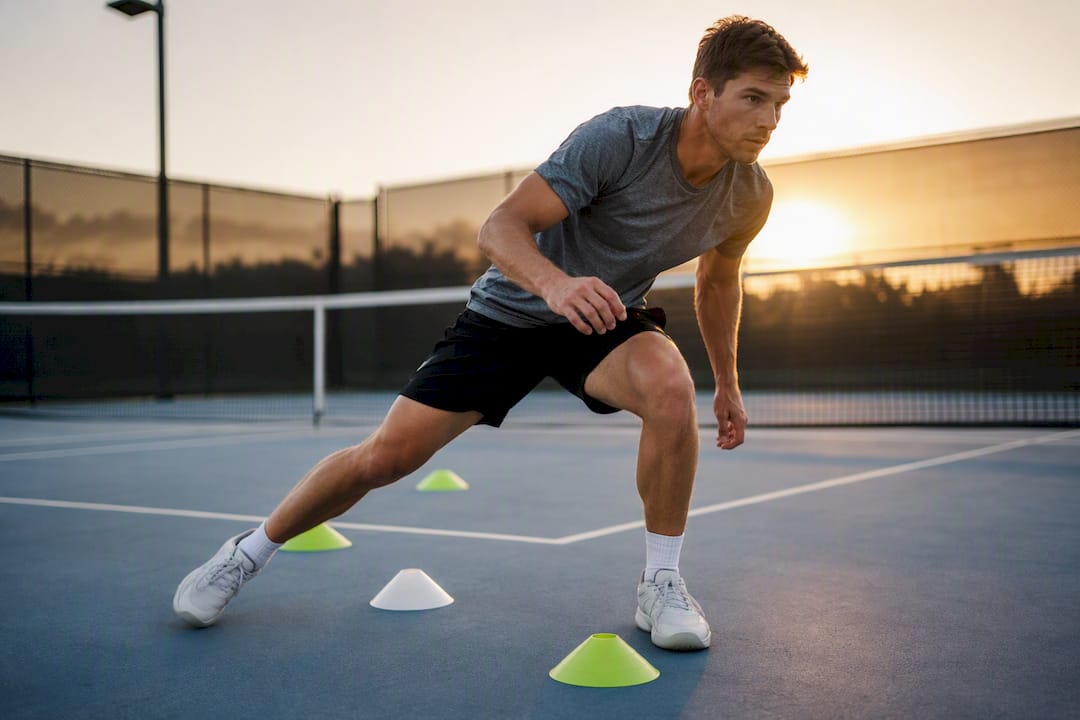
- Cone zig-zag (W pattern): Set five cones in a W shape, 3 to 5 feet apart. Sprint the pattern, jog back, repeat for 6 to 8 reps with 30 seconds rest between. Progress by tightening the spacing as your control improves.
- T-drill: Set cones in a T shape, sprint forward, shuffle laterally to each side, backpedal to start. This drill lives and dies on deceleration, so the emphasis belongs on stopping under control, not on raw speed.
- Reactive shuffle drill: Have a partner point or toss a ball to signal direction, then shuffle that way and recover. Adding a racket and a real ball turns a generic agility drill into something that actually resembles kitchen-line footwork.
- Plyometric progressions: Start with low-impact hops (lateral bounds, ankle hops) for 2 to 3 weeks before adding bounding or box jumps. Rushing this step is how tendons get overloaded.
Pro Tip: Do speed work when you're fresh, ideally at the start of a session or on a non-heavy-lifting day. Fatigued sprints teach your body bad mechanics, not speed.
How Do You Build Pickleball Endurance Without Long Cardio?
Stamina for pickleball looks nothing like marathon training. You need to repeat high-quality efforts for two hours, not sustain one steady pace.
Try this 20 minute circuit twice a week:
- Lateral shuffle sprints: 10 seconds work, 20 seconds rest, 8 rounds
- Split-step and reaction sprint: 10 seconds work, 20 seconds rest, 8 rounds
- Mountain climbers or high knees: 10 seconds work, 20 seconds rest, 6 rounds
That work-to-rest ratio isn't arbitrary. It mirrors the short rally, short rest structure that defines actual match play far more closely than a 30 minute jog does.
Steady-state cardio still has a place. Zone 2 aerobic work, easy pace where you can hold a conversation, builds the aerobic base that helps you recover faster between points and between games. Two things to remember on scheduling:
- Keep circuit days separate from your heaviest play days so your legs aren't fried for both
- Watch for early fatigue signals like sloppier footwork or slower reaction time; that's your cue to back off, not push through
Strength and Power Training for Pickleball Players
Two sessions a week is the number that keeps showing up in serious training guides, and for good reason. It's enough to build real strength without eating into court time. Strength training that covers legs, hips, trunk, and shoulders delivers gains that show up directly in your movement and your resistance to injury.
Build each session around these categories:
- Lower body: Goblet squats or trap-bar deadlifts, 3 sets of 8 to 12 reps
- Unilateral work: Split squats or step-ups, since pickleball is played on one leg far more than people realize
- Calves: Standing and seated calf raises for ankle stability under repeated impact
- Upper body: Rows and presses for shoulder balance, not just push-dominant work
- Trunk: Pallof press or anti-rotation holds, which train your core to resist rotation rather than just create it
Once that base is solid, add power: controlled jumps, medicine-ball rotational throws, or kettlebell swings, 2 to 4 sets of 5 to 8 reps. This layered progression, strength first, then power, protects tendons that haven't adapted to explosive loading yet.
Pro Tip: If you're over 50 or new to lifting, keep power work in the controlled, concentric range longer than you think you need to. Save high-impact plyometrics for once your single-leg strength and balance are dialed in.
Agility, Balance, and Injury Prevention on the Court
Pickleball's injury numbers have climbed sharply as the sport has exploded in popularity, and older players show notably higher injury rates, largely from falls and sprains tied to sudden direction changes.
A few habits close most of that gap:
- Single-leg balance holds, 30 seconds per side, done daily, build the ankle and hip stability that prevents rolled ankles
- Banded lateral walks and ankle inversion/eversion work strengthen the exact tissues that absorb kitchen-line scrambles
- Rotator cuff and scapular control exercises, like band pull-aparts and external rotations, address the shoulder overuse issues common in players who serve and overhead-smash often
- Basic load management matters more than any single drill: back off volume when soreness lingers past 48 hours, and see a clinician for any sharp or radiating pain rather than playing through it
A Simple Warm-Up and Recovery Routine
Skipping the warm-up is the single most common mistake recreational players make, and it's an easy fix. A consistent dynamic warm-up targeting the same joints you stress in play cuts injury risk and sharpens your first few points.
Run through this before you pick up a paddle:
- Leg swings, front-to-back and side-to-side, 10 each leg, to open the hips
- Thoracic rotations, 10 per side, since trunk mobility drives your groundstrokes and dinks
- Shoulder activation with band pull-aparts, 15 reps, to wake up the rotator cuff
- Split-step practice, 10 reps, rehearsing the ready position you'll use hundreds of times per match
After play, a few minutes of static stretching for the calves, hips, and shoulders helps you cool down. Sleep and hydration do more for recovery than any stretch, though. Prioritize both, and treat an easy walk or light bike ride the day after a tournament as active recovery, not wasted time.
A 2-Day Pickleball Conditioning Program You Can Follow
Here's a template built around the drills already covered.
Day A: Speed, power, and full-body strength
- Dynamic warm-up (5 to 10 minutes)
- Cone zig-zag sprints, 6 reps
- Squats or trap-bar deadlifts, 3x8 to 12
- Split squats, 3x10 per leg
- Medicine-ball rotational throws, 3x6 per side
Day B: Lateral movement, deceleration, and conditioning
- T-drill, 6 reps
- 20 minute repeated-effort circuit
- Rows and shoulder work, 3x10
- Pallof press, 3x10 per side
If you play two to three times a week, slot Day A and Day B on non-consecutive days, ideally with at least one full rest day between a lift and your most competitive match. If you play four or more times a week, compress both days into shorter 25 minute sessions and keep heavy lower-body work a day removed from tournament day. Progress by adding one set every two to three weeks, and scale back the moment soreness or footwork quality starts slipping.
Flexibility and Cool-Down Routines for Pickleball Players
Stretching gets treated as optional by most recreational players, which is a mistake given how much rotational and lateral stress the sport puts on hips, shoulders, and calves. The goal isn't gymnast-level flexibility. It's keeping the specific ranges of motion pickleball demands from tightening up between sessions.
Save static stretching for after play, not before. Holding a stretch cold, before your muscles are warm, does little for performance and can even reduce short-term power output. Dynamic movement belongs in the warm-up; static holds belong in the cool-down.
A simple post-play sequence covers the areas that take the most abuse:
- Calves: Standing wall stretch, 30 seconds per side, since calf tightness compounds ankle injury risk over a season
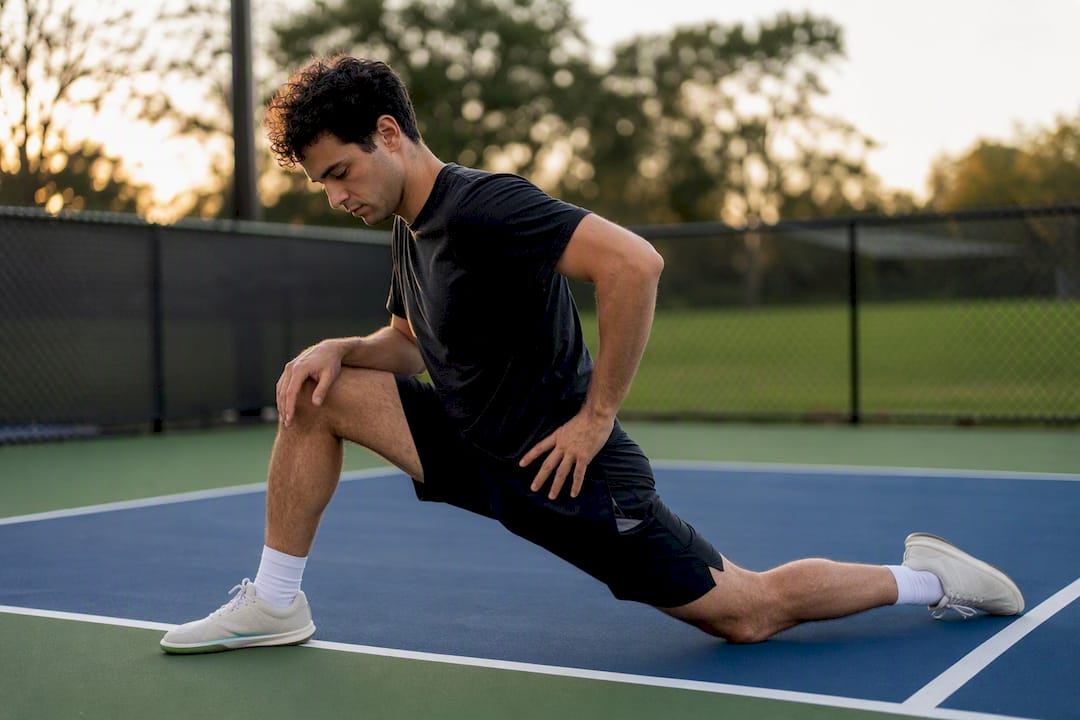
- Hip flexors: Half-kneeling stretch, 30 seconds per side, to counter the forward lunging position pickleball repeats constantly
- Shoulders: Cross-body and overhead tricep stretches, 20 seconds each, targeting the joints most taxed by serving and smashing
- Thoracic spine: Seated or kneeling rotation stretch, 30 seconds per side, restoring the rotation you use on every groundstroke
Five to eight minutes covers the full routine. Do it right after you finish playing, while your muscles are still warm, rather than waiting until you're home and cold. Players who skip this step consistently report tighter hips and calves within a few weeks of regular play, and that tightness is exactly what shows up later as strains.
Adjusting Pickleball Conditioning by Age and Skill Level
A 25 year old tournament player and a 65 year old weekend rec player need fundamentally different conditioning emphasis, even though the underlying drills overlap.
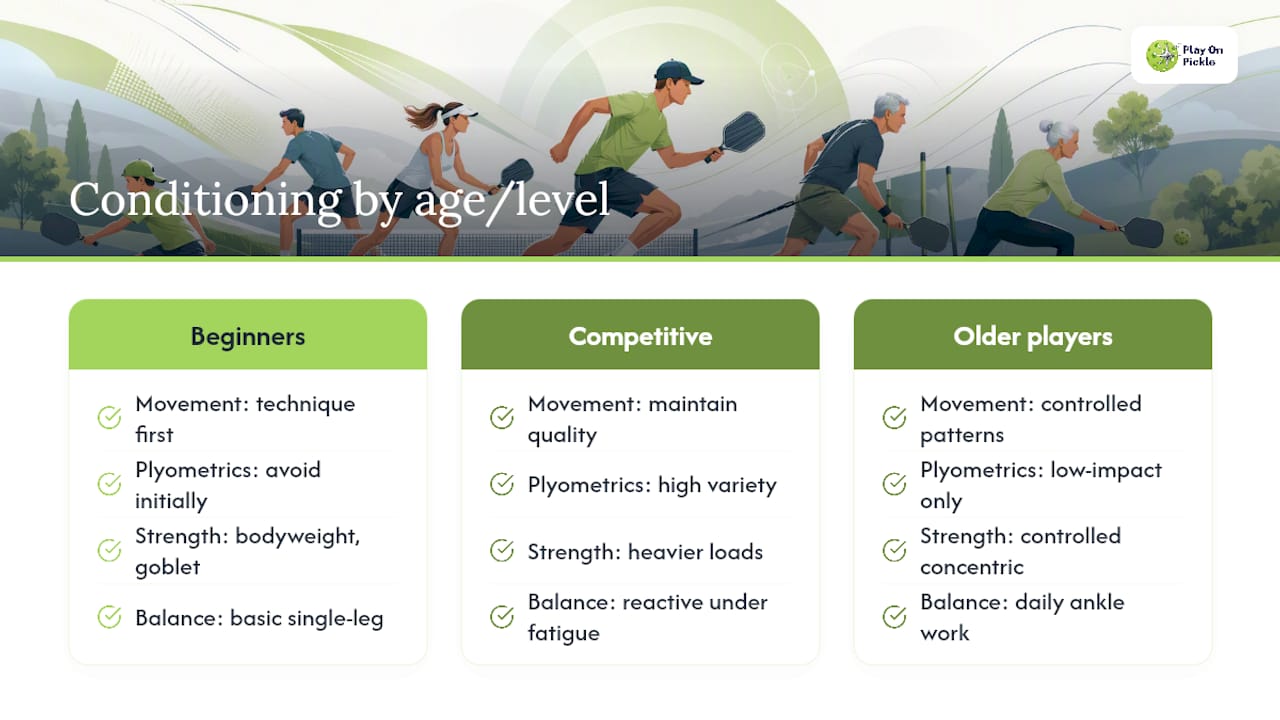
Beginners and casual players should spend more time on movement quality before adding any load or speed work. Master the split step, basic lateral shuffle, and controlled deceleration before touching cone drills or plyometrics. Strength sessions can start with bodyweight versions of the same lifts, goblet squats before barbell work, incline push-ups before full presses, and still deliver real benefit.
Competitive and tournament players can push volume and intensity higher: more plyometric variety, heavier strength loads, and shorter rest in conditioning circuits. This group benefits most from the reactive shuffle drill with actual ball feeds, since their limiting factor is usually reaction speed under fatigue rather than base fitness.
Older players, a group with notably elevated injury rates in recent reporting, should prioritize single-leg balance work and controlled concentric strength training over high-impact plyometrics. Power training still has value here, but emphasizing controlled movement patterns over explosive jumping protects joints that recover more slowly. Balance and ankle stability work deserve daily attention, not just a warm-up afterthought, since falls account for a disproportionate share of injuries in this group.
Regardless of age or level, the sets and reps in the strength sections above work as a starting point. Adjust the load, not the exercise selection.
Why Movement Analysis Changes How You Choose Exercises
Generic programs guess at your weak points. Identifying actual stress points, a shoulder that overrotates, an ankle that collapses on lateral moves, changes exercise selection entirely. One player's "core work" is another's ankle stability drill.
If nagging soreness keeps returning, an individualized movement assessment is worth trying before guessing again.
— Drona
Get a Conditioning Plan Built Around Your Own Movement
Generic programs treat every player's shoulders, hips, and ankles the same way. Playonpickle doesn't. Upload a video of your play, and the AI-driven movement analysis flags your specific stress points, the deceleration pattern putting pressure on your knee, the serve motion straining your shoulder, then builds exercise and equipment recommendations around what your body actually needs instead of a one-size-fits-all circuit.
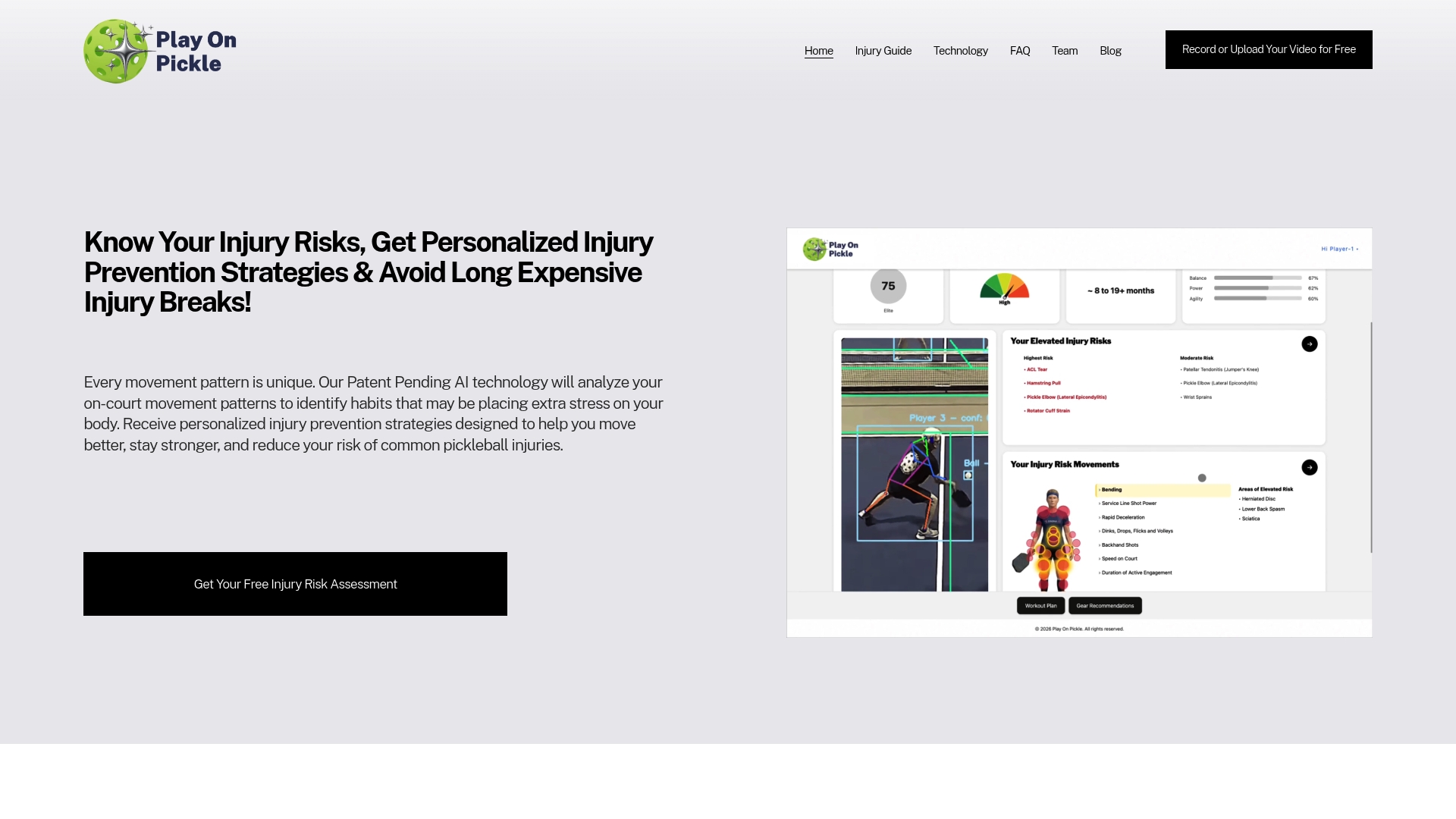
A free trial gets you started, and the first assessment walks through your movement patterns to surface risks before they turn into the kind of layoff that costs you a season. If you've read this far because something already nags at you mid-match, that's exactly the signal worth investigating. Start your movement assessment and build a plan around your own biomechanics instead of a generic template.
Key Takeaways
Effective pickleball conditioning sequences movement quality, then strength, then repeated-effort circuits, and skipping that order raises injury risk without improving performance.
| Point | Details |
|---|---|
| Train for repeated efforts | Short, intense work-to-rest circuits transfer better to match play than long steady-state cardio. |
| Strength twice weekly | Two 30 to 45 minute sessions covering legs, hips, core, and shoulders build court durability. |
| Warm up every time | A 5 to 10 minute dynamic routine before play cuts injury risk and sharpens early-match performance. |
| Scale by age and level | Beginners and older players should prioritize balance and controlled movement over high-impact plyometrics. |
| Personalize with movement analysis | Playonpickle's AI assessment identifies individual stress points and tailors exercise recommendations to your biomechanics. |
Sources
- PubMed item (physiology of intermittent sports)
- Muscle & Fitness — The Ultimate Pickleball Workout Plan
- Men’s Health — The Ultimate Pickleball Workout Plan
- NFPT — Pickleball fitness: Workouts to boost performance
Recommended
- Pickleball 101: Understanding the Game, Rules, and Essential Fitness and Gear — Play On Pickle - Smart Pickleball Fitness
- Pickle Elbow, FOOSH… — Play On Pickle - Smart Pickleball Fitness
- The Dink Movie — Play On Pickle - Smart Pickleball Fitness
- Blog | Improve Your Game Now — Play On Pickle - Smart Pickleball Fitness