
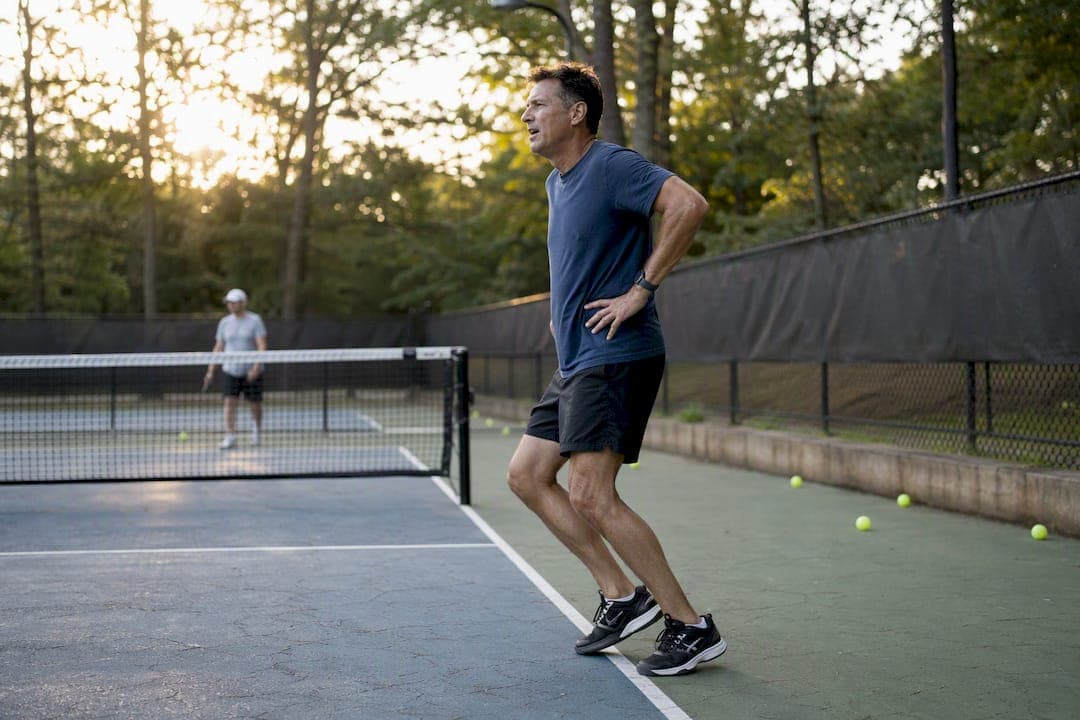
Most pickleball hip pain comes from overuse soft-tissue irritation, bursitis, tendinopathy, or piriformis irritation, not a structural emergency. If the pain is mild and your gait looks normal, shorten your sessions and watch how your body responds over the next day or two. If you're limping, feeling your hip lock or catch, going numb, or can't put weight on the leg, stop playing and get evaluated. Keck Medicine points out that many players aggravate a preexisting, silent problem the moment they ramp up activity too fast. Play On Pickle exists partly because of this pattern: catching a mechanical stress point before it becomes a three week layoff.
- Mild, no limp, resolves quickly → modify and monitor
- Limp, locking, numbness, can't bear weight → stop and see a clinician
- Persistent soreness or clicking beyond a reasonable time → get it checked before it becomes chronic
Key Takeaways
Pickleball hip pain usually stems from overuse and load mismanagement, and progressive loading, not passive stretching, is what resolves it and prevents recurrence.
| Point | Details |
|---|---|
| Location signals diagnosis | Outer hip suggests bursitis or tendinopathy; groin suggests flexor strain or labral issues; buttock suggests piriformis or hamstring tendinopathy. |
| Use the three-tier framework | Green light means modify and monitor; yellow light means back off and rehab; red light means stop and get evaluated. |
| Progressive loading beats stretching | Activate, strengthen, then reintroduce sport-specific movement over weeks, not days. |
| Recovery timelines vary widely | Mild strains often resolve in 2 to 3 weeks; tendinopathy can take 6 to 12 weeks of consistent rehab. |
| Prevention is mostly preparation | A short dynamic warm-up, proper footwear, and gradual weekly load increases cut recurrence risk. |
Table of Contents
- What's Actually Causing Your Pickleball Hip Pain?
- Is Your Hip Pain a Stop-and-Rest or Play-Through Situation?
- How Do You Relieve Hip Pain in the First Few Days?
- Building a Rehab Plan That Gets You Back on Court
- Warming Up and Managing Load to Avoid a Repeat
- How Long Does It Take to Recover From Pickleball Hip Pain?
- Where AI Movement Analysis Fits Into Prevention
- The Real Problem Isn't Pain, It's Ignoring the Pattern
- Frequently Asked Questions
- Sources
What's Actually Causing Your Pickleball Hip Pain?
Where the pain sits usually tells you more than how it feels. Pickleball's mix of lateral shuffles, sudden stops, and low reaches loads the hip in ways that running or cycling never does, and different movements stress different structures.
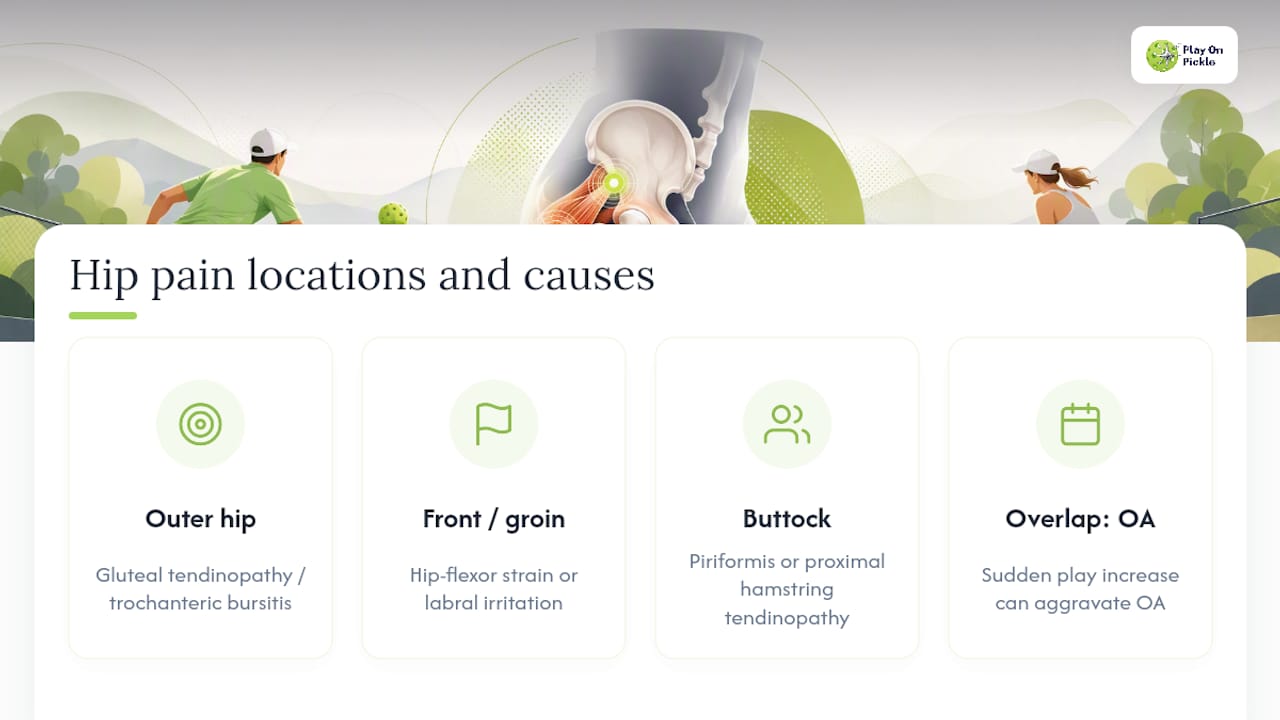
Outer hip pain is typically gluteal tendinopathy or trochanteric bursitis. You'll notice it during lateral shuffles, single-leg deceleration off a wide dink, or when lying on that side at night. The glute medius and minimus tendons take a beating from repeated side-to-side control, and bursitis often rides along as a secondary irritation.
Front-of-hip or groin pain points more toward hip flexor strain or labral irritation. Pivoting hard to reach a drop shot, low lunges for a ball at your ankles, and repeated deep splits are the usual triggers. Groin pain that comes with clicking or a catching sensation deserves attention. Avid Sports Medicine notes that persistent clicking or groin discomfort can signal tendon irritation, bursitis, or labral damage, and recommends early evaluation rather than waiting it out.
Buttock or high-hamstring pain, sometimes radiating down the back of the leg, usually means piriformis irritation, proximal hamstring tendinopathy, or referred sciatic symptoms. Sitting for a long car ride right after a match tends to make this worse, and lateral overload from aggressive court coverage is a common cause.
One overlap worth knowing: Cedars-Sinai reports that repetitive play can aggravate existing osteoarthritis, especially in players who suddenly increase how often they play. A hip that was quietly fine at low volume can become symptomatic once you go from one session a week to four.
Is Your Hip Pain a Stop-and-Rest or Play-Through Situation?
You don't need an MRI to make a smart decision about tonight's open play session. A simple three-tier framework covers most cases.
- Green light. Mild soreness, no limp, and it settles within 24 to 48 hours with reduced load. Keep playing, just dial back intensity for a few days.
- Yellow light. Stiffness that lingers into the next day, pain that returns every time you resume play, or discomfort that changes how you move on court. Back off volume and start structured rehab, ideally with a physical therapist guiding the progression.
- Red light. A limp, locking or catching in the joint, sudden sharp pain after a fall, numbness or weakness down the leg, pain that wakes you at night, or inability to bear weight. Stop playing and get evaluated soon, not next month.
Ohio State Health lists hip issues among the most common pickleball complaints and recommends rest, appropriate medication, and physical therapy for anything that becomes chronic.
Pro Tip: Keep a simple two-line log after each session: how the hip felt during play and how it felt the next morning. Patterns show up fast, and that log is exactly what a physical therapist wants to see if you end up needing one.
How Do You Relieve Hip Pain in the First Few Days?
The first 48 to 72 hours are about protecting the joint without shutting down completely. Total rest often stiffens things up more than it helps.
Cut session length before you cut out pickleball entirely. Favor doubles over singles since it demands less lateral range, shorten how far you chase wide balls, and skip deep lunges for low shots until things settle.
Ice or heat, depending on the moment. Ice works best in the first 24 to 48 hours if there's sharp pain or swelling, 15 to 20 minutes at a time. Heat helps more with lingering stiffness once the acute phase passes, especially before gentle movement. Over-the-counter NSAIDs like ibuprofen can ease pain and swelling short term, but check with a pharmacist or doctor if you're taking them regularly, have kidney or stomach issues, or are on other medications.
Keep moving gently. Walking and controlled hip mobility drills maintain blood flow and range of motion. Aggressive static stretching of an irritated tendon or bursa usually backfires, and playing through an actual limp almost guarantees a longer recovery.
A pillow between the knees for side-sleepers takes pressure off an irritated outer hip. Swimming or stationary biking can hold onto some fitness without the lateral stress pickleball demands.
Building a Rehab Plan That Gets You Back on Court
Stretching alone rarely fixes tendinopathy or bursitis. What actually works is progressive loading: teaching the tissue to tolerate stress again in stages, rather than just trying to make it feel loose. NCBI's clinical resources on musculoskeletal rehabilitation back this up, and PubMed research on tendinopathy shows graded, progressive loading programs consistently outperform passive approaches like rest and stretching alone.
The sequence runs activate, strengthen, load, then sport-specific movement.
- Activation phase. Glute bridges, clamshells, and mini-band lateral walks, 2 to 3 sets of 10 to 20 reps, done daily. This wakes up the glutes that pickleball's lateral demands rely on heavily.
- Strength phase. Move to single-leg work: step-ups, single-leg Romanian deadlifts, and lateral step-downs, 3 sessions a week. If proximal hamstring tendinopathy is part of the picture, add slow eccentric hamstring exercises here.
- Sport-specific phase. Controlled lateral shuffles, deceleration drills, and short-interval plyometrics reintroduce the exact movements that caused the problem in the first place, just at lower intensity.
The rule for moving between phases is simple: no increase in symptoms 24 to 48 hours after the session. If pain spikes, drop back a phase rather than pushing through.
Avid Sports Medicine repeatedly points to glute-focused strengthening and progressive, sport-specific loading as the backbone of lasting recovery, not a one-time fix.
Pro Tip: Do activation work daily, even on rest days. Five minutes of glute bridges and clamshells before you even step on court primes the muscles that actually protect your hip during play.
Warming Up and Managing Load to Avoid a Repeat
Most recurring hip pain traces back to preparation and pacing, not bad luck. A few adjustments cut recurrence risk substantially.
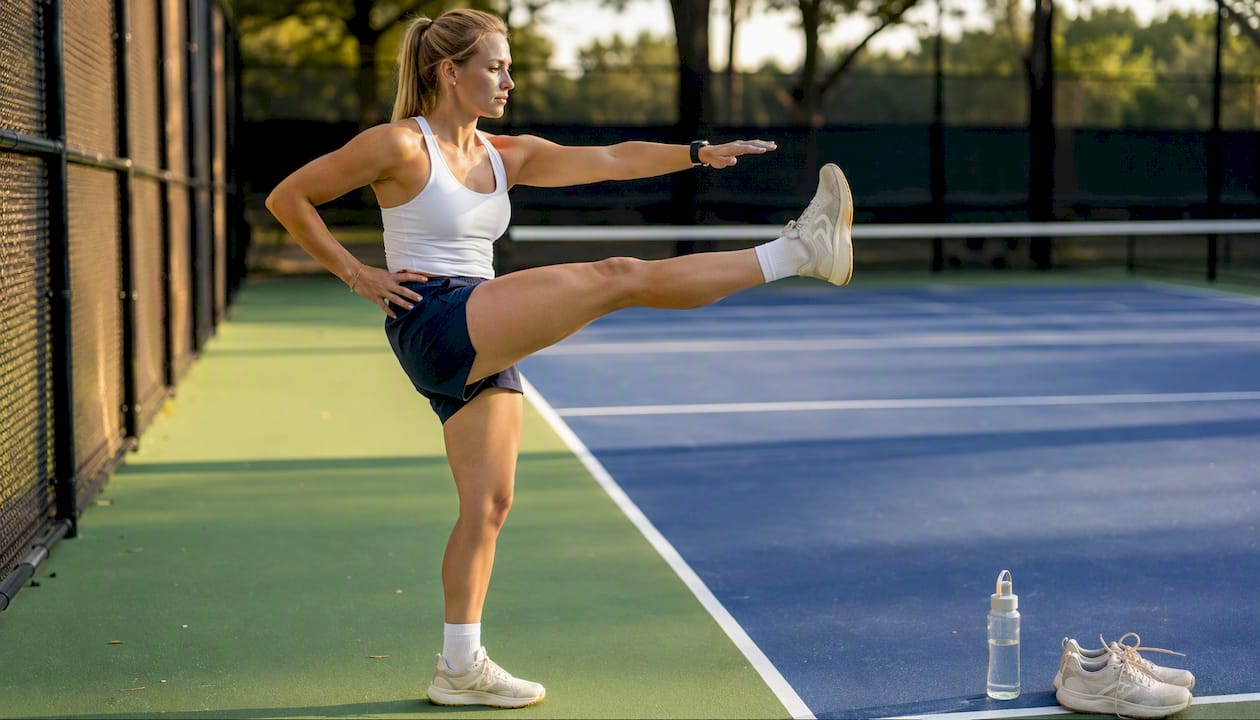
Spend several minutes on a dynamic warm-up before you pick up a paddle: light cardio to raise your heart rate, hip circles and leg swings for mobility, then a few glute activation reps like banded lateral walks. Skip this and you're asking cold tissue to handle sudden lateral loads.
Footwear matters more than most players realize. Court shoes with lateral stability and enough cushioning reduce the jarring load on your hip during quick direction changes, and worn-out tread increases slip risk that forces awkward corrective movements. Replace shoes regularly or when the outsole shows visible wear. Rush University emphasizes that footwork and footwear choices directly affect lateral load on the lower body.
On the footwork side, cut down on crossover lunges when you can use a split-step and shuffle instead, and keep your center of mass lower during direction changes rather than reaching with a straight leg.
Weekly load matters as much as any single session. Avoid jumping from one match a week to daily play. Build in rest days, cross-train with biking or swimming, and use a symptom log to catch flares early.
Pro Tip: If you're adding a second or third weekly session, add it gradually over 3 to 4 weeks rather than all at once. Sudden volume jumps are one of the most common triggers clinicians see.
How Long Does It Take to Recover From Pickleball Hip Pain?
Recovery timelines vary a lot by diagnosis, so treat these as general ranges rather than promises.
- Mild strains: Usually 2 to 3 weeks with load modification and basic activation work.
- Tendinopathy (gluteal, hip flexor, hamstring): Typically 6 to 12 weeks of progressive loading, sometimes longer if the irritation had been building for months before symptoms showed up.
- Labral issues or osteoarthritis flares: Highly variable, and often require imaging and a specialist's input before a rehab timeline makes sense.
Before returning fully to competitive play, check off these markers: pain under 2 out of 10 during sport-specific movements, single-leg strength close to matching your uninjured side, no limp during shuffles or lunges, and the ability to handle a full practice session without a symptom flare the next day.
If two weeks of consistent, conservative care hasn't moved the needle, or symptoms keep flaring every time you resume play, that's the signal to escalate to a physical therapist or sports medicine doctor rather than repeating the same approach.
Where AI Movement Analysis Fits Into Prevention
Rehab and prevention both hinge on knowing exactly what your body is doing wrong, and that's the piece most recreational players never get. You can do every exercise in a rehab plan correctly and still get reinjured if the actual movement pattern causing the stress never changes.
Playonpickle's AI-driven video analysis reviews your on-court movement using computer vision technology to flag specific stress points, the kind of asymmetries a player rarely notices in real time.
- Objective feedback on movement patterns instead of guesswork about what "feels" off
- Early flagging of side-to-side asymmetries before they become painful
- Personalized exercise progressions matched to what your own movement shows
- Equipment recommendations tied to your actual biomechanics, not generic advice
A recreational player who feels fine can still be loading one hip asymmetrically on every lateral shuffle. Catching that pattern before it turns into bursitis is the entire point of movement analysis.
Think of it as a layer that sits alongside clinical care, not a replacement for it. If you're in yellow or red light territory from the framework above, see a physical therapist first. Once you're back to green light status, a tool like Playonpickle can help you spot the mechanical habits that put you there in the first place, and feed that into a more targeted return-to-play plan.
Pro Tip: Run a movement analysis before you start a new rehab program, not after. It gives you and your PT a clearer starting picture of what actually needs to change.
Ready to see what your own movement pattern looks like? Play On Pickle offers a free trial that pairs AI-driven analysis with personalized injury-prevention strategies built around your biomechanics.
The Real Problem Isn't Pain, It's Ignoring the Pattern
Most advice on pickleball hip pain treats it like a single event: something hurts, so you stretch it, ice it, and hope it goes away. That misses what's actually happening. Hip pain in this sport is almost always the tail end of a pattern, a movement compensation or a loading imbalance that's been building for weeks before it became sore enough to notice.
The conventional playbook of rest and stretch also gets the sequence backward. Rest calms symptoms; it doesn't fix the tissue's capacity to handle load, which is why so many players feel better, return to full intensity, and get hurt again within a month. Progressive loading is slower to start but it's the piece that actually holds up.
If there's one priority worth taking from this, it's catching the mechanical pattern before it produces pain, not after. That's a harder habit to build than icing a sore hip, but it's the difference between managing flare after flare and just not having them.
Frequently Asked Questions
Can pickleball cause permanent hip damage? Most pickleball hip pain resolves fully with appropriate rest and rehab. Chronic labral tears or advanced arthritis can cause longer-term issues, which is why persistent clicking, locking, or pain lasting beyond two weeks warrants professional evaluation.
Should I keep playing pickleball with hip pain? Mild soreness that resolves within 24 to 48 hours is usually fine to play through at reduced intensity. A limp, locking sensation, numbness, or pain that changes your technique means it's time to stop and get evaluated.
What exercises help hip pain from pickleball? Glute bridges, clamshells, and mini-band lateral walks build the foundation, followed by single-leg step-ups and single-leg Romanian deadlifts once basic activation feels solid. Progress only when a session doesn't increase symptoms the next day.
How long does hip bursitis from pickleball take to heal? Tendinopathy and bursitis typically take 6 to 12 weeks with consistent progressive loading. Timelines vary based on how long the irritation was present before treatment started.
Is hip pain after pickleball a sign of arthritis? It can be, especially in players who suddenly increase how often they play. Repetitive activity can aggravate existing joint disease, so pain that feels deep, stiff, and doesn't respond to load modification deserves a clinical evaluation.
This article is general information, not a substitute for advice from a qualified doctor. Consult a qualified healthcare professional about your own circumstances before acting on anything here.
Sources
- How to prevent pickleball injuries | Keck Medicine of USC
- Pickleball Hip Injuries: Causes, Recovery, and Prevention | Avid Sports Medicine
- NCBI Bookshelf resource on musculoskeletal practice
- PubMed article relevant to tendinopathy and loading
Persistent or severe symptoms always warrant a conversation with a clinician rather than relying on general guidance alone.
Recommended
- Pickle Elbow, FOOSH… — Play On Pickle - Smart Pickleball Fitness
- Blog | Improve Your Game Now — Play On Pickle - Smart Pickleball Fitness
- Celebrate National Pickleball Day: Play Harder, Move Smarter, and Stay Injury-Free — Play On Pickle - Smart Pickleball Fitness
- Pickleball 101: Understanding the Game, Rules, and Essential Fitness and Gear — Play On Pickle - Smart Pickleball Fitness