
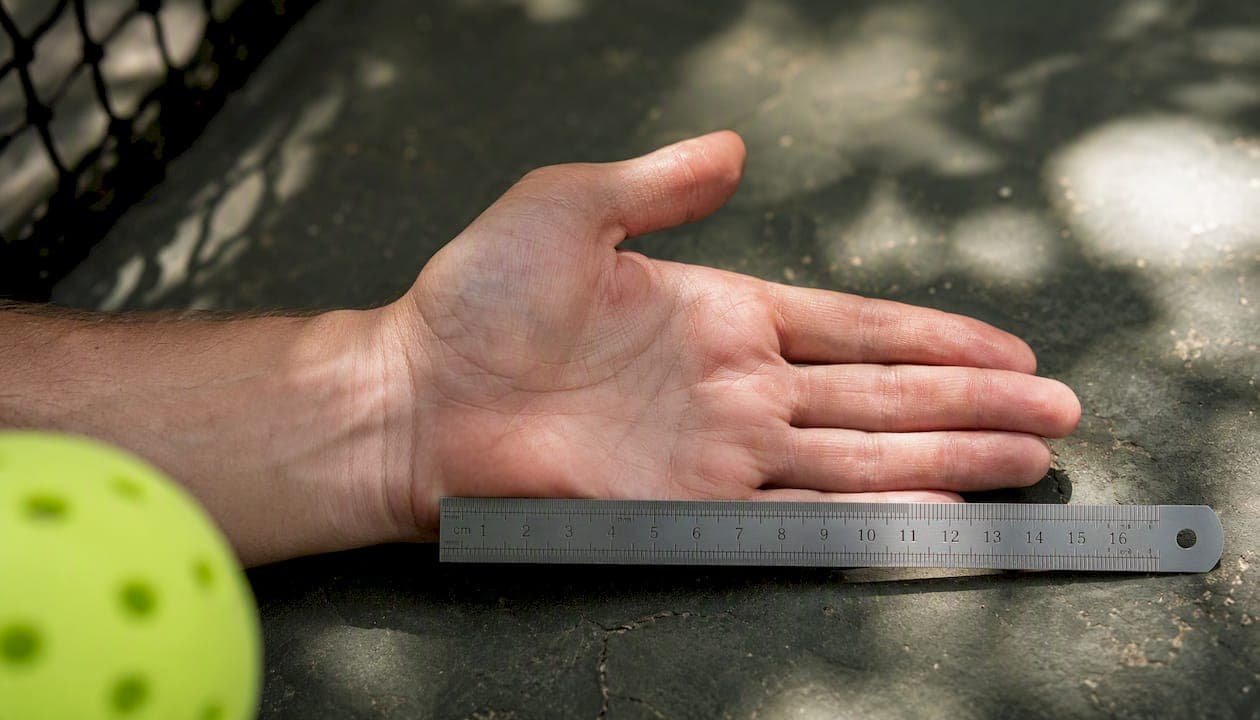
For most adults, the right pickleball paddle grip circumference falls between 4.0" and 4.5", and the single rule that saves you from a bad purchase is this: when your measurement lands between two sizes, always choose the smaller one. Adding grip circumference later is easy; removing it is not.
The fastest way to find your number is the ruler test. Place a ruler at the bottom lateral crease of your palm (the middle horizontal line) and measure straight to the tip of your ring finger. That measurement in inches is your starting grip circumference. Pickleball-paddles that one thin overgrip layer adds roughly 1/16" to circumference, so you can fine-tune from there.
- Most adult grips ship between 4.0" and 4.5", in 1/8" steps: 4.0, 4.125, 4.25, 4.375, 4.5
- If your measurement is 4.2", buy the 4.125" or 4.0" and add one overgrip
- Each overgrip layer adds ~1/16"; two layers is a practical ceiling before feel degrades
Key Takeaways
The right pickleball paddle grip size starts with one measurement, one rule, and one cheap fix: measure palm crease to ring-finger tip, choose the smaller size when between options, and use overgrip to build up from there.
| Point | Details |
|---|---|
| Measure first, always | Use the ruler test (palm crease to ring-finger tip) for the most accurate starting circumference. |
| Choose smaller if unsure | A grip that's slightly too thin is fixable with a $3–$5 overgrip; one that's too large requires a new paddle. |
| 1/16" per overgrip layer | Each thin overgrip layer adds approximately 1/16" — two layers is the practical ceiling before bevel feel degrades. |
| Wrong size raises injury risk | Too-small grips cause over-squeezing and forearm fatigue; too-large grips restrict wrist motion and strain elbow tendons. |
| Playonpickle for persistent pain | If correct grip size doesn't resolve forearm or elbow pain, Playonpickle's AI movement analysis identifies the biomechanical cause. |
Table of Contents
- How to measure your pickleball paddle grip size at home
- Size chart: hand measurement to grip circumference
- What grip thickness categories actually feel like on court
- How grip size affects performance and injury risk
- How to adjust your grip size: overgrips, replacement grips, and rewrapping
- What pros use and the myths worth ignoring
- Quick signs your grip is wrong and what to do right now
- When grip size alone doesn't fix the pain
- A note from the court
- Playonpickle: expert movement analysis when grip alone isn't enough
- Sources
How to measure your pickleball paddle grip size at home
Two tests cover nearly every situation. Use the ruler test for a purchase decision and the index-finger test to verify fit once a paddle is in your hand.
The ruler test (best for buying)
Hold your dominant hand flat, fingers together, palm facing up. Find the bottom lateral crease — the horizontal line that runs across the middle of your palm. Set the end of a ruler there and read the distance to the tip of your ring finger. That number is your grip circumference target.
Most hands measure somewhere between 4.0" and 4.5". Selkirk Sport notes that fit within this range directly affects wrist mobility and injury risk, so precision here matters more than most players expect.
The index-finger test (best for verifying)
Grip the paddle with your dominant hand as you would during play. Slide the index finger of your other hand into the gap between your fingertips and your palm. The fit is right when your index finger fills that gap snugly — not jammed in, not floating loose. Too tight means the grip is too small; too much space means it may be too large.
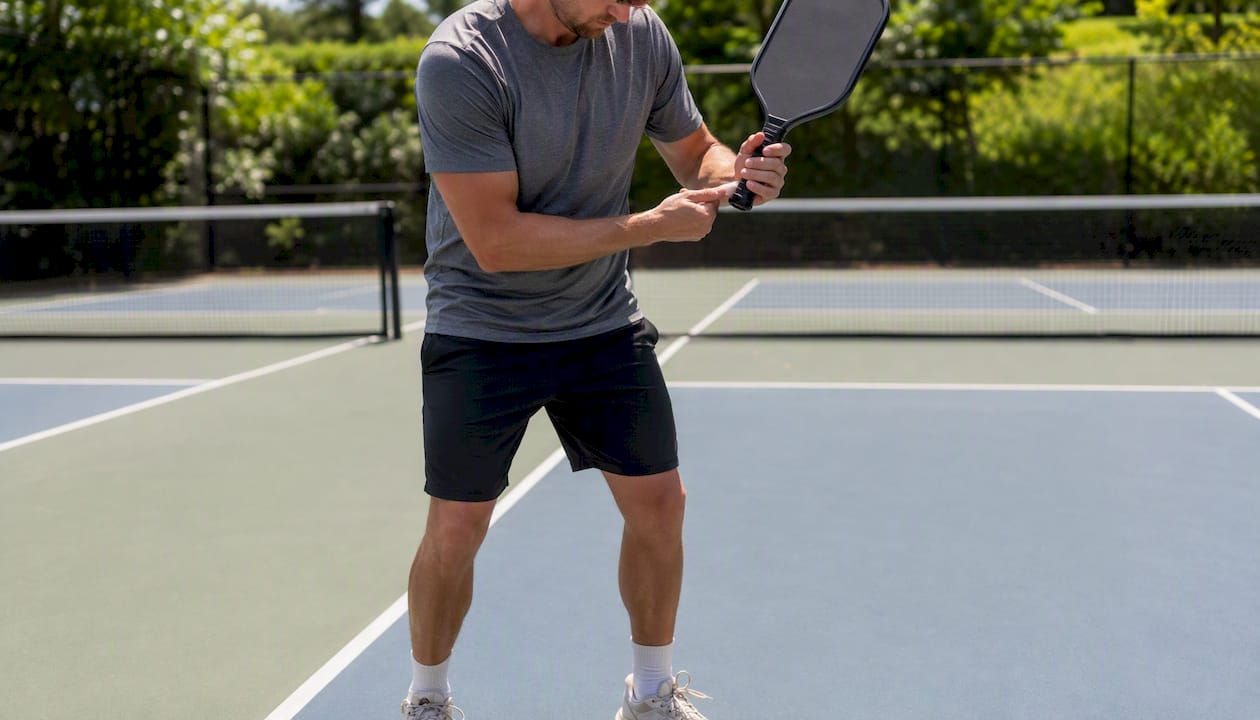
Pro Tip: If you're shopping online and can't test in hand, always order the smaller of two candidate sizes. You can build up with a $3–$5 overgrip in minutes. You cannot shave down a grip that's already too large.
What to do when you're between sizes
Pickleball Galaxy's sizing guide and most equipment specialists agree: choose the smaller size. A grip that's slightly too thin is correctable on the spot; one that's slightly too thick forces you to live with it or buy a new paddle.
Size chart: hand measurement to grip circumference
FORWRD's grip size guide confirms that standard sizes run in 1/8" increments and that many performance paddles ship around 4.25" because it fits the widest range of adult hands.
| Hand measurement (ruler test) | Recommended grip circumference | Common label |
|---|---|---|
| Under 4.0" | 4.0" | Small |
| 4.0"–4.125" | 4.125" | Medium-small |
| 4.125"–4.25" | 4.25" | Medium |
| 4.25"–4.375" | 4.375" | Medium-large |
| 4.375" and above | 4.5" | Large |
No ruler handy? Height works as a rough fallback, though it's less accurate than the palm measurement:
- Under 5'3": start at 4.0"
- 5'3"–5'8": try 4.125"–4.25"
- Above 5'8": consider 4.25"–4.5"
Think of this chart as a starting point. On-court feel after 20–30 minutes of real play is the final judge, and plenty of players end up one step away from where the chart puts them.
What grip thickness categories actually feel like on court
Numbers on a chart don't tell you much about what a grip feels like mid-rally. Here's how the three broad categories translate to real play.
Thin grips (4.0"–4.125") give your wrist more freedom to snap through the ball. That extra wrist action helps with spin, soft touch in the kitchen line, and quick resets. The trade-off is that your hand works harder to stabilize the paddle, which can fatigue smaller muscle groups faster. Women and junior players tend to land here, and many dink-heavy players prefer it for the feel it provides on soft touch shots.
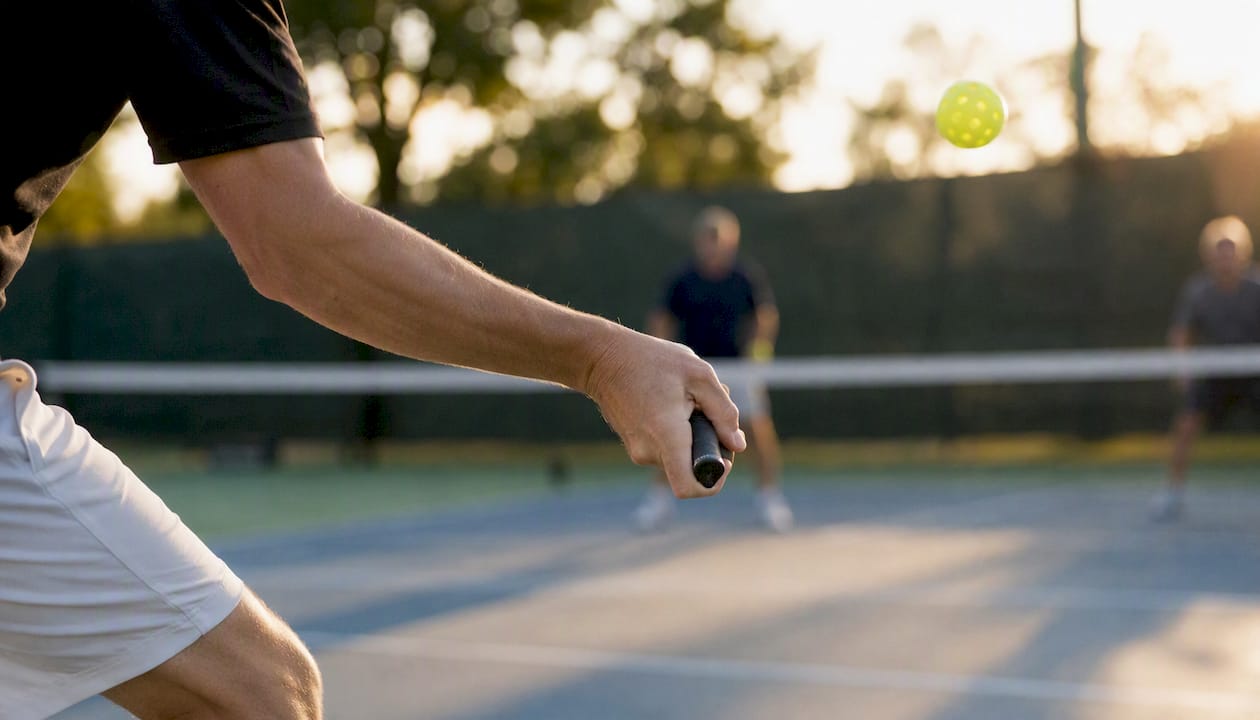
Medium grips (4.25") are where most adult players end up. Joysent Sport's sizing breakdown identifies 4.25" as the most commonly used circumference among adults, and it's easy to see why: it balances wrist mobility with enough stability that you're not fighting the paddle on drives.
Thick grips (4.375"–4.5"+) reduce wrist snap and add a planted, stable feel. Players transitioning from tennis, where slightly larger grips are standard, often gravitate here. Power hitters who rely on body rotation rather than wrist flick can benefit from the added stability. The downside: less feel on touch shots and reduced ability to generate spin with the wrist alone.
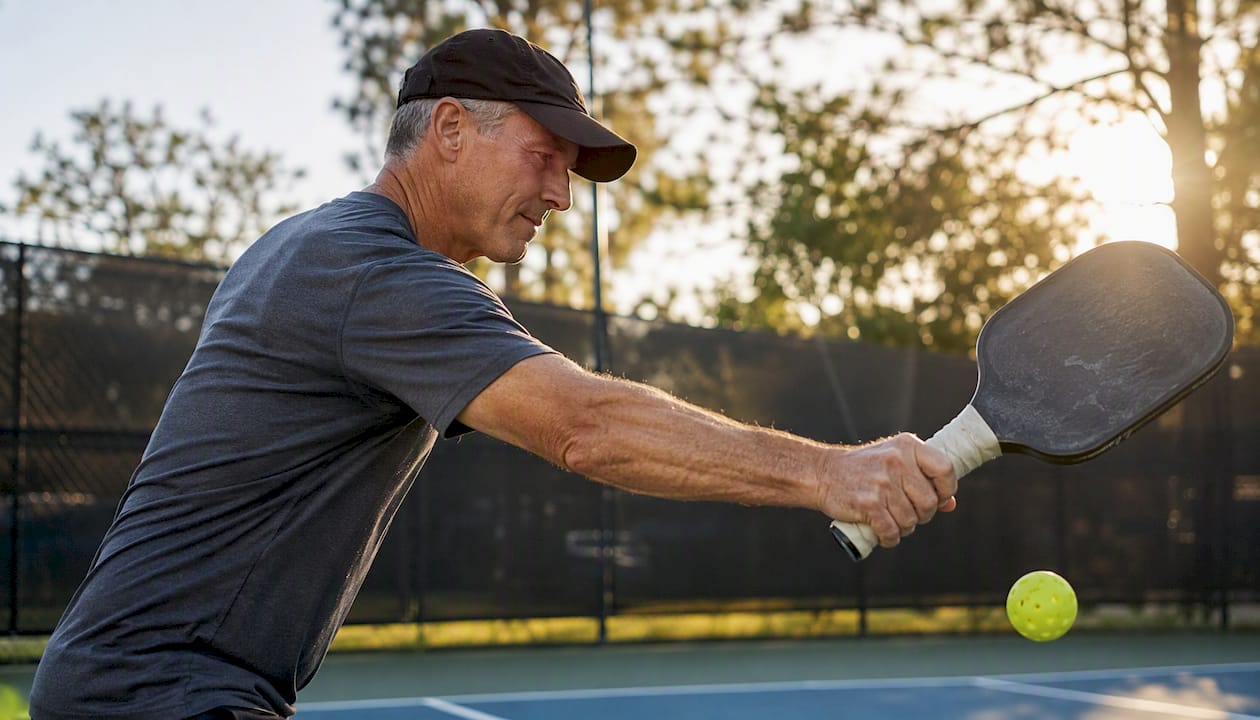
Pro Tip: If you play both a power game from the baseline and a touch game at the net, lean toward the medium size. You can always add one overgrip layer for drives and remove it for a softer feel — though most players just pick the size that serves their dominant style.
How grip size affects performance and injury risk
Getting this wrong doesn't just feel uncomfortable. It changes how your forearm and wrist absorb force on every single shot.
A grip that's too small forces you to squeeze harder to keep the paddle from twisting. That constant gripping contracts the forearm flexors repeatedly, and over hundreds of shots per session, that tension accumulates. Selkirk's education team links incorrect grip diameter directly to overuse injuries including medial epicondylitis, sometimes called pickleball elbow or golfer's elbow. Forearm fatigue that players blame on poor stamina is often the grip asking to be changed.
A grip that's too large creates the opposite problem. Your wrist can't move freely through the swing, so it compensates with eccentric strain on the extensor tendons — the same pathway that leads to lateral epicondylitis (tennis elbow). You also lose the ability to redirect the paddle quickly, which shows up as slower reaction time at the net.
A correct grip fit reduces unnecessary muscle tension and improves kinetic transfer through the swing — meaning the force you generate actually reaches the ball instead of being absorbed by a compensating grip. Experts at Selkirk Sport emphasize that grip size is one of the most overlooked components of injury prevention in pickleball.
Pro Tip: Re-check your grip fit every few weeks when you're ramping up play volume. Hands can change slightly with conditioning, and a grip that felt fine at two sessions per week may feel wrong at five.
For a deeper look at how overuse injuries develop in pickleball, the pickle elbow breakdown on the Playonpickle blog covers the mechanics in plain language.
How to adjust your grip size: overgrips, replacement grips, and rewrapping
Increasing circumference is straightforward. Decreasing it is not — and that's exactly why the "choose smaller" rule exists.
-
Add a thin overgrip layer. This is the fastest, cheapest fix. A single layer of a standard overgrip (brands like Tourna Grip or Wilson Pro Overgrip are widely available) adds roughly 1/16" and costs $3–$6 per roll. Wrap it tightly over the existing grip, starting at the butt cap and overlapping slightly. One layer is almost always enough for a half-size adjustment.
-
Stack a second overgrip layer. Two layers add about 1/8" total. This is the practical ceiling for most players. Beyond two thin layers, the handle starts to feel round rather than octagonal, and you lose the ability to feel the paddle's bevels. That bevel feedback matters more than most beginners realize — it tells you where the face is pointing without looking down.
-
Replace the base grip. If you need more than two overgrip layers, the better move is a full replacement grip. These are thicker than overgrips (typically 1.5–2mm vs. 0.5–0.6mm for overgrips) and change the feel, tack, and weight distribution of the handle. Expect to spend $10–$20 and about 15 minutes. It's a longer-term solution that also refreshes the cushion and sweat absorption.
-
Rewrap with a thicker base grip. Some players swap the factory grip for a padded or cushioned replacement to add both circumference and shock absorption in one step. This makes sense if your current grip is worn and you want a size bump at the same time.
Pro Tip: Never try to remove material from a grip to make it smaller. Sanding or cutting a grip damages the handle and voids most warranties. If you genuinely need a smaller size, buy a paddle that ships in that size.
What pros use and the myths worth ignoring
Most professional pickleball players use grip circumferences in the 4.0"–4.25" range. That's smaller than many recreational players assume, and it reflects a deliberate choice: pros want maximum wrist freedom for spin, touch, and rapid paddle repositioning. A few players with tennis backgrounds — where grip sizes run larger — use 4.375" or 4.5", but they're the exception.
Common patterns and myths worth knowing:
- "Bigger grip = more power" is the most persistent myth. A larger grip actually reduces wrist snap, which is a primary power source in pickleball. Power comes from body rotation and swing path, not grip diameter.
- Pros customize constantly. Many top players adjust overgrip thickness between tournaments based on humidity, hand sweat, and how their arm feels. That level of fine-tuning is real, but it's not necessary for recreational play.
- Copying a pro's exact setup rarely works. A 5'10" male pro using 4.0" grips has conditioned forearms and a swing mechanics profile built over years. A recreational player with the same hand measurement may need 4.125" or 4.25" for comfort and injury safety.
- Handle length matters alongside circumference. CORE Athletics' paddle size guide points out that players using two-handed backhands with longer handles (5.5"–6") often do better with a slightly smaller base circumference to keep swing weight manageable after adding overgrips.
Quick signs your grip is wrong and what to do right now
You don't need to wait for pain to know something's off. These signals show up fast.
Signs your grip is too small:
- You feel the paddle twisting in your hand on hard shots
- Your forearm burns or cramps within the first 20 minutes
- You're gripping noticeably harder as the session goes on
- You notice your knuckles whitening during rallies
Signs your grip is too large:
- Your wrist feels locked or stiff through the swing
- Dinks and drops feel imprecise or "dead"
- You struggle to generate spin even when you try
- The paddle feels heavy and slow to redirect
Immediate fixes to try:
- Add one overgrip layer and play another 20 minutes before deciding
- Try shifting your hand slightly down the handle (choking up) to test a smaller effective circumference
- For a too-large grip, wrap a thinner overgrip over the existing one to at least improve tack, then plan a paddle swap
Pro Tip: Always re-assess grip feel after a proper warm-up, not cold. Cold hands grip differently — tighter and with less sensitivity. A grip that feels wrong in the first five minutes may settle in once your hands are warm. Give it 15–20 minutes before making a change.
When grip size alone doesn't fix the pain
If you've measured correctly, chosen the right size, and the forearm or elbow pain keeps coming back, the grip isn't the whole story. Persistent pain despite a proper fit usually points to movement pattern issues: compensations in your swing path, footwork, or shoulder mechanics that put excess load on the arm regardless of what's in your hand.
This is where a biomechanical lens becomes useful:
- A movement analysis can reveal whether you're leading with your elbow instead of your shoulder on drives
- It can identify asymmetries in your footwork that force your arm to do work your legs should be doing
- It can flag swing-path habits that increase stress on the medial or lateral elbow tendons
Playonpickle offers an AI-driven movement analysis built specifically for pickleball players. You upload video of your play, and the system identifies biomechanical stress points and delivers personalized corrective exercise recommendations. It's the kind of individualized assessment that used to require an in-person sports medicine visit.
Pro Tip: When preparing for a movement assessment, bring video of the specific shots that cause pain — not just your best rallies. A forehand drive that triggers elbow discomfort tells an analyst far more than a clean dink exchange. Also note your recent injury history and how long the pain has been present.
For more on how individual movement patterns connect to injury risk, the Playonpickle piece on your movement signature is worth reading alongside this guide.
A note from the court
Small grip changes produce surprisingly large results. Dropping half a size and adding a single overgrip layer can shift a player from constant forearm fatigue to two-hour sessions without discomfort. The measurement takes two minutes, and the overgrip costs less than a can of pickleballs.
What I'd encourage every player to do: treat grip fit as a living variable, not a one-time decision. Your hand strength, playing volume, and shot repertoire all shift over months of play. Check the fit again when something feels off, and don't assume forearm soreness is just conditioning. Often it's the paddle telling you something.
Playonpickle: expert movement analysis when grip alone isn't enough
Grip size gets you most of the way there. But if forearm pain, elbow soreness, or inconsistent mechanics keep showing up despite the right fit, the issue is likely in how you move, not just what you're holding.

Playonpickle's AI-powered movement analysis gives you a concrete answer. Upload video of your play, and the system maps your biomechanical stress points, identifies compensations in your swing and footwork, and delivers a personalized plan of corrective exercises. No guesswork, no generic advice — just a clear picture of what your body is doing and what to adjust.
It's built for players who want to stay on the court, not sit out with an overuse injury. A free trial gets you started, and there's no pressure to commit beyond what's useful to you. Visit Playonpickle to begin your assessment.
Sources
- How to measure pickleball paddle grip size
- How do I find my pickleball paddle grip size? | Selkirk Sport
- Pickleball Paddle Grip Size Guide | FORWRD Blog
- How to Choose a Pickleball Paddle Grip Size | Pickleball Galaxy
- Pickleball Paddle Grip Size Guide: How to Choose the Right Fit (2026) – Joysent Sport
- Pickleball Paddle Size Guide: Choose the Best Dimensions & Grip - CORE Athletics
This article is general information, not a substitute for advice from a qualified doctor. Consult a qualified healthcare professional about your own circumstances before acting on anything here.
Recommended
- Pickleball 101: Understanding the Game, Rules, and Essential Fitness and Gear — Play On Pickle - Smart Pickleball Fitness
- The Dink Movie — Play On Pickle - Smart Pickleball Fitness
- Celebrate National Pickleball Day: Play Harder, Move Smarter, and Stay Injury-Free — Play On Pickle - Smart Pickleball Fitness
- Pickle Elbow, FOOSH… — Play On Pickle - Smart Pickleball Fitness