
If your forearm burns after every third-shot drop, the fastest fix isn't a new grip technique. It's a paddle with a 16mm core, a soft face, and a swing weight that your arm can actually tolerate. Skip anything under 13mm if you're symptomatic right now, and skip anything advertised as "power-first" until the pain settles.
Three paddles cover most situations. For all-around elbow relief, look at the Selkirk Luxx Control Air or a similar thicker-core Selkirk model built around a soft, flexible face. If budget matters more than brand, the ProKennex Kinetic line has built its reputation for over a decade on kinetic dampening tech designed specifically to reduce arm shock. If vibration is your main enemy, whether from a metal face or a stiff carbon layup, the Vatic Pro PRISM Flash uses foam-injected edge technology that measurably cuts down on the sting you feel on off-center hits.
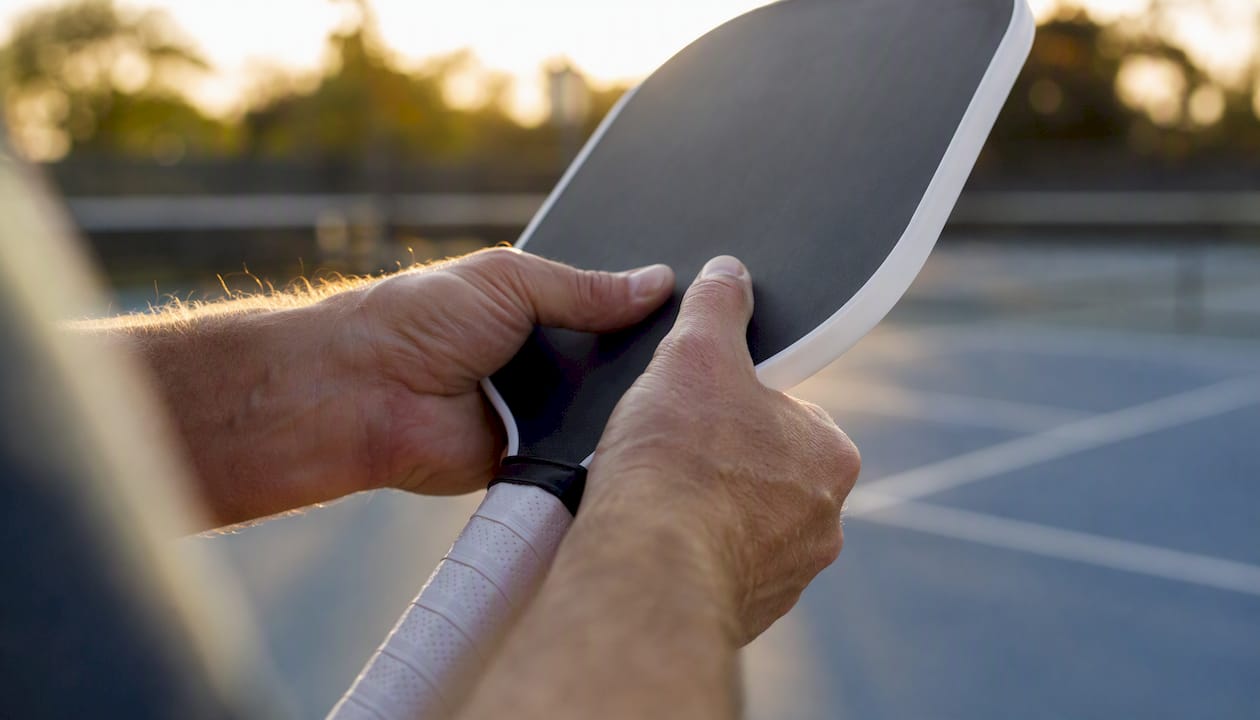
Before you spend a dollar on a new paddle, though, try this: add an overgrip to your current paddle and hit 20 dinks. If your forearm feels less "electric" and more like a "dull thud," you've just confirmed grip size was part of the problem, and you may not need a new paddle at all.
- Best overall for elbow relief: thicker-core paddle (16mm), soft face, neutral or head-light balance
- Best budget arm-friendly option: ProKennex Kinetic series, known for shock-dampening tech at accessible price points
- Best for high vibration damping: Vatic Pro PRISM Flash, foam-injected perimeter for reduced sting on mishits
- Immediate action step: demo with an added overgrip and a few strips of lead tape at 3 and 9 o'clock before committing to a purchase
Table of Contents
- Which Pickleball Paddle Specs Actually Reduce Tennis Elbow Pain?
- Paddle-by-Paddle Breakdown: What Helps and What to Watch For
- How Do You Choose and Test a Paddle for Tennis Elbow?
- Why Your Paddle Is Only Part of Fixing Tennis Elbow
- Which Paddle Should You Actually Pick?
- A Smarter Way to Fix the Root Cause, Not Just the Symptom
- Key Takeaways for Managing Pickleball Elbow
- Sources
Which Pickleball Paddle Specs Actually Reduce Tennis Elbow Pain?
Five specs determine how much load reaches your lateral epicondyle on every swing: core thickness, face stiffness, static weight, swing weight, and grip size. Get those five right and you've solved most of what a paddle can solve. Get them wrong and no amount of "arm-friendly" marketing copy will save your elbow.
Core thickness is the biggest lever. A 16mm core is the recommended threshold for players with active or recent tennis elbow symptoms, because thinner cores (13mm and 14mm) transmit far more vibration straight into your wrist and forearm on contact. Thicker isn't just a marketing checkbox. It's a physical buffer between the ball and your tendon.
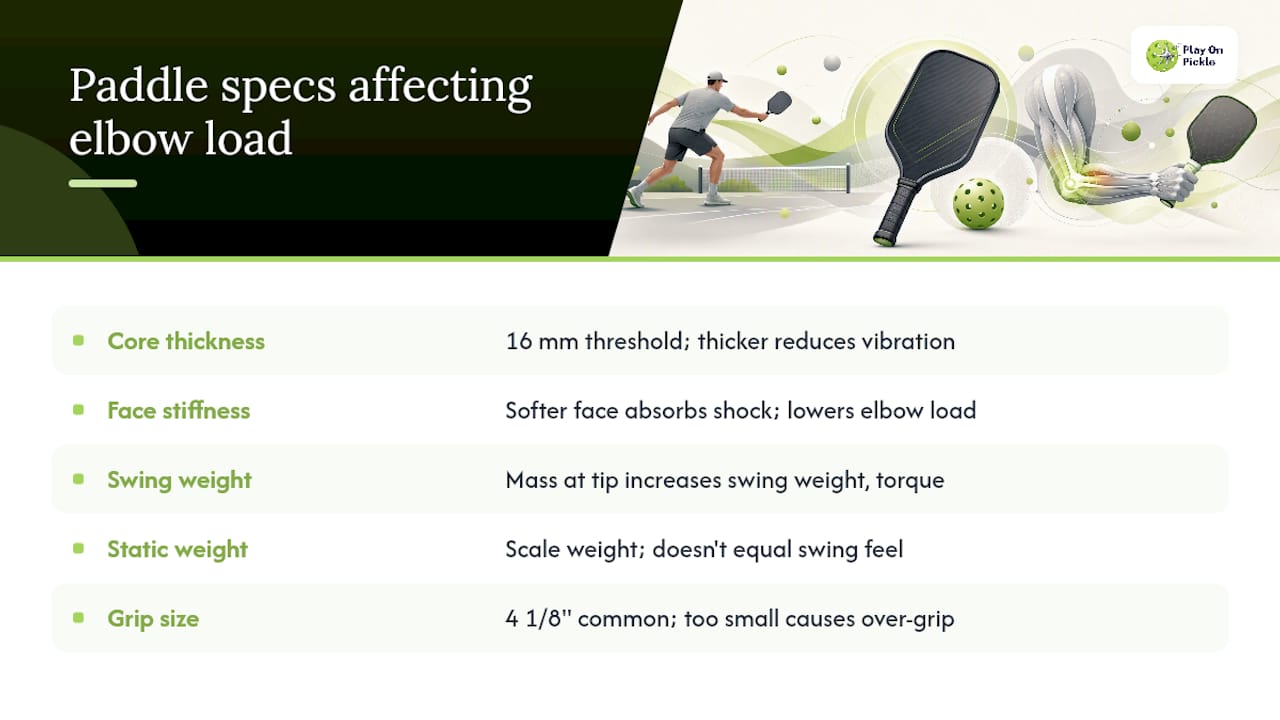
Face stiffness matters almost as much. A softer, more flexible face absorbs shock the way a running shoe's midsole absorbs impact. A rock-hard carbon fiber face might give you more pop, but that pop has to go somewhere, and it usually ends up in your elbow.
Static weight and swing weight are related but not identical, and this is where most buyers get confused.
Static weight is just the number on the scale. Swing weight measures how heavy the paddle feels when you actually move it through a swing, which depends on where the mass sits. Two paddles can both weigh 7.8 ounces and feel completely different on a full drive because one has weight concentrated near the handle (lower swing weight, easier on the arm) and the other has it out toward the tip (higher swing weight, more torque on your wrist with every stroke).
Grip size rounds out the list, and it's the cheapest fix of all. Most paddles ship with a 4 1/8-inch grip, which is undersized for a lot of adult hands. When a grip is too small, you compensate by squeezing harder, and that reflexive over-gripping loads the wrist extensors on every single shot of a two-hour session.
Paddle-by-Paddle Breakdown: What Helps and What to Watch For
Here's how the paddles most commonly recommended for tennis elbow actually stack up, spec by spec, with the tradeoffs nobody puts in the marketing copy.
Engage Pursuit Pro1 and the Pursuit series
Engage built the Pursuit line around a shape and weight distribution meant to feel stable without feeling punishing on mishits. Most Pursuit models land in the mid 7-ounce to low 8-ounce range with a textured face designed for spin rather than raw pace.
- Who it suits: Control-oriented players and anyone transitioning off a heavier power paddle after an elbow flare-up.
- Key specs: Roughly 7.6 to 7.9 oz, 4 1/8-inch stock grip (plan to build it up), core in the 14mm to 16mm range depending on version.
- Why it helps: Lower swing weight relative to power paddles means less torque on the wrist during full swings, and the softer face reduces the "sting" on off-center contact.
- Watch for: The stock grip runs small. Add an overgrip or heat-shrink sleeve immediately if you have any elbow history.
- Demo cue: Hit ten soft drives and pay attention to whether your forearm feels a sharp jolt or a muted thud on contact.
ProKennex Black Ace and the Kinetic Technology line
ProKennex has spent years marketing directly to arm-injury sufferers, and the Kinetic Technology system, essentially a small internal chamber designed to dampen shock, is the reason. This isn't a gimmick layered on top of a standard paddle. It's the core design premise.
- Who it suits: Players with a documented history of tennis elbow or golfer's elbow who want the widest margin of safety.
- Key specs: Typically midweight in an appropriate range, grip sizes from 4 1/8 to 4 1/2 inches depending on model, dampening chamber built into the paddle body.
- Why it helps: The internal kinetic system is engineered specifically to absorb vibration before it reaches your hand, which is a more targeted solution than simply adding a thicker core.
- Watch for: Some players find the feel "dead" compared to stiffer, more responsive paddles. That trade-off is the entire point.
- Demo cue: Hit a few hard resets and notice whether the paddle feels like it's fighting the shock or passing it straight through to your hand.
Vatic Pro PRISM Flash
The PRISM Flash uses foam injected into the paddle's edge wall, a design choice aimed squarely at reducing the shock spike you feel on shanked or off-center hits, which are often the shots that aggravate an already inflamed tendon.
- Who it suits: Players who mishit occasionally under pressure (which is most of us) and want a forgiving margin built into the frame itself.
- Key specs: Around 7.7 to 8.1 oz, 4 1/4-inch grip, 16mm core in most current versions.
- Why it helps: The foam edge absorbs energy on mishits specifically, which matters because off-center contact is where tendon load spikes hardest.
- Watch for: Slightly less pop on clean center-face hits compared to stiffer competitive paddles, a fair trade for the forgiveness.
- Demo cue: Deliberately hit a few shots off-center and compare the shock to your current paddle.
Selkirk Luxx and Amped Luxx thicker-core models
Selkirk's thicker-core line pairs a 16mm core with a flexible face layup, and the company explicitly markets grip-size correction as part of its tennis elbow prevention guidance.
- Who it suits: Players who want a premium, elongated shape with extra stability on returns and drives.
- Key specs: 7.9 to 8.3 oz, 4 1/2-inch grip with a slight taper, 16mm core standard across the line.
- Why it helps: The elongated shape and thicker core combine to reduce twist on off-center contact, which lowers the wrist torque that aggravates a healing tendon.
- Watch for: The higher static weight and larger grip won't suit smaller hands or players who prioritize maneuverability at the net.
- Demo cue: Focus on volleys and quick exchanges; notice whether the extra stability translates to less wrist correction on reflex shots.
JOOLA Agassi Pro
JOOLA's Agassi Pro line targets players who want a blend of control and comfort without sacrificing the pop needed for competitive rallies, built around a moderate core thickness and a face designed to flex slightly on contact.
- Who it suits: Intermediate to advanced players managing mild symptoms who aren't ready to give up power entirely.
- Key specs: Roughly 7.8 to 8.0 oz, 4 1/4-inch grip, core thickness in the 14mm to 16mm range depending on the specific model.
- Why it helps: The moderate flex in the face takes some edge off vibration without pushing swing weight so low that players feel like they've lost their drive.
- Watch for: Not as forgiving as a dedicated 16mm control paddle if your symptoms are currently active rather than resolved.
- Demo cue: Run a mix of drives and dinks in the same session and see if the paddle feels consistent across both shot types.
Across every model here, the tuning fix is the same: adding lead tape at the 3 and 9 o'clock positions raises twist weight and stability, which reduces the wrist torque you feel on off-center hits without changing the paddle's overall feel dramatically.
How Do You Choose and Test a Paddle for Tennis Elbow?
Buying the "right" paddle on paper doesn't guarantee it'll feel right in your hand, which is why a structured demo matters more than a spec sheet.
Work through your changes in this order, cheapest and least disruptive first:
- Grip size. Wrap an overgrip around your current paddle before you do anything else. This single change often reduces reflexive over-gripping more than any other single fix.
- Counterforce strap. A basic tennis elbow brace worn just below the elbow can reduce tendon strain during play while you sort out longer-term equipment or rehab changes.
- Lead tape placement. Add small strips at 3 and 9 o'clock to raise twist weight and cut down on wrist correction from mishits.
- Core swap. If you're still on a 13mm or 14mm paddle and symptoms persist, move to a 16mm core, which is the recommended standard for players managing active symptoms.
On the court, run three specific drills and pay attention to what your forearm tells you, not what the marketing sticker says.
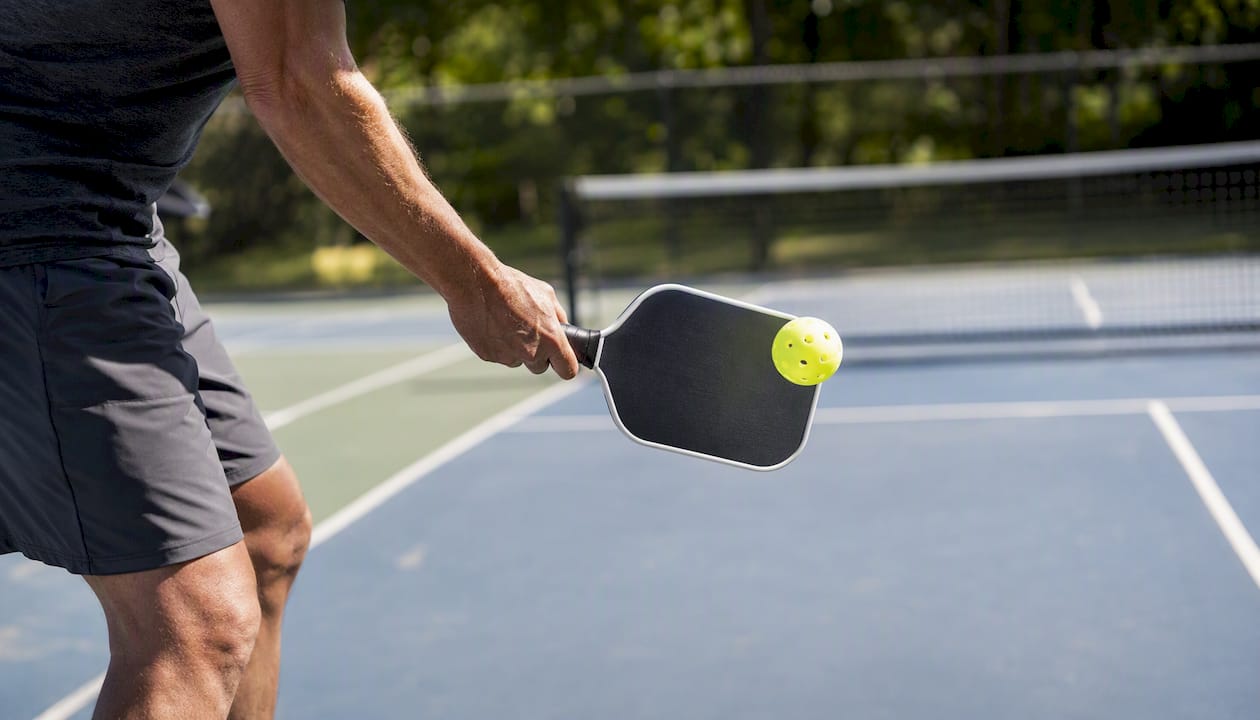
Start with dinks. Twenty soft dinks should feel like almost nothing hits your arm at all. If you feel a sharp jolt on contact, the paddle's face is too stiff for where you're at right now. Move to soft drives next. These generate more force than dinks but should still feel absorbed rather than transmitted. A paddle that turns a soft drive into a wrist-jarring event is not the paddle for an elbow in recovery. Finish with volleys at the net, since reflex shots expose whether the paddle's stability (driven by twist weight, not just static weight) is doing its job when you don't have time to set up properly.
Pro Tip: Marketing terms like "arm-friendly" and "comfort tech" mean almost nothing on their own. What actually predicts elbow-friendliness on court is how much wrist shock you feel on a mishit dink and how much forearm activation you notice on a soft drive. Trust your arm over the label.
Understanding swing weight versus static weight is worth a minute of your time, because it's the single most misunderstood spec in paddle shopping. Picture two identical-looking paddles on a kitchen scale reading the exact same number. Now picture swinging both through a full drive. If one has extra material near the tip (for a "power" feel) and the other concentrates weight near the handle, the tip-heavy paddle will feel noticeably heavier through the swing even though the scale says they're equal. That extra effort at the end of the swing translates directly into more torque on your wrist and forearm, shot after shot, game after game.
Why Your Paddle Is Only Part of Fixing Tennis Elbow
Equipment matters, but it's not the whole story. Coaches and physical therapists commonly describe equipment changes as roughly one-third of what actually resolves a tennis elbow problem, with the remaining two-thirds coming from correcting movement patterns and following a progressive loading program. Swap paddles all you want. If your swing mechanics keep loading the same tendon the same way, you'll be back where you started within a few weeks.
Lateral epicondylitis, the clinical name for tennis elbow, is an overuse injury of the wrist-extensor tendons at the point where they attach to the bony bump on the outside of your elbow. Repetitive micro-loading from thousands of small impacts, not one dramatic injury, is what causes the tissue to break down over time.
Higher play volume, skipped warmups, and arm-only swing mechanics are common drivers behind the rise in cases among recreational players, which is worth sitting with if you've picked up pickleball as a second sport after years away from racket sports. Your body hasn't built up the tendon resilience that a lifelong tennis or racquetball player has, and jumping straight into three-hour open-play sessions is asking for trouble.
A staged, evidence-backed rehab pathway looks like this: start with isometric holds, progress to eccentric loading using a tool like the FlexBar Tyler Twist, move into heavy slow resistance work, and finish with a sport-specific ramp back into full play over roughly six to twelve weeks. That FlexBar exercise, incidentally, is one of the most widely replicated eccentric-loading protocols in upper-extremity rehab research, which is why you'll see it recommended across nearly every serious tennis elbow program.
Recovery timelines vary by severity, and pretending otherwise sets you up for frustration:
- Mild cases: Typically 6 to 8 weeks with consistent rest, bracing, and eccentric loading.
- Moderate cases: Often 3 to 6 months, especially if symptoms have been present for a while before treatment starts.
- Chronic cases: Can run 6 to 12 months or longer, and usually require a physical therapist's guidance rather than a self-directed program.
If pain persists past two to three weeks despite rest and equipment changes, or if you notice weakness in your grip alongside the pain, that's the signal to stop guessing and see a physical therapist. A simple starting exercise you can try today: hold a light dumbbell (2 to 3 pounds) with your palm down, slowly lower it with control over three to five seconds, then use your other hand to lift it back up. Ten reps, twice a day, is a reasonable starting point before you escalate to anything more structured. For a deeper dive into how recurring elbow pain shows up in pickleball specifically, Playonpickle's breakdown of pickle elbow covers training habits and workload management that pair well with the equipment fixes above.
How the Paddle Shortlist Was Chosen
Every paddle recommendation here was filtered through the same set of criteria, not vibes or brand loyalty.
- Core thickness: Priority given to 16mm cores, since thinner options transmit measurably more vibration to symptomatic players.
- Face stiffness: Softer, more flexible faces ranked above stiffer carbon layups for arm comfort, even when the stiffer option offered more raw power.
- Swing and twist weight: Paddles with lower swing weight and higher twist weight (more stability on mishits) were favored over pure power-oriented designs.
- Grip size and adjustability: Preference given to paddles where a grip build-up (overgrip or heat-shrink) was a realistic, low-cost fix rather than a dealbreaker.
- Player feedback: Real-world reports from recreational and competitive players managing elbow symptoms factored into which models made the list.
Some specifics here come straight from manufacturer spec sheets (core thickness, stated static weight, grip circumference as shipped). Others, particularly swing weight and twist weight, aren't always published by every brand, so those categories lean on player-reported feel and independent measurements where available rather than a single hard number. If a brand doesn't publish swing weight, treat that as a reason to demo in person rather than buy on spec alone.
Which Paddle Should You Actually Pick?
Match your choice to where you are right now, not where you hope to be in six weeks.
- Mild or early symptoms: Start with a 16mm core paddle in the control-oriented category, add an overgrip immediately, and layer in eccentric wrist exercises twice a week even if the pain feels manageable.
- Active symptoms right now: Prioritize a ProKennex Kinetic model or similar dampening-focused paddle, wear a counterforce brace during play, and pause high-volume sessions until pain drops below a 3 out of 10 during activity.
- Long-term prevention after recovery: A Selkirk thicker-core model or Vatic Pro PRISM Flash gives you stability and vibration control without locking you into a purely defensive playstyle, paired with ongoing eccentric maintenance work.
Whichever path fits, the next move is simple: book a demo session at a local shop or borrow paddles from playing partners before you buy, and pair that demo with the grip and lead-tape tuning covered above.
A Smarter Way to Fix the Root Cause, Not Just the Symptom
A new paddle can quiet the pain. It rarely explains why the pain showed up in the first place. That's the gap Playonpickle was built to close, and it's a different kind of tool than anything in a pro shop.
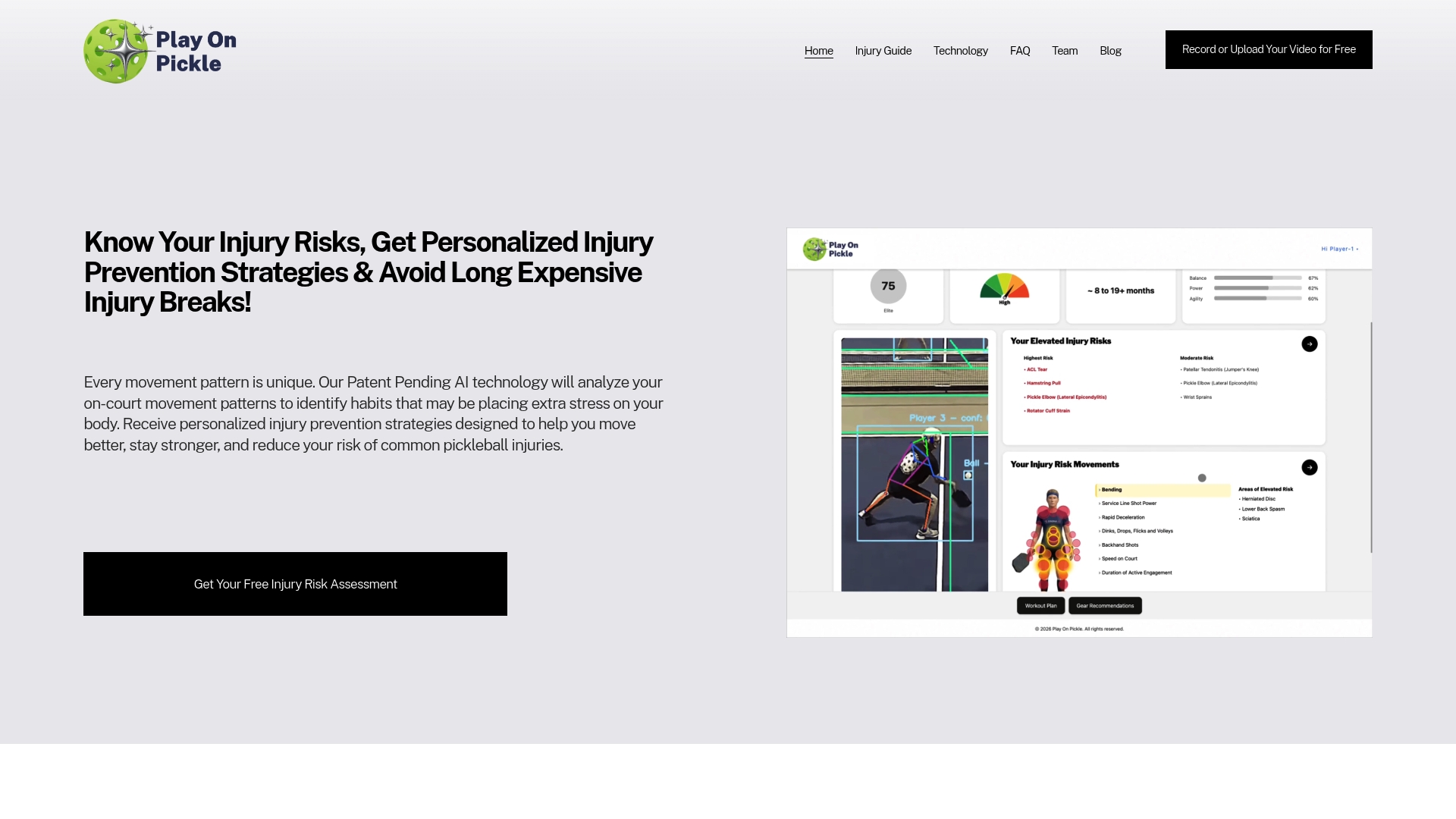
Playonpickle uses AI-driven movement analysis, built on patented computer vision technology, to review video of your actual swing and identify the specific biomechanical stress points loading your elbow shot after shot. Instead of guessing whether your pain comes from grip size, swing weight, or a kinetic-chain issue in your shoulder or hip rotation, you get a personalized breakdown of where the strain is really coming from, along with targeted exercises and equipment recommendations tailored to your own mechanics. It's the two-thirds of the recovery equation, movement and technique, that no paddle spec sheet can address on its own.
If you've already tuned your paddle and added the overgrip and lead tape but the pain keeps creeping back, that's usually a sign the root cause is upstream of your equipment. Start a free trial at Playonpickle and upload a video of your swing to see exactly where your mechanics are putting your elbow at risk.
Equipment Fixes Half the Problem: A Coach's View
Most of the recovery success stories I've come across share one pattern: the player fixed their paddle and fixed their swing at roughly the same time. Neither change alone gets full credit, and treating them as separate problems is where a lot of players get stuck cycling through paddle after paddle without real relief.
Here's a test I'd recommend before you spend money on a new paddle: measure your hand from the tip of your ring finger to the second-longest crease in your palm. That number in inches is roughly your ideal grip circumference. If your current paddle's grip is noticeably smaller than that measurement, build it up before you do anything else. It's the cheapest fix on this entire list and the one players skip most often because it feels too simple to matter.
On lead tape, my preference leans toward placing a slightly larger strip at 9 o'clock than at 3 o'clock for right-handed players, since the extra stability on the backhand side tends to matter more for recreational players whose backhand mechanics are shakier than their forehand. It's a small asymmetry, but it's made a noticeable difference for players I've worked with.
If you've tuned the paddle, built up the grip, and started eccentric work but the pain hasn't budged after three or four weeks, stop self-managing and get a physical therapist's assessment. Persistent pain past that window is a signal, not a nuisance to push through.
Key Takeaways for Managing Pickleball Elbow
A 16mm core paddle with a soft face, added overgrip, and lead tape at 3 and 9 o'clock cuts elbow load faster and cheaper than any other single equipment change available today.
| Point | Details |
|---|---|
| Prioritize core thickness | Choose a 16mm core over thinner 13mm or 14mm options if symptoms are active. |
| Fix grip size first | Add an overgrip or heat-shrink sleeve before considering a new paddle purchase. |
| Tune before you buy | Add lead tape at 3 and 9 o'clock to raise twist weight and reduce wrist torque on mishits. |
| Start eccentric loading | Begin twice-weekly wrist-extensor exercises like the FlexBar Tyler Twist alongside any equipment change. |
| Know when to escalate | See a physical therapist if pain persists past two to three weeks despite rest and tuning. |
| Address the root cause | Playonpickle's AI movement analysis identifies the swing mechanics driving elbow load, complementing paddle changes with personalized exercise recommendations. |
Sources
For readers who want to verify the clinical guidance or dig deeper into rehab protocols before making changes, these sources cover the ground this article draws from.
- Tennis elbow - Symptoms and causes | Mayo Clinic
- Pickleball Elbow: The Paddle Specs That Cause It and the Specs That Prevent It | DinkFlow
- The 8-week pickleball tennis elbow comeback program | My Pickleball Connect
If a paddle's swing weight isn't published anywhere, don't guess. Demo it in person and trust what your forearm tells you over what the box says.
This article is general information, not a substitute for advice from a qualified doctor. Consult a qualified healthcare professional about your own circumstances before acting on anything here.
Recommended
- Pickle Elbow, FOOSH… — Play On Pickle - Smart Pickleball Fitness
- Pickleball 101: Understanding the Game, Rules, and Essential Fitness and Gear — Play On Pickle - Smart Pickleball Fitness
- Blog | Improve Your Game Now — Play On Pickle - Smart Pickleball Fitness
- Celebrate National Pickleball Day: Play Harder, Move Smarter, and Stay Injury-Free — Play On Pickle - Smart Pickleball Fitness