
The most effective pickleball training plan is a phase-based, 90-day roadmap that pairs structured drilling with intentional match play, three weekly strength sessions, and regular benchmark checks. It breaks into four stages: Foundation (Weeks 1 to 3), Skill Stacking (Weeks 4 to 7), Competitive Integration (Weeks 8 to 11), and Tournament Prep (Week 12). Every phase rests on four pillars:
- Structured, progressive drills targeting one skill cluster at a time
- Match play used deliberately, not as a substitute for practice
- Strength and conditioning built around rotation and lateral movement
- Metrics that tell you when you're actually ready to move forward
Key Takeaways
A phase-based 90-day plan that combines progressive drills, deliberate match play, three weekly strength sessions, and tracked benchmarks produces faster, more durable improvement than unstructured court time.
| Point | Details |
|---|---|
| Follow four phases | Foundation, Skill Stacking, Competitive Integration, and Tournament Prep each run 3 to 4 weeks. |
| Balance drills and matches | Use roughly a 60/40 drill-to-play ratio for intermediate players, adjusting by level. |
| Train strength 3x weekly | Focus sessions on rotation, lateral movement, and unilateral leg work. |
| Track real benchmarks | Advance phases only after hitting serve, dink, and drop targets twice in a row. |
| Screen your movement | Playonpickle's AI video analysis flags stress points and adds injury-prevention checks at key points in the 90-day cycle. |
Table of Contents
- Why Most Players Stop Improving
- Core Components Every Pickleball Training Plan Needs
- Phase 1: The Foundation (Weeks 1 to 3)
- Phase 2: Skill Stacking (Weeks 4 to 7)
- Phase 3: Competitive Integration (Weeks 8 to 11)
- Phase 4: Tournament Preparation (Week 12)
- How Often Should You Drill vs. Play Matches?
- Strength and Conditioning: A 3-Day Pickleball Workout
- Warm-Ups That Actually Prevent Injury
- What to Track and When to Advance Phases
- Using Video and AI to Speed Up Progress
- How Playonpickle Fits Into Your 90-Day Plan
- Frequently Asked Questions
- Sources
Why Most Players Stop Improving
Recreational players plateau because they mistake playing for training. Three or four casual matches a week feels productive, but it mostly reinforces whatever habits you already have, good or bad. Common traps include:
- Skipping progressive overload and repeating the same drills at the same intensity for months
- Ignoring strength and mobility work entirely until something hurts
- Never measuring anything, so "getting better" is a feeling instead of a fact
A player who dinks the same 50 balls every week without tracking accuracy will still be missing the same shots in six months. Unstructured play grooves whatever pattern is already there.
Pro Tip: End each session with a two-minute note: one shot that felt confident, one that broke down under pressure. That single habit turns vague progress into a trackable pattern within a month.
Core Components Every Pickleball Training Plan Needs
Any plan worth following contains the same building blocks, whether you're rated 3.0 or chasing tournament points. Skip one and progress stalls.
- Phased technical drills that get harder on a schedule, not randomly
- Match play used to test what you drilled, not to avoid drilling
- Strength and conditioning focused on rotation and single-leg stability
- Mobility and recovery built into the week, not bolted on after an injury
- A simple tracking method for percentages, rally length, and consistency
A typical intermediate week splits time using roughly a 60/40 drill-to-live-play ratio, based on structured 4-week programs built around that exact ratio. A sample week: two solo/partner drill sessions, one pattern-based practice, one live match session, one strength day, and one full rest day.
Phase 1: The Foundation (Weeks 1 to 3)
This phase is about ball control and clean mechanics, not winning points. USA Pickleball's phased training model recommends beginners focus on serve mechanics, dinking consistency, and court positioning before adding complexity.
- Serve and return placement drills, targeting corners rather than just getting the ball in
- Dink blocks: sustained cross-court and straight-ahead exchanges
- Self-feed third-shot drop practice against a wall or with a partner feeding balls
Benchmark to advance: hit a solid serve-in rate and sustain dink rallies of moderate length before moving to Phase 2.
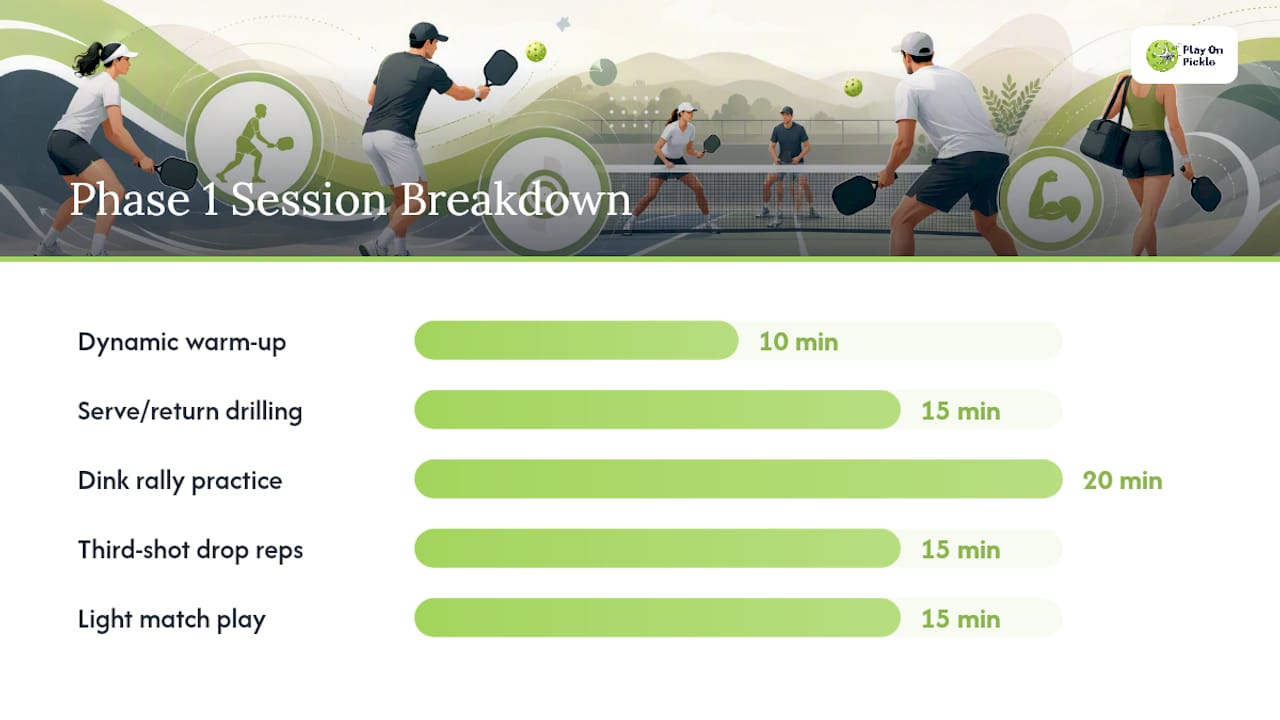
| Session Component | Minutes |
|---|---|
| Dynamic warm-up | 10 |
| Serve/return drilling | 15 |
| Dink rally practice | 20 |
| Third-shot drop reps | 15 |
| Light match play | 15 |
Phase 2: Skill Stacking (Weeks 4 to 7)
This is where isolated skills start combining into real decisions. Drills should progress weekly: isolation drills first, then patterns, then random feeds, then constrained live points.
- Week 4: isolate transition-zone footwork with controlled feeds
- Week 5: add third-shot drop into a two-shot pattern (drop, then reset)
- Week 6: introduce random feeds that force split-second shot selection
- Week 7: play constrained points (start every rally at the kitchen line)
A 45 to 75 minute session in this phase typically runs 20 minutes of pattern drilling, 20 minutes of live-constraint points, and 15 to 35 minutes of transition-zone footwork depending on available court time.
Pro Tip: Pick one weak shot, often the backhand reset or the third-shot drop, and track its success rate for a full 30-day cycle before switching focus. Chasing five fixes at once fixes none of them.
Phase 3: Competitive Integration (Weeks 8 to 11)
By now, skills need to survive pressure. Run simulated points that mimic real scoring conditions instead of drilling in a vacuum.
- Play to 7 or 11 starting from specific positions (both at the net, both at the baseline)
- Score bonus points for executing the targeted shot correctly, even in a loss
- Rotate partners weekly so patterns don't become predictable
- Schedule strength sessions on non-consecutive days from high-intensity match simulation to avoid compounding fatigue
- Use a pre-point breathing routine (four counts in, four counts out) to reset focus between rallies
- Visualize the next two shots before serving, a habit borrowed from competitive routines that reduces decision lag under pressure
Phase 4: Tournament Preparation (Week 12)
This week is about arriving fresh, not squeezing in more reps. Volume drops while sharpness stays high.
- Days 1 to 3: short, high-quality sessions (30 to 40 minutes), full intensity, low volume
- Days 4 to 5: light hitting only, focus on serve rhythm and reset shots
- Day before: rest completely, prioritize sleep and hydration over any extra practice
- Pack gear and check paddle grip the night before, not the morning of
- Review any known tendencies of likely opponents
- Run your full warm-up routine before the first match, not a shortened version
Avoid adding new drills or intensity spikes this week. Overreaching in the final days is the fastest way to show up flat.
How Often Should You Drill vs. Play Matches?
The right split depends on your commitment level, and getting it wrong in either direction stalls progress.
| Level | Weekly Sessions | Typical Split |
|---|---|---|
| Beginner | 3x per week | 60% drilling, 40% match play |
| Intermediate | 3 to 4x per week | 60% drilling, 40% match play |
| Competitive | 4 to 6x per week | 50% drilling, 50% match simulation |
A 30-day structured cycle built around four drill sessions plus one or two match sessions, roughly 4 to 6 hours of court time weekly, tends to produce measurable gains faster than open play alone, with three cycles commonly needed to move up a full rating level.
- Give each practice day a single focus: don't drill dinks and serves and drops in the same 60-minute block
- Place strength sessions on days without high-intensity court work when possible
- Keep at least one full rest day weekly, regardless of level
Strength and Conditioning: A 3-Day Pickleball Workout
Pickleball demands quick lateral cuts, rotational power, and single-leg stability, not just general fitness. Performance-focused coverage points to rotation, lateral movement, unilateral training, and explosivity as the core levers for both power and injury reduction.
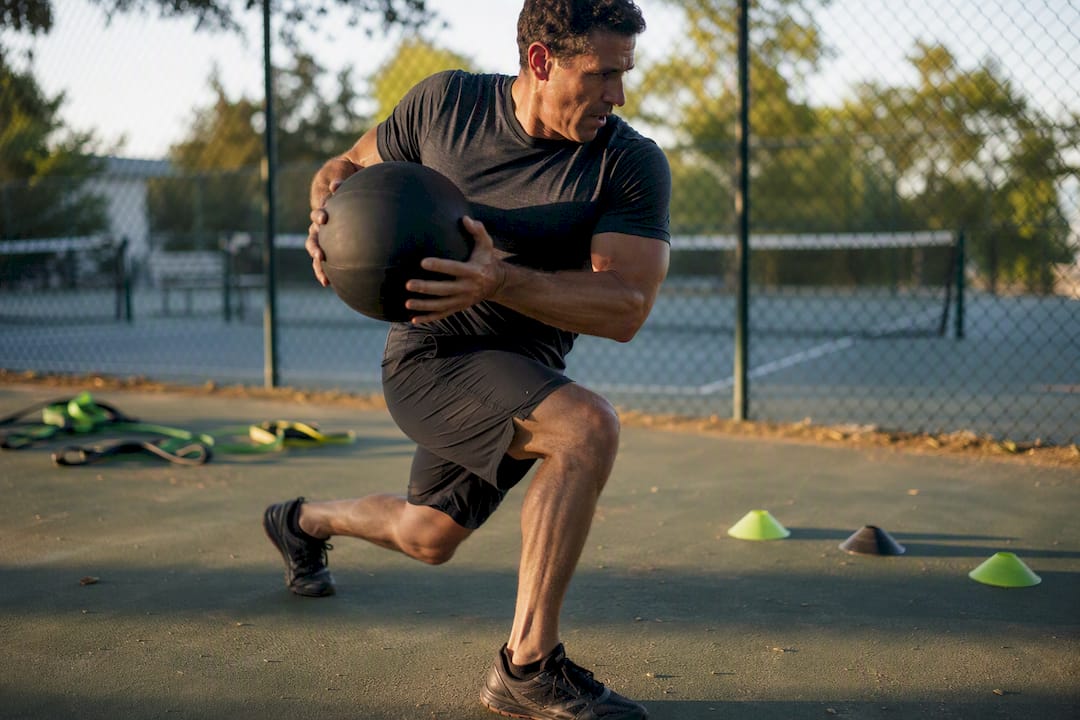
Day 1 (Rotation and Power): medicine ball rotational throws (3x10), cable woodchops (3x12), split squats (3x8 per leg)
Day 2 (Lateral and Reactive): lateral bounds (3x8 per side), banded side steps (3x15), reactive shuffle drills (4x20 seconds)
Day 3 (Unilateral Strength): single-leg deadlifts (3x8 per leg), step-ups (3x10 per leg), core anti-rotation holds (3x30 seconds)
- Build in progressive overload every two weeks, adding reps or resistance, not both at once
- Prioritize recovery days between sessions rather than stacking them back to back
- Rotate in unilateral work year-round, not just during injury rehab
Pro Tip: Players over 40 or returning from injury should cut volume by roughly a third and add an extra recovery day between strength sessions rather than skipping strength work altogether.
Warm-Ups That Actually Prevent Injury
A rushed warm-up is one of the fastest routes to a strained calf or a sore shoulder. Every session, on court or in the gym, should start with the same 10 to 12 minute sequence.
- Light cardio to raise heart rate (2 minutes)
- Dynamic leg swings and lunges (3 minutes)
- Shoulder and scapular activation with resistance bands (3 minutes)
- Hip mobility drills, including 90/90 stretches (2 minutes)
- Short reactive footwork bursts to prime the nervous system (2 minutes)
Overuse injuries, particularly in the shoulder and elbow, are a well-documented risk in racket sports when conditioning and recovery aren't built into training volume. This mobility restoration checklist offers a useful framework for structuring that recovery work. Watch for early warning signs like pickle elbow, a repetitive-strain issue that shows up quietly before it sidelines a season.
What to Track and When to Advance Phases
Progress should be measured, not guessed at. Without numbers, it's easy to feel stuck even when you're actually improving.
- Serve-in percentage (target: 80%+ by end of Phase 2)
- Third-shot drop success rate (target: 60%+ by end of Phase 2)
- Average dink rally length (target: 15+ shots by end of Phase 1)
- Successful transition-zone arrivals per game (target: consistent by Phase 3)
| Date | Session Type | Key Metric | Notes |
|---|---|---|---|
| Week 3 | Dink drill | Rally length | Confident |
| Week 6 | Pattern drill | Drop success % | Shaky |
| Weeks 8 to 11 | Match sim | Transition arrivals | Confident |
Advance to the next phase only after hitting your target benchmarks in two consecutive weekly checks, not just once.
Using Video and AI to Speed Up Progress
A player who keeps sailing third-shot drops long often can't see the problem themselves. Recording a short clip and reviewing paddle angle and footstep timing usually reveals it in seconds.
- Record 10 to 15 second clips of serves, drops, and transition footwork weekly
- Watch for repeated stress points: overreaching on backhands, poor knee tracking on lateral cuts
- Adjust the following week's drill focus based on what the footage actually shows, not what it felt like in the moment
AI-driven video analysis extends this further by flagging biomechanical stress points a training partner would likely miss.
A repeated shoulder strain pattern on the serve often shows up in movement footage long before it becomes a noticeable injury. Catching it early is what separates players who train through their 90 days and those who get sidelined at week six.
Pro Tip: Run a movement screening at the start of your 90-day plan, then check again mid-cycle and before any tournament. Tools like Playonpickle build this kind of screening directly into a training schedule instead of treating it as a separate task.
What Actually Produces Steady Improvement
Structured 30-day cycles produce visible gains when players stick with a single focus instead of chasing every new drill they see online. The biggest trap isn't laziness. It's overtraining without a plan, mistaking soreness for progress, and quitting a cycle in week two because results feel slow.
How Playonpickle Fits Into Your 90-Day Plan
A structured plan tells you what to drill. It doesn't tell you why your shoulder aches after Phase 2 or which movement pattern is quietly setting you up for an overuse injury. That's the gap Playonpickle closes.
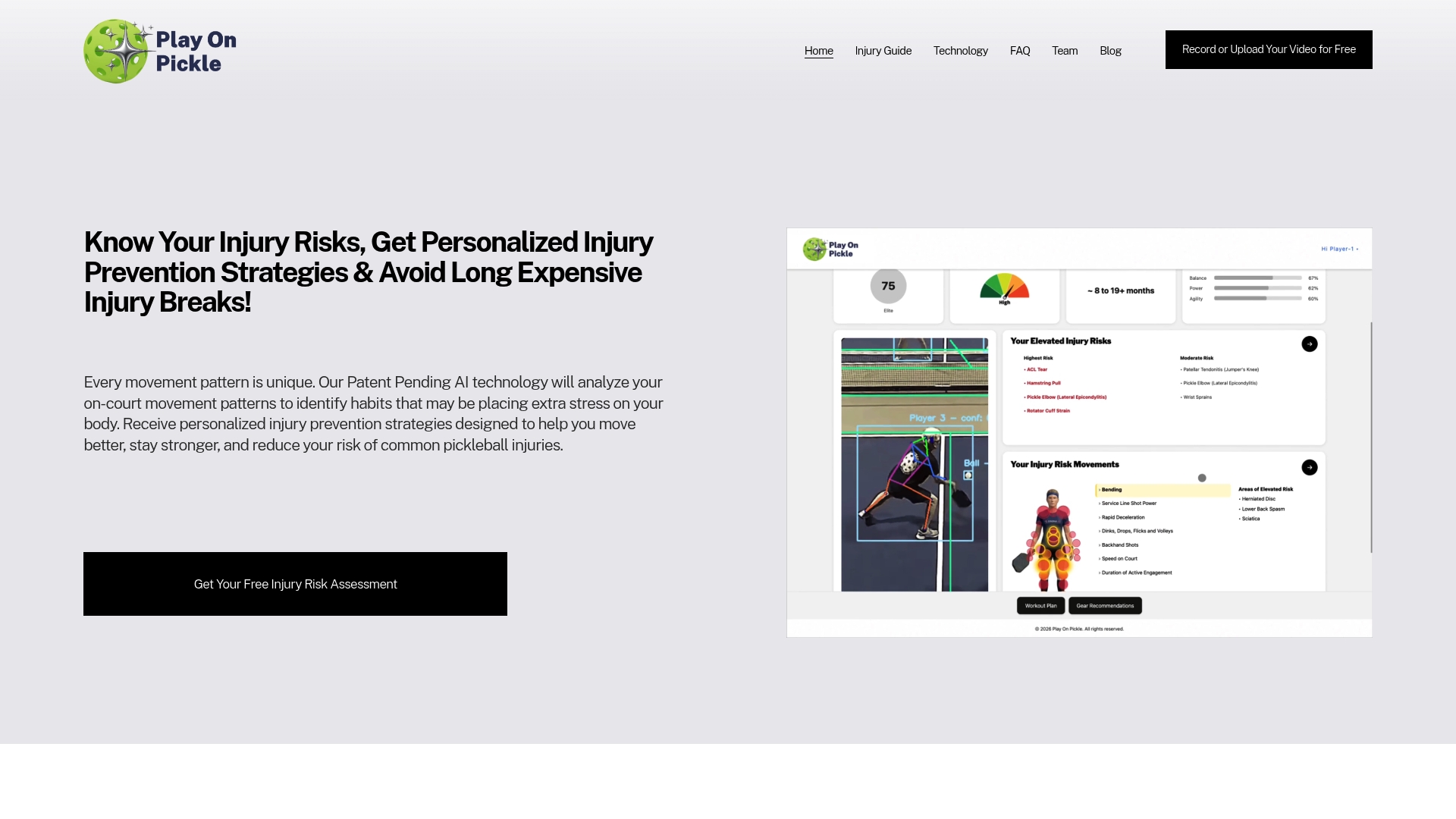
Playonpickle uses patented computer vision to analyze uploaded video of your play, flag biomechanical stress points, and generate a personalized set of injury-prevention exercises based on your actual movement, not a generic checklist. It fits naturally into the phase structure above: a baseline screening before Phase 1, a mid-cycle check around Week 6 to catch compensation patterns before they become injuries, and a pre-tournament readiness check in Week 12. Recreational players who skip physical screening are often the ones sidelined mid-season. Start a trial at Playonpickle and add a movement screening to your next training cycle.
Frequently Asked Questions
How long should a pickleball training plan last? A 90-day plan, broken into four phases of roughly three weeks each, gives enough time to build skills progressively and see measurable rating improvement.
How many days a week should I train for pickleball? Beginners do well with three sessions weekly, intermediates with three to four, and competitive players with four to six, mixing drilling and match play.
Do I need strength training for pickleball, or just court time? Court time alone doesn't build the rotational power or lateral stability pickleball demands. A 3x/week strength routine focused on rotation and single-leg work meaningfully reduces injury risk.
What's a good drill-to-match-play ratio?
How do I know when to move to the next training phase? Advance only after hitting your target benchmarks, like serve-in percentage or dink rally length, in two consecutive weekly checks rather than a single good session.
Sources
- USA Pickleball
- Pickleball Training: The 30-Day Plan to Move Up a Rating Level | Pickleball Playbook
- Pickleball Training Program for Intermediate Players: 4-Week Plan
- Men's Health: The Ultimate Pickleball Workout Plan (coverage)
- PubMed entry (sports/rehab research)
Recommended
- Blog | Improve Your Game Now — Play On Pickle - Smart Pickleball Fitness
- Celebrate National Pickleball Day: Play Harder, Move Smarter, and Stay Injury-Free — Play On Pickle - Smart Pickleball Fitness
- The Dink Movie — Play On Pickle - Smart Pickleball Fitness
- Pickleball 101: Understanding the Game, Rules, and Essential Fitness and Gear — Play On Pickle - Smart Pickleball Fitness