
Markerless, AI-driven pickleball video analysis is a practical, evidence-backed way to spot movement risk before it turns into an injury. It works by measuring joint angles, load asymmetries, and fatigue patterns from ordinary smartphone footage, then converting those numbers into a prevention plan.
- Roughly half of pickleball players report non-time-loss overuse injuries, and about two in five report time-loss injuries serious enough to sideline them, with adults 50 and older accounting for the large majority of cases.
- Predictive biomechanical models built on movement data have reached 79.5% to 96% accuracy identifying musculoskeletal risk factors in targeted studies.
- Play On Pickle packages this into a usable tool: markerless computer vision reads your movement from one video, flags stress points, and builds a personalized exercise plan around them.
Key Takeaways
Markerless AI video analysis turns a smartphone clip into joint-level risk data, and pairing that data with targeted prehab exercises is the most direct way to reduce pickleball overuse injuries.
| Point | Details |
|---|---|
| Injury rates justify screening | About half of players report overuse injuries and 90%+ of cases hit adults 50 and older. |
| Key metrics to track | Joint angles, angular velocity, and asymmetry indices flag Achilles, elbow, shoulder, and knee risk. |
| Single camera works | Side-on smartphone footage with clean lighting produces usable kinematic data for most shots. |
| Act on reports quickly | Address red flags immediately, then follow a 4 to 8 week prehab progression before re-testing. |
| Where to start | Play On Pickle offers a free trial and monthly subscription for ongoing biomechanical tracking. |
Table of Contents
- What Does Pickleball Video Analysis Actually Measure?
- How Does AI Extract Risk Data From a Single Video?
- What Do You Actually Get in a Report?
- Who Should Actually Use This?
- How Long Does It Take and What Does It Cost?
- Does the Research Actually Back This Up?
- Why Play On Pickle Fits This Approach
- Get Your First Movement Assessment Started
- Frequently Asked Questions
- Sources
What Does Pickleball Video Analysis Actually Measure?
Biomechanical pickleball video analysis is not the same thing as the shot-tracking, stats-and-highlights video review some coaching apps offer. This is movement science: software watches how your joints move during play and flags patterns that predict injury, not patterns that predict points won.
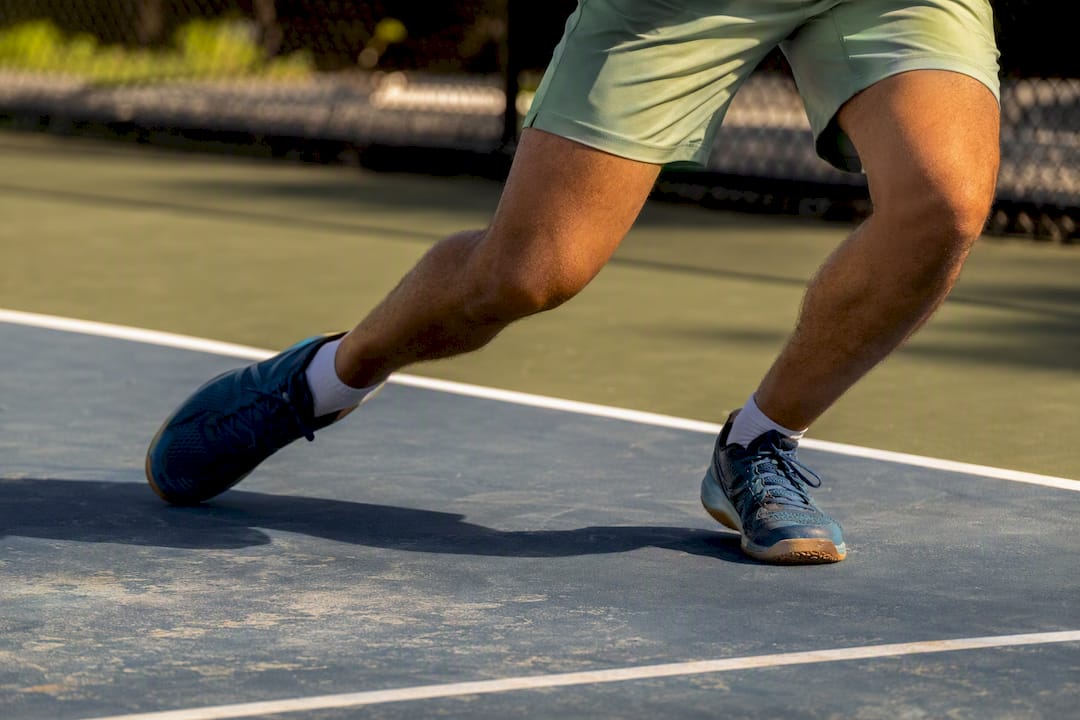
The output centers on a handful of specific metrics. Joint angles matter most, particularly hip and femur angle, knee flexion, and knee valgus (the inward knee collapse that shows up during quick direction changes). Wrist motion and angular velocity get tracked closely too, since pickleball produces significantly higher wrist motion loads in advanced players executing dinks than in beginners. Add asymmetry indices (left leg loading differently than right), fatigue signatures (form breaking down late in a session), and incident flags for high-eccentric-load moments, like a hard deceleration off a lateral lunge.
These metrics map to real injury patterns. Ankle and Achilles stress correlates with rapid direction changes, and one small comparative study found pickleball produced nearly 30 more at-risk ankle movements per session than tennis in the sample studied. Wrist and forearm metrics flag lateral epicondylalgia risk, better known as pickle elbow, a topic Play On Pickle has covered in detail. Shoulder and knee metrics round out the picture for overuse and ACL-adjacent risk.
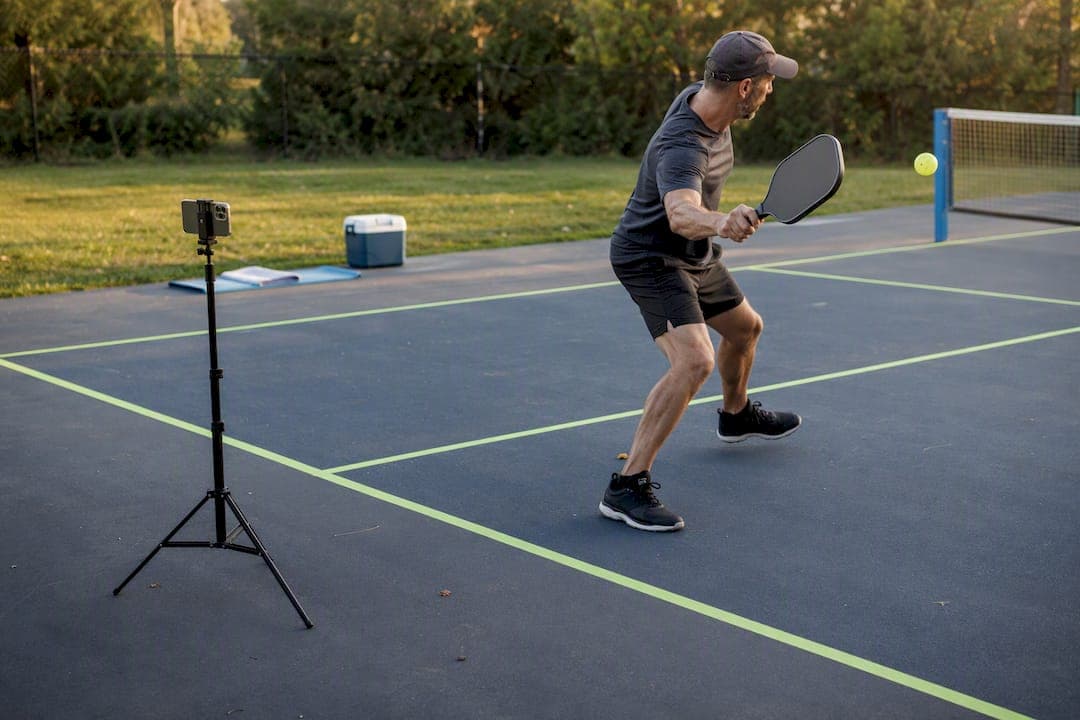
Pro Tip: Shoot from the side at hip height, roughly 8 to 10 feet back, with the camera perpendicular to your direction of movement. Side-on footage gives pose-estimation software a clean sagittal-plane view of hip, knee, and ankle angles, which is where most of the useful data lives.
How Does AI Extract Risk Data From a Single Video?
A single smartphone camera, pointed correctly, can produce clinically useful kinematic data when paired with a validated pose-estimation model and a sport-specific risk framework. This is the entire premise behind markerless analysis, and it is why you don't need a motion-capture lab or reflective markers taped to your knees.
The pipeline runs in five steps:
- Capture: you record 30 to 60 seconds of gameplay or a specific drill (a dink exchange, a lateral lunge, a serve) on a tripod-mounted phone.
- Pose estimation: software identifies keypoints on your body frame by frame, typically using a framework similar to MediaPipe, which one pilot study used to detect significant femur-angle and wrist-motion differences between skill levels with a sample of 14 players.
- Angle and velocity derivation: the system converts raw keypoints into joint angles and angular velocity across the movement sequence.
- Risk scoring: derived metrics get compared against thresholds. An asymmetric load exceeding roughly 10 degrees between left and right sides, or a sudden angular velocity spike during a lunge, typically triggers a flag.
- Incident summarization: the system prioritizes flagged moments into a ranked list, similar to how visual analytics tools reconstruct 3D motion from sports video to highlight time-aligned joint-angle spikes tied to specific injury mechanisms like Achilles stress.
The assumptions matter here. Single-camera systems estimate joint angles primarily in one plane of motion, so they work best on movements that happen mostly side-on to the lens, like a drive or a lunge, rather than movements with heavy rotation toward the camera.
Pro Tip: For dinks and drives, capture at least 8 to 10 repetitions in one clip. A single swing gives the model almost nothing to compare against; a short rally gives it a baseline pattern and lets it flag the rep that deviates from your norm.
What Do You Actually Get in a Report?
A biomechanical analysis report gives you a prioritized incident list, joint-by-joint risk scores, a chart tracking deviation from your own baseline over time, and a set of exercises tied directly to whatever it flagged.
| Report Component | What It Shows | Example Action |
|---|---|---|
| Incident list | Ranked moments where load or angle exceeded a safe threshold | Review the top 3 flagged reps in the video playback |
| Joint risk scores | A score per joint (ankle, knee, hip, wrist, shoulder) relative to baseline | Focus corrective work on the highest-scoring joint first |
| Baseline trend chart | How your metrics shift week to week or session to session | Confirm whether prior corrective work is actually working |
| Exercise prescription | Targeted movements matched to the flagged pattern | Follow a 2 to 3 week microprogram before re-testing |
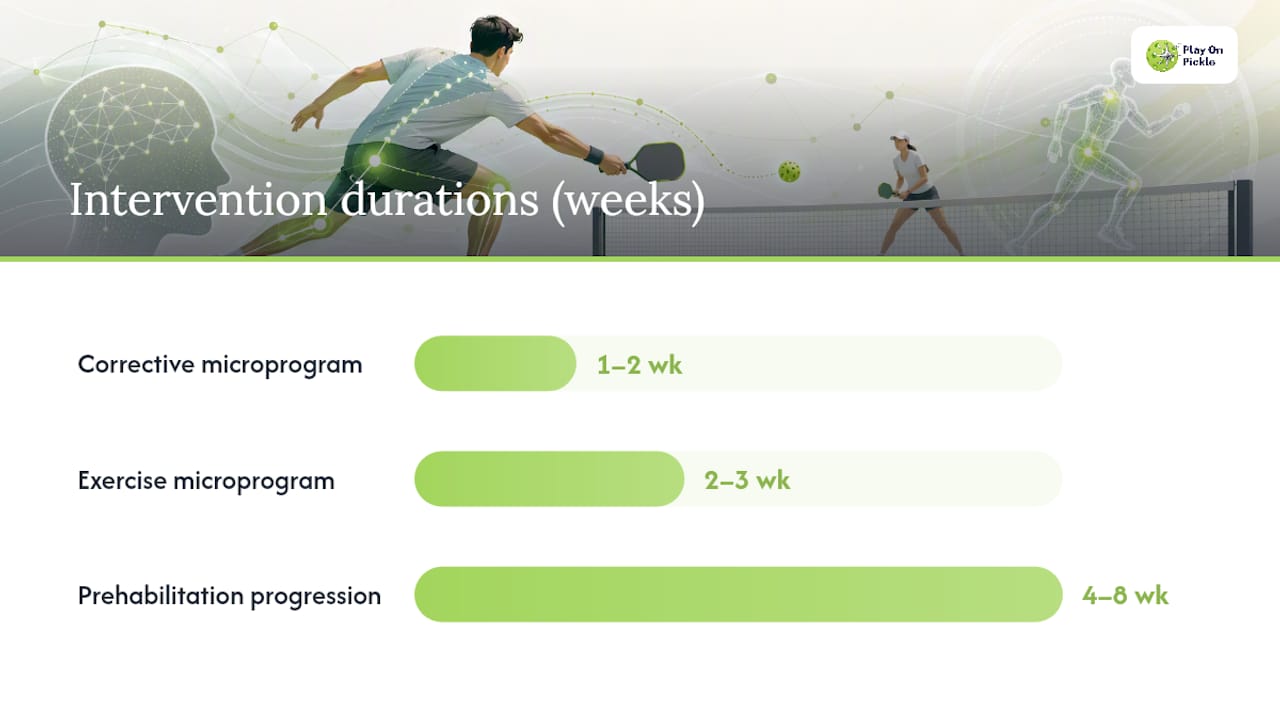
Turning a report into results follows a rough timeline. Immediate red flags (a sharp asymmetry or a repeated high-load event) get addressed first, usually with a one to two week corrective microprogram. From there, a four to eight week prehabilitation progression builds real capacity, followed by a re-assessment to check whether the numbers actually moved.
The exercise matching is specific, not generic. Achilles loading asymmetry typically calls for eccentric calf loading work. Elbow-risk wrist patterns call for eccentric wrist extension and scapular stability drills, an approach grounded in evidence-informed prehabilitation that corrects the underlying asymmetry rather than just treating the pain after it shows up.
Who Should Actually Use This?
Four groups get the most value from biomechanical video review: recreational players over 50 dealing with recurring soreness, competitive players chasing longevity, coaches managing squads, and physical therapists or athletic trainers who want objective numbers instead of a visual guess.
- Recreational older players get early-warning prehab before a nagging ache becomes a torn tendon, especially relevant given how heavily injury rates skew toward the 50-plus age group.
- Competitive players use it to catch the asymmetries that quietly limit performance long before they cause pain.
- Return-to-play athletes use longitudinal tracking to confirm a healing tendon or joint is actually ready for full-contact play again.
- Coaches can screen an entire squad in one afternoon instead of eyeballing each player's form individually.
Where it falls short: this is not a diagnostic tool for acute trauma. A suspected fracture, a sudden severe sprain, or any injury involving sharp acute pain needs imaging and a medical evaluation, not a video upload.
How Long Does It Take and What Does It Cost?
The typical workflow runs from upload to report in 48 to 72 hours for a single analysis, with faster turnaround available on some plans.
- Record 30 to 60 seconds of gameplay or a specific drill.
- Upload the clip and complete a short intake questionnaire about pain history and playing frequency.
- Wait for the automated analysis to process.
- Receive your report with prioritized incidents and exercise recommendations.
- Start the corrective microprogram and track sessions against your baseline.
Pricing in this category generally follows a free trial into monthly subscription model. The trial usually covers your first assessment; the subscription unlocks ongoing re-assessments, longitudinal tracking across weeks or months, and updated exercise progressions as your metrics change. Some providers offer a single-session report as a lighter option, though a subscription makes more sense if you're actually trying to correct a pattern over time rather than get a one-time snapshot.
A basic tripod and decent lighting go a long way toward clean footage, and providers sometimes bundle a free tripod as a signup incentive.
Does the Research Actually Back This Up?
What backs it up:
- A pilot study using MediaPipe-based pose estimation found significant femur-angle and wrist-motion differences between skill levels during dink shots, confirming markerless capture works for pickleball-specific movement.
- Visual analytics research shows 3D motion reconstruction from video can flag event-based risk, like an Achilles stress spike, in a way that supports rather than replaces clinical judgment.
- A systematic review of AI models for ACL injury prediction found useful accuracy ranges but flagged small sample sizes and inconsistent methodology as barriers to full clinical adoption.
79.5% to 96% is the accuracy band predictive biomechanical models have hit in identifying musculoskeletal risk factors, according to prehabilitation research. That's a meaningful signal, not a guarantee.
The honest limits: pilot studies tend to run small samples, single-camera 2D estimation carries more error than lab-grade motion capture, fatigue can produce false positives late in a session, and any service handling video and health data needs to treat that data with the same seriousness as medical records.
Why Play On Pickle Fits This Approach
Play On Pickle builds its assessment around markerless computer vision and validated risk modeling, then turns the output into an exercise plan built specifically around pickleball's movement demands, not a generic fitness template.
- Patented computer-vision technology drives the movement capture and joint tracking.
- Assessments reference peer-reviewed clinical literature rather than internal guesswork.
- Health and video data get handled with HIPAA-like privacy standards.
- You need only a single phone; there's no lab equipment or marker setup involved.
- Reports come with a prioritized incident list, a progressive exercise program, and a scheduled re-assessment.
- Free trial access and a monthly subscription unlock ongoing tracking.
Pro Tip: If you coach a squad, run everyone through a standard 45-second drill (three dinks, three drives, one lateral lunge) on the same camera setup. Uniform footage makes it much easier to compare risk scores across your entire roster in one sitting.
A Direct Note on Why This Matters
Most pickleball injuries don't come from one bad step. They build slowly from small technique errors, an excessive wrist extension here, an asymmetric landing there, that nobody notices until something tears. Waiting for pain before you screen your movement is backwards.
If you're serious about staying on the court, record a 30 to 60 second clip of your regular play and run it through an initial assessment. See what your baseline actually looks like before you have a reason to worry about it.
Author credentials and case-study references available upon request.
Get Your First Movement Assessment Started
There's no clinic visit required and no motion-capture lab to book. Play On Pickle turns a video you can shoot in your own driveway into a full biomechanical report, which beats guessing at your form or waiting until something already hurts to pay attention to it.
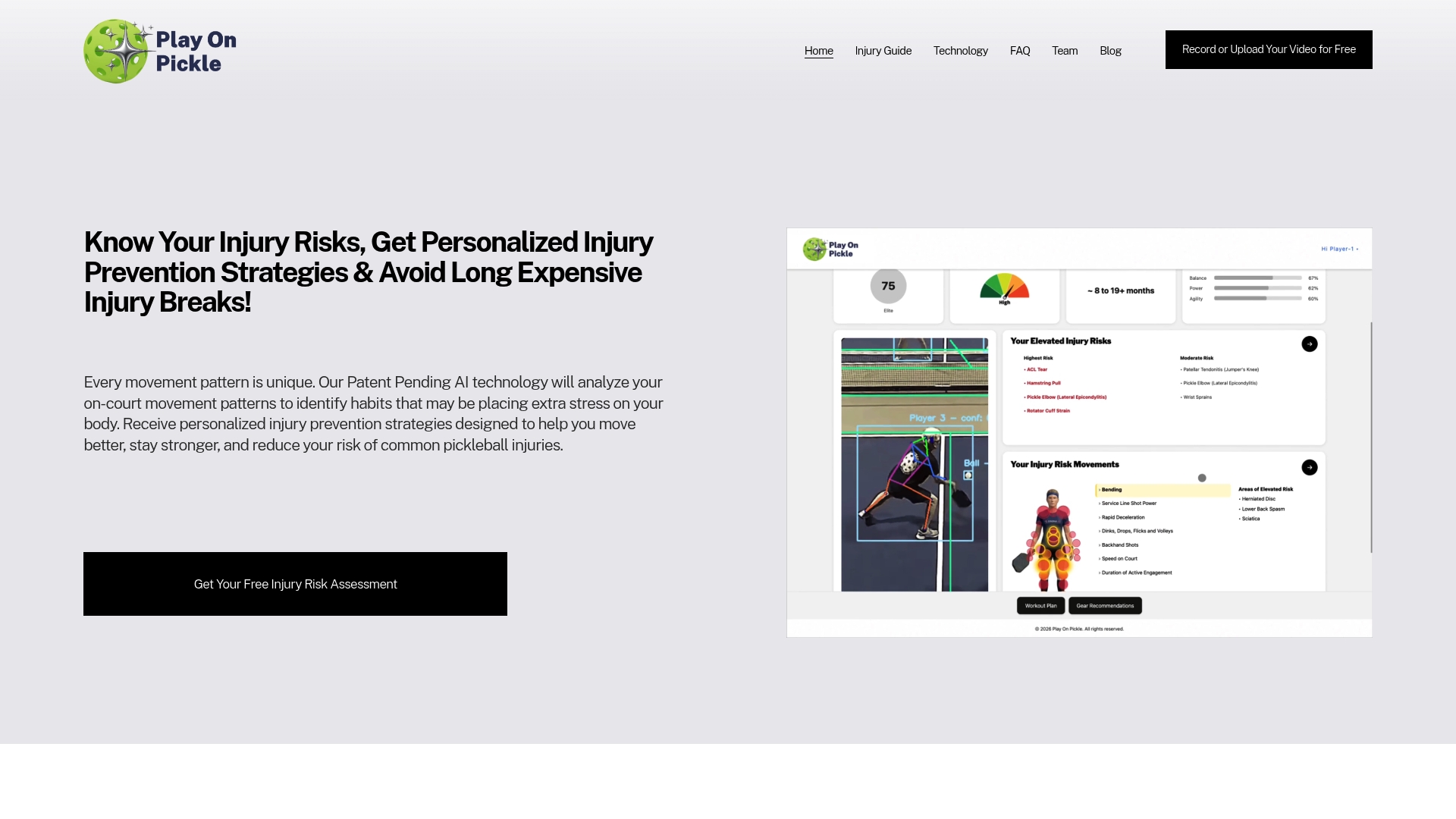
Sign up starts with a free trial: create an account, upload your first 30 to 60 second clip following the camera guidance above, and answer a short intake about your play history and any existing pain. Your first report arrives within the standard turnaround window and includes your prioritized incident list, baseline joint metrics, and a starter set of corrective exercises matched to whatever the system flags. Coaches and clinicians can use the same reports to track a player over time rather than relying on a single visual impression.
New sign-ups often get a free tripod as an onboarding incentive, which solves the camera-stability problem before it becomes one. Head to Play On Pickle to start your first assessment and see what your movement signature actually looks like.
Frequently Asked Questions
Is pickleball video analysis different from gameplay stat-tracking apps? Yes. Biomechanical video analysis measures joint angles and movement risk to prevent injury. Stat-tracking apps count shots and rallies for performance coaching, an entirely separate function.
How accurate are AI-based injury risk predictions from video? Targeted predictive models have reached 79.5% to 96% accuracy identifying musculoskeletal risk factors in specific studies, though sample sizes remain small across the field.
Can one video really replace a lab-based motion capture assessment? Not entirely. Single-camera analysis estimates joint angles reliably in one plane of motion and works well for practical screening, but it carries more error margin than marker-based lab systems.
What equipment do I need to record a useful clip? A smartphone, a tripod, and decent lighting. Side-on framing at hip height, 8 to 10 feet back, gives the cleanest angle data for most shots.
How often should I re-test after starting a corrective program? Most prehab progressions run four to eight weeks before re-assessment, though immediate red flags get addressed within one to two weeks with a shorter corrective block.
This article is general information, not a substitute for advice from a qualified doctor. Consult a qualified healthcare professional about your own circumstances before acting on anything here.
Sources
Recommended
- Pickle Elbow, FOOSH… — Play On Pickle - Smart Pickleball Fitness
- Blog | Improve Your Game Now — Play On Pickle - Smart Pickleball Fitness
- Celebrate National Pickleball Day: Play Harder, Move Smarter, and Stay Injury-Free — Play On Pickle - Smart Pickleball Fitness
- Pickleball 101: Understanding the Game, Rules, and Essential Fitness and Gear — Play On Pickle - Smart Pickleball Fitness