
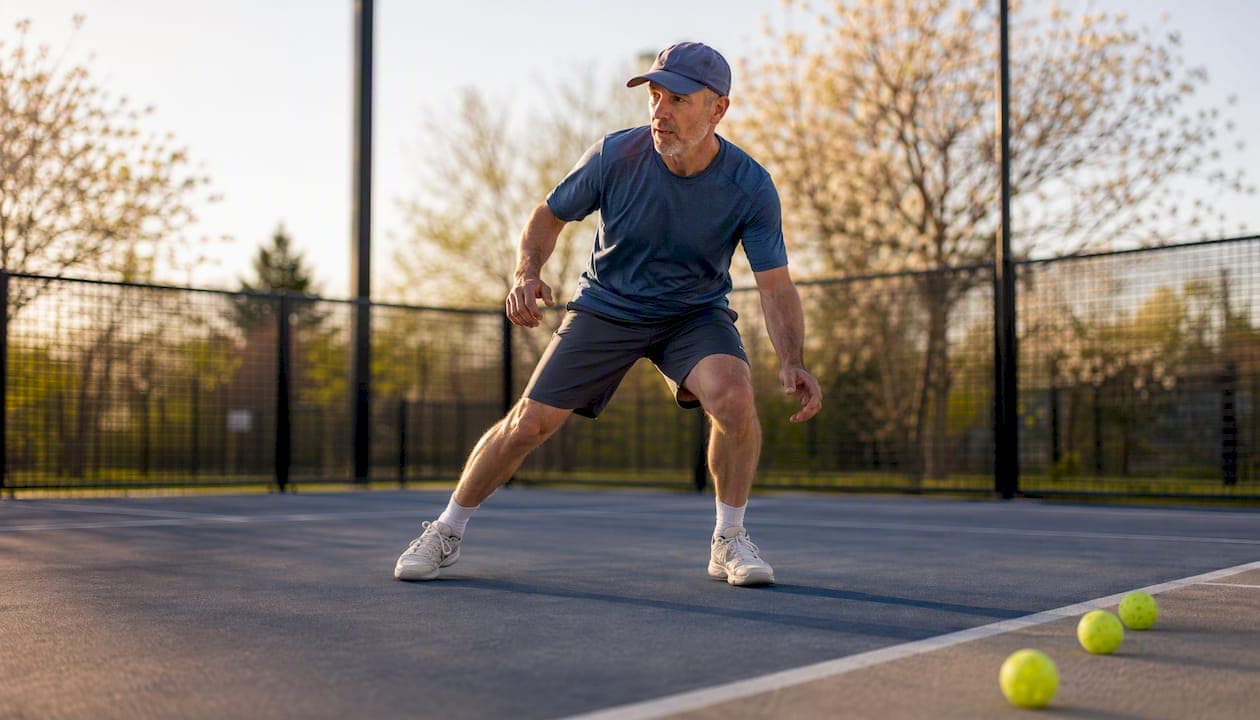
The most effective pickleball warm up combines three things in this order: a pulse raiser to get blood moving, dynamic joint prep for the shoulders, hips, wrists, and ankles, and sport-specific activation that mimics the shuffles, lunges, and swings you'll actually use on court. Do it in five minutes if you're rushed, or stretch it to eight to twelve minutes before a real match.
Skip the long static stretches before you play. Save those for after. The HSS sports medicine team is blunt about this: treating pickleball as a "low impact" sport underestimates how much lateral, high-velocity stress it puts on your body, and dynamic movement is what actually protects you before you step on the court.
If you only have two minutes, prioritize these:
- Thirty seconds of high-knee marching or light jogging in place
- Ten arm circles each direction
- Six walking lunges with a torso twist
- Ten lateral shuffles, five steps each direction
- Five slow shadow swings, forehand and backhand
That's the floor. Everything below builds on it.
Key Takeaways
A pickleball warm up that sequences a pulse raiser, dynamic joint mobility, and sport-specific activation in five to twelve minutes cuts injury risk while sharpening early-match performance.
| Point | Details |
|---|---|
| Time budget | Use 5 minutes courtside when rushed, 8 to 12 minutes for a full pre-match routine. |
| Sequence matters | Always start with a pulse raiser before mobility work or paddle drills. |
| Dynamic beats static pre-play | Save static stretches with 20 to 30 second holds for after you play, not before. |
| Watch four hotspots | Prioritize shoulder, elbow, knee, and Achilles prep since they're the most injury-prone areas. |
| Modify, don't skip | Older players or those with joint limits should shrink range and impact, not cut steps. |
| Personalize when needed | Play On Pickle's movement analysis flags individual stress points a generic routine can't catch. |
Table of Contents
- The 5-Minute Courtside Pickleball Warm Up
- The Full 8- to 12-Minute Pre-Match Warm Up
- How Do You Warm Up Each Muscle Group for Pickleball?
- Which Warm-Up Moves Protect You From the Most Common Pickleball Injuries?
- How Should Players Over 50 Modify Their Pickleball Warm Up?
- When Should You Get Your Warm Up Personalized?
- What's a Good Cooldown After Pickleball?
- Why We Built Our Approach Around Individualized Warm-Ups
- Get a Warm-Up Plan Built Around Your Own Movement
- Frequently Asked Questions
- Sources
The 5-Minute Courtside Pickleball Warm Up
You don't need a gym or a foam roller to get ready for pickleball. You need five minutes and a little floor space near the court. Here's the sequence, broken into rough 60-second blocks.
- Minute 1: Pulse raiser. Jog in place or march with high knees. Get your heart rate up and your breathing slightly labored. This is the step people skip, and it's the one that matters most if you're short on time.
- Minute 2: Leg swings. Hold a fence or paddle for balance. Ten front-to-back swings per leg, then ten side-to-side swings per leg. Keep the motion controlled, not kicking for height.
- Minute 3: Lateral shuffles and walking lunges. Shuffle five steps right, five steps left, three rounds. Follow with six walking lunges, adding a gentle torso rotation toward your front leg each time.
- Minute 4: Upper body and wrist prep. Ten arm circles forward, ten back. Then wrist circles and gentle wrist flexion and extension stretches, ten reps each direction. Your grip and forearm take a beating in this sport, so don't rush this part.
- Minute 5: Shadow swings. Five slow-motion forehands, five backhands, five overheads, no ball needed. Focus on full range of motion, not speed.
Pro Tip: If you're under five minutes, don't cut the pulse raiser to save time. A cold pulse raiser is worse than a rushed mobility set. Do 45 seconds of jogging even if it means trimming shadow swings to three reps each side.
By the end, you should feel warm and loose, not winded. If your legs feel heavy or your heart rate is still spiking, you overdid the pulse raiser and undercut the mobility work. The goal is elevated readiness, not exhaustion.
The Full 8- to 12-Minute Pre-Match Warm Up
Tournament day or a serious club match calls for more than the courtside version. The Dink's 8-minute routine is a solid model, and stretching it to 12 minutes when you have the time gives you a buffer for partner drills.
- Pulse raiser (2 minutes). Jog, jump rope, or do jumping jacks. Get your core temperature up before you touch a paddle.
- Dynamic mobility (3 to 4 minutes). Leg swings, lateral lunges, torso rotations, and arm circles. Move through full ranges, not partial ones.
- Joint prep and activation (2 to 3 minutes). Bodyweight squats, calf raises, glute bridges or lateral band walks if you carry a mini band in your bag, and wrist circles.
- Court-based paddle work (2 to 3 minutes). This is where a partner helps. Try moving third-shot drops from mid-court, controlled putaways at the net, and paced dinks back and forth.
Each drill serves a different purpose. Moving third-shot drops rehearse the soft-game footwork and touch you'll need within the first few points. Controlled putaways prime the quick, compact swing you use to close out a rally. Paced dinks aren't just about touch, they're about timing your reaction speed before the real thing starts.
This progression matches what pros use before matches: warm the body first, then warm your touch while moving, then deliberately warm your reaction time by mixing in speed-ups during those early dinks. Skipping straight to hard hitting without that sequence is how players tweak a shoulder on the first overhead of the day.
Static stretching doesn't belong here. HSS and other sports medicine sources agree that holding a stretch for 20 to 30 seconds before you play can actually reduce muscle power output right when you need it most. Dynamic movement wins before play; static holds win after.
How Do You Warm Up Each Muscle Group for Pickleball?
Every movement in a pickleball warm up should map to something you'll actually do on court. Here's the full exercise bank, with cues, timing, and modifications.
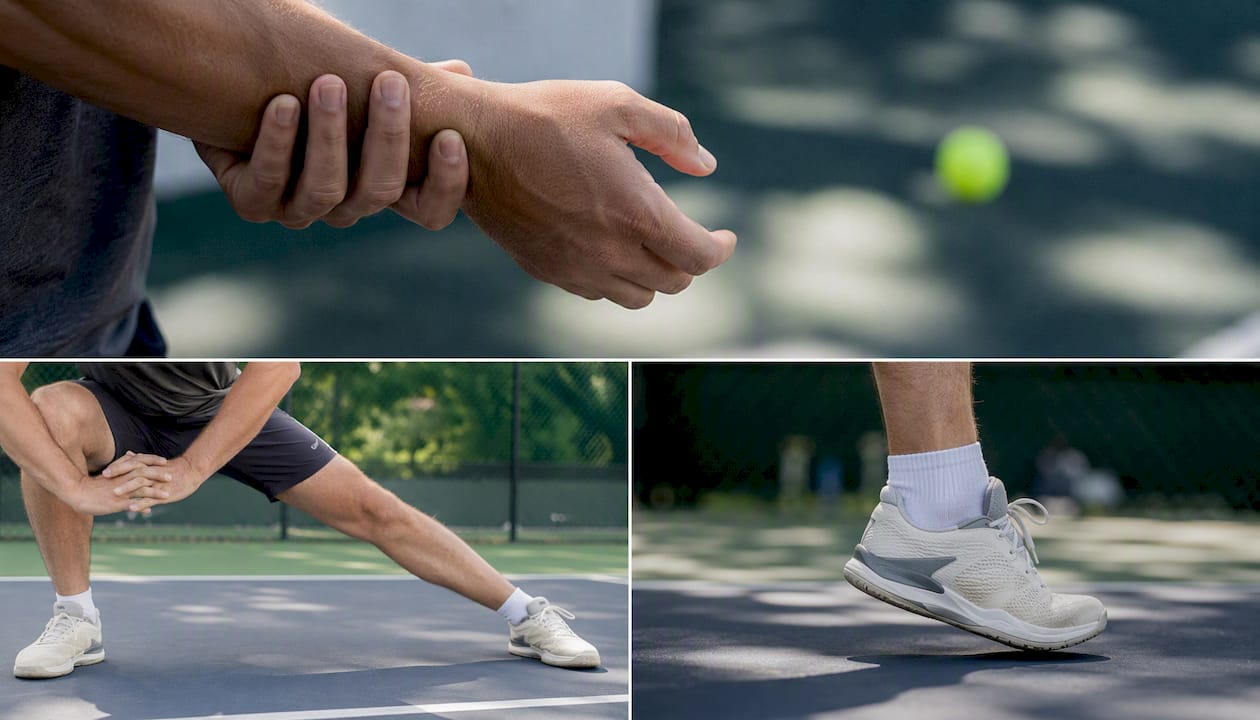
Light jog or high-knee march. Purpose: raises heart rate and core temperature. Cue: land softly, keep shoulders relaxed. Do 30 to 60 seconds. Regression: brisk walk in place. Progression: add butt kicks between knee lifts.
Lateral shuffles. Purpose: primes the side-to-side movement pattern that dominates pickleball footwork. Cue: stay low, don't cross your feet. Do five to ten shuffles per direction. Regression: shorter, slower shuffles. Progression: add a split-step at the end of each shuffle.
Leg swings, front and lateral. Purpose: opens up hip flexors and adductors used in lunges and reaches. Cue: controlled swing, not a kick. Do ten per leg, per direction. Regression: hold a fence and reduce range. Progression: add a slight pause at the top of each swing.
Walking lunges with rotation. Purpose: warms the hips and core for low, wide shots. Cue: front knee tracks over the ankle, rotate toward the lead leg. Do six to eight per side. Regression: stationary lunges without the walk. Progression: add a reach overhead on the rotation.
Arm circles. Purpose: loosens the shoulder capsule before overheads and serves. Cue: small circles first, then larger. Do ten forward, ten back. Regression: smaller range. Progression: add resistance with a light band.
Wrist and forearm prep. Purpose: protects against pickleball elbow and grip strain. Cue: slow circles, then gentle flexion and extension stretches. Do ten reps each direction. Regression: fewer reps, gentler range. Progression: add wrist curls with a lightweight if available.
Bodyweight squats. Purpose: activates glutes and quads for split-step readiness. Cue: chest up, weight in heels. Do eight to twelve reps. Regression: partial range squats. Progression: add a jump squat.
Calf raises. Purpose: primes the Achilles and calf for quick pushes and stops. Cue: rise slowly, control the descent. Do twelve to fifteen reps. Regression: hold onto something for balance. Progression: single-leg calf raises.
Split-step drills. Purpose: rehearses the ready position used before every return. Cue: small hop, land with feet shoulder-width. Do eight to ten reps. Regression: step in place instead of hopping. Progression: add a direction change on landing.
Shadow swings and slow dinks. Purpose: grooves swing patterns and touch before live points. Cue: full extension, controlled tempo. Do five to eight per stroke type. Regression: half-speed, smaller motion. Progression: add footwork before each swing.
| Exercise | Purpose | Reps/Time | Regression / Progression |
|---|---|---|---|
| High-knee march | Raise heart rate | 30–60 sec | Brisk walk / add butt kicks |
| Lateral shuffles | Footwork pattern | 5–10 per side | Shorter shuffle / add split-step |
| Leg swings | Hip mobility | 10 per leg | Reduced range / pause at top |
| Walking lunge + twist | Hip and core prep | 6 to 8 per side | Stationary lunge / add reach |
| Wrist circles | Elbow and grip protection | 10 per direction | Gentler range / add light curls |
| Calf raises | Achilles priming | twelve to fifteen reps | Assisted / single-leg |
Which Warm-Up Moves Protect You From the Most Common Pickleball Injuries?
The AMA identifies the shoulder, elbow, knee, and Achilles tendon as the areas most likely to get hurt in pickleball, and each one responds to a different piece of your warm up.
| Injury area | Prioritized warm-up drills | Why it helps |
|---|---|---|
| Shoulder | Arm circles, shadow overheads, band work if available | Loosens the rotator cuff before repeated overhead swings |
| Elbow | Wrist and forearm circles, slow dinks before hard drives | Reduces tendon strain that leads to pickleball elbow |
| Knee | Bodyweight squats, lateral shuffles, split-steps | Activates stabilizing muscles around the joint before lateral loading |
| Achilles | Calf raises, light jog progression, ankle circles | Prepares the tendon for sudden stops and pushes |
Pickle elbow in particular sneaks up on players who go straight from the parking lot to hard drives with no wrist prep at all. A few minutes of forearm work up front, covered in more depth in Play On Pickle's breakdown of pickle elbow, goes a long way toward heading it off.
Watch for red flags that mean you should stop, not push through:
- Sharp, localized pain that wasn't there before you started
- A catching or locking sensation in a joint
- Swelling that shows up during or right after the warm up
- Pain that gets worse instead of better as you move
Pro Tip: If a joint feels off during warm up, don't try to "work through it" with more reps. Dial back intensity for that session and get it looked at by a physical therapist if the discomfort repeats across multiple sessions.
How Should Players Over 50 Modify Their Pickleball Warm Up?
Age and joint history change the dose, not the formula. You still want a pulse raiser, mobility work, and activation. You just adjust impact and range.
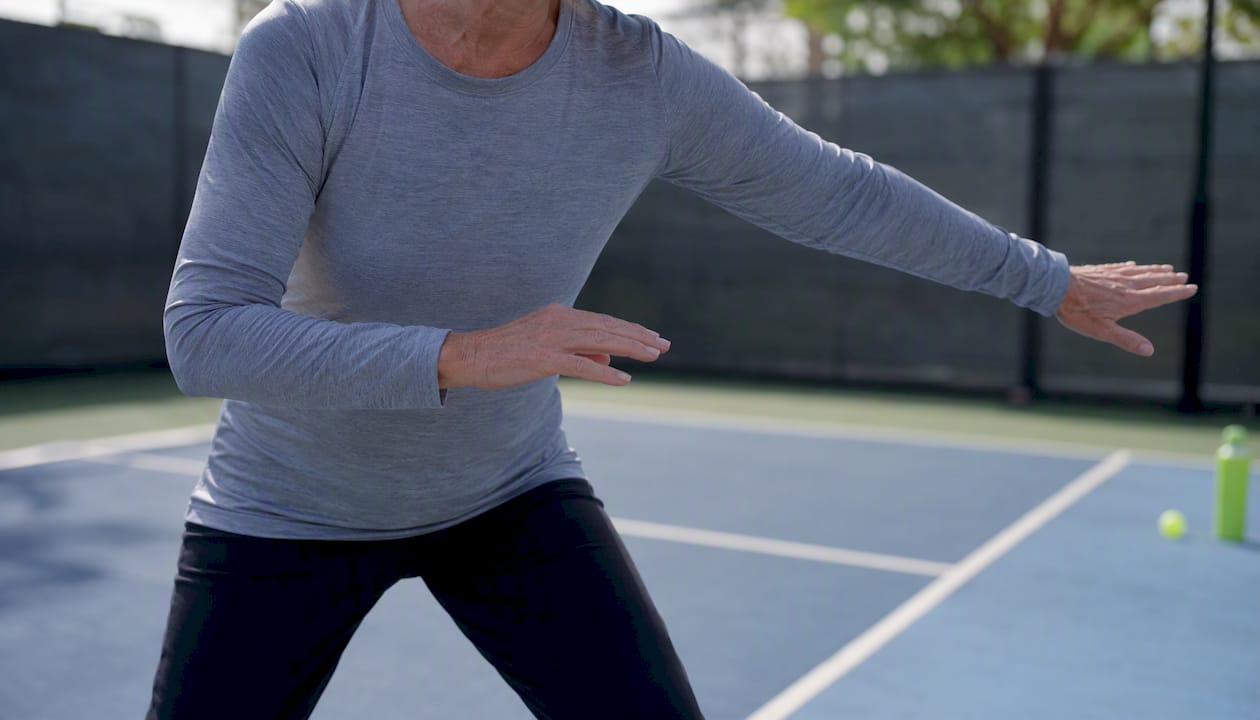
Swap jogging for a brisk march if your knees or hips are cranky. Shrink the range on leg swings so you're not forcing a stretch at the end point. If shoulder impingement is a concern, keep arm circles small and skip overhead shadow swings until you're fully warm. Calf raises can be done seated with a resistance band if standing balance is an issue.
Here's a modified 5-minute routine for players managing joint limits or working around a cardiac concern that requires a gentler ramp:
- Minute 1: Brisk marching in place, arms swinging naturally.
- Minute 2: Small-range leg swings, holding a fence for balance.
- Minute 3: Slow walking lunges, no rotation if hips are sensitive.
- Minute 4: Gentle arm circles and wrist stretches, seated if needed.
- Minute 5: Slow shadow swings at half speed, focusing on smooth motion over power.
Do's and don'ts worth keeping in mind:
- Do raise your heart rate gradually rather than jumping straight into sprints.
- Do reduce range on any movement that causes pinching or grinding.
- Don't hold static stretches before play, especially with a history of joint stiffness.
- Don't skip the pulse raiser just because your mobility work feels sufficient. It doesn't replace raising core temperature.
- Don't push through sharp pain assuming it will "warm out." It rarely does.
When Should You Get Your Warm Up Personalized?
A generic routine covers most players most of the time. It stops being enough when your body starts sending specific signals: pain that returns in the same spot across multiple sessions, one side of your body that feels noticeably tighter or weaker than the other, or a swing pattern that feels inconsistent from one day to the next even though nothing else changed.
Those signals are worth recording, not guessing about. If you want a coach or physical therapist to actually help, bring them something concrete: a short video from two angles, front and side, showing five or six reps of your serve, your groundstroke, and a lateral shuffle. Consistent framing matters more than production quality. A phone propped against a fence works fine.
Pro Tip: One signal players almost never test on purpose: reaction time in the first few dinks of the day. Your hands and eyes need a warm-up separate from your muscles. During your first exchanges, ask a partner to mix in a couple of unpredictable speed-ups. If you're consistently late to react, your nervous system needed more warm-up time than your legs did.
This is also where a growing category of movement-analysis tools has started to matter. Watching your own footage frame by frame, or letting software flag asymmetries you can't feel yourself, catches issues before they become the kind of nagging pain that keeps you off the court for a season. For a deeper look at how a single overlooked movement pattern can sideline a player, the case discussed in Play On Pickle's piece on Jeff Webb's injury is worth a read. Broader mobility screening tied to long-term athletic health, covered in this performance and mobility guide, is another useful reference if you're building a maintenance plan beyond just the warm up.
What's a Good Cooldown After Pickleball?
Static stretching has a place. It's just after you play, not before. Once you're done on court, spend two to three minutes walking at an easy pace to bring your heart rate down gradually rather than stopping cold.
Then hold three static stretches for 20 to 30 seconds each:
- Standing quad stretch, pulling your heel toward your glutes
- Seated or standing hamstring stretch, hinging at the hips with a flat back
- Posterior shoulder stretch, pulling one arm across your chest at shoulder height
These three cover the areas that tighten up most from repeated lunging, quick stops, and overhead swings. Holding each for 20 to 30 seconds gives connective tissue time to actually lengthen, which is the opposite of what you want before play, when a temporary strength dip from static holding works against you.
For ongoing maintenance beyond the court, a few minutes of foam rolling on the calves and quads, plus steady hydration afterward, helps you show up less stiff for your next session.
Why We Built Our Approach Around Individualized Warm-Ups
Most warm-up advice treats every player the same, and that's the gap Play On Pickle exists to close. A 45-year-old weekend player with a history of tennis elbow needs a different emphasis than a 25-year-old competitive player with clean joints and a hard drive. Generic routines get most people most of the way there, but the players who actually stay injury-free over years, not just weeks, are the ones who know their own specific stress points.
That's the thinking behind Play On Pickle's computer-vision approach: analyze how an individual actually moves, not how the average player moves, and build recommendations around that. We publish free routines like the ones above because they work for most people most of the time. We built the underlying analysis technology because "most people" isn't the same as "you." An author byline on this piece belongs to Drona, and the broader case-based writing on the Play On Pickle blog reflects that same individualized lens across injury topics.
Get a Warm-Up Plan Built Around Your Own Movement
The routines above work well for most players, but they're built for an average body, not yours specifically. Play On Pickle's AI movement analysis looks at your own swing mechanics and footwork from a short video upload, flags the stress points generic advice can't see, and turns that into a personalized set of warm-up and conditioning recommendations.
This isn't a replacement for the free routines in this guide. It's the next layer for players who have noticed a recurring ache, an asymmetry, or a pattern that a standard warm-up hasn't fixed. Upload a clip, get a biomechanical read on where your risk actually sits, and start your session with a plan built for your body instead of an average one. Start with Play On Pickle to see what your own movement data shows.
Frequently Asked Questions
How long should a pickleball warm up take? Five minutes covers the essentials if you're short on time. Give yourself 8 to 12 minutes before a competitive match or tournament so you can add partner drills and paddle work.
Should you stretch before or after playing pickleball? Dynamic stretching, like leg swings and arm circles, goes before play. Static stretches with longer holds belong after, during your cooldown, when they support flexibility and recovery instead of temporarily reducing muscle power.
What's the best warm-up for pickleball if I only have two minutes? Prioritize a short pulse raiser, then move straight into lateral shuffles and a few shadow swings. Skipping mobility entirely is riskier than trimming it slightly.
Can a pickleball warm-up routine really prevent injuries? It reduces risk significantly by priming the shoulder, elbow, knee, and Achilles before the sudden lateral loading and overhead swings that cause most pickleball injuries, though it can't eliminate risk from a bad step or an awkward fall.
Do older players need a different pickleball warm up? Yes. The framework stays the same, but reduce impact and range, swap jogging for marching if needed, and skip aggressive static holds before play regardless of age.
This article is general information, not a substitute for advice from a qualified doctor. Consult a qualified healthcare professional about your own circumstances before acting on anything here.
Sources
- What doctors want patients to know about preventing pickleball injuries | AMA
- Stretches and exercises to prevent pickleball injuries | HSS
- Pickleball pre-match warm up: the 8-minute routine | The Dink Pickleball
- Stretches for pickleball players | Athletico
Recommended
- Pickleball 101: Understanding the Game, Rules, and Essential Fitness and Gear — Play On Pickle - Smart Pickleball Fitness
- Pickle Elbow, FOOSH… — Play On Pickle - Smart Pickleball Fitness
- The Dink Movie — Play On Pickle - Smart Pickleball Fitness
- Blog | Improve Your Game Now — Play On Pickle - Smart Pickleball Fitness