
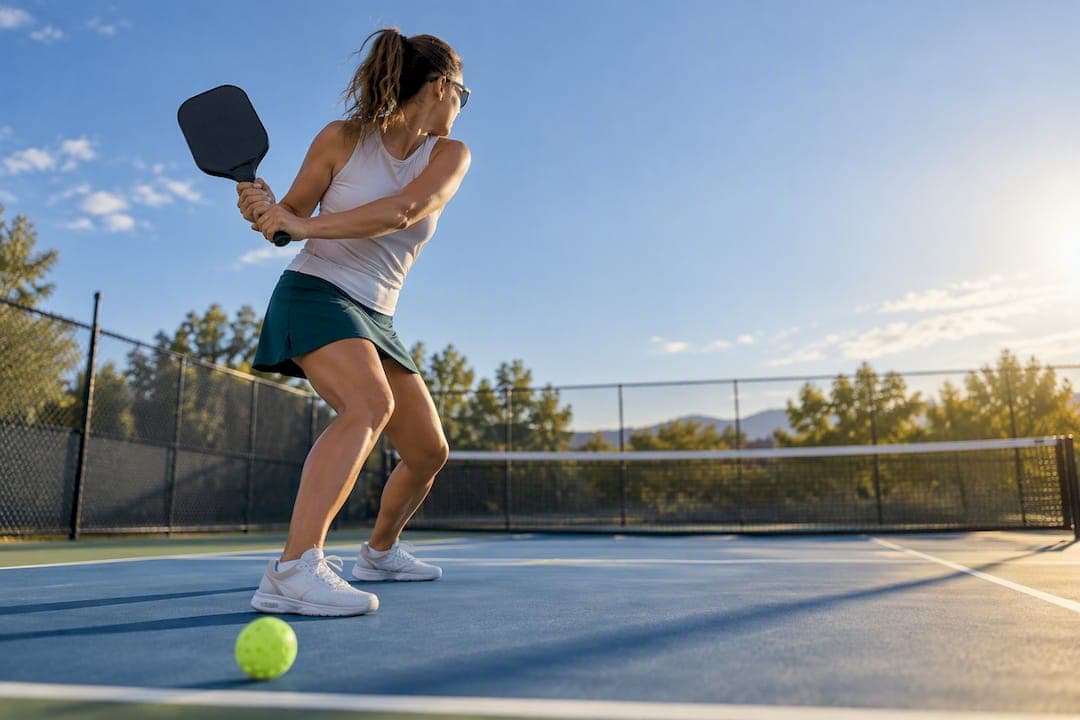
The single change that fixes most recreational backhands is an earlier, fuller shoulder turn, taken before the ball crosses the net, not as it arrives. Test it now: on your next backhand, rotate your shoulders and load the paddle the instant your opponent makes contact.
This guide covers grips, footwork, shot-by-shot mechanics, the most common breakdowns, and a drill progression to make that turn automatic.
TL;DR:
- Most backhand errors occur when players do not turn their shoulders early enough before contact, leading to contact behind the body and inconsistent shots.
- Fixing shoulder turn timing first can resolve over 80 percent of common backhand problems, including weak pace and wrist compensation.
- A proper grip choice depends on shot type, with the continental grip favored for control near the net and the Eastern for topspin drives, while two-handed backhands offer stability at the expense of reach.
- Learning specific cues for each shot, such as paddle face angle and swing path, enables faster shot recognition and improved consistency during play.
- Movement analysis services with video review can identify individual swing stress points, providing targeted exercises to fix leaks and prevent injuries.
Table of Contents
- Pickleball Backhand Mechanics: The Three-Phase Checklist
- Backhand Grip for Pickleball: Continental vs. Eastern and One vs. Two Hands
- How to Hit Every Backhand Shot: Dink, Drive, Drop, Roll, and Volley
- Backhand Footwork: Positioning That Produces Repeatable Contact
- Common Pickleball Backhand Mistakes and Quick Fixes
- Backhand Training Drills: A 4-Week Progression to Build the Habit
- Why Movement Analysis Helps You Fix Backhand Leaks Faster
- Technique Before Flair: An Editorial Take
- Get a Personalized Read on Your Backhand Mechanics
- Sources
- FAQ
Pickleball Backhand Mechanics: The Three-Phase Checklist
Every clean backhand runs through the same three phases: preparation, swing path, and contact with follow-through. Treat them as a checklist, not a single fluid blur, and you'll catch breakdowns before they become habits.
Preparation starts with your split-step timing to your opponent's contact point, not the ball's flight. That earlier trigger gives your shoulders time to turn fully sideways and get the paddle loaded before the ball is halfway across the net. Pickleball US frames this as the foundation phase, and for good reason: skip it, and everything downstream compensates badly.
Swing path comes next, shaped differently for a drive, dink, or roll, but always initiated from the shoulders and core rather than the arm alone.
Contact and follow-through finish the sequence, with the paddle meeting the ball slightly in front of your lead hip and the finish pointing toward your target.
A missing shoulder turn is the root cause in over 80 percent of backhand errors, mostly because a late turn forces contact behind the body, and the wrist takes over to compensate.
- Shadow swing 10 reps focusing only on shoulder rotation, no ball.
- Mirror check: pause mid-backswing and confirm your chest faces the sideline.
- Toss-and-catch drill: catch the ball at your ideal contact point to feel where "in front of the hip" actually is.
Pro Tip: Freeze at the top of your backswing during shadow reps. If your chest isn't facing the side fence, your shoulder turn stopped short, and that's the leak to fix before anything else.
Backhand Grip for Pickleball: Continental vs. Eastern and One vs. Two Hands
Your grip decision shapes what the shot can do before you even swing. The continental grip, paddle face perpendicular to the ground, hand on top like a hammer, gives you versatility for dinks, volleys, and quick exchanges at the kitchen line without a grip change. The Eastern backhand grip rotates your hand slightly toward the backhand side, opening up more topspin and pop for drives and passing shots.
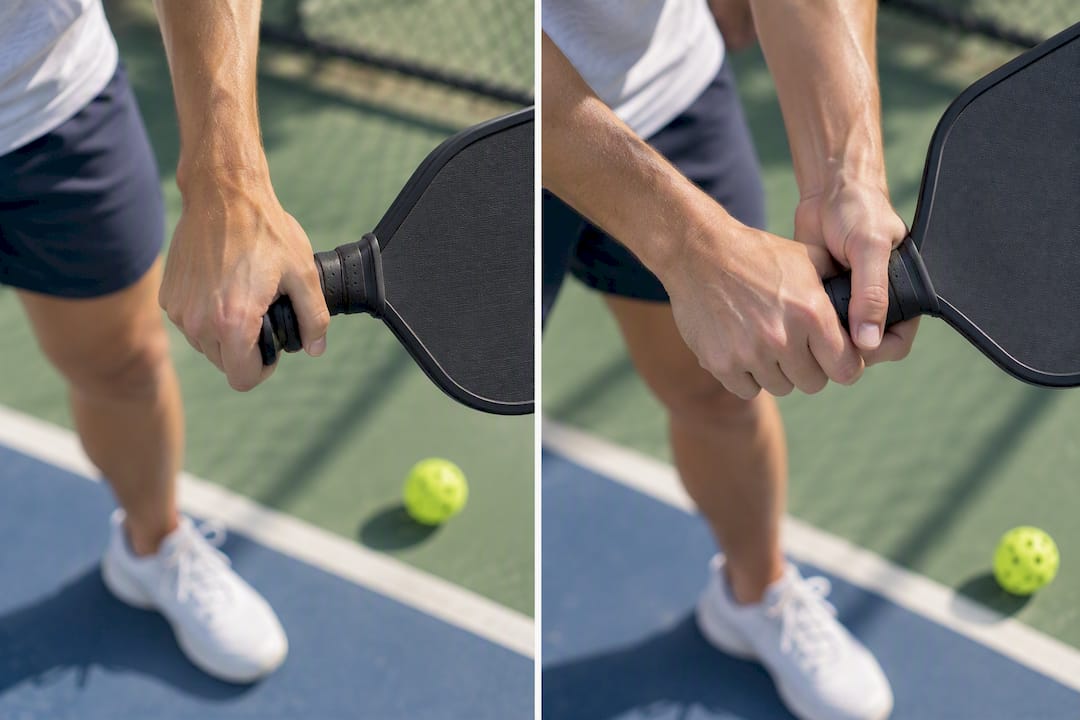
For two-handed backhands, place your dominant hand at the base of the grip and your non-dominant hand just above it. That second hand adds real stability on drives and takes strain off your wrist, though it costs you some reach on wide balls.
Most recreational and intermediate players do best with a hybrid approach: continental at the kitchen for control, shifting toward Eastern backhand mechanics when you get a ball to drive. FORWRD's coaching guide backs this hybrid model as the practical route for most players rather than committing to one grip for everything.
- Continental: best for dinks, resets, quick volleys near the net.
- Eastern backhand: best for drives, passing shots, added topspin.
- Two-handed: added stability and power, less reach.
- One-handed: faster reset, better for flicks and tight-space contact.
How to Hit Every Backhand Shot: Dink, Drive, Drop, Roll, and Volley
Each backhand shot needs its own face angle, swing shape, and contact height. Once you know the cues, shot selection becomes a fast, almost automatic read rather than a guess.
- Backhand dink. Paddle face slightly open, short pendulum swing path, contact around knee to waist height. Finish low and soft, aimed at your opponent's feet. Use it when the ball is low and you're both at the kitchen line.
- Backhand drive. Face closer to vertical, swing path forms a compact C-shape from low to a bit past the ball. Contact at waist height, finish out toward the target with the paddle face still facing forward. Use it on a ball sitting up above the net.
- Backhand drop (third shot). Paddle face open, swing path shaped like a U, soft acceleration through contact around hip height. Aim for the opposing kitchen, not for pace.
- Backhand roll. Face angle closes gradually through contact, swing path moves low to high, brushing up the back of the ball for topspin. Contact slightly in front of the hip. Use it on a ball you can attack from mid-court.
- Backhand punch volley. Minimal backswing, face stays neutral to slightly closed, contact out front and firm, finish short. This is a reaction shot at the net, not a full swing.
- Backhand slice return. Paddle face angled, swing path moves high to low across the ball. Contact above waist height with a controlled, downward finish that keeps the return low and difficult to attack.
The Pickleball Inform decision framework ties shot choice to ball height and opponent position, which is the fastest way to stop overthinking mid-point. Under pressure, three words help: turn, load, extend.
Backhand Footwork: Positioning That Produces Repeatable Contact
Footwork decides whether your shoulder turn and grip choices ever translate into clean contact. Your split-step, taken as your opponent makes contact rather than as the ball arrives, gives you a half-second head start on rotating your shoulders. That small timing shift is one of the fastest fixes available to recreational players, and it costs nothing but a change in cue.
From there, a right-angle triangle step pattern, one step to position, one step to close, gets your front foot planted where contact should happen: slightly ahead of your lead hip. Closed stances add rotational power on drives; neutral stances keep you quicker for resets and dinks. Whichever you choose, transfer your weight forward through contact so your follow-through carries your body toward the target instead of leaving you stuck flat-footed.
- Split-step on opponent's contact, not ball flight.
- Right-angle triangle footwork into the shot.
- Closed stance for power, neutral stance for control.
- Weight transfer forward through follow-through.
Pro Tip: Small adjustment steps beat one big lunging step almost every time. Coaches consistently find that shortening your last step and turning earlier fixes jammed contact better than trying to stretch your swing to reach the ball.
Common Pickleball Backhand Mistakes and Quick Fixes
Most backhand problems trace back to one of four issues, and they tend to cascade: fix the first one, and two or three others often disappear with it.
| Mistake | Root cause | Mechanical fix |
|---|---|---|
| Late contact, weak pace | Shoulder turn starts too late | Turn shoulders as opponent contacts the ball |
| Contact behind the hip | Feet arrive after the swing starts | Step to the ball before initiating the swing |
| Wristy, inconsistent shots | Wrist compensates for a missing turn | Stabilize the wrist, drive rotation from the shoulders |
| Erratic power, mis-hits | Overswinging on drives and rolls | Shorten the backswing, accelerate only through contact |
Check your shoulder turn first. It's the root issue behind most of the rest. Once that's solid, check contact timing, then face angle. Verify each fix with a slow-motion shadow swing before adding pace back in.
Backhand Training Drills: A 4-Week Progression to Build the Habit
Locking in new mechanics takes repetition, in the right order, using aids like the ZoneGrip™ Golf Grip & Wrist Hinge Trainer which can be repurposed for paddle grip and wrist stability drills. Isolate preparation before you ever touch live speed.
- Shadow turn reps. 50 to 100 reps focused purely on shoulder rotation and split-step timing, no ball involved.
- Wall contact-out-front drill. Hit against a wall, checking that every contact happens slightly ahead of your lead hip.
- Kitchen dinking ladder. Progressive dink rallies that force consistent face angle and soft hands.
- Two-handed drive reps. Feed or self-toss drives, focusing on the C-shaped swing path and weight transfer.
- Roll and topspin repetition. Low-to-high swing path drills against a partner or ball machine.
- Partner speed-up and block drill. Live-speed reps that test whether your mechanics hold up under pressure.
Week 1: shadow reps and wall drills, 100+ reps, goal is consistent contact position. Week 2: add kitchen dinking, goal is face-angle control. Week 3: add drive and roll reps, goal is controlled power, not max power. Week 4: add live speed-up drills, goal is mechanics holding under pressure.
Pro Tip: If a joint starts aching, especially the wrist or shoulder, cut volume before cutting corners on form. Bad mechanics under fatigue is how injuries start.
Why Movement Analysis Helps You Fix Backhand Leaks Faster
Most players can't feel a late shoulder turn or an asymmetrical load in real time. Video-based movement analysis can flag those leaks that live practice hides, since the swing happens faster than self-perception can track.
A specialized computer-vision analysis can spot stress points in your swing and body loading pattern, then build exercises around what it finds, rather than generic drills. That's relevant here because a backhand fix that ignores your actual movement pattern risks reinforcing the same compensation it's meant to correct.
- Flags mechanical stress points a mirror or shadow drill can't catch.
- Turns diagnosis into a short, personalized exercise plan.
- Pairs mechanics work with injury-awareness, including wrist strain and elbow overuse patterns common in recreational players.
Technique Before Flair: An Editorial Take
Chase clean contact before you chase power or spin. Reliable mechanics make pressure shots safer and easier later. Split practice time between isolated reps and live drills, and resist the urge to skip ahead.
— Drona
Get a Personalized Read on Your Backhand Mechanics
Reading about shoulder turns and contact points only gets you so far. There are services available for players who want to see their own mechanics, not just guess at them, using video you upload from your own court.

Such services analyze your movement pattern, flag stress points like a late shoulder turn or an off-center load, and build a personalized set of exercises around what is found in your swing. That's a different starting point than a generic drill list, because the fixes match your body instead of an average player's. New users can start with the Monthly subscription at $9.99 per month, or commit annually for less per month with the Annual subscription at $99 per year. Sign up now and you can also claim a free tripod with your subscription to make filming your swing simple from day one.
Sources
- The Complete Guide for a Better Backhand in Pickleball – The Dink Pickleball
- Pickleball backhand: technique and drills – Pickleball US
- Pickleball Backhand Guide 2026: Techniques, Grips & drills – FORWRD
- Pickleball backhand: The best technique in 2026 – Pickleball Inform
FAQ
Is a one-handed or two-handed backhand better in pickleball?
Neither wins outright. Two-handed backhands add stability and power for drives, while one-handed backhands react faster for dinks, flicks, and tight-space volleys. Most recreational and intermediate players benefit from training both and switching based on the shot, following the hybrid approach coaches recommend.
What is the hardest serve to return in pickleball?
A deep, spin-heavy serve aimed at your backhand corner is consistently the toughest to handle, because it forces a stretch return with less time to set your shoulder turn. Strong backhand mechanics, especially early preparation, make these returns far more manageable.
What are the most common backhand mistakes?
The biggest issues are a late shoulder turn, contact happening behind the hip instead of in front, and over-wristing to compensate for both. Fixing the shoulder turn first tends to resolve the other two automatically, since most backhand errors trace back to it.
What is the 10 second rule in pickleball?
The 10 second rule governs serve timing, giving the server up to 10 seconds after the score is called to put the ball in play. It's a pace-of-play rule and isn't directly tied to backhand mechanics, though rushing your prep to beat a clock is a common source of sloppy shoulder turns.
Can Playonpickle help me fix my backhand mechanics specifically?
Yes. Certain movement analysis services analyze uploaded video of your swing to flag mechanical stress points, including timing issues in your shoulder turn and load, then build a personalized exercise plan around what they find. Pricing starts at $9.99 per month or $99 annually.