
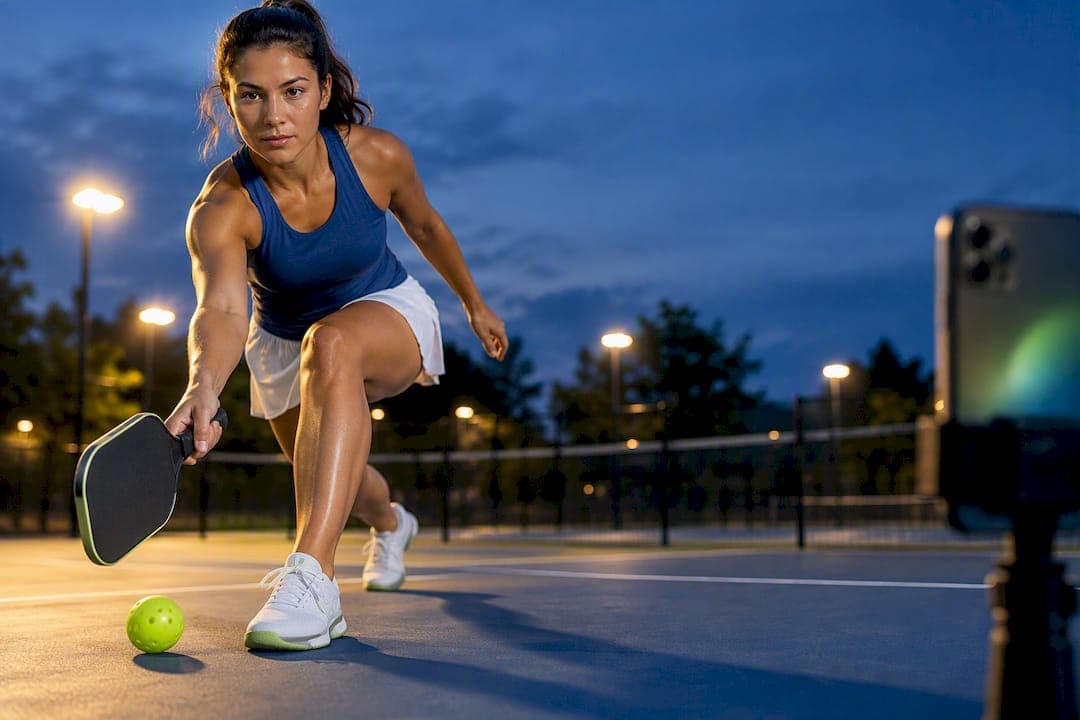
AI coaching in pickleball, at least the version that matters most right now, means using computer vision to analyze how you move on court and flagging the movement patterns most likely to cause injury. It scores things like joint angles, side-to-side asymmetry, and how fast you recover from a lunge, then hands you a short list of corrective exercises. Some providers build entire products around this idea. It's aimed at anyone from a weekend player who rolled an ankle last month to a competitive team hunting for an edge, but it flags risk. It doesn't replace a physical therapist when something already hurts.
TL;DR:
- AI assessment methods can accurately estimate joint angles and movement patterns using just smartphone videos, making regular screening accessible for most players.
- Common injury risks include falls due to weak hip abductor strength and rapid directional changes, which can be mitigated through targeted, short exercises like lateral band walks and balance drills.
- Most injury-prone movements in pickleball involve ankle stress, with players performing nearly 98 at-risk ankle motions per game versus about 68 in tennis.
- Progressive correction routines should focus on improving hip strength, balance, and rotator cuff stability, with a few minutes of exercises three to four times weekly.
- Regular tracking of movement asymmetries and pain scores every 2 to 4 weeks helps players identify small issues before they develop into serious injuries.
Table of Contents
- How AI Injury Assessments Work From a Few Seconds of Video
- Why Pickleball Puts So Much Strain on Aging Joints
- Corrective Exercises Matched to What AI Flags
- Building an AI Coaching Routine Into Your Practice
- What the Research Actually Shows So Far
- The Honest Limits of AI Screening (And Why That's Fine)
- Getting Started With AI-Guided Injury Prevention
- Sources
- FAQ
How AI Injury Assessments Work From a Few Seconds of Video
Most AI biomechanical assessment starts with markerless pose estimation. You record a clip on your phone, and a tool like MediaPipe maps dozens of points on your body frame by frame, no sensors or reflective markers required. A recent pilot study found that a MediaPipe-based deep learning pipeline could estimate joint angles and motion patterns during pickleball dink shots accurately enough to tell beginner mechanics apart from advanced ones. That's the video-only path, and for most recreational and competitive players, it's the practical entry point.
Wearable setups go further. Systems combining inertial measurement units (IMUs) with surface electromyography (sEMG) sensors read muscle activation directly, not just limb position. A fusion model using both data streams paired with an LSTM neural network hit roughly 92% accuracy classifying injury risk in real time, with feedback delivered in under 200 milliseconds. Some early smartphone-only pipelines are even experimenting with detecting elbow-related risk patterns tied to lateral epicondylalgia using nothing but a single camera angle.
Whichever input you use, the output tends to include the same core metrics:
- Joint angles at key moments, like knee flexion during a lunge
- Left/right asymmetry in strength, range of motion, or timing
- Angular velocity during rapid direction changes
- Change-of-direction time when recovering from a shot
None of this is a diagnosis. It's a pattern flag, a way of pointing at where your movement deviates from a lower-risk baseline.
Why Pickleball Puts So Much Strain on Aging Joints
Falls are the injury players underestimate most. Close to half of recreational pickleball players report having fallen during play, usually while lunging forward for a dink or scrambling backward for a lob. That same research found weaker hip abductor strength correlated directly with slower change-of-direction speed, which means the muscles stabilizing your hip are doing more work protecting you from a fall than most players realize.
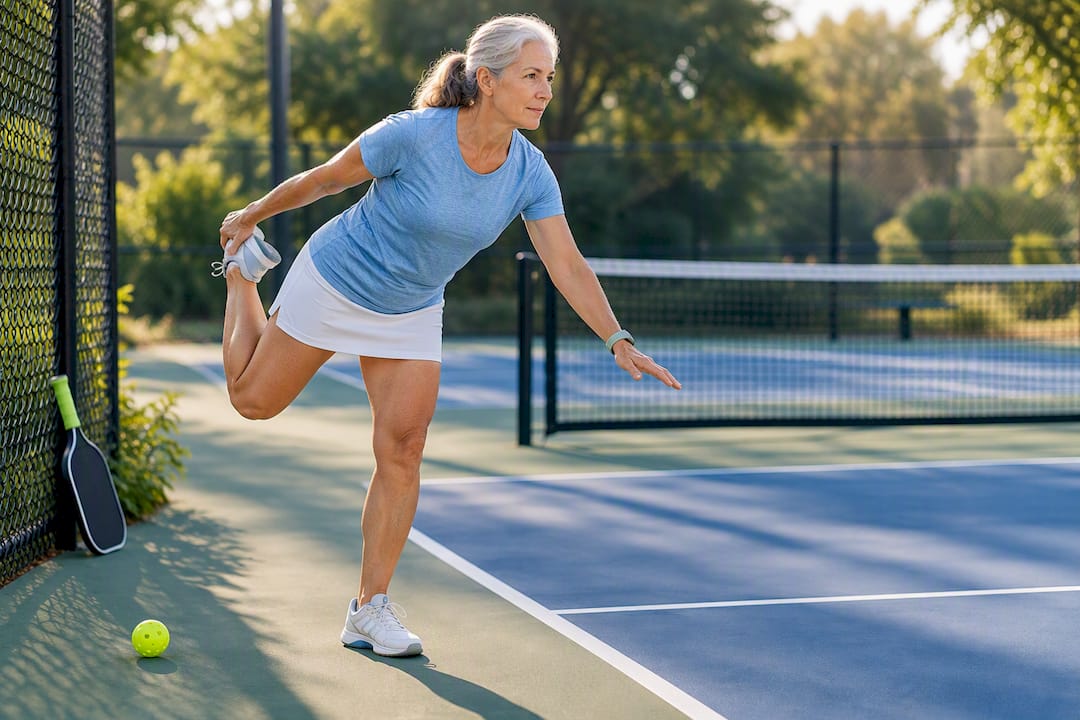
Nearly half of recreational pickleball players have fallen during play, and slower change-of-direction speed tracks closely with weaker hip abduction strength.
Beyond falls, the injury landscape breaks into a few repeating patterns:
- Overuse injuries from high weekly play frequency, especially in players hitting the court three or more times a week
- Rotator cuff strain from repetitive overhead motion on serves and overheads
- Wrist and elbow overload from mistimed dinks and volleys
- Ankle and Achilles stress from constant short, sharp pivoting
That last one deserves attention. Footage analysis comparing the two sports found pickleball players average nearly 98 at-risk ankle movements per ankle versus about 68 in tennis, a meaningful gap tied to the sport's tighter court and quicker direction changes. Broader survey data puts annual injury prevalence at roughly 69% among regular players, with male sex and higher weekly frequency both showing up as predictors. The upside: hip strength, ankle control, and shoulder stability are all trainable. They're modifiable risk factors, not fixed ones.
Corrective Exercises Matched to What AI Flags
Once a scan flags a risk pattern, the fix is usually a short, targeted routine, not a full workout overhaul. Here's how to match exercises to common flags:
- Weak hip abductors or slow change-of-direction time: Side-lying leg raises and lateral band walks, 2 to 3 sets of 12 to 15 reps, three times a week.
- Shoulder or rotator cuff asymmetry: Eccentric external rotation with a light resistance band, controlling the return phase for a slow 3 to 4 count, 2 sets of 10 per side.
- Poor balance or proprioception flagged during lateral movement: Single-leg stance progressing to single-leg reach, 30 to 45 seconds per side, daily if possible.
- Core instability during rotational shots: Dead bugs or side planks, 2 sets of 30 to 45 seconds, four times a week.
- Ankle or ankle pivoting risk: Calf raises with a slow eccentric lowering phase, plus ankle dorsiflexion mobility drills, 2 sets of 15.
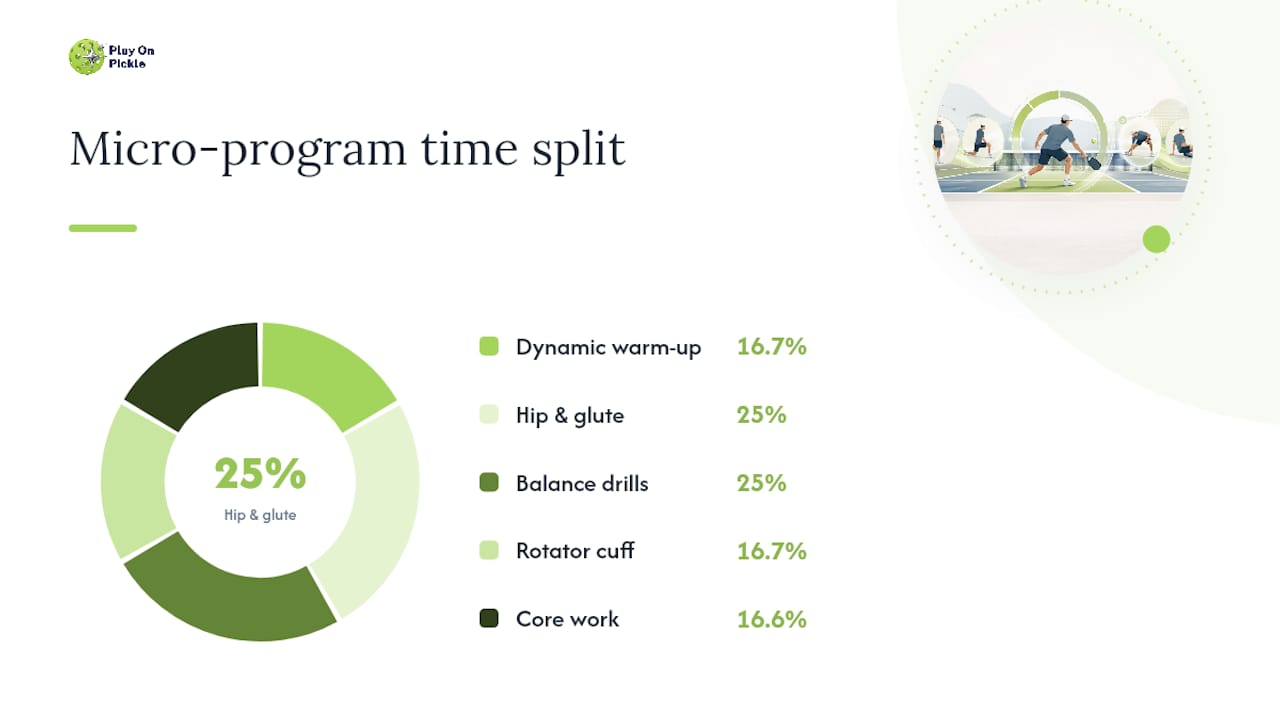
A workable 10 to 12 minute micro-program strings these together: 2 minutes of dynamic warm-up, 3 minutes of hip and glute work, 3 minutes of balance drills, 2 minutes of rotator cuff work, and 2 minutes of core. This kind of prehabilitation, blending eccentric strengthening, balance training, and core stability, is exactly what the research on pickleball-specific prevention recommends.
Progress by adding load or reducing stability, like moving from a stable surface to a foam pad for balance work. Regress by shortening range of motion or slowing the tempo if anything feels sharp or pinching rather than a normal working burn.
Pro Tip: If an exercise causes pain that lingers more than a day or changes how you walk, stop and see a physical therapist rather than pushing through the program. AI flags patterns. It can't tell you whether that twinge in your shoulder is fatigue or a tear.
Building an AI Coaching Routine Into Your Practice
The workflow that actually sticks is simple: capture, review, act, track. Record short clips of your dink recovery, your forehand lunge, and your backward scramble for a lob, ideally from a side angle at hip height. A tripod stabilizes the shot far better than a friend holding a phone.
- Capture footage every 2 to 4 weeks, or after any notable increase in play volume
- Review flags immediately: a mild asymmetry might just call for the micro-program, while a sharp red flag paired with pain warrants a clinician visit
- Track a small set of numbers over time: change-of-direction time, left/right symmetry percentage, and any pain reported on a simple 0 to 10 scale
- Reassess on the same 2 to 4 week cycle to see whether the corrective work is closing the gap
Players who track symmetry percentage alongside pain scores tend to catch small asymmetries before they become the kind of overuse injury that sidelines a season.
One more thing coaches and facilities often skip: get clear consent before recording players, and store footage only as long as it's useful for tracking progress.
What the Research Actually Shows So Far
The evidence backing AI-driven pickleball assessment is young but genuinely encouraging, not just marketing gloss. The MediaPipe pilot study mentioned earlier demonstrated that deep learning pose estimation could separate skill levels by tracking femur flexion differences during dink shots, a level of detail no coach can eyeball reliably. On the wearable side, the IMU-sEMG fusion system's sub-200 millisecond latency suggests real-time feedback during play, not just after-the-fact review, is becoming realistic.
Wearable sensor fusion combined with LSTM modeling can flag risky joint-loading states before a coach or trainer would catch them visually, simply because the system is reading muscle activation and joint angle simultaneously rather than relying on the eye.
Clinical and epidemiological work fills the gap on the "why it matters" side, from fall prevalence to Achilles-loading comparisons against tennis. What's still missing is scale. Most of these are pilot studies or small-sample video analyses, not multi-year trials across thousands of players. Treat the technology as a strong, early-stage signal, not a settled science.
The Honest Limits of AI Screening (And Why That's Fine)
AI screening is a triage tool, not a substitute for a clinician's hands-on exam. The realistic expectation is that it surfaces priorities. It tells you which one or two movement patterns deserve attention this month, instead of leaving you guessing.
Coaches and facilities get the most value running this at a modest cadence, monthly screening sessions rather than constant monitoring, paired with simple routines players will actually finish. Overcorrecting on every minor flag burns motivation fast. A facility can run a low-cost screening clinic with nothing more than a few tripods, a shared review process, and a short list of corrective exercises handed out after each session. The technology scales down to that level easily, which is part of why it's spreading through recreational leagues as fast as competitive ones.
— Drona
Getting Started With AI-Guided Injury Prevention
If you've read this far, you already know the workflow: capture footage, get a biomechanical read, apply a short corrective routine, and track results over time. Playonpickle is built to run that exact loop, using patent-pending computer vision technology to turn a smartphone video into a personalized injury-risk profile and a matching exercise plan, without needing wearables or a lab visit.
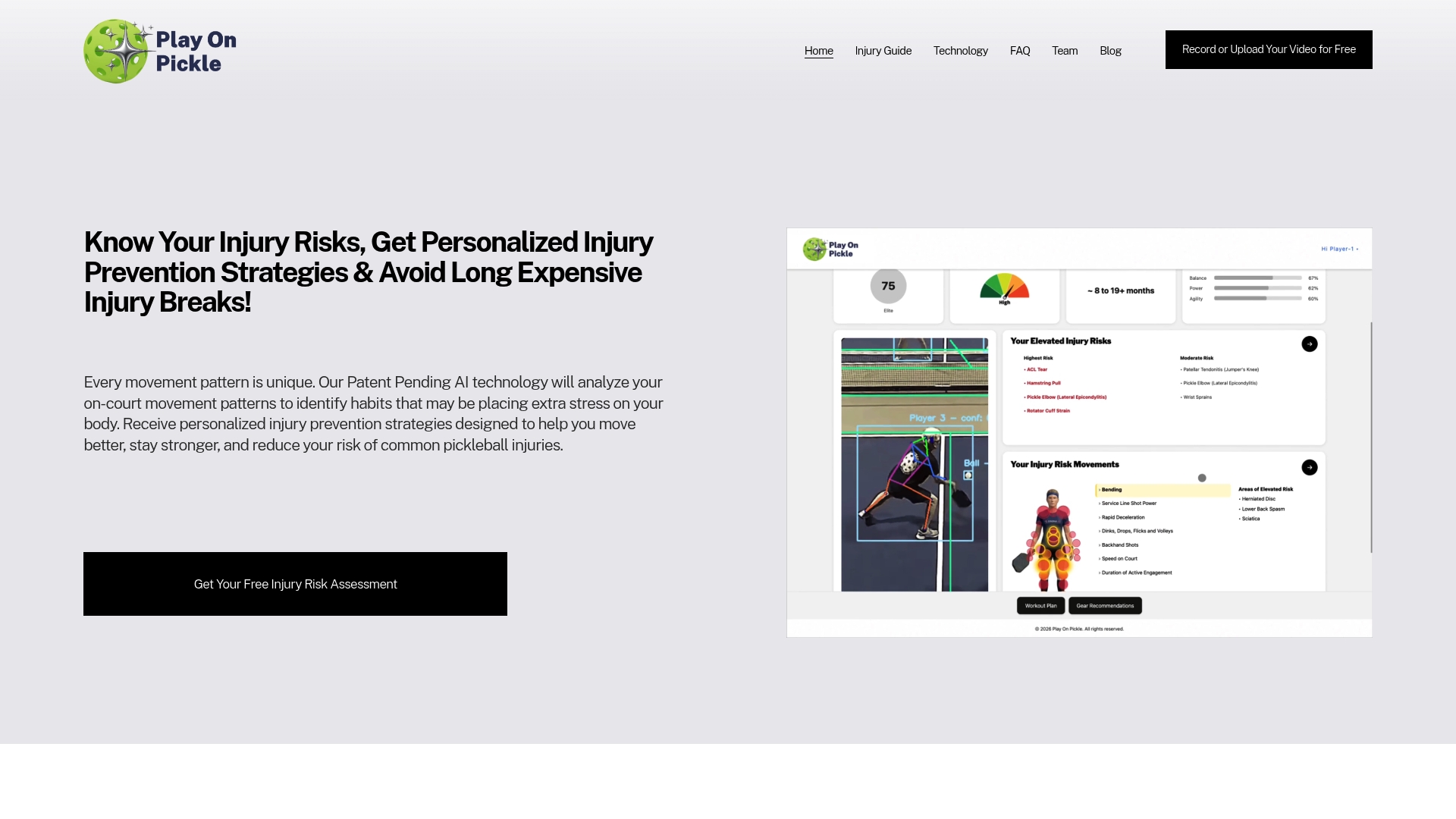
The platform maps directly onto the capture-review-act-track routine described above: you upload footage of your dinks, lunges, and recovery steps, and it returns the same kinds of flags covered here, joint asymmetry, angular velocity, change-of-direction speed, translated into a plan you can actually follow between matches. New users get a free trial before committing, and signing up for the $9.99 monthly subscription currently comes with a free tripod to make consistent video capture painless. Players who want to commit for the season can save with the $99 annual plan instead. Head to the pricing page to start your trial and get your first biomechanical read this week.
Sources
For readers who want the underlying research: the hip strength and fall-risk study in recreational pickleball players, the MediaPipe pose estimation pilot study, the IMU-sEMG wearable fusion trial, the pickleball versus tennis ankle-loading video analysis, and the clinical review on pickleball injury prevention. For posture-focused rehabilitation cues that complement this kind of prehab work, see this guide on improving posture after injury.
- Hip Strength, Change of Direction, and Falls in Recreational Pickleball Players (PMC)
- Pose estimation for pickleball players’ kinematic through MediaPipe-based deep learning: A pilot study (2025)
- Integrated IMU–sEMG biomechanics framework for real-time injury-risk assessment (Nature Scientific Reports, 2026)
- Video analysis comparing pickleball and tennis gameplay: Is the Achilles tendon at risk? (2024)
FAQ
How Often Should I Record Video for AI Analysis?
Every 2 to 4 weeks works for most recreational and competitive players, or sooner if you've increased how often you play. More frequent capture mainly helps if you're actively working through a flagged risk pattern.
Can AI Coaching Replace Seeing a Physical Therapist?
No. AI screening flags movement patterns that carry elevated injury risk, but it doesn't diagnose pain or injury. Any sharp, lingering, or worsening pain needs a clinician's evaluation, not just a corrective exercise routine.
What Does Playonpickle Cost to Try?
Playonpickle offers a free trial before you commit to anything. After that, the monthly subscription runs $9.99, or you can save with the annual plan at $99.
Do I Need Wearable Sensors for Accurate Results?
No. Video-only pose estimation using tools like MediaPipe can estimate joint angles and motion patterns with enough accuracy for practical screening. Wearables add muscle activation data but aren't required to get started.
What's the Biggest Injury Risk AI Coaching Targets in Pickleball?
Falls tied to lunging and backward movement are the most common risk, reported by nearly half of recreational players. Hip abductor weakness and slow change-of-direction speed are the two metrics most closely tied to that risk.