
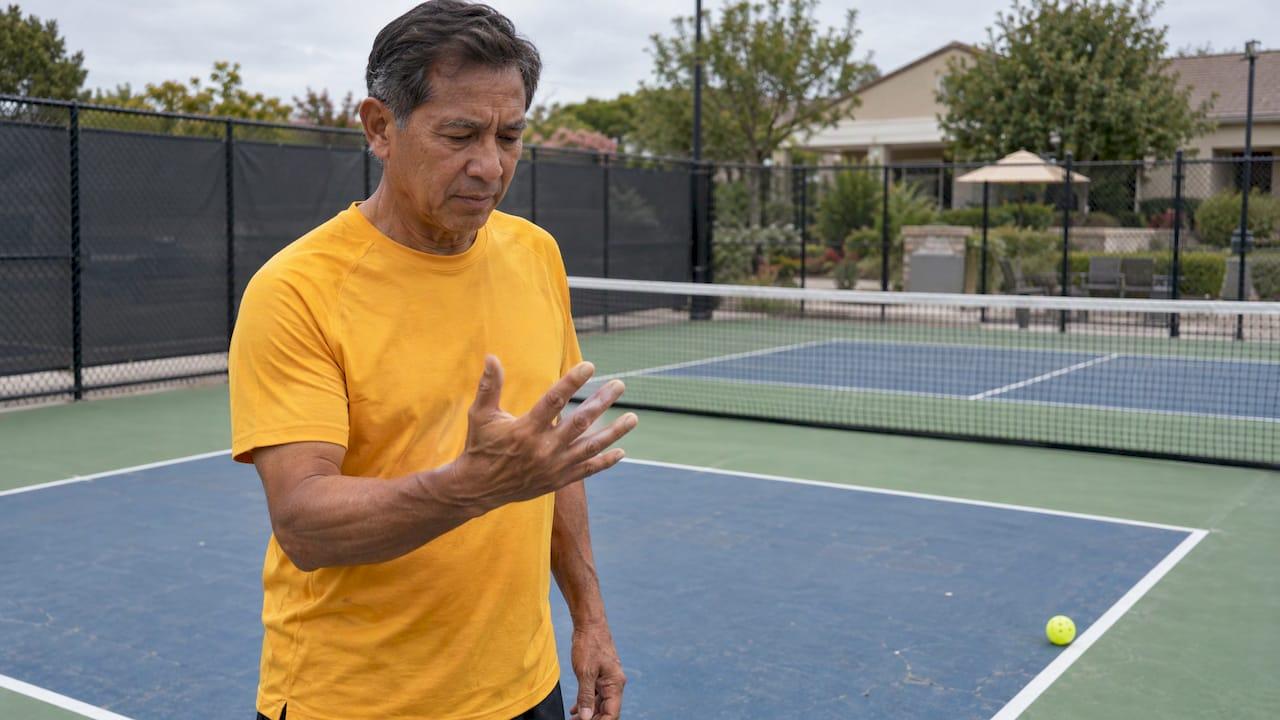
A finger sprain in pickleball is a stretched or torn ligament in a finger joint, usually from a ball, paddle or fall jamming the finger. Most mild ones settle with a few days of rest, ice and a gentle return. The skill is telling a mild sprain from something that needs an X-ray, then fixing the habits that put your hands in harm's way. Play On Pickle analyzes your movement from a video you upload and gives you personalized exercises, so the next season looks different from the last.
TL;DR
- A sprain is a ligament injury. Swelling at one knuckle, tenderness and pain with bending are typical, and mild cases often improve within one to two weeks.
- A crooked finger, severe pain, numbness, a pale tip, or being unable to bend or straighten the finger means get it examined, not taped.
- Rest, ice, gentle compression and elevation help a mild sprain. See a doctor if pain and swelling last beyond 48 hours.
- Return to play depends on grade: roughly two weeks for mild sprains, six to eight weeks for severe ones, with a clinician's okay.
- Loose grip, good footwork, no diving for shots and a movement check lower your odds of a repeat.
Table of Contents
- How pickleball sprains a finger
- Sprain, fracture or dislocation: how to tell
- What to do in the first 48 hours
- How long until you can play again
- Why the same finger gets hurt twice
- Who this matters for
- Promo: see your own movement patterns
- Perspective
- FAQ
- Sources
How pickleball sprains a finger
Pickleball is a fast, close-quarters game, and your fingers are the first thing between a ball and your paddle. The Sports Foundation lists the usual scenes: a fall where a finger catches the court, a ball or paddle striking an extended finger, and paddles colliding in tight doubles play at the net.
The American Academy of Orthopaedic Surgeons explains the mechanism: a sprain happens when the ligaments that support a finger joint are stretched, commonly when a strong force bends the finger backward, pushes it sideways or hits it on its tip, as when you catch a ball. Most sprains involve the PIP joint, the middle knuckle of the finger.
Typical signs are:
- Pain and fast swelling at one knuckle
- Tenderness on one side of the joint
- Bruising
- Stiffness when you try to bend or straighten it
- A loose or wobbly joint if the ligament is fully torn
Older players should take note. A 2024 review of pickleball injuries in aging athletes points out that the sport skews older than other racquet sports, and that slower reaction time and more slips and falls make sudden traumatic injuries more likely.
Sprain, fracture or dislocation: how to tell
A jammed finger is a sprain of the joint-supporting ligaments without a broken bone, as the American Academy of Pediatrics describes it. The trouble is that a break can look similar early on. Cleveland Clinic notes that broken fingers share swelling, stiffness and tenderness with sprains, but may also bring bruising, severe pain, an inability to move the finger, or visible deformity.
Use this quick sort right after the point ends:
| What you notice | Points toward | What to do |
|---|---|---|
| Swelling and soreness, finger moves fully, improves within a couple of hours with rest and ice | Mild sprain | Rest, ice, watch it over the next days |
| Redness and swelling on the side of the finger | Collateral ligament sprain | Protect it and recheck within 48 hours |
| Tenderness on the underside of the finger after a backward bend | Ligament injury on the palm side | Get it checked if it does not settle quickly |
| Crooked or angled finger, severe bruising, cannot bend or straighten it | Possible fracture or dislocation | Same-day or next-day X-ray |
| Numb, pale or cold fingertip, tip cannot be actively straightened | Nerve, blood flow or tendon problem | Seek care promptly |
The first rows follow Hospital for Special Surgery guidance: if symptoms ease within a couple of hours and the finger moves fully, it was most likely a sprain that heals by itself, while severe bruising, swelling or an inability to bend or straighten the finger calls for an X-ray and evaluation at urgent care or with a hand doctor. The last row reflects the Sports Foundation warning signs: visible deformity, a tip that cannot be actively straightened or bent, numbness or paleness.
Two more points matter on court. Do not pull a dislocated finger straight yourself. The Sports Foundation advises having it reduced professionally with an X-ray afterward. And take rings off right away, before swelling makes that impossible.
How doctors grade a sprain
AAOS grades finger sprains by how much ligament is damaged:
- Grade 1 (mild): the ligament is stretched but not torn.
- Grade 2 (moderate): a partial tear, sometimes with some loss of function.
- Grade 3 (severe): a complete tear or the ligament pulling away from the bone, sometimes with a small chip of bone. This needs medical or surgical care.
Diagnosis usually starts with an exam of joint stability and an X-ray. Stress X-rays, MRI or ultrasound are used when more detail is needed.
What to do in the first 48 hours
For a mild sprain, AAOS recommends the RICE routine:
- Rest. Keep the hand out of strenuous use for at least 48 hours.
- Ice. Use a cold pack for 20 minutes at a time, several times a day, with a cloth between the pack and your skin.
- Compression. Wrap with an elastic bandage that is snug but not tight.
- Elevation. Keep the hand above heart level.
Over-the-counter anti-inflammatory medicines such as ibuprofen can reduce pain and swelling, according to AAOS. If you take other medications, have a stomach, kidney or heart condition, or are unsure, ask your doctor or pharmacist first. For a general walk-through of home care for sprains in the hand and wrist, see these sprained wrist treatment basics.
See a doctor if pain and swelling persist beyond 48 hours, as AAOS advises. Cleveland Clinic gives a similar line: get seen if symptoms worsen 24 to 48 hours after the injury, or if severe pain continues despite RICE and an anti-inflammatory.
Buddy taping: useful, not universal
Buddy taping fastens the injured finger to its neighbor so the healthy finger acts as a splint. It suits stable sprains and is often used after brief immobilization for moderate ones. Midwest Orthopaedics at Rush adds an important limit: taping a rotated fracture, or a mallet or central slip tendon injury that needs the joint held straight, can lock the finger in the wrong position while it heals. If the finger is not clearly better after a day or two, or any warning sign above applies, get it examined before you tape.
Do not keep it still for long, either. The Sports Foundation notes that finger joints stiffen quickly when held still, so once the doctor agrees, start gentle bending and straightening within days. If the joint is still stiff or swollen after a few weeks, hand therapy is the next step.

How long until you can play again
Timelines vary with the grade, and a clinician should confirm yours. The published ranges:
| Source | Mild | More severe |
|---|---|---|
| Cleveland Clinic | Most jammed fingers heal in one to two weeks; return to sport up to two weeks | At least three to six weeks to heal; return to sport in six to eight weeks |
| Sports Foundation | Two to six weeks out for a sprain | Four to eight weeks for a reduced dislocation with buddy taping; eight to twelve weeks or more for tendon injuries and fractures involving the joint surface |
AAOS adds a patience note: PIP joint sprains can take up to 12 months to fully heal, and swelling may linger a long time. A knuckle that stays a little thick after you are playing pain-free is common, but a finger that keeps getting worse is not.
A sensible return to the court
Treat the return as a ramp, not a switch:
- Full, pain-free range of motion in the finger, matching the other hand.
- Normal grip strength when squeezing the paddle handle, no sharp pain.
- Dinking and soft hands drills first, before volleys at the net.
- Protective taping if your clinician approves it, particularly for the first sessions back.
- Shorter sessions with rest days between them.
Avoid the net exchanges in doubles until the finger tolerates a ball hitting the paddle without pain, since fast hands battles are where jams happen.
Why the same finger gets hurt twice
A sprain is rarely just bad luck. The research points to a handful of repeat offenders:
- A tight grip. A 2020 review in ACSM's Current Sports Medicine Reports advises novices to start with a continental neutral grip, avoid gripping the paddle too tightly, and choose a lighter paddle (it gives 7.2 oz rather than 8.5 oz as an example).
- Falls. A 2026 study of 164 pickleball injuries at a tertiary academic center found 30 wrist and hand injuries, and falls accounted for most of the serious hand and wrist cases. The authors point to fall prevention, proper footwear, and off-court balance and coordination work.
- Diving for shots. Baptist Health recommends not diving, using good footwork and shot technique, wearing supportive shoes, stretching hands and wrists before and after play, and allowing rest between sessions.
- Prior injury and poor warm-up. The aging-athlete review lists advanced age, poor technique and equipment, improper stretching or warm-up, past injury and court surface among eight risk factors.
Notice that most of these are movement problems: how you step, reach, brace and grip. They are also things you can see on video. If wrist pain is part of your story too, our guide to pickleball wrist pain and safe return to play covers it, and the injury prevention guide for recreational and older players covers the wider picture.
Who this matters for
Recreational and older players get the most from simple changes: looser grip, a lighter paddle, a better warm-up and balance work. Competitive players tend to play more at the net, where paddles and balls collide at speed, so reaction drills and technique matter. Coaches and facilities can reduce net-play collisions by teaching court spacing and a relaxed grip. Physiotherapists who treat hand injuries will recognize the pattern: the injury is the end of a chain that starts in how the player moves.

Promo: see your own movement patterns
Play On Pickle uses patent-pending computer vision to analyze a video you upload, identify biomechanical stress points and give you personalized injury risk assessments, plus exercise and equipment recommendations. You can start with a free trial. After that, the plans are $9.99 per month or $99 per year, listed on the pricing page. The technology page explains how the analysis works, and the free tripod offer comes with the $9.99 monthly plan.
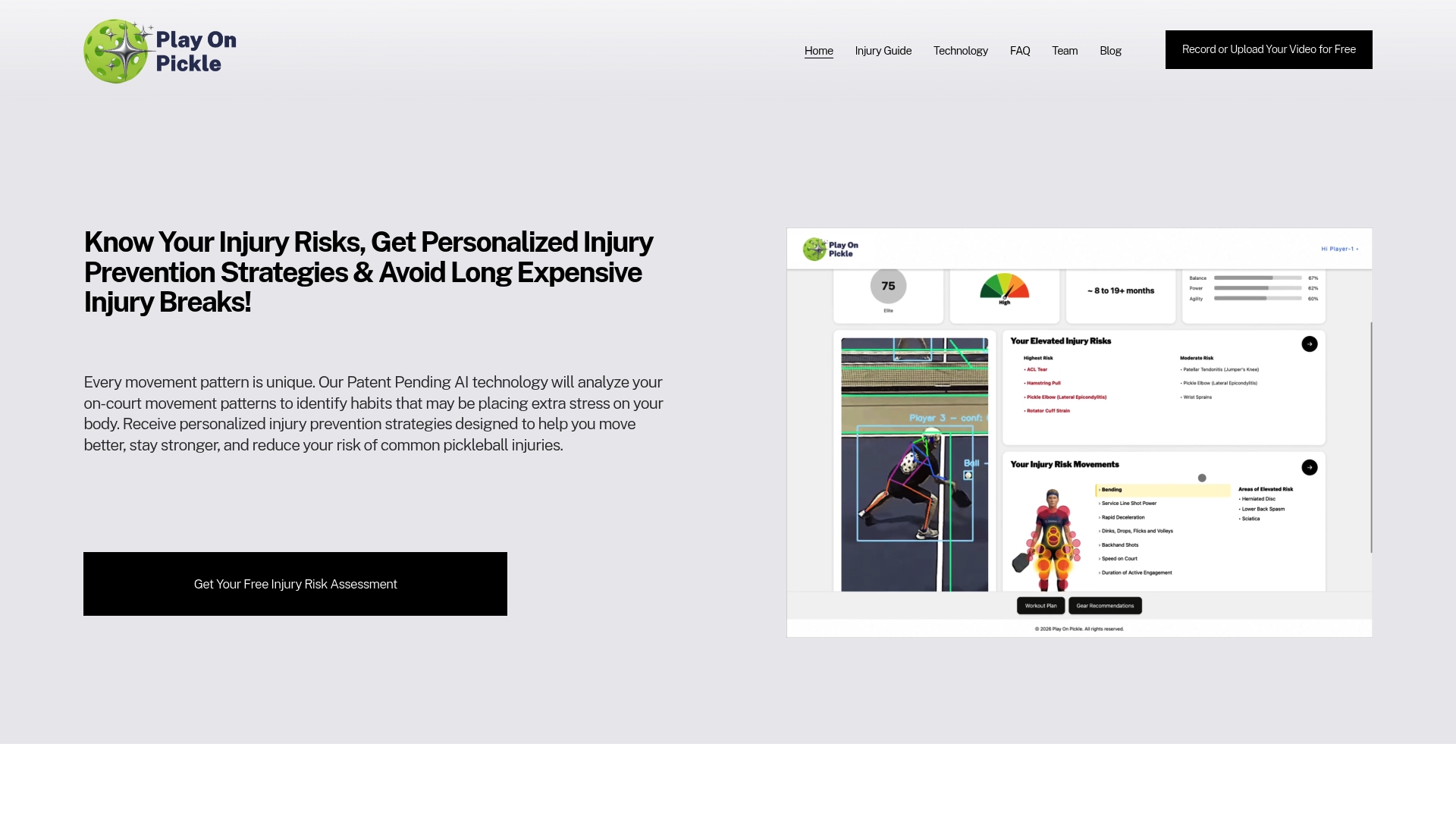
If you are coming back from a finger sprain, get your doctor's clearance first, then use your own footage to see how you grip, reach and land.
Perspective
Most players think of a sprained finger as a freak accident. We see it differently: it is often the last step in a movement pattern. Gripping the paddle too hard, reaching late at the kitchen line, or bracing with an open hand while falling all load the fingers in ways that a few small changes can ease.
That is why we built Play On Pickle around video. Recreational players rarely have a coach watching every session, and few people do conditioning work for a sport they think of as casual. Our approach is designed to identify stress points in your individual biomechanics and turn them into simple exercises that fit into your routine, with minimal equipment and time.
Recovery gets you back on the court. Understanding why the injury happened is what keeps you there. If you want a second set of eyes on how you move, start with a clip of your own play.
Drona
FAQ
Can I keep playing pickleball with a sprained finger?
Not right away. Mild sprains need at least 48 hours of rest from strenuous hand use, and many people need one to two weeks. Return to non-contact play with buddy taping can be possible sooner for stable mild sprains, but only if a clinician has confirmed the finger is stable.
Should I wear a brace or tape for pickleball?
Buddy taping can protect a stable sprain, and the ACSM review mentions taping and bracing for players with prior injury or joint instability. Tape only after a fracture or tendon injury has been ruled out, since the wrong position can hurt healing.
How do I know my finger is not broken?
You cannot be certain without an X-ray. A deformed finger, severe pain, heavy bruising, numbness, a pale tip or an inability to bend or straighten it means you should be examined the same or next day.
How do I prevent finger sprains in pickleball?
Hold the paddle loosely, choose a paddle weight that suits you, avoid diving, wear supportive shoes and warm up your hands and wrists. Balance and coordination work off the court helps too. A movement analysis shows where your technique loads your hands.
Sources
- Finger Sprains, OrthoInfo (AAOS)
- Jammed Finger: Causes, Symptoms & Treatment, Cleveland Clinic
- Common Finger Injuries in Athletes, HealthyChildren.org
- So You Jammed Your Finger: Now What?, Hospital for Special Surgery
- 16 Common Pickleball Injuries, Sports Foundation
- Is My Finger Jammed or Broken?, Midwest Orthopaedics at Rush
- Pickleball Injuries in the Aging Athlete, PMC
- Pickleball-related injuries treated at a tertiary academic center, PMC
- Pickleball: Review and Clinical Recommendations, ACSM's Current Sports Medicine Reports
- Pickleball-Related Hand and Wrist Injuries, Baptist Health