
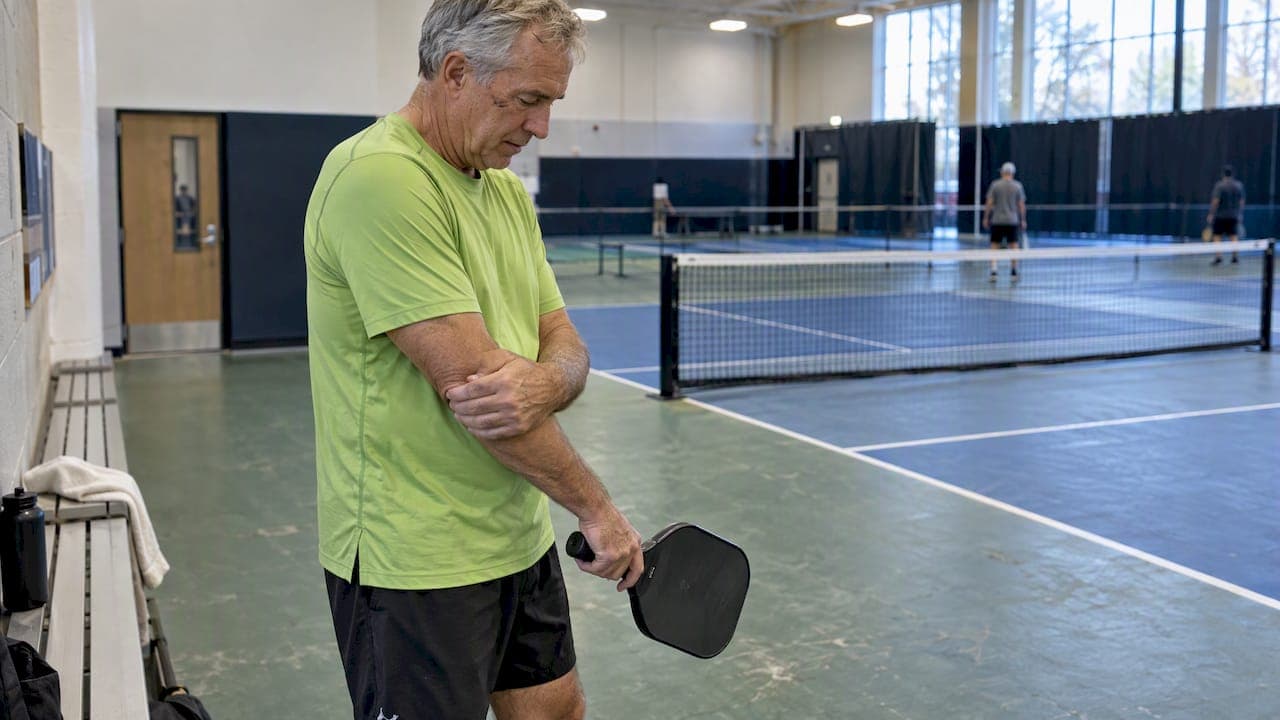
Yes, pickleball players can develop golfer's elbow, and the fix starts the moment you feel it. Stop the motion that triggers the pain, ice the inner elbow, and ease into gentle wrist mobility within a day or two. Medial epicondylitis in pickleball is usually tied to wrist and forearm overuse from repetitive shots, and most cases respond to conservative care over several weeks, though full relief can take months. See a doctor if the pain is severe, numbness appears, or nothing improves after a couple of weeks of rest.
TL;DR:
- Most cases of golfer's elbow in pickleball respond well to conservative care, including rest, ice, and gradual strengthening exercises over several weeks to months.
- Equipment adjustments, such as using a mid-weight paddle with a suitable grip size and limiting wrist flicking, can significantly reduce stress on the elbow.
- Proper warm-up, technique correction, and avoiding overloading by increasing play volume gradually are key preventive measures.
- Self-checks like resisted wrist flexion and grip strength comparison can help gauge injury severity before seeking medical advice.
- A staged rehab process focusing on isometric and eccentric exercises, plus sport-specific loading, is essential for safe return to play.
Table of Contents
- What golfer's elbow is and how it differs from other elbow injuries
- How pickleball play creates elbow stress: mechanics and equipment factors
- Symptoms and quick self-checks to decide what to do next
- Prevention: warm-up, technique, equipment, and conditioning
- Treatment and rehab: stepwise conservative care and evidence-backed adjuncts
- Recovery timeline and staged return-to-play plan
- How movement analysis helps identify and reduce mechanical risk
- Long-term complications and risks of ignoring golfer's elbow in pickleball players
- Comparison of treatment options specific to pickleball athletes, including effectiveness and evidence
- Ergonomic paddle selection and modification tips tailored to minimize golfer's elbow risk
- Detailed rehabilitation exercises progression with clear milestones for pickleball participants
- Psychological impact and coping strategies for athletes during recovery from golfer's elbow
- Small daily habits that prevent long absences from play
- FAQ
- Sources
- Keep building a durable game
What golfer's elbow is and how it differs from other elbow injuries
Golfer's elbow, or medial epicondylitis, is irritation and microscopic damage to the tendons that attach your wrist flexor and forearm pronator muscles to the bony bump on the inside of your elbow, the medial epicondyle. It develops from repeated gripping and wrist-flexing motions rather than a single traumatic event, which is why Mayo Clinic describes it as an overuse condition.
It is easy to confuse with its better-known cousin, tennis elbow (lateral epicondylitis), which affects the outer elbow and extensor tendons instead. A few distinctions help sort out what you are dealing with:
- Location matters: pain on the inner elbow points to golfer's elbow, while outer elbow pain suggests tennis elbow.
- Instability or a popping sensation during a swing can indicate a ligament sprain rather than tendon irritation, which needs a different evaluation.
- A clinician typically diagnoses it through a physical exam, resisted wrist flexion testing, and sometimes imaging if symptoms are unusual or prolonged.
How pickleball play creates elbow stress: mechanics and equipment factors
Pickleball loads the inner elbow in ways that tennis and golf do not always replicate. The constant dinking in the kitchen line asks your wrist and forearm to make small, repeated flexion movements, and a one-handed backhand adds torque right at the tendon origin on the inside of the elbow. Players who grip the paddle tightly or snap their wrist on dinks instead of using a stable forearm tend to load that tendon the hardest.
Equipment plays a role too. A paddle that is too heavy, too stiff, or fitted with a grip that does not match your hand size forces your forearm muscles to compensate on every shot. Behavioral patterns compound the mechanical issues:
- Sudden jumps in play volume, like three tournaments in a weekend after playing once a week, overload tissue that has not adapted.
- Skipping a warm-up sends cold tendons straight into fast, repetitive loading.
- Playing through early soreness turns a minor irritation into a lingering injury.
Pro Tip: Loosen your grip pressure on dinks. A relaxed hand transfers less shock into your forearm tendons than a white-knuckle grip.
Symptoms and quick self-checks to decide what to do next
The hallmark signs are tenderness on the inner elbow, pain when gripping or shaking hands, and sometimes aching that radiates down the forearm. Stiffness when making a fist and weakness in the hand are also common, according to Mayo Clinic's symptom overview.
Two quick checks can help you gauge severity:
- Resisted wrist flexion test: bend your wrist downward against gentle resistance from your other hand; sharp inner-elbow pain suggests tendon involvement.
- Grip strength check: compare your grip on the affected side to the healthy side; a notable difference points toward golfer's elbow rather than general soreness.
Seek prompt medical attention if you notice numbness, tingling into the fingers, significant swelling, or an inability to bend or straighten the elbow.
Prevention: warm-up, technique, equipment, and conditioning
Most golfer's elbow cases in pickleball are preventable with a few consistent habits layered into your routine; for practical self-care and conservative measures, see Tennis & Golfer's Elbow: Natural Fixes by Align Clinic.
- Warm up your forearms before you serve a single ball. Spend five minutes on wrist circles, light forearm stretches, and a few practice swings that gradually increase in speed.
- Fix the technique habits that load the tendon. Keep your grip relaxed, favor a two-handed backhand on hard-driven balls, and minimize wrist flicking when dinking; let your shoulder and core drive the shot instead.
- Match your equipment to your body. A mid-weight paddle in the 210 to 240 gram range with a polymer core absorbs more vibration than a heavier, stiffer paddle, and a grip sized to your hand reduces the squeeze force needed to control it, according to pickleball-focused rehab guidance from sports clinics.
- Build a simple strength routine. Eccentric wrist curls, where you slowly lower a light weight rather than lifting it, are considered a gold-standard tendon-loading exercise. Add rotator cuff and core work since a stronger shoulder and trunk take pressure off the elbow during groundstrokes.
- Manage your playing load. Increase weekly play time gradually rather than jumping from once a week to daily sessions, build in two rest days, and jot down minutes played and any soreness in a simple log so you notice patterns before they become injuries.
Pro Tip: If you play back-to-back days, alternate a hard-hitting session with a dinking-only or doubles-focused session to vary the load on your forearm.
For more on matching equipment to your swing, our guide to paddle choices for elbow relief covers specific features worth checking before you buy.
Treatment and rehab: stepwise conservative care and evidence-backed adjuncts
Conservative care is the starting point for nearly every case. Early steps include:
- Briefly modifying or pausing the aggravating activity rather than stopping all movement.
- Icing the inner elbow for 15 to 20 minutes after activity.
- Wearing a forearm strap or brace during play to offload tendon stress.
- Using topical or oral NSAIDs as appropriate for short-term pain relief.
Once acute pain settles, Mayo Clinic recommends progressing through isometrics, then eccentric strengthening, and eventually heavier slow-resistance work, done consistently rather than intensely. Eccentric exercise is considered the primary rehabilitation strategy because it encourages the tendon to remodel and tolerate load again.
A randomized controlled trial of 111 participants found that combining dry needling with eccentric exercise produced greater short-term pain reduction and functional improvement than eccentric exercise paired with NSAIDs, as reported in a trial on epicondylalgia treatment. That result applies specifically to short-term outcomes and should be read as one option delivered by a qualified clinician, not a stand-alone fix.
If symptoms persist despite months of structured rehab, a provider may discuss corticosteroid injections, shockwave therapy, or a referral to a specialist. Mayo Clinic's treatment overview notes that surgery is rarely needed and is typically considered only after 6 to 12 months of failed conservative management.
Recovery timeline and staged return-to-play plan
Many players notice improvement within a few weeks of consistent rest and rehab, but Mayo Clinic notes that total symptom relief often takes 3 to 6 months. Rushing back tends to cause setbacks, so a staged return works better than an all-or-nothing comeback.
- Stage one: daily wrist mobility and light isometric holds with no pain the next day.
- Stage two: short, easy dinking sessions focused on form, not pace.
- Stage three: controlled rallies at moderate intensity, watching for soreness in the 24 to 48 hours after.
- Stage four: full-speed drives, serves, and match play once each prior stage is pain-free.
Working with a physical therapist or coach on sport-specific loading drills before returning to full intensity catches technique issues before they cause a repeat injury.
How movement analysis helps identify and reduce mechanical risk
A lot of elbow overload comes down to patterns players cannot see in themselves: a wrist that snaps instead of stays stable, a grip that tightens under pressure, or small repeated motions that add up over hundreds of dinks. These are the exact categories that movement analysis is built to catch:
- Wrist motion patterns during dinks, drives, and backhands.
- Grip tightness and timing relative to ball contact.
- Repeated micro-loading across a session that a player would not notice in the moment.
Our Play On Pickle service uses AI-driven computer vision to flag these stress points from uploaded video and build a biomechanics-based prevention plan. Pairing that analysis with a physical therapist or coach helps turn the findings into actual technique changes and a progressive loading plan.
Long-term complications and risks of ignoring golfer's elbow in pickleball players
Playing through persistent inner elbow pain rarely resolves on its own, and the tendon damage tends to compound with continued loading. What starts as mild tenderness after a session can progress into chronic tendinosis, a degenerative change in the tendon tissue that is slower to heal and more resistant to standard rehab than an early-stage strain.
Ignoring symptoms also increases the odds of compensatory injuries elsewhere. Players who alter their grip or swing to avoid elbow pain often shift stress to the wrist or shoulder, creating a second problem on top of the first. A weakened grip from chronic tendon irritation can also affect control and consistency during play, which frustrates recreational and competitive players alike.
In more severe or neglected cases, the tendon can partially tear, which typically requires a longer, more structured rehabilitation period and occasionally surgical consultation if conservative measures fail over many months. The earlier a player addresses symptoms with rest, mobility work, and progressive strengthening, the shorter and more predictable the recovery tends to be. Waiting it out while continuing full-intensity play is one of the most common reasons a short-term ache turns into a months-long absence from the sport.
Comparison of treatment options specific to pickleball athletes, including effectiveness and evidence
No single treatment works in isolation, and the right combination depends on how long symptoms have lasted. Rest and activity modification are the first lever for everyone: pausing the aggravating motion for a short period reduces acute inflammation without requiring any special equipment or cost.
Bracing or a forearm strap offloads tendon stress during play and is a reasonable short-term bridge for players who need to keep some activity going. NSAIDs, whether topical or oral, help manage pain in the early phase but do not address the underlying tendon changes on their own.
Structured physical therapy, progressing from isometrics to eccentric loading to heavier slow-resistance work, has the strongest backing as a long-term fix because it addresses the tendon's capacity to handle load again. Adding dry needling to an eccentric program produced greater short-term pain and function gains than eccentric exercise paired with NSAIDs in a controlled trial of 111 participants, though that benefit is specific to the short term and depends on access to a qualified clinician.
Shockwave therapy and corticosteroid injections sit further down the list, generally reserved for cases that have not responded to months of conservative care. Surgery remains a last resort, considered only after 6 to 12 months of failed conservative treatment according to Mayo Clinic. For most recreational pickleball players, a combination of rest, bracing, and a consistent eccentric strengthening program resolves symptoms without ever needing the more invasive options.
Ergonomic paddle selection and modification tips tailored to minimize golfer's elbow risk
Your paddle is one of the few variables you control completely, and small adjustments here can meaningfully change the load on your forearm. A mid-weight paddle in the 210 to 240 gram range tends to balance power and control without forcing your forearm to overwork on every swing, a range commonly cited in physiotherapist guidance for pickleball players.
Core material matters as much as weight. Polymer cores absorb more vibration at contact than harder composite cores, which means less shock transmits into your wrist and elbow on mishits or hard exchanges. If you already own a stiffer paddle, adding an overgrip can dampen some vibration without replacing the whole paddle.
Grip size deserves more attention than most players give it. A grip that is too small forces you to squeeze harder to maintain control, which keeps your forearm flexors under constant tension throughout a match. A grip that is too large makes it harder to snap the wrist appropriately for spin, which can push players toward compensatory elbow-loading motions. Matching grip circumference to your hand size, with your fingers comfortably wrapping the handle and a small gap between fingertip and palm, reduces the sustained gripping force your tendons absorb over a long session.

Our breakdown of paddles suited for elbow relief walks through specific features worth checking, including core type, weight distribution, and grip taper, before you buy your next paddle or modify your current one.
Detailed rehabilitation exercises progression with clear milestones for pickleball participants
Rehab works best as a sequence rather than a single exercise repeated indefinitely. Early on, the goal is pain control: isometric wrist flexion holds, where you push your wrist into a stable surface without moving it, done for 30 to 45 seconds at a time, calm an irritated tendon without adding mechanical stress. A reasonable milestone here is holding the position pain-free for several sets before moving forward.
Once isometrics feel comfortable, eccentric wrist curls become the centerpiece. Using a light dumbbell, you lift with the unaffected hand and lower slowly with the affected wrist, emphasizing the controlled descent. Mayo Clinic identifies eccentric exercise as a primary rehabilitation strategy because the slow lengthening motion encourages the tendon to remodel and handle load again. A fair milestone is completing three sets of 10 to 15 slow repetitions without next-day soreness.
From there, progression moves to heavier slow-resistance training, which loads the tendon through a fuller range at higher intensity while keeping the tempo controlled. Pair this with shoulder and core strengthening, since a stronger shoulder reduces compensatory strain on the elbow during swings.

The final milestone before returning to pickleball is sport-specific loading: simulating dinks, backhands, and drives with a paddle in hand, gradually increasing speed and volume, ideally supervised by a physical therapist or coach who can spot any lingering compensation patterns before they turn into a setback.
Psychological impact and coping strategies for athletes during recovery from golfer's elbow
Stepping away from a sport you play regularly takes a toll that goes beyond the physical injury. Recreational players often describe frustration at missing league nights, a sense of lost routine, and worry that their game will not return to the level it was before. That frustration can tempt players to return earlier than the tendon is ready for, which sets recovery back further and creates a discouraging cycle.
Setting realistic expectations helps more than almost anything else. Knowing upfront that consistent rehab often takes 3 to 6 months for full relief reframes a slow week as normal progress rather than a failure. Tracking small wins, like pain-free grip strength or a completed set of eccentric curls without soreness, gives recovery a visible shape instead of an open-ended wait.
Staying connected to the sport in ways that do not aggravate the injury also helps. Watching matches, reviewing your own footage for technique adjustments, or coaching a newer player keeps the social and mental benefits of pickleball alive while your tendon heals. Leaning on a coach, training partner, or physical therapist for both accountability and encouragement tends to make the stretch between injury and full return feel shorter than it would navigating it alone.
Small daily habits that prevent long absences from play
Most golfer's elbow cases I see discussed come down to skipped basics rather than bad luck. A five-minute warm-up, a quick grip check before you tighten your hand around the paddle, and two true rest days a week do more for long-term durability than any single piece of gear.
Patience beats urgency here. Progressive loading, done consistently, prevents recurrence far more reliably than rushing back at the first pain-free day. Pairing a coach's technique feedback with targeted conditioning, and a movement-analysis tool where it fits your routine, builds a more complete picture of what your body actually needs.
— Drona
This article is general information, not a substitute for advice from a qualified doctor. Consult a qualified healthcare professional about your own circumstances before acting on anything here.
FAQ
What is the fastest way to fix a golfer's elbow?
There is no instant fix, but the fastest path to improvement combines stopping the aggravating motion, icing the area, and starting eccentric wrist exercises early. Mayo Clinic identifies eccentric strengthening as the primary rehab strategy, though consistent total symptom relief often takes 3 to 6 months.
What is the most common injury in pickleball?
Elbow injuries, including golfer's elbow and tennis elbow, are among the most frequently reported issues in pickleball players, largely due to repetitive wrist and forearm loading during dinks and groundstrokes. Harvard Health notes that pickleball-related elbow injuries are common and highlights technique and equipment changes as practical prevention steps.
How do I get rid of pickleball elbow?
Start with rest from the aggravating motion, ice, and a brace or strap to offload the tendon, then progress through isometric holds into eccentric strengthening exercises as pain allows. If symptoms persist past a few weeks despite consistent home care, a physical therapist can guide the progression and check your pickleball technique for contributing habits.
How long does it take for a pickleball elbow to heal?
Many players notice improvement within a few weeks of consistent rest and rehab, but Mayo Clinic states that total symptom relief often requires 3 to 6 months of consistent rehabilitation. Returning to full-intensity play too early is one of the most common reasons recovery drags on longer than expected.
Sources
- Mayo Clinic Q and A: Understanding ‘golfer’s elbow’
- Golfer's elbow (Medial epicondylitis) - Symptoms and causes - Mayo Clinic
- Efficacy of Dry Needling Combined with Eccentric Exercise Versus Oral and Topical NSAID Treatment in Patients with Tennis Elbow: A Randomized Controlled Trial - PMC
- How to avoid this common pickleball injury - Harvard Health
Keep building a durable game
Technique fixes and a smarter warm-up only go so far without knowing exactly where your own swing puts the most strain. Our Play On Pickle subscription analyzes your uploaded video with AI-driven computer vision to flag the wrist and grip patterns most likely to lead to injury, then builds a prevention plan around your own biomechanics rather than generic advice. A monthly plan runs $9.99, or $99 per year if you prefer to commit for the season, and new subscribers can currently grab a free tripod to make filming your sessions easier from day one. If you have been nursing a sore elbow or just want to catch problems before they sideline you, check your plan options and get a read on your own mechanics before your next session.