
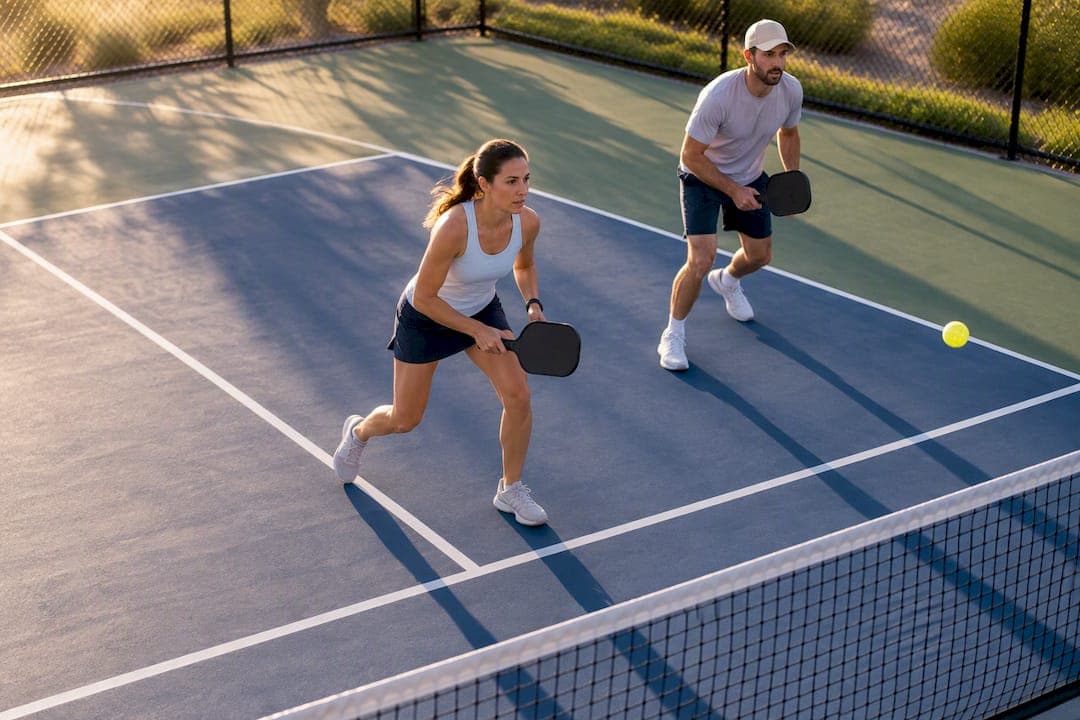
The most effective way to protect yourself in doubles is a short video-based biomechanical screen paired with a targeted exercise plan built around what that screen finds. Record a few representative clips of your rallies and footwork, run a real dynamic warm-up before you play, and treat any persistent pain as a signal to see a clinician. An AI-assisted screening tool is one option available for players wanting a direct, do-it-yourself method.
TL;DR:
- Video clips should focus on baseline rallies, kitchen volleys, lunges, backward recoveries, and change-of-direction movements to identify specific biomechanical risks.
- A personalized exercise routine should target deficits in lower extremity strength, upper limb stability, balance, and movement coordination, with gradual progression based on control and pain-free execution.
- Playing beyond 90 minutes or consecutive days increases injury risk, so players should limit session duration, incorporate rest days, and monitor soreness and equipment wear.
- Video analysis accurately reveals joint angles and symmetry but cannot diagnose tissue injuries; persistent pain or stability issues still require clinical evaluation.
- Using proper court footwear, eyewear, and clear communication signals can significantly reduce the risk of falls and collisions during doubles play.
Table of Contents
- Why Biomechanics Matters for Doubles Injury Risk
- What Video Should You Capture for a Doubles Safety Screen?
- How Does a Biomechanical Screening Turn Into an Exercise Plan?
- Which Exercises Actually Reduce Doubles Injury Risk?
- How Much Doubles Pickleball Is Too Much?
- What Can Video Analysis Actually Tell You, and What Can't It?
- Your First Two Weeks: A Doubles Safety Checklist
- Protective Gear That Actually Matters in Doubles
- Communication and Signaling That Prevent Doubles Collisions
- Emergency Preparedness for Doubles Play
- Court Positioning Strategies That Prevent Doubles Collisions
- Court, Paddle, and Footwear Factors That Change Your Risk
- Why a Biomechanics-First Approach Fits Where Doubles Pickleball Is Now
- Start Your Personalized Doubles Safety Screen
- Key Research and Guidance
- Sources
- FAQ
Why Biomechanics Matters for Doubles Injury Risk
Doubles play looks calmer than singles, but the movement demands that hurt players are almost identical. A 2025 nationwide study of 1,758 pickleball participants found that acceleration, deceleration, jumping, and sudden direction changes generate axial and torsional loading through the joints, whether you're covering a lob at the baseline or shuffling to protect the middle in the kitchen line.
The injury map backs this up. Emergency department data shows a steep climb in pickleball injuries, with fractures and sprains or strains making up a large share of cases, the wrist showing up repeatedly in fracture reports. A separate single-institution review found soft-tissue strains and ruptures accounted for nearly half of all injuries treated, with rotator cuff problems and arthritis-related pain following behind.
Nearly half of recreational players in one study reported a pickleball-related fall, and most of those falls happened during lunging or backward movement. Doubles players make that exact movement constantly, retreating for lobs while a partner covers the net. Neuromuscular and proprioceptive training measurably changes how the body absorbs these forces, which is the whole argument for a movement-first approach.
What Video Should You Capture for a Doubles Safety Screen?
A useful screen doesn't require a studio setup. It requires the right moments captured clearly enough to see joint angles and timing.
Prioritize these clips:
- Baseline rallies showing your normal groundstroke stance and recovery.
- Kitchen-line volley exchanges, where reaction time is shortest.
- Acceleration into a lunge for a drop shot or dink.
- Backward recovery steps chasing a lob.
- A full change-of-direction sequence, such as transitioning from net coverage to a defensive retreat.
Each clip reveals something different. The lunge clip shows knee and hip control under sudden load. The backward recovery clip shows whether you're falling-risk shuffling versus stepping with control, which matters given how often falls happen during that exact motion.
Pro Tip: Film from a low tripod at a slight side angle rather than straight on. A 45-degree view captures both forward and lateral movement in the same clip, and 60 frames per second or higher keeps fast direction changes from blurring into an unreadable smear.
How Does a Biomechanical Screening Turn Into an Exercise Plan?
Clinical reviews describe a consistent workflow for turning raw movement footage into something actionable, and it applies just as well to a weekend doubles player as to a competitive one.
- Start with a quick history. Note prior injuries, current pain, and how many days a week you play.
- Record the representative clips described above, doubles-specific movement and stroke mechanics both.
- Identify repeatable stress patterns, not one-off wobbles. A knee that caves inward on every third lunge matters more than one that looked off once.
- Match exercises to the specific deficit you actually observed, rather than a generic strength routine.
- Reassess on a set schedule, tracking whether the same movement pattern looks different after four to six weeks of targeted work.
This is screening, not diagnosis. Video can flag an asymmetry or a risky landing pattern. It cannot tell you whether that pattern reflects a tendon issue, a mobility restriction, or simple fatigue. That distinction belongs to a clinician.
Which Exercises Actually Reduce Doubles Injury Risk?
The exercise science here isn't vague. A systematic review of 28 prevention studies covering 466 participants found that structured programs reduced peak knee-abduction moment and increased hip and knee flexion during landing, meaning players absorbed force through bent, controlled joints instead of stiff, twisting ones.
Build a doubles-specific routine around these categories:
- Lower extremity: eccentric hamstring and calf work, multidirectional lunges, hip abductor exercises (lateral band walks, side-lying leg lifts), and controlled deceleration drills like stick-the-landing jumps.
- Upper extremity: rotator cuff and scapular control exercises (external rotation with a light band, scapular retractions), progressive volley-loading drills, and grip-tension awareness during long rallies.
- Balance and trunk control: single-leg stance work, wobble-board or foam-pad balance holds, and anti-rotation core exercises like Pallof presses.
- Movement integration: shuttle-style change-of-direction drills and backward-step recovery patterns that mimic chasing a lob.
Dose this conservatively at first. Two to three sessions a week, two to three sets of eight to twelve reps for strength work, and 30 to 45 seconds per balance hold is a reasonable starting point. Progress load or complexity only when a movement feels controlled and pain-free, not just tolerable. Our conditioning guide walks through fuller progression templates if you want to build this out further.
Pro Tip: If a drill causes sharp pain or your form breaks down before you hit your target reps, that's your stopping point for the day, not a signal to push through.
How Much Doubles Pickleball Is Too Much?
Workload is one of the most overlooked injury drivers in recreational pickleball, and it's also one of the easiest to fix. Playing three back-to-back matches in one session, or five straight days without a rest day, adds up in ways that don't show up until a tendon or joint finally protests.
A few practical caps:
- Cap continuous play at 60 to 90 minutes before taking a real break, not just a water pause between games.
- Build in at least one full rest day between consecutive days of competitive doubles.
- Scale intensity down, not just volume, when sleep or soreness is off from your baseline.
- Check footwear, paddle weight, and grip tension periodically. Worn court shoes and an overly heavy paddle both change how your joints load during a match.
Simple self-monitoring works better than nothing. Track resting soreness on a one-to-ten scale before you play, and treat a rising trend across a week as a cue to back off rather than push through it.
What Can Video Analysis Actually Tell You, and What Can't It?
Video-based movement analysis is genuinely useful for what it measures well: joint angles, movement speed, acceleration, and left-right symmetry. What it can't do is measure force directly inside a joint or tell you what's happening at the tissue level. Reviewers are explicit on this point: no single proprietary metric, however sophisticated, should be treated as a standalone injury predictor.

The safest way to use a video screen is alongside a basic history and a simple strength or balance check, not instead of them. And certain signs override any screening result entirely. Persistent or worsening pain, a noticeably altered walking gait, swelling that doesn't resolve, or anything resembling an acute traumatic injury (a pop, sudden instability, inability to bear weight) means stop screening and see a clinician.
Your First Two Weeks: A Doubles Safety Checklist
Getting started doesn't require overhauling your entire routine. It requires a short, deliberate sequence.
- This week: Record your baseline rally, lunge, and backward-recovery clips. Run a 5 to 10 minute dynamic warm-up before every session, and start two to three core exercises from the categories above.
- Weeks two through six: Keep the same exercises consistent, adding load or complexity only as control improves. Reassess your movement on video around week four.
- Weeks six to eight: Compare your new footage to your baseline. A cleaner landing pattern or steadier backward step is the signal the plan is working.
- Any time: If pain shows up and doesn't fade within a day or two of rest, stop the progression and get it looked at.
Protective Gear That Actually Matters in Doubles
Doubles puts you closer to your partner and closer to the net than singles ever does, and the gear that protects you reflects that. Court shoes built for lateral stability, not running shoes, are the single highest-value piece of equipment, since most falls in recreational play happen during lunging or backward movement rather than straight-line sprinting.
Eyewear deserves more attention than most players give it. At the kitchen line, paddle contact and ball deflections happen at close range, and impact-rated sports eyewear costs little compared to the risk of a corneal injury from a mistimed dink exchange.
Knee sleeves and compression sleeves won't prevent a ligament injury, but they offer proprioceptive feedback that some players find genuinely helps with joint awareness during rapid direction changes. If you've had a prior ankle sprain, a low-profile ankle brace is worth discussing with a physical therapist, particularly if your video screen shows a lunge pattern that looks unstable.
Grip matters more in doubles than singles because rallies at the net involve more reactive, high-tension grip changes. An overgrip that's worn smooth increases the chance your paddle twists mid-volley, which changes your wrist angle at exactly the moment tendons are already under load. Replace it more often than feels necessary.
Sun protection counts as safety gear too. A hat and sunglasses that don't fog or slide reduce the chance you lose a ball in the glare during a fast net exchange, which is a genuine collision risk with a partner or opponent standing a few feet away.
Communication and Signaling That Prevent Doubles Collisions
Most doubles collisions trace back to a communication gap, not a lack of skill. Two players moving toward the same ball, each assuming the other has it, is one of the most common non-contact incidents in the sport, and it's entirely preventable with a shared verbal system.
Establish simple, loud calls before you ever step on court together: "mine," "yours," and "switch" cover the vast majority of overlap situations. The call needs to come early, ideally as soon as the ball's trajectory is clear, not in the half-second before contact when both players are already committed to a path.
Middle-of-the-court balls cause the most confusion because both players have a legitimate claim to the shot. Assign a default rule ahead of time, such as the player with the forehand takes middle balls, so neither of you has to negotiate mid-point.
Beyond verbal calls, develop simple non-verbal signals for situations where noise or distance makes talking impractical, like a hand signal for switching sides after a lob or a quick point to indicate who's covering a specific zone. Coaches working with doubles teams often build this into warm-up drills specifically, running mock rallies where the only goal is practicing calls under time pressure.
The partner communication habit that matters most, though, is a quick check-in after any near-miss. If you and your partner almost collided, say so immediately and agree on what should happen next time, rather than letting the same ambiguous zone cause a repeat incident later in the match.
Emergency Preparedness for Doubles Play
A four-person court means help is usually close by, but "close by" only matters if everyone knows what to do. Before a fall or collision happens, doubles teams and the players around them benefit from a basic shared understanding of how to respond.
If a player goes down after a fall, backward stumble, or collision, the first move is to stop play immediately and assess before moving them, particularly if there's any suspicion of a head, neck, or spine injury. Twisting or repositioning an injured limb to "walk it off" is a common instinct that can worsen a fracture or ligament tear.
Every facility or backyard setup where doubles is regularly played should have a clear answer to a few basic questions: where's the nearest phone, who calls emergency services, and is there a first aid kit within reach. For facilities running organized doubles leagues or open play sessions, posting this information near the court isn't overkill. It's the same logic that puts an AED map on a gym wall.

Heat-related emergencies deserve specific attention in doubles because matches often run long, with players resting only briefly between games while waiting for a court. Recognizing early signs of heat exhaustion (dizziness, nausea, stopping sweating) and having water and shade available matters as much as any strength exercise on this list.
For traumatic injuries such as a suspected fracture from a fall, the immediate priority is stabilization and stopping play, not pushing through the match. A pickup game rarely justifies the risk of turning a manageable injury into a worse one.
Court Positioning Strategies That Prevent Doubles Collisions
Positioning is where a lot of doubles safety actually lives, separate from strength or flexibility. The two most collision-prone zones on a doubles court are the middle seam between partners and the transition zone between the baseline and the kitchen line.
A consistent positioning system solves most of this before it becomes a problem. Both players should move together, maintaining roughly parallel positions relative to the net rather than one player camped at the kitchen while the other lingers at the baseline. When one partner moves forward, the other moves forward too, closing gaps that would otherwise invite confusion about who covers what.
The transition zone deserves particular caution because it's where the falls this article keeps returning to actually happen. Moving from baseline to kitchen line involves a forward sprint followed by a controlled stop, exactly the acceleration-to-deceleration sequence linked to axial loading. Teams that rush this transition together, rather than one player darting ahead, reduce both collision risk and the fall risk tied to an uncontrolled stop.
Assign court halves clearly, generally splitting left and right rather than front and back, since front-back splits create more ambiguity about overhead balls. When a lob sends both players scrambling backward, having a predetermined rule (the player on that side takes it, the other rotates to cover the vacated space) prevents the two-players-converging scenario that causes most doubles collisions.
Court, Paddle, and Footwear Factors That Change Your Risk
Environmental and equipment factors don't get discussed as often as exercises, but they shift injury risk just as much. Outdoor courts with uneven seams, standing water, or debris accumulation near the lines create fall risk that no amount of proprioceptive training fully offsets. Check the court surface before you play, especially after rain or in facilities with older resurfacing.
Footwear matters more in doubles than most players assume, precisely because doubles involves more short, sharp lateral movements than sustained sprinting. Running shoes, built for forward motion, offer poor lateral support and are a genuine contributor to ankle and knee injuries during the kind of lunging and backward stepping doubles requires. Court-specific shoes with a wider base and lateral reinforcement are worth the investment.
Paddle grip size affects your wrist mechanics on every single shot. A grip that's too small forces excess wrist flexion to control the paddle face, adding cumulative load during long rallies. Most players benefit from having their grip size checked rather than guessing, since an ill-fitting grip is an easy fix with an outsized effect on wrist strain.
Paddle mass matters too, particularly for players managing early shoulder or elbow symptoms. A heavier paddle increases the torque your rotator cuff and forearm tendons absorb on every volley exchange, so players working through an upper-extremity issue often do better temporarily switching to a lighter paddle rather than pushing through with their usual equipment.
Why a Biomechanics-First Approach Fits Where Doubles Pickleball Is Now
The sport grew faster than the injury-prevention infrastructure around it, and most players still treat conditioning as an afterthought. Play On Pickle's positioning reflects a straightforward idea: give players a screening tool that's honest about what it can and can't tell them, rather than one more app promising certainty it doesn't have. The gap between generic fitness advice and real biomechanical insight is where most preventable injuries live.
— Drona
Start Your Personalized Doubles Safety Screen
Play On Pickle turns the workflow this article just walked through into something you can actually do from your phone. Upload a few clips of your doubles rallies and footwork, and the computer vision technology identifies stress points in your movement, then builds a personalized exercise plan around what it finds. Reassessment happens the same way, so you can track whether your lunge or backward recovery pattern is actually improving over weeks, not just guess.
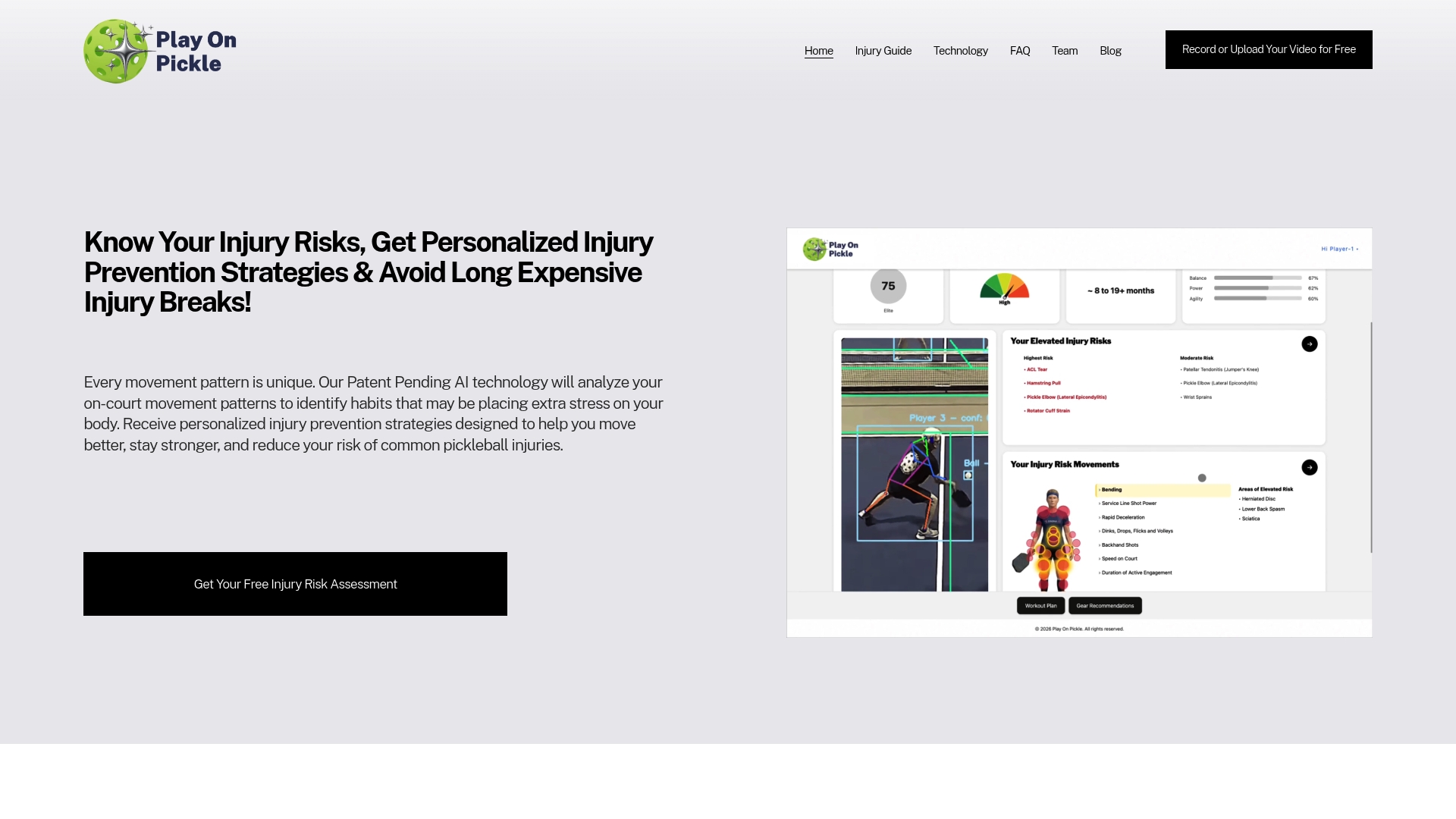
This isn't a replacement for a doctor or physical therapist. It's a screening tool, not a diagnostic one, and anything resembling a red flag (persistent pain, altered movement, a traumatic injury) still belongs in a clinic. What it does offer is a starting point most recreational players never get: an actual look at their own mechanics instead of a generic workout plan. New subscribers get a free tripod to make filming easier, and the monthly subscription runs $9.99, with an annual plan at $99 for players ready to commit to a full season of tracking. Head to the pricing page and start with your first upload this week.
Key Research and Guidance
The injury-prevention claims throughout this article draw on peer-reviewed epidemiology and biomechanics research, including the nationwide pickleball injury study, a systematic review of lower-extremity injuries, and a review of injury-prevention program outcomes. Screening workflow guidance follows recommendations from clinical reviews on upper-extremity injury risk.
This article is general information, not a substitute for advice from a qualified doctor. Consult a qualified healthcare professional about your own circumstances before acting on anything here.
Sources
- Understanding injury patterns and predictors in pickleball players: nationwide study (2025)
- Systematic review: lower-extremity injuries and prevention strategies (2026)
- Risk of upper extremity injury in recreational pickleball players (MDPI)
FAQ
What Is a Biomechanics-Based Doubles Safety Screen?
It's a video-based assessment of your court movement and stroke mechanics that identifies repeatable stress patterns, such as an unstable lunge or a limited backward recovery step. Services like Play On Pickle use AI movement analysis to flag these patterns and build a personalized exercise plan around them.
Can Video Analysis Diagnose an Injury?
No. Video reliably shows angles, speed, and movement symmetry, but it cannot measure joint forces directly or confirm a tissue-level diagnosis. Persistent pain, altered gait, or any traumatic injury signs require a clinical evaluation, not just a screening app.
How Often Should Doubles Players Reassess Their Movement?
A four to eight week cycle is a reasonable window to progress exercises and then re-record movement to check for improvement. Players managing an active issue or recent injury may benefit from checking in sooner, especially if symptoms change.
What Causes Most Falls in Doubles Pickleball?
Falls most often happen during lunging for a shot or moving backward to chase a lob, both common doubles movements. Nearly half of recreational players report a pickleball-related fall, which is why backward-movement and multidirectional lunging drills are a core part of prevention programs.
How Much Does Play On Pickle Cost?
Play On Pickle offers a monthly subscription for $9.99 and an annual subscription for $99. New subscribers can also get a free tripod with the monthly plan to make recording movement clips easier.