
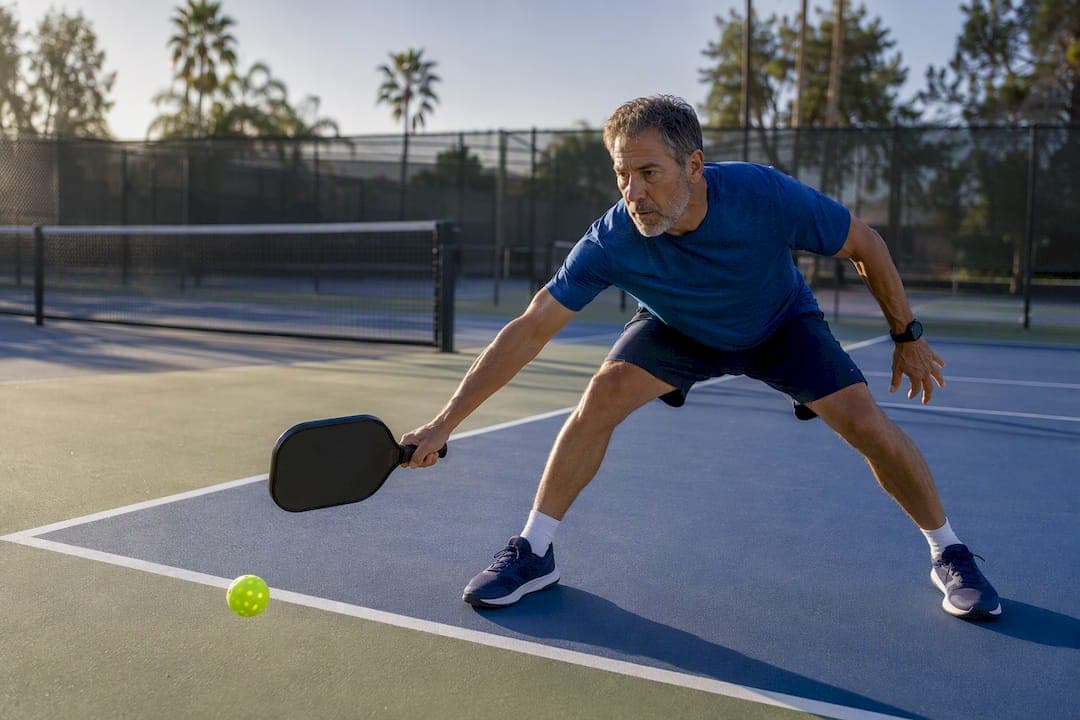
Do a focused short dynamic warm-up plus three targeted prehab exercises, shoulder, single-leg, and ankle/core, before every session. Start moving right now with two minutes of light cardio, like marching in place or jogging the baseline, to get blood flowing. That alone cuts your odds of a strain or sprain more than skipping straight to dinks. The full step-by-step version, with timing and coaching cues, comes next.
TL;DR:
- A warm-up under five minutes is insufficient, while exceeding ten minutes begins to deplete energy; 5 to 10 minutes of dynamic movement is optimal.
- Sport-specific exercises like lateral lunges, shoulder circles, and ankle rolls target common injury patterns such as sprains, strains, and fractures.
- Proper court shoes with firm support and non-compressible midsoles significantly reduce lateral ankle and knee injury risk during quick directional changes.
- Gradually increasing play duration by no more than 10-20% weekly, while monitoring for pain or stiffness, helps prevent overuse injuries.
- Consistent daily warm-up routines and off-court strength exercises, especially for balance and lateral control, maintain long-term injury prevention.
Table of Contents
- Why a Dynamic Pickleball Warm-Up Routine Matters
- What Injuries Does This Routine Actually Prevent?
- Your Step-by-Step Dynamic Prehab Routine
- Off-Court Strengthening for Long-Term Durability
- Does Your Footwear Actually Affect Injury Risk?
- How Should You Progress Without Getting Hurt?
- The Research Behind This Routine
- Nutrition and Hydration Habits That Support Injury-Free Play
- What Actually Keeps Players Injury-Free Long Term
- Get a Prehab Plan Built Around Your Own Movement
- Sources
- FAQ
Why a Dynamic Pickleball Warm-Up Routine Matters
A proper warm-up isn't about looking busy before the first serve. It's a physiological reset. Yale Medicine recommends 5 to 10 minutes of dynamic movement before play, and the reasoning is straightforward: raising your core temperature increases blood flow to muscles and improves joint lubrication, which makes tendons and ligaments more pliable when you plant hard for a lateral shot.
Static stretching, the kind where you hold a hamstring stretch for 30 seconds, belongs after play, not before it. Dynamic movement primes the nervous system for the quick, reactive footwork pickleball demands, while static holds can actually reduce muscle power output right before activity.
How do you know you're ready? Look for these signs:
- A light sweat has broken, signaling your core temperature has risen enough for safe, reactive movement
- Your reactions feel quicker than when you walked onto the court
- You can change direction without hesitation or stiffness
- Your shoulders and hips move through a full range without pinching
Quick fact: a warm-up under 5 minutes rarely raises core temperature enough to matter, and one over 10 minutes starts eating into your energy for actual play.
What Injuries Does This Routine Actually Prevent?
The moves in a pickleball prehab routine aren't arbitrary. They target the exact patterns behind the sport's most common injuries. A PubMed review of pickleball injury prevalence found that muscle strains, joint sprains, and fractures dominate emergency room visits tied to the sport, with a notable demographic split: men trend toward more strains and sprains, while women show higher rates of fractures.
The mechanics behind these injuries are predictable:
- Sudden lateral cuts to reach a wide dink often cause ankle sprains, especially when the foot rolls on an unstable surface
- Repetitive overhead motions from serves and smashes strain the shoulder's rotator cuff and, over time, the elbow
- Sprinting to a drop shot without adequate hip mobility can pull a groin or hamstring
- Falls from overreaching or backpedaling account for many of the fractures seen in older players
Much of this traces back to what clinicians call the "weekend warrior" pattern: someone plays hard for two hours after a sedentary week, with no progressive buildup. The body simply hasn't been asked to move that way recently, and it protests.
Your Step-by-Step Dynamic Prehab Routine
This sequence takes about 8 to 10 minutes and covers the joints that take the most abuse in pickleball: shoulders, hips, knees, and ankles.
- Light cardio (2 minutes). March in place, jog the baseline, or do jumping jacks at a moderate pace to raise your heart rate and core temperature.
- Shoulder circles and wall slides (1 minute). Roll shoulders forward and back for 10 reps each direction, then stand against a wall and slide your arms up and down like a snow angel to loosen the rotator cuff.
- Torso twists (30 seconds). Feet planted, rotate your upper body side to side to warm up the core and lower back.
- Walking lunges with a reach (1 minute). Step into a lunge and reach both arms overhead, alternating legs down the court. This wakes up hips, quads, and shoulders together.
- Lateral lunges (30 seconds). Step wide to each side, sitting into the hip. This directly rehearses the sideways loading that causes most ankle and knee injuries.
- Leg swings (30 seconds per leg). Hold a fence or paddle for balance and swing one leg forward and back, then side to side, to open up hip flexors and adductors.
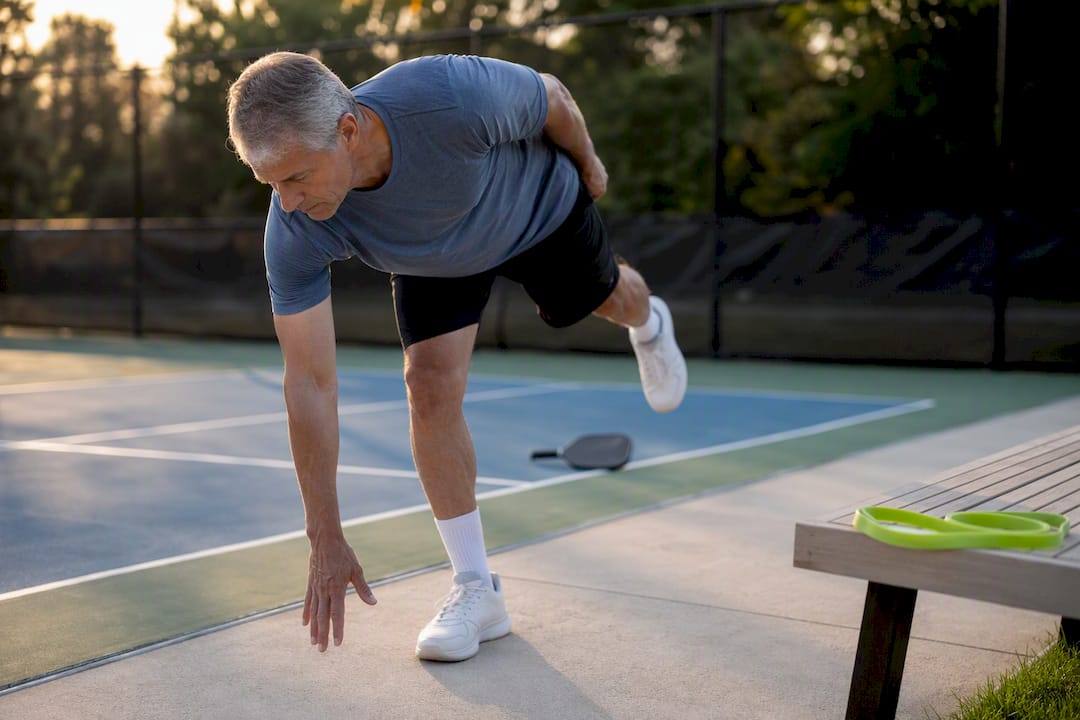
- Single-leg RDL, bodyweight version (30 seconds per side). Hinge at the hip on one leg, reaching toward the ground, to prime balance and hamstring control.
- Ankle rolls and calf raises (30 seconds). Roll each ankle through its full range, then do 10 slow calf raises to prep the lower leg for quick stops.
- Fast feet (20 to 30 seconds). Quick, small steps in place to fire up reaction speed.
- Slow dinks and drives (1 to 2 minutes). Finish by hitting easy, controlled shots with a partner or against a wall to pattern the actual movements you'll use in the game.
Keep every movement controlled. If you have a known mobility limit, a stiff hip or a cranky shoulder, reduce the range rather than skipping the move entirely. Half a lunge done well beats a full one done poorly.
Pro Tip: Never skip step 10. Sport-specific ball work at the end of your warm-up teaches your nervous system to fire the same patterns it'll use in a real point, which static stretching or generic cardio can't replicate.
Off-Court Strengthening for Long-Term Durability
A warm-up handles the day of play. Strength work handles the weeks between sessions, and it's what actually reduces overuse injuries over a season. Two to three sessions a week, roughly 20 minutes each, is enough for most recreational players.
- Rotator cuff external rotations with a light band, 2 to 3 sets of 12 to 15 reps, protect the shoulder from the repetitive overhead load of serves and overheads.
- Single-leg RDLs or step-ups, 2 to 3 sets of 8 to 12 reps, build the balance and hamstring strength that prevent falls and knee strain.
- Banded lateral walks, 2 to 3 sets of 15 steps each direction, strengthen the hip muscles that control lateral cuts.
- Calf raises, 2 to 3 sets of 15 reps, build the lower leg resilience needed for quick stops and starts.
- Dead-bug core holds, 3 sets of 30 seconds, stabilize the trunk so force transfers efficiently through swings instead of leaking through a wobbly core.
If balance or joint pain makes any of these tough, start seated or holding a chair for support, then progress to unassisted and eventually add light weight or a single-leg variation as strength improves. Cross-training with swimming or biking on off days also builds the cardiovascular reserve that keeps fatigue, and the sloppy footwork that comes with it, from creeping into your third game of the day, a pattern Cedars-Sinai points to as a real driver of late-game injuries.
Pro Tip: If you only have time for two exercises a week, pick the single-leg RDL and the banded lateral walk. They cover the two movement patterns, balance and lateral control, most responsible for falls and ankle sprains.
Does Your Footwear Actually Affect Injury Risk?
Yes, and it's one of the easiest fixes in this entire routine. Scripps Health recommends court-specific shoes over running shoes, because running shoes are built for forward motion and have soft, compressible soles that offer little resistance when your foot rolls sideways during a hard lateral cut.
Look for these features when shopping for court shoes:
- Firm side support that resists rolling during lateral movement
- A non-compressible midsole, rather than the soft cushioning found in running shoes
- Durable outsole tread designed for quick stops on hard court surfaces
Beyond shoes, paddle weight and handle fit matter more than most players realize. A paddle that's too heavy strains the elbow and shoulder over repeated swings, and a grip that's too small or too large forces extra wrist compensation. A wrist strap can help if you've had prior wrist issues. Test paddle feel during a low-stakes practice session before committing to it for competitive play.
How Should You Progress Without Getting Hurt?
Injuries often happen not because someone played pickleball, but because they went from zero to two hours of aggressive play with no buildup. The fix is simple: progress gradually.
- Start with shorter sessions, 30 to 45 minutes, if you're returning after a break or new to the sport.
- Increase total playing time or intensity by roughly 10 to 20% per week, not per session.
- Track how your body feels the next morning. Mild soreness that fades within a day is normal; sharp pain or new stiffness is not.
- Stop play immediately if you feel sharp pain, sudden swelling, or a loss of function in a joint.
- Seek evaluation from a clinician if pain persists beyond 72 hours or worsens with continued activity.
Keck Medicine warns that playing through pain is one of the most common ways a minor, treatable strain turns into a chronic overuse injury. A quick self-check before every session: any morning stiffness, any pain that changes how you move, and any symptom that's limiting your daily activity are all signs to dial back rather than push through.
The Research Behind This Routine
This routine draws on a specific set of clinical sources rather than generic fitness advice. The 5 to 10 minute dynamic warm-up structure comes from Yale Medicine, the injury prevalence data comes from a peer-reviewed PubMed review, the footwear guidance comes from Scripps Health, and the caution around playing through pain comes from Keck Medicine.
No warm-up routine, however well designed, accounts for the fact that every player's shoulders, hips, and stride length carry different stress points built from years of individual movement habits.
That's the gap a generic routine can't close. Play On Pickle's AI-driven movement analysis looks at your specific mechanics from a video upload and flags where your individual stress points are, rather than assuming every recreational player needs the exact same fix. If you have an existing joint condition or a prior injury, loop in your physician or a physical therapist before ramping up intensity, regardless of which routine you follow.
This article was written by Drona for Playonpickle.
Nutrition and Hydration Habits That Support Injury-Free Play
Muscles that are dehydrated or under-fueled fatigue faster, and fatigue is when form breaks down and injuries happen. A two-hour pickleball session, especially in warm weather, can lead to meaningful fluid loss through sweat well before you feel thirsty.
Start hydrating a couple of hours before you step on the court, not five minutes before the first serve. Water is fine for most recreational sessions under an hour; for longer play or hot conditions, an electrolyte drink helps replace the sodium and potassium lost through sweat, which supports muscle contraction and helps prevent cramping.
On the food side, eat a light, carbohydrate-focused meal roughly one to two hours before play, something like oatmeal, a banana with peanut butter, or toast with eggs. Heavy, high-fat meals sit in the stomach and can leave you sluggish during quick footwork drills. Avoid playing on a completely empty stomach, especially in the morning, since low blood sugar can affect reaction time and coordination, the exact qualities your warm-up just spent ten minutes sharpening.
After play, a snack combining protein and carbohydrates within an hour, like Greek yogurt with fruit, supports muscle recovery and helps reduce the lingering soreness that can tempt players to skip their next warm-up altogether.
What Actually Keeps Players Injury-Free Long Term
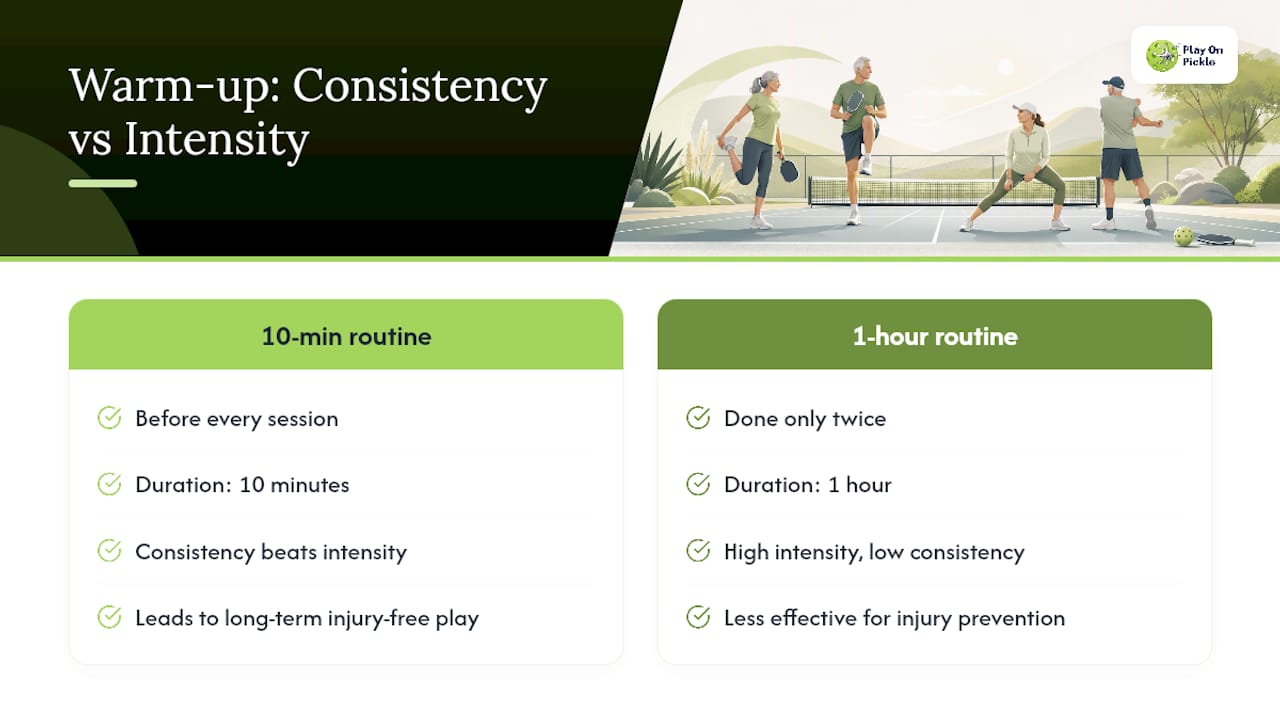
The players who stay injury-free aren't the ones with the most elaborate routines. They're the ones who do a short, imperfect warm-up every single time instead of a perfect one occasionally. Consistency beats intensity here, and ten honest minutes before every session beats an hour-long routine you only do twice.
The mistakes that cause real damage are almost always the same three: skipping the warm-up because you're running late, wearing running shoes because they're comfortable, and playing through sharp pain because you don't want to sit out a game. Fix those three habits before you fix anything else.
Try the routine before your next session. Your knees will thank you by the third game.
— Drona
Get a Prehab Plan Built Around Your Own Movement
A generic warm-up treats every player the same, but your shoulder mechanics, hip mobility, and stride aren't the same as the person on the next court. Some players seek prehab plans built around their own biomechanics instead of a one-size-fits-all checklist.

The process is simple: upload a short video of yourself playing, and the AI-driven movement analysis identifies your specific stress points, the joints and movement patterns most likely to lead to injury based on how you actually move, not a generic model. From there, you get a personalized set of exercises that fit into the same 10 minutes you'd already spend warming up. It's built for recreational players who want targeted results without adding a second workout to their week. If you're ready to see what your own movement pattern reveals, check the Playonpickle pricing page for current plan options and get started.
Sources
- How to Prevent Pickleball Injuries | Yale Medicine
- Pickleball: A Standard Review of Injury Prevalence and Prevention in a Rapidly Growing Sport | PubMed
- How to prevent pickleball injuries: 7 safety tips | Scripps Health
- How to prevent pickleball injuries | Keck Medicine
FAQ
What Are the Five P's of Pickleball?
The "five P's" isn't a standardized medical or coaching framework, and definitions vary by source. Focus instead on the proven basics covered here: proper warm-up, progressive loading, appropriate footwear, pain awareness, and off-court prehab.
What Is the 10 Second Rule in Pickleball?
This typically refers to serving etiquette, the informal expectation that a server starts play within about 10 seconds of the score being called, rather than an injury-prevention guideline. It has no bearing on your warm-up or prehab routine.
Is Two Hours of Pickleball a Good Workout?
Yes. Two hours of pickleball involves repeated sprints, lateral cuts, and reactive movement, which builds cardiovascular fitness and agility, but that same duration is exactly why a proper warm-up and hydration plan matter, since fatigue over two hours is when form breaks down and injury risk rises.
What Is the Best Meal to Eat Before Playing Pickleball?
A light, carbohydrate-focused meal eaten one to two hours before play, like oatmeal with fruit or toast with eggs, provides steady energy without leaving you sluggish. Avoid heavy, high-fat meals right before a session.
How Often Should I Do a Pickleball Prehab Routine?
Do the dynamic warm-up before every single session, and add the off-court strengthening exercises two to three times a week on non-playing days to build lasting durability.