
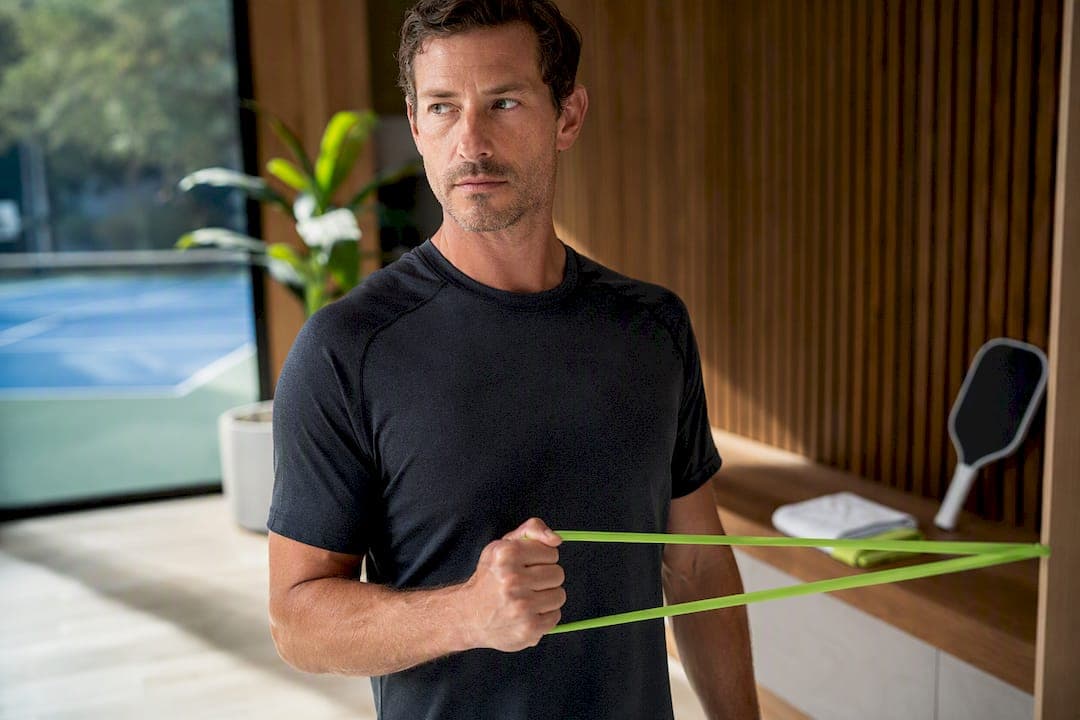
Band and light dumbbell external rotation, posterior-chain rows, scapular squeezes, and isometric holds during flare-ups form the core of any effective program. Several sessions per week of moderate duration with high repetitions and low load are recommended to reduce shoulder overload for most recreational players. Stop and get evaluated if you notice night pain or new weakness. Play On Pickle's Drona put this framework together from clinical guidance and movement-pattern data specific to the sport.
TL;DR:
- Moderate, high-repetition shoulder exercises focus on endurance rather than maximum strength, with progressions based on pain and endurance levels.
- A short warm-up routine including shoulder circles, arm swings, scapular squeezes, and light external rotations can help reduce flare-ups if done consistently.
- Scapular and thoracic mobility work, such as rows and thoracic extensions, significantly improve shoulder stability and decrease impingement risk during play.
- If shoulder pain worsens at night, or there is new weakness or catching sensation, players should seek prompt medical evaluation and modify activity immediately.
- Consistency over several weeks with a simple routine is more effective than intense single sessions, and personalized movement analysis can identify stress points specific to each player.
Table of Contents
- Rotator Cuff Exercises for Pickleball: The Pre-Play Warm-Up That Actually Matters
- Core Rotator Cuff Exercises With Regressions and Progressions
- Why Scapular and Thoracic Mobility Work Belongs in Your Routine
- A Realistic 20 to 30 Minute Weekly Program
- When Shoulder Pain Means Stop, Not Push Through
- How Movement Analysis Sharpens These Recommendations
- A Note From Play On Pickle
- Get a Movement Analysis Built Around Your Actual Swing
- Where This Guide's Recommendations Come From
- Sources
Rotator Cuff Exercises for Pickleball: The Pre-Play Warm-Up That Actually Matters
Most shoulder flare-ups in pickleball don't come from one bad swing. They come from swinging hundreds of times on a cuff that never got asked to wake up first. A short warm-up before you step on the court changes how your shoulder tolerates that volume, and it does not need to take long.
Run through this sequence in a few minutes before your first serve:
- Shoulder circles forward and backward to get synovial fluid moving through the joint.
- Arm swings across your body and overhead, gradually increasing range.
- Scapular squeezes, pulling your shoulder blades together and holding for short durations.
- Light band external rotations with your elbow tucked at your side.
- A few practice swings and dinks at half speed to groove the motion pattern before it counts.
Add one thoracic extension stretch. Sit tall, hands behind your head, and gently arch back over a chair or foam roller while breathing slow and deep. Overhead reach depends on how well your upper back extends, not just your shoulder.
One rule overrides everything else here: if the warm-up itself increases your pain, that's your answer for the day. Play shorter, hit fewer overheads, or sit it out. A structured warm-up routine before every session catches problems while they're still cheap to fix.
Core Rotator Cuff Exercises With Regressions and Progressions
These four exercises cover the rotator cuff's real job in pickleball: decelerating your arm on hundreds of repeated swings, not lifting maximum weight once. Hinge Health's clinical guidance lists isometric rotation, band pull-aparts, retraction rows, and open-book rotations as the foundation, and that order also happens to work as a natural progression path.
- External rotation, elbow at your side. Start with an isometric hold against a wall or doorframe for a short duration if any motion hurts. Progress to a light resistance band, then a 2 to 5 pound dumbbell lying on your side. Perform multiple sets of repetitions, aiming for a higher number rather than low-rep sets.
- Internal rotation, elbow at your side. Mirror the external rotation setup on the other side of the joint. Balanced strength here matters as much as the external rotators everyone focuses on.
- Band pull-aparts and face pulls. Hold a light band at chest height and pull it apart, squeezing your shoulder blades. These hit the posterior cuff and rear deltoid, the muscles that get chronically outworked by forehand-dominant play.
- Isometric holds, both directions. During an active flare, isometrics let you load the muscle without moving through the painful arc, which keeps you training instead of sitting completely still.
Control the tempo: 2 to 3 seconds on the concentric (lifting) phase, a slower, controlled release on the way back down. Rushing the eccentric portion is where most home programs quietly lose their benefit.
Choose a resistance level that challenges you toward the end of a set but maintains good form. Progress resistance gradually as endurance improves.
Pro Tip: Resist the urge to chase heavier weight. Pickleball asks your cuff to fire hundreds of low-force times per match, not once at maximum effort. Endurance-focused training with higher reps and lighter load matches that demand far better than a heavy, low-rep strength routine ever will.
Why Scapular and Thoracic Mobility Work Belongs in Your Routine
Your rotator cuff can only do its job if your shoulder blade holds a stable position underneath it. When the scapula slides or tilts during a volley, the cuff muscles have to work overtime just to keep the joint centered, which is exactly the kind of overuse pattern that leads to impingement and cuff strain.
Build these into your routine alongside the core rotation work:
- Rows and Y/T/W raises on a bench or cable to train mid and lower trap endurance.
- Serratus anterior push-ups, a small push-up variation where you protract your shoulder blades at the top, plus band-assisted protraction drills.
- Open-book rotations, lying on your side and rotating your top arm open toward the ceiling, to restore thoracic rotation.
- Seated thoracic extension over a foam roller, holding 20 to 30 seconds, several times through your session.
The practical cue during a match: think about setting your shoulder blade down and back before you reach for an overhead smash, rather than reaching from a shrugged, rounded position. That single adjustment reduces the mechanical demand on the cuff more than most players expect.
A Realistic 20 to 30 Minute Weekly Program
You don't need an hour in a gym. You need consistency across six to eight weeks, structured simply enough that you'll actually do it.
- Warm-up (5 to 8 minutes): the pre-play sequence above, done as its own session on non-playing days too.
- Three cuff exercises (10 to 15 minutes): rotate between external rotation, internal rotation, and band pull-aparts.
- Two scapular drills (5 to 8 minutes): rows or Y/T/Ws, plus one thoracic mobility drill.
- Cool-down (3 to 5 minutes): gentle static stretching for the posterior shoulder and a slow-breathing thoracic stretch to bring your heart rate down.
Weeks one and two, stick to isometrics and light bands only, especially if you're coming off any soreness. Weeks three through six, add a light dumbbell and increase band tension once 3 sets of 20 feel easy. During tournament or heavy-match weeks, cut your off-court volume in half. Your body is already absorbing plenty of load on the court. Before returning to full-intensity play after any flare-up, you should be able to complete the full exercise set with zero pain and no next-day soreness that lingers past 24 hours.
When Shoulder Pain Means Stop, Not Push Through
Most rotator cuff issues in pickleball are overuse injuries, and most respond well to conservative care when you catch them early. That's the good news. The catch is knowing which symptoms mean "modify" and which mean "see someone now."
Get evaluated promptly if you notice any of these:
- Sharp, stabbing pain during a specific motion, not a dull ache.
- Pain that worsens at night or disrupts sleep.
- New weakness when lifting your arm or reaching overhead.
- Catching, popping, or grinding sensations in the joint.
- Numbness or tingling running down the arm.
Absent those red flags, try the conservative route first: cut your session length, add an extra rest day between matches, and dial back overhead volume for a week or two. Some players can keep playing through a minor, non-painful issue as long as symptoms don't worsen the next day. If you see no real improvement after one to two weeks of that approach, it's time for a physical therapist or physician, not another week of hoping it resolves on its own.
How Movement Analysis Sharpens These Recommendations
Generic exercise lists assume every player swings the same way. They don't. Play On Pickle's AI-driven video analysis reviews your actual serve, dink, and overhead mechanics to flag where stress concentrates in your shoulder, whether that's an early cocking phase overload or a scapula that drops during backhand volleys.
A player with a slightly dropped scapula on overhead shots needs more serratus and lower-trap work than a player whose main issue is limited thoracic rotation. Two different swings, two different exercise priorities, even if both show up as "shoulder pain" on the surface.
That's the gap a personalized injury-prevention plan closes that a one-size list can't.
A Note From Play On Pickle
We'd rather see you do 15 minutes, three times a week, for two months than one brutal hour-long session before you give up. Consistency beats intensity here, every time. If something feels off and you're not sure whether it's normal soreness or a real problem, get it looked at. Your shoulder will thank you either way.
— Drona
Get a Movement Analysis Built Around Your Actual Swing
Playonpickle is the alternative to guessing which exercises you need. Instead of running through a generic list and hoping it targets the right muscles, you upload a short video of your play, and the AI-driven analysis maps where stress concentrates in your shoulder, elbow, and overall mechanics.

The process is simple: upload a video from your phone, let the computer vision technology break down your swing mechanics, and receive a personalized report flagging your specific stress points along with exercise and equipment recommendations built around them. A free trial gets you your first assessment at no cost, so you can see exactly what your mechanics look like before committing to anything. If you've been managing shoulder soreness with generic stretches and want to know what's actually driving it, start your free movement analysis and get a plan built around your own swing instead of an average one.
Where This Guide's Recommendations Come From
- Baptist Health: overuse injury patterns and conservative care outcomes.
- Franciscan Health: warm-up guidance for shoulder protection.
- Avid Sports Medicine: endurance-based cuff training rationale.
- Hinge Health: specific exercise selection and dosing.
- IronAtForty: movement safety cautions for shoulder rehab.
This article is general information, not a substitute for advice from a qualified doctor. Consult a qualified healthcare professional about your own circumstances before acting on anything here.
Sources
- Pickleball-related shoulder injuries — Baptist Health
- Shoulder & Rotator cuff injuries in pickleball — Avid Sports Medicine
- Pickleball & Rotator cuff injuries in the shoulder — Franciscan Health
- Pickleball shoulder pain: tips and exercises — Hinge Health