
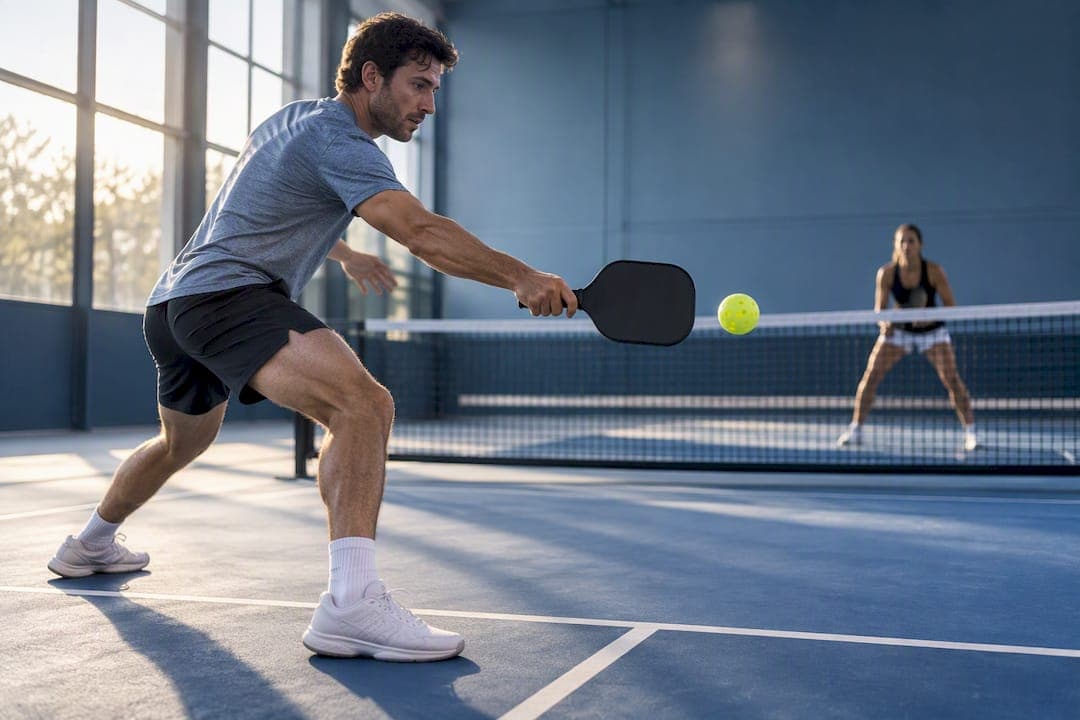
Shorten your backswing, keep your paddle up, and meet the ball out in front. Do those three things and most recreational volley problems disappear. Volley mechanics in pickleball come down to paddle face control, an early contact point, and a compact arm motion rather than a swing. Fewer pop-ups and fewer netted balls follow almost immediately once those cues become habit at the kitchen line.
TL;DR:
- Keeping the paddle up, shortening the backswing, and meeting the ball out in front significantly reduce errors like pop-ups and netted balls.
- Consistently controlling paddle face angle within one to three degrees and meeting the ball at a forward contact point are crucial for precise volleys.
- Attacking balls at or above net height with punch or roll volleys and resetting low or hard shots with soft blocks align with optimal strategic choices.
- Proper footwork involves small splits and quick shuffles, with pre-contact movement and a paddle-ready position to enhance reaction time.
- Avoiding momentum into the kitchen zone, maintaining correct hand, wrist positioning, and controlling load during volley exchange helps prevent injuries and enhances control.
Table of Contents
- Volley Mechanics Pickleball Fundamentals: Grip, Face, and Contact
- Types of Volleys and When to Use Each One
- Ready Position and Footwork for Consistent Volleys
- Kitchen Rules That Shape Your Volley Decisions
- Drills and a Practice Progression That Actually Builds Control
- Common Volley Mistakes and How to Fix Them
- Movement, Injury Risk, and Volley Performance
- Hand and Wrist Positioning for Control and Power
- Offensive Versus Defensive Volley Strategy
- Adjusting Volleys for Different Opponents and Court Positions
- Volley Mechanics, Fixed: A Technician's Take
- Sources
- FAQ
Volley Mechanics Pickleball Fundamentals: Grip, Face, and Contact
A continental grip is the standard for volleying because it lets you switch between forehand and backhand without rotating your hand mid-point. That single adjustment saves the split second that separates a clean punch volley from a shanked one.
Paddle face angle matters more than most players realize. A change of just 1 to 3 degrees in face angle can send a ball into the net or sail it long. Keep the face neutral to slightly open on most volleys, and let the incoming ball's pace do the work rather than adding your own.
Contact point is the other non-negotiable. Meet the ball as far in front of your body as your reach comfortably allows. That forward contact point gives you better leverage, more time to react to the next shot, and a stable base since your weight is already moving forward, not falling backward.
The arm action itself should be shoulder-led with a short elbow hinge, extending forward roughly 6 to 12 inches. Wrist involvement should be close to zero on control volleys. Follow-through stays short, and your paddle resets to the ready position immediately.
Checkpoints to repeat until they're automatic:
- Continental grip held loosely, around a 3 or 4 on a 10-point pressure scale
- Paddle face neutral to slightly open, adjusted in one or two degree increments
- Contact point out in front, never even with or behind your torso
- Elbow hinges 6 to 12 inches; shoulder provides direction, not power
- Follow-through short, paddle back to ready position within a second
Types of Volleys and When to Use Each One
Different balls call for different volleys, and picking the wrong one is how easy points get given away. Here's a practical breakdown of pickleball volley mechanics by shot type.
- Punch volley. A short, firm jab with almost no backswing. Use it on balls at or above net height when you want to end the point or push your opponent back.
- Block volley. Soften your grip, absorb the incoming pace, and let the paddle act like a wall. This is your reset shot against hard drives, especially on balls arriving below net height.
- Roll volley. A slight upward brushing motion on the ball that adds topspin and keeps the shot low over the net. Good for balls at net height when you want depth without giving your opponent a sitter.
- Speed-up volley. A sudden increase in pace off a slower exchange, usually aimed at the opponent's body or feet. Reserve this for balls sitting up above the net.
- Drop volley. A soft, controlled touch that dies just over the net, useful when you're pulled off the kitchen line and need to reset the point.
- Swing volley. A fuller stroke with more backswing, typically for balls well above shoulder height that you can attack aggressively from a legal position.
The general decision rule from USA Pickleball's own strategy guidance is simple: attack anything at or above net height, and reset anything below it. Try to drive a low ball and you're fighting the net's geometry.
Ready Position and Footwork for Consistent Volleys
Your paddle should sit up near chest height at rest, angled slightly out in front of you, elbows bent and relaxed rather than locked. That paddle-up habit is the single biggest separator between players who react in time and players who get rushed.
Footwork starts with a small split step timed just before your opponent makes contact. From there, short shuffles get you behind the ball rather than lunging or reaching, which keeps your base stable and your shot repeatable. Moving into the kitchen line for an opportunity or retreating from a lob both require the same principle: small adjusting steps, not big committed strides.
Drills that build this pattern:
- Split step drill. Have a partner feed balls at random intervals; practice the timing of your split step before each one.
- Figure eight with movement. Shuffle laterally in a figure eight pattern while a partner feeds volleys, forcing you to reset your feet between shots.
- Fridge and toaster drill. Two players volley back and forth at close range, focusing purely on compact hands and quick feet, not power.
Pro Tip: Practice your split step to a metronome or count out loud. Most players either skip it entirely or time it too late, which is why balls seem to "rush" them at the net.
Kitchen Rules That Shape Your Volley Decisions
The USA Pickleball rulebook treats "the act of volleying" as everything from your backswing through your follow-through, including any momentum that carries after contact. If that momentum carries you into the non-volley zone, it's a fault, even if your feet were outside the line when you struck the ball.
Quick reference: what counts as a fault at the kitchen line
| Situation | Legal or fault |
|---|---|
| Feet outside NVZ at contact, no momentum carries you in | Legal |
| Feet outside NVZ at contact, momentum carries you in after | Fault |
| Jumping in from outside the NVZ, landing inside after volleying | Fault |
| Paddle crosses over the NVZ line without touching the ground inside it | Legal |
In-play checklist: start every volley attempt with both feet clearly outside the NVZ, kill your forward momentum before or during contact, and never lunge or jump into the zone to reach a ball. This is exactly why the swing volley, with its longer backswing and follow-through, is riskier right at the kitchen line. A single memory cue helps: stop your feet before you swing your paddle.
Drills and a Practice Progression That Actually Builds Control
Volley control comes from stacking small wins, not from grinding through chaotic rallies. A short mobility check, ankles, wrists, shoulders, before you touch a paddle prevents the stiff, jerky motion that ruins early reps.
- Wall volleys. Stand a few feet from a wall and volley continuously, aiming for smooth, compact contact. Build toward a minute of unbroken control before adding pace.
- Partner ladder. Start with slow, cooperative exchanges, then let your partner gradually increase pace once you're consistent. Only move to the next stage after a stable run of clean contact.
- Speed-up response reps. Have your partner mix in occasional speed-ups so you practice absorbing pace with a block volley instead of panicking.
- Target zone practice. Set targets on the court and aim for 20 to 30 consecutive controlled volleys into a specific zone before increasing speed or adding movement.
Once those reps are stable, add complexity: footwork patterns, decision-making between punch and block, or live-ball pressure. Consistency built early prevents the kind of skipped practice that stalls progress, a pattern Heala's research on habit formation frames well: breaking a streak once is a slip, breaking it twice starts a new, worse habit. For a longer runway beyond these drills, a structured plan like a 90-day pickleball training program can keep the progression organized.
Common Volley Mistakes and How to Fix Them
Most volley problems trace back to one of a handful of root causes, and fixing them one at a time works far better than trying to overhaul your whole shot at once.
- Pop-ups. Usually caused by an open paddle face or contact that's too far under the ball. Fix: check your face angle before each rep and aim to meet the ball slightly above center.
- Netting the ball. Often from a closed paddle face or a backswing that adds unwanted downward angle. Fix: shrink your backswing to almost nothing and keep the face neutral.
- Late contact. Comes from reacting instead of anticipating. Fix: tighten your ready position and rehearse the split step until it's automatic.
- Stiff wrist. A locked wrist kills touch on drop volleys and reset shots. Fix: loosen grip pressure to around a 3 or 4 out of 10 and let the paddle float slightly.
Improvement on any one of these usually shows up within a week of focused daily reps, not months. Pro Tip: Pick one cue per practice session, paddle up or loose grip, and ignore the rest. Chasing four fixes at once is why most players plateau.
Movement, Injury Risk, and Volley Performance
Volleying puts real demand on your joints, not just your hands. Research on pickleball's movement patterns shows the sport requires frequent lateral shuffles and short, sudden decelerations, especially near the net where volleys happen. Poor deceleration control at the kitchen line is a common source of knee and ankle strain among recreational players who never trained that stopping motion.
This is where movement analysis becomes useful. Tools that track how your body loads and decelerates during volley exchanges can flag stress points before they turn into overuse injuries, which matters most for recreational players who skip conditioning work entirely.
Practical safety habits worth pairing with your volley drills:
- Warm up ankles, hips, and shoulders before any volley session, not just a general jog
- Progress your practice pace gradually rather than jumping straight into speed-up drills
- Build in mobility work on off days rather than only stretching before matches
- Watch for one-sided fatigue, a sign your footwork is compensating rather than moving cleanly
A short warm-up routine before drill sessions and a broader look at injury prevention strategies both pair well with the mechanical work above.
Hand and Wrist Positioning for Control and Power
Your hand position on the paddle handle directly affects how much control you have over face angle. Grip too far up toward the paddle face and you lose leverage; grip too low and you lose stability. A standard continental grip, hand centered on the handle, thumb resting lightly along the top bevel, gives you the fastest access to both forehand and backhand volleys without adjusting.
Grip pressure matters as much as hand placement. Squeezing tightly locks your wrist and turns every volley into a jerky push instead of a controlled block or punch. Aim for pressure around a 3 or 4 out of 10, loose enough that the paddle can absorb pace naturally, firm enough that it doesn't twist in your hand on contact.
Wrist angle should stay largely fixed through contact on control volleys. The temptation to flick the wrist for extra power is strong, especially on speed-ups, but that flick is exactly what turns a controlled shot into an erratic one. Power on a volley should come from the incoming ball's pace plus a small, compact push, not from wrist snap.
The one exception is the roll volley, where a slight upward wrist and forearm motion adds topspin. Even there, the movement is subtle: a brushing action, not a whip. If your wrist is doing more work than your shoulder and elbow combined on any volley, that's usually a sign your grip pressure is too tight or your backswing has crept in.
Offensive Versus Defensive Volley Strategy
Offensive volleying means taking the ball early, at or above net height, and using a punch or roll to keep pressure on your opponents. The goal is to shrink their reaction time and either end the point outright or force a weak reply you can attack next.
Defensive volleying is about survival. When a ball comes in low or hard, below net height especially, your job shifts from attacking to resetting. A soft block volley that absorbs pace and drops the ball short in the kitchen buys you time to recover position rather than trying to match power with power.
The mistake most recreational players make is treating every volley as an offensive opportunity. Driving a ball that's below net height almost always sends it into the net or sets up an easy put-away for your opponent. Reading the ball's height before you decide your shot matters more than raw paddle skill.
A useful mental split: above the net, look to attack; at the net, look to control the point with depth and placement; below the net, reset and reset again until a better ball arrives. Mixing these up under pressure, attacking when you should reset, is one of the fastest ways to hand points away at the kitchen line.

Adjusting Volleys for Different Opponents and Court Positions
A hard-hitting opponent calls for a different volley approach than a soft, placement-focused one. Against pace, lean on block volleys that absorb energy rather than trying to match speed. Against a dinker who works you side to side, punch and roll volleys that end the exchange quickly deny them the extended rally they want.
Court position changes your options too. Standing dead center at the kitchen line gives you the most reach and the most volley choices. Pulled wide to one side, your best move is often a shorter punch or a controlled block rather than an ambitious roll volley you don't have the balance to execute.
Playing against two players who both crowd the net requires quicker decision-making, since speed-ups will come faster and from tighter angles. Against a team with one player back and one up, targeting the up player's feet with a well-placed volley often creates confusion about who covers the return.
Watch for patterns, too. A right-handed opponent's backhand volley is usually weaker, so directing volleys there over several exchanges tends to produce errors. The goal isn't a single perfect shot; it's stacking small positional advantages until an easy put-away appears.
Volley Mechanics, Fixed: A Technician's Take
Most volley advice recreational players get is backward. Coaches talk about power and paddle speed when the real fix is almost always subtraction: less backswing, less wrist, less reaching. The players who improve fastest aren't the ones who work hardest on aggression. They're the ones who get boring and mechanical about paddle angle and contact point first.
The conventional wisdom that volleys are a "feel" shot undersells how measurable this actually is. A degree or two of paddle face angle changes outcomes predictably. That's not feel, that's geometry, and it's coachable in a single practice session if you isolate the right cue.

If you take one thing from this article, prioritize the paddle-up ready position before anything else. Every fault, pop-ups, netting, late contact, traces back to a paddle that dropped or drifted out of position between shots. Fix that first, and the rest of your volley mechanics get noticeably easier to correct.
Players serious about fixing these patterns without guesswork might consider how movement analysis tools track loading and fatigue during net play, since a volley fault that shows up late in a match is often more about tired legs than bad hands.
— Drona
Ready to see how your own footwork and joint loading hold up during volley exchanges? Play On Pickle's AI movement analysis uses computer vision to flag stress points before they become injuries, then builds a personalized plan around them. New players can start with the Monthly subscription at $9.99 per month or the Annual subscription at $99 per year, and signing up currently includes a free tripod with the monthly plan so you can record your volley sessions and track your mechanics over time.
Sources
- Pickleball volley tips | USA Pickleball
- Understand Pickleball Volley Control: Physics & Technique — The Dink
- Movement patterns and biomechanical characteristics of Pickleball — GJSES review (2026)
FAQ
What Are the Best Strategies for Volleying in Pickleball?
Keep your paddle up, use a short backswing, and meet the ball out in front of your body rather than letting it get to you. Attack balls at or above net height with a punch or roll volley, and reset anything below net height with a soft block, following the decision framework USA Pickleball recommends.
What Are the Five P's of Pickleball?
Definitions of the "five P's" vary across coaches and clubs, and there's no single official version endorsed by USA Pickleball. Rather than force a shaky acronym, focus on the mechanics this article covers: paddle position, patience on shot selection, and precise contact points at the net.
What Is the Hardest Shot to Hit in Pickleball?
Many coaches point to the third-shot drop as the hardest shot to execute consistently, since it requires soft touch under pressure right after the serve return. It's also the shot that sets up your team's move to the kitchen line where volleys decide most points.
What Is the Rule for Volleying in Pickleball?
The act of volleying includes your swing, follow-through, and any resulting momentum, and you must be completely outside the non-volley zone during that entire act. Momentum that carries you into the kitchen after contact is a fault, even if your feet were legal when you struck the ball, according to the official USA Pickleball rulebook.