
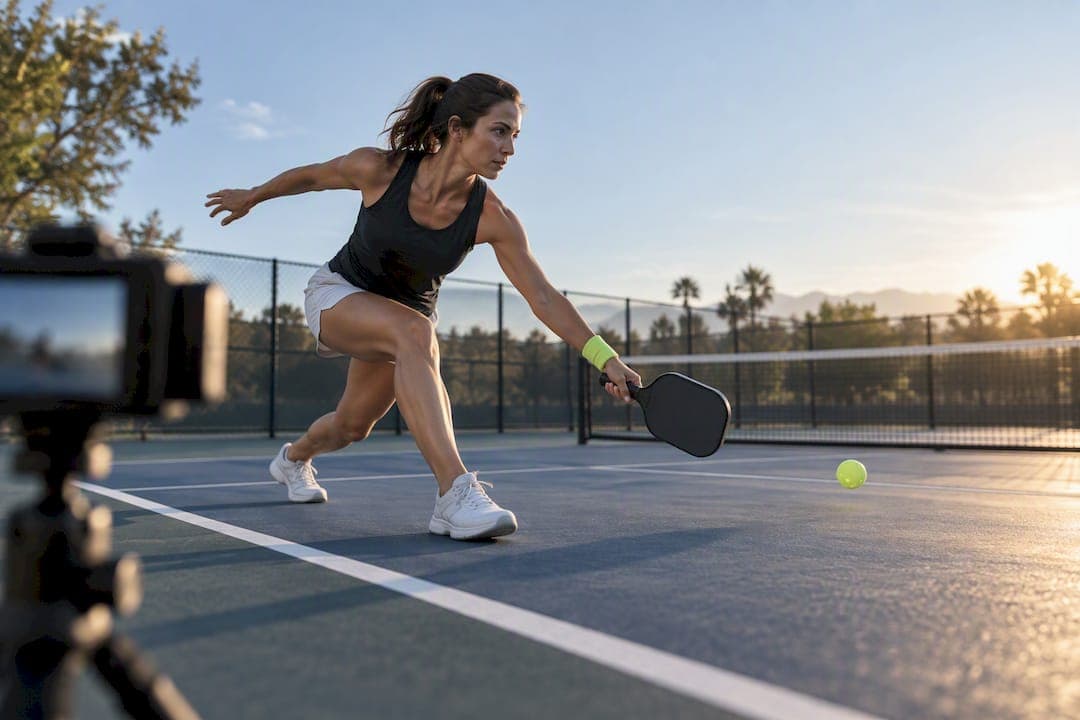
The single most protective habit in pickleball is a real 5 to 10 minute dynamic warm-up paired with a slow ramp-up in weekly play, not a new gadget. Where computer vision earns its place is downstream of that habit: markerless video analysis can catch a rigid arm swing or a lagging trunk rotation before it turns into lateral epicondylalgia or a rotator cuff strain, flagging exactly which corrective exercise matters most for your body. It's a screening layer, not a diagnosis. The specifics on both fronts are below.
TL;DR:
- Dynamic warm-ups of five to ten minutes before playing significantly reduce injury risk compared to static stretching or jumping into intense play.
- Overuse injuries such as elbow, shoulder, and ankle strains are most common, often caused by stiff arm swings, poor trunk rotation, or inadequate conditioning.
- Computer vision-based video analysis can reliably detect risky movement patterns like rigid arms and late hip rotation, enabling early intervention.
- Proper equipment, including supportive court shoes and protective eyewear, along with gradual volume increases, are vital for injury prevention.
- Pairing AI movement analysis with professional clinical assessment is the most effective way to prevent serious injuries and address persistent pain.
Table of Contents
- What Are the Most Common Pickleball Injuries?
- How Do Pickleball Injuries Actually Happen?
- How Can You Actually Prevent Pickleball Injuries?
- Can Computer Vision Actually Spot a Risky Pickleball Swing?
- How Do You Turn a Video Into an Injury-Prevention Plan?
- Where Clinical Care Still Beats an Algorithm
- Try Play On Pickle's AI Movement Analysis
- Sources
- FAQ
What Are the Most Common Pickleball Injuries?
Pickleball injuries cluster in predictable places, and a radiologic review of pickleball-related imaging confirms the pattern: musculoskeletal damage in the upper and lower extremities dominates, tracking closely with the sport's stop-start court mechanics. Here's what shows up most often, and what it feels like:
- Lateral epicondylalgia (pickleball elbow): Pain on the outside of the elbow from repetitive backhand and volley strain, often tied to a stiff, all-arm swing. It's common enough that it has its own nickname among orthopedic clinics.
- Rotator cuff tendinopathy: Shoulder pain during overhead shots or reaching volleys, usually from overuse rather than one bad hit.
- Ankle sprains: Rolled ankles from lateral cuts on a court that's smaller and tighter than a tennis court, forcing sharper direction changes.
- Achilles tendinopathy and rupture: A sudden, sharp calf or heel injury common in players who sprint and stop without adequate calf conditioning.
- Knee meniscal tears and MCL strains: Twisting injuries from pivoting on a planted foot, frequently seen when footwear lacks lateral support.
- Low back pain: Often from repeated trunk rotation without core support.
- Wrist and forearm fractures: Usually from a fall, since pickleball's quick reflexes leave little time to brace.
- Ocular trauma: Direct hits from a fast-moving ball or an opponent's paddle at the net.
Orthopedic guidance notes that rapid injury growth is concentrated among older players and those who jump into frequent play without conditioning behind them, a group sports-medicine writers sometimes call the "weekend warrior" pattern.
Eye injuries deserve special attention. Because pickleball is played at close range with a hard, fast ball, ocular trauma ranges from minor corneal abrasions to serious events like hyphema or retinal detachment, according to guidance from Mass General Brigham. That's a meaningfully different risk profile than most racket sports, where the ball travels farther from the face before contact.
How Do Pickleball Injuries Actually Happen?
Most pickleball injuries fall into two clear buckets: acute trauma from a single bad movement, and overuse injuries that build slowly from thousands of repeated, slightly wrong motions. Both matter, but they call for different fixes.
Acute injuries usually come from ground reaction forces during sudden stops and pivots. A standard pickleball court is a fraction of the size of a tennis court, so players decelerate and change direction constantly in a tight footprint, loading the ankles and knees far more per minute of play than a sport with wider spacing would.
Overuse injuries are where movement quality matters most, and recent research has started naming the exact faults involved. A pilot study using MediaPipe-based pose estimation found that amateur players prone to lateral epicondylalgia tend to swing with a rigid, locked arm and show measurable kinematic lag between torso rotation and arm acceleration. In plain terms: the arm fires late and stiff, so the elbow absorbs force the shoulder and core should be handling.
Other faults linked to common diagnoses include:
- Constrained hip and knee flexion during split-step recovery, which pushes stress into the knee joint.
- Poor trunk rotation on groundstrokes, forcing the shoulder to overcompensate.
- Foot-placement errors during lateral shuffles, a frequent precursor to ankle sprains.
Pro Tip: If your backhand feels "all elbow" by the end of a session, that's often the rigid-swing pattern talking. Loosening the wrist and initiating the shot from hip rotation, not the forearm, is the single cheapest fix a coach can give you.
How Can You Actually Prevent Pickleball Injuries?
Prevention isn't complicated, but it's sequential. Skip a step and the next one does less good.
- Warm up dynamically, not statically. A 5 to 10 minute routine of leg swings, walking lunges, arm circles, and light lateral shuffles primes the tissues that pickleball actually stresses. The American Medical Association specifically calls out dynamic warm-ups over static stretching before play, and a structured pre-game routine makes this easy to repeat every session.
- Ramp up volume gradually. Doctors point to rapid jumps in play frequency as a major driver of the current spike in pickleball injuries. Build toward roughly 150 minutes a week the way you'd build mileage for a race, not all at once in month one.
- Add targeted strength work. Rotator cuff activation, hip and glute strengthening, core stability, and eccentric calf raises directly address the joints pickleball loads hardest. None of this requires a gym; resistance bands and body weight cover most of it, and the same principle of prioritizing dynamic mobility over passive stretching shows up in other racket and swing sports too.
- Get the equipment right. Court shoes with lateral support beat running shoes, protective eyewear cuts ocular risk substantially, and worn-out paddles can subtly change how much force your arm absorbs on contact.
- See a clinician early. Persistent joint pain that doesn't ease within a few days of rest is worth a professional evaluation, not another few sets of play.
Can Computer Vision Actually Spot a Risky Pickleball Swing?
Yes, within limits, and the research backing this is more mature than most players realize. Human pose estimation, or HPE, works by mapping a grid of key points onto a body from ordinary video: shoulders, elbows, hips, knees, ankles. No sensors, no markers stuck to your skin. Markerless 2D motion capture then tracks how those points move frame by frame, which is enough to flag a stiff elbow angle or a late hip rotation without any lab equipment.
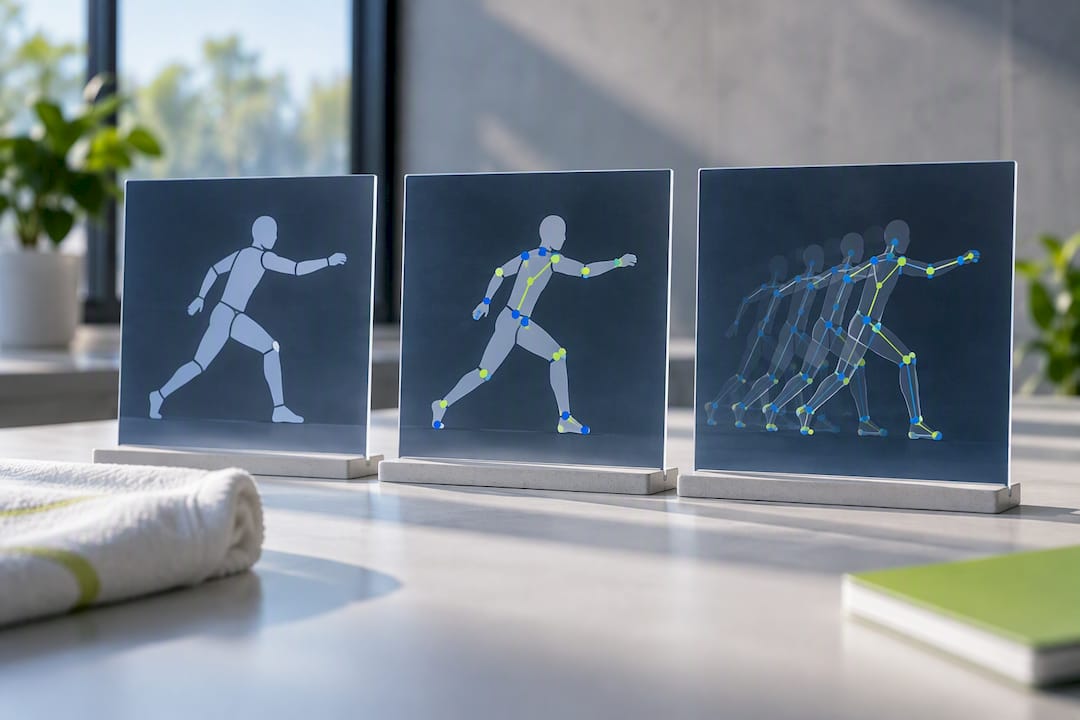
The MediaPipe-based pilot study mentioned earlier used exactly this approach on smartphone footage and reliably identified the rigid-swing, kinematic-lag pattern tied to elbow injuries. Separately, a YOLO11-Pose pipeline with unsupervised clustering classified pathological upper-limb patterns across hundreds of smartphone-recorded trials from novice players using nothing more than a single low-cost camera.
Validation numbers matter here. In a controlled tactical tracking system for doubles play, researchers reported a MOTA of 0.89 and F1 score of 0.90, with about 105 milliseconds of latency. Those are solid tracking and recognition metrics for a real-time system, though consumer-facing tools built for convenience typically trade some of that precision for speed and simplicity.
| Factor | What it means | Practical impact |
|---|---|---|
| Occlusion | Camera can't see a joint clearly | Faulty rep gets missed or mislabeled |
| Projection error | 2D video misreads 3D depth | Rotation angles can be slightly off |
| Camera placement | Angle and distance from player | Fixed with a tripod at hip height, side-on |
| Single vs. multi-angle | One camera vs. several | Multiple angles reduce occlusion errors |
The honest limitation: a single side-on camera can misjudge depth and lose a joint behind the body mid-swing. The fix is mostly logistical, not technical, a consistent tripod setup filmed from the same angle every session, which practitioners in the pose-estimation field point to as the simplest way to cut down on those occlusion errors.
How Do You Turn a Video Into an Injury-Prevention Plan?
- Set a tripod at hip height, roughly 8 to 10 feet from the baseline, angled to catch your full swing from the side.
- Film a few reps each of a dink, a drive, and a volley in good lighting, ideally outdoors or under bright gym lights.
- Review the flagged movement faults; the AI usually prioritizes the pattern most linked to injury risk, not just the most visible one.
- Follow the suggested corrective exercises for 4 to 8 weeks, reassessing with a new video at the midpoint.
- Stop and see a clinician if pain persists rather than improves as you correct the flagged movement.
Pro Tip: Film on the same day of the week, same court, same shoes. Consistency in the recording setup matters almost as much as the swing itself for getting a clean comparison over time.
Play On Pickle's movement analysis platform applies this exact workflow, turning uploaded video into a personalized exercise plan built around your specific stress points.
Where Clinical Care Still Beats an Algorithm
Computer vision is a screening tool, not a diagnostic one. It's good at catching a pattern before pain shows up. It cannot rule out a torn meniscus or a stress fracture, and it shouldn't try to. The most useful setup pairs the two: a player gets flagged for a movement fault, works the corrective plan, and brings that same video data to a physical therapist if pain persists. Coaches, in particular, can use flagged patterns as a coaching cue rather than a verdict, which keeps the technology in its proper lane.
— Drona
Try Play On Pickle's AI Movement Analysis
Generic fitness apps guess at your form. Play On Pickle's patent-pending computer vision is built specifically around pickleball biomechanics, so the corrective exercises it recommends actually match how your elbow, shoulder, and hips move on a real court, not a generic workout template.
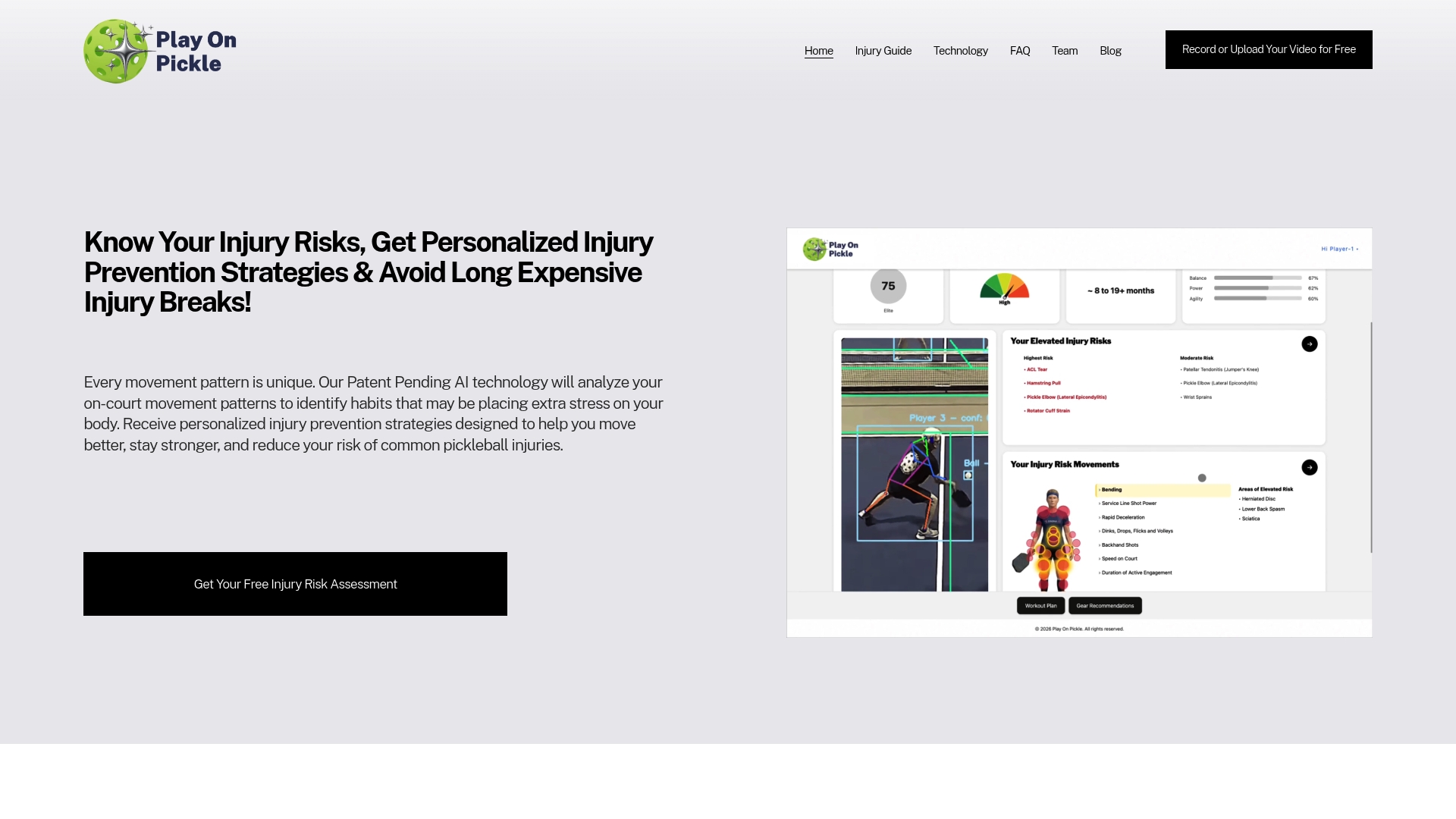
Upload a video and the platform maps your stress points the same way the research above describes, then builds you a personalized exercise plan around what it finds. You can see exactly how the technology works before committing to anything. New subscribers on the Monthly subscription plan at $9.99 per month get a free tripod or selfie stick to make filming easier from day one, and the Annual subscription runs $99 per year for players ready to commit for the season. Start with a video upload and see what your swing is actually doing, then talk to a clinician if anything flagged needs a closer look.
This article is general information, not a substitute for advice from a qualified doctor. Consult a qualified healthcare professional about your own circumstances before acting on anything here.
Sources
- Pose estimation for pickleball players’ kinematic analysis through MediaPipe-based deep learning: A pilot study
- Automated Diagnosis of Upper-Limb Kinetic Chain Deficiencies in Amateur Pickleball Players Using YOLO11 and Unsupervised Clustering
- What doctors want patients to know about preventing pickleball injuries (AMA)
- Pickleball eye injuries: prevention & treatment (Mass General Brigham)
FAQ
What Is the Most Common Pickleball Injury?
Lower-body strains and sprains, especially ankle sprains, along with upper-body overuse injuries like lateral epicondylalgia (pickleball elbow) and rotator cuff tendinopathy, top the list. A radiologic review confirms these patterns dominate imaging findings tied to court mechanics.
Why Are So Many People Getting Injured Playing Pickleball?
Rapid increases in play volume without conditioning are the biggest driver, according to the AMA. Many new players, often older adults, jump straight into frequent games on a small, demanding court without building up strength or mobility first.
What Eye Injuries Does Pickleball Cause?
Pickleball can cause anything from minor corneal abrasions to serious trauma like hyphema or retinal detachment, since the ball travels fast at close range. Mass General Brigham recommends protective eyewear as a preventive step.
Does Pickleball Have a Worse Injury Rate Than Other Sports?
Pickleball's injury rate has risen sharply as participation has exploded, with a documented pattern of soft-tissue and joint injuries concentrated in older players. It isn't uniformly labeled the worst among all sports, but its combination of high-impact stops on a small court and an aging player base makes prevention especially important.
Can Computer Vision Really Prevent a Pickleball Injury?
It can't prevent an injury by itself, but it can flag risky movement patterns, like a rigid arm swing or poor trunk rotation, before they cause pain. Studies using MediaPipe-based pose estimation and YOLO11 pipelines show these patterns are detectable and linked to real injury risk, which is why pairing that feedback with a corrective exercise plan matters more than the flag alone.