
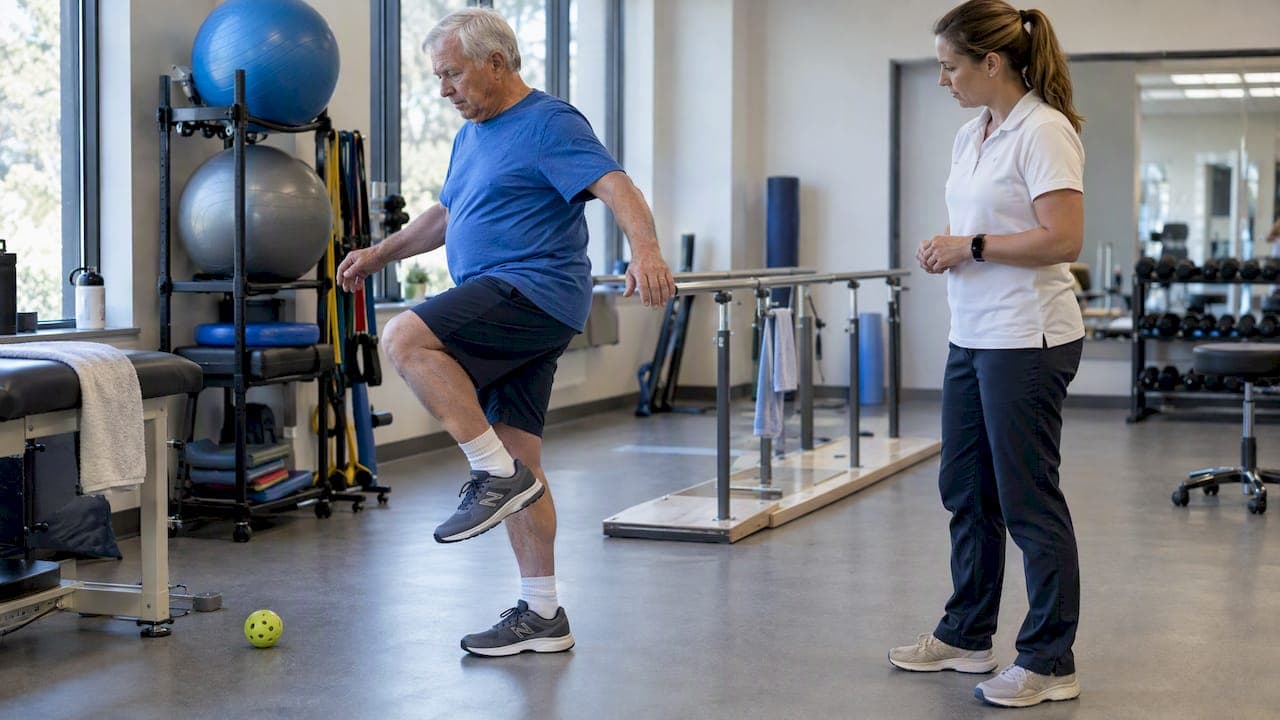
Most recreational players can return to pickleball, and many do within 3 to 6 months of total knee replacement, though full healing and confident lateral movement can take up to a year. The real gate isn't the calendar. It's whether your pain, strength, and range of motion meet objective benchmarks and whether your surgeon or physical therapist has cleared you for on-court play.
TL;DR:
- Your care team should confirm clearance when strength reaches 70% of the opposite leg and balance and sport movements cause no increasing pain or swelling.
- Start with doubles, dinking, and half court drills; cap sessions at 20 to 30 minutes, build duration before intensity, and allow rest days.
- A cohort of 1,782 athletes had a median return at 12 weeks, and 90% returned within 27 weeks; health and prior activity affect timing.
- Stop and contact your care team for fever, incision redness or drainage, sudden instability, inability to bear weight, or rapidly increasing swelling.
Table of Contents
- How Your Recovery Timeline Maps to Pickleball Readiness
- What Tests Determine When You're Cleared to Play
- Rehab Priorities That Get You Ready for the Court
- A Stepwise Plan for Returning to On-Court Play
- Gear and Habits That Protect a New Knee on Court
- Warning Signs That Mean You Should Stop and Get Checked
- Why Your Return-to-Play Plan Should Match Your Own Movement
- Using AI-Driven Movement Checks Alongside Your Rehab
- The Honest Reality of Returning to a Sport You Love
- FAQ
- Sources
- Sources Worth Bookmarking
How Your Recovery Timeline Maps to Pickleball Readiness
Recovery after knee replacement unfolds in overlapping phases, and pickleball fits into the later ones.
In the first 0 to 4 weeks, the priority is wound healing, pain control, and restoring early range of motion through gait training. There's no on-court activity at this stage, even gentle drills.
From 1 to 3 months, most patients work on rebuilding range of motion and basic strength. You're not back on the court yet, but low-level conditioning like stationary cycling or pool walking often starts here.
The 3 to 6 month window is when many patients pass functional tests and, if cleared, begin cautious on-court activity such as doubles or controlled drills. A prospective cohort study of 1,782 patients found a median return-to-sport time of 12 weeks among athletes, with 90% returning within 27 weeks, though return odds depend heavily on preoperative activity level and other health factors.
Beyond 6 months and into the first year, intensity, balance, and tolerance for faster play keep improving. For some recreational players, full competitive readiness takes longer.
- 0 to 4 weeks: healing, early ROM, gait training, no court time
- 1 to 3 months: strength and ROM rebuilding, light conditioning only
- 3 to 6 months: functional testing, possible cautious return if cleared
- 6 to 12 months: progressive intensity and full competitive readiness for some
What Tests Determine When You're Cleared to Play
Clearance for pickleball rests on measurable benchmarks, not how many weeks have passed since surgery.
Strength is usually assessed against the uninjured leg. A common functional target is reaching about 70% of the opposite limb's strength, particularly in the quadriceps and hamstrings, before resuming racket sports, according to HSS guidance on pickleball after joint replacement.
Balance matters just as much as raw strength for a sport built on quick direction changes and balance training for seniors is essential to prevent falls and improve stability after knee replacement. A single-leg stance on both sides is one possible balance measure. Ask your care team which tests they use before clearing racket sports.
About 85% of patients return to sport after total knee replacement, with a mean delay of 5 months, according to a retrospective study on return to sport after TKR.
Functional tests round out the picture: stair-climb time, 6-minute walk tolerance, and whether sport-specific movements like lateral shuffles trigger swelling or pain that builds rather than fades.
- Strength: around 70% of the opposite limb, quads and hamstrings especially
- Balance: 30-second single-leg stance, both sides
- Function: stair climb, 6-minute walk, and pain-free sport movements
- Pain and swelling: minimal and non-progressive with activity
Surgeon and PT agreement is non-negotiable before stepping on court. Being "cleared" for daily activity doesn't automatically mean you're ready for competitive intensity.
Rehab Priorities That Get You Ready for the Court
Pickleball asks a lot from a rebuilt knee: quick lateral cuts, split steps, and sudden stops. Eccentric strength in the quadriceps and hamstrings, along with sharp neuromuscular control, is what absorbs that load and protects the implant during those movements.
Rehab typically follows a progression rather than jumping straight to sport drills:
- Restore range of motion with straight-leg raises and heel slides
- Build closed-chain strength through squats and step-ups
- Add unilateral work like split squats and single-leg squats
- Introduce eccentric loading and controlled plyometrics
- Finish with agility drills that mimic court movement
Early on, straight-leg raises and heel slides rebuild basic motion and activation. As strength improves, lateral step-ups and single-leg balance holds target the stability pickleball demands. Later in rehab, controlled lateral hops at low height start bridging the gap between therapy and real court movement, always under PT guidance.
Some clinics use blood flow restriction training during early rehab to build strength with lighter loads, which can be useful when a full-intensity exercise isn't yet appropriate. Targeted, sport-specific rehab can help prepare you for the movements involved in returning to sport.
A structured pickleball prehab routine built around these movement patterns may help you prepare for sessions back on court.
Pro Tip: Record short video clips of your squats or lateral steps on your phone and bring them to your next PT session. It's one of the simplest ways to catch a movement pattern that needs correction before it becomes a habit.
A Stepwise Plan for Returning to On-Court Play
Once cleared, resist the urge to jump straight into full games. A staged return protects your new joint while you rebuild confidence and conditioning.
Start with doubles rather than singles, since doubles involves less court coverage and fewer explosive sprints. Within doubles, begin with dinking drills and half-court rallies before playing full points.
Keep early sessions short and increase duration before you increase intensity. Build in 1 to 2 rest days between sessions in the first few weeks so your knee has time to recover between outings.
Drill work should mimic court demands without full speed: shadow footwork without a ball, short shuttle steps, and controlled lateral shuffles are useful ways to build tolerance gradually. Our 4-stage return-to-play guide walks through this kind of staged protocol in more detail.
- Begin with doubles, dinking, and half-court drills, not singles or full points
- Cap sessions at 20 to 30 minutes and build duration before intensity
- Take 1 to 2 rest days per week in early return-to-play weeks
- Use shadow footwork and controlled lateral shuffles to build tolerance safely
Watch for next-day swelling or sharp pain after each session. If either shows up, dial back intensity and check in with your physical therapist before your next outing.
Gear and Habits That Protect a New Knee on Court
Small equipment and technique choices add up to meaningfully less stress on a replaced knee.
Court shoes with solid lateral stability and grippy, non-slip soles matter more after knee replacement than before. Worn-out soles that lose traction increase the risk of an awkward slide or pivot, so replace them before they're visibly smooth.

Technique adjustments help too. Prioritizing court positioning and anticipation over last-second lunges reduces how often you need an extreme reach. Clinical commentary on post-arthroplasty return to racket sports describes a lower-impact playing style that favors positioning over extreme lunges and jerky pivots.
A light knee sleeve or temporary taping can offer reassurance during the transition back to play, though it shouldn't become a long-term crutch for instability that needs actual rehab attention.
- Choose shoes with lateral stability and grippy soles, replacing worn pairs promptly
- Favor positioning and anticipation over extreme lunges or twisty pivots
- Use a knee sleeve or tape short-term, not as a permanent fix
- Cross-train with cycling, swimming, and strength work to spread the load
Pro Tip: Swap a pickleball session for cycling or swimming during your return to play. It keeps your cardiovascular fitness up while giving the joint a lower-impact break.
Warning Signs That Mean You Should Stop and Get Checked
Most soreness after a return to play settles with rest. Some symptoms don't, and those deserve prompt attention rather than a wait-and-see approach.
Red flags include fever, increased redness or drainage at the incision site, a feeling of acute instability, inability to bear weight, or swelling that's rapidly increasing rather than gradually settling.
For soreness or swelling after surgery, contact your care team for advice rather than relying on self-treatment. OrthoInfo from AAOS recommends continuing prescribed physical therapy exercises for at least two months after surgery, which also helps you recognize what's normal fatigue versus something that needs a second look.
- Fever, redness, or drainage at the incision: contact your surgeon promptly
- Acute instability or inability to bear weight: seek evaluation right away
- Rapidly increasing swelling: don't wait it out, call your care team
- Persistent symptoms despite rest and ice: ask about imaging
If symptoms persist, seek medical evaluation promptly.
Why Your Return-to-Play Plan Should Match Your Own Movement
Generic return-to-play timelines are a starting point, not a personal prescription. Two players at the same point post-surgery can have very different lateral stability, step mechanics, and compensations built up from months of altered gait.
A plan based only on weeks since surgery misses the movement details that actually predict reinjury risk, things like how much weight shifts onto the non-surgical leg during a split step, or whether a lateral lunge loads the knee evenly. Preoperative activity level and other health factors also shape how quickly someone can safely progress, which is part of why return-to-sport timing varies so widely across patients.
Movement analysis that looks at your specific stress points, rather than applying one generic curve to everyone, makes it possible to flag an asymmetry or compensation pattern before it turns into pain or a setback. That's the gap personalized, biomechanics-based assessment is built to close: matching the pace and content of your return to how your knee is actually moving, not just how many months have passed.
Using AI-Driven Movement Checks Alongside Your Rehab
Pairing structured rehab with ongoing movement feedback gives you a way to catch small issues before they become setbacks. This is where our own approach at Play On Pickle fits into a return-to-play plan.
Our patent-pending computer vision technology analyzes video of your own movement on the court to identify biomechanical stress points. We turn that analysis into a personalized set of exercise and equipment recommendations suited to how your knee is actually loading during pickleball-specific movement.
For someone easing back into the sport after knee replacement, that means checking in periodically through each phase: during early drills, as you add intensity, and again once you're playing fuller sessions. Instead of guessing whether your lateral step mechanics have normalized, you get a concrete, individualized read tied to your own footage.
This kind of targeted feedback complements, rather than replaces, the clearance process your surgeon and physical therapist oversee. It's an added layer of insight for the stretch after clearance, when you're managing your own pace and watching for the stress points that generic advice can't see.
The Honest Reality of Returning to a Sport You Love
Returning to pickleball after knee replacement rarely follows a straight line. Expect good weeks and a few frustrating ones, and don't treat a setback as a sign you've failed.
What actually works is boring but reliable: lean on objective tests, not optimism, and keep your surgeon and physical therapist in the loop as you progress. Patience pays off. Most people who follow a structured, staged plan do get back to the court they missed.
— Drona
This article is general information, not a substitute for advice from a qualified doctor. Consult a qualified healthcare professional about your own circumstances before acting on anything here.
FAQ
Can you play pickleball with two knee replacements?
Yes, many patients with bilateral knee replacements return to pickleball once both knees independently meet clearance benchmarks like strength and balance testing. Recovery and clearance timing may differ slightly between the two knees, so readiness is judged knee by knee rather than as a single combined milestone.
How long does it take for muscles to heal after total knee replacement?
Muscle strength and healing typically continue improving for several months, with many patients regaining substantial function over time. OrthoInfo from AAOS recommends continuing prescribed physical therapy exercises for at least two months after surgery, and some patients keep gaining strength and endurance well into recovery.
How painful is a knee replacement on a scale of 1 to 10?
Pain levels vary by person, surgical technique, and day of recovery, so individual experiences differ widely. Pain is generally highest in the first days after surgery and should trend downward with appropriate pain management and physical therapy as healing progresses.
What can you never do again after total knee replacement?
There's no universal list of permanently banned activities, since outcomes depend on your specific implant, surgical approach, and how well you meet rehab milestones. High-impact, high-pivot activities are generally approached with more caution, and your surgeon is the right source for guidance on any activity specific to your case.
Sources
- Activities After Total Knee Replacement - OrthoInfo - AAOS
- Factors lead to return to sports and recreational activity after total knee replacement
- Playing Pickleball after Knee or Hip Replacement: What to Know
- Return to Sports After Primary Total Knee Arthroplasty: A Prospective Cohort Study of 1782 Patients
Sources Worth Bookmarking
For readers who want to go deeper, OrthoInfo from AAOS covers general activity guidance after knee replacement, the PMC study on return to sport after TKR offers peer-reviewed data on timing, and HSS guidance on pickleball after joint replacement lays out hospital-based functional benchmarks.