
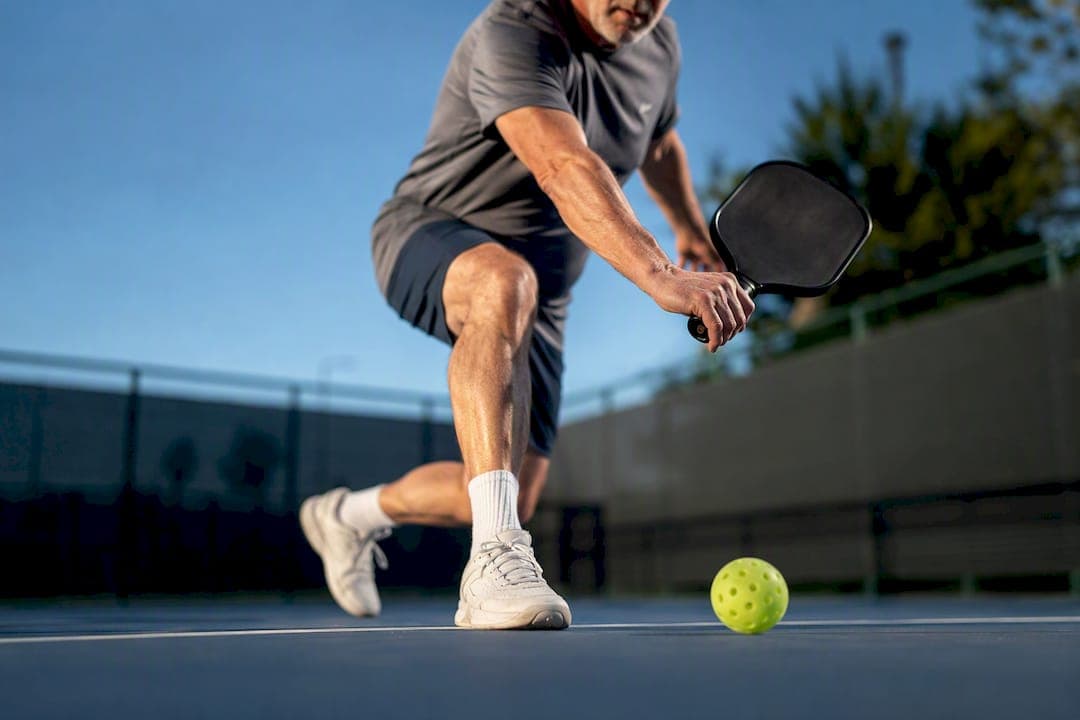
Pickleball puts real, repeated stress on your knees, shoulders, and ankles through quick pivots and overhead swings, but it doesn't have to leave you sidelined. The fastest way to cut that stress starts before you ever step on the court: a 3 to 5 minute dynamic warm-up and court shoes built for lateral movement. Add sensible pacing and the sport stays what it should be, a low-drama way to stay active for decades.
TL;DR:
- Proper warm-up routines and court shoes with lateral support significantly reduce joint stress during quick pivots and overhead swings.
- Most injuries stem from overuse, such as tendon irritation, or acute trauma like falls causing sprains or fractures, especially in older players.
- Consistent prevention habits, including strength training, surface-specific shoes, and surface-aware court inspection, lower injury risk over time.
- Early recognition of symptoms like swelling or inability to bear weight is crucial, with modern care emphasizing protection and gradual load increase over rest alone.
- AI movement analysis can identify individual mechanical stress points, helping players customize exercises and prevent recurrent overuse injuries.
Table of Contents
- How Pickleball Movements Load Your Joints
- What Are the Most Common Pickleball Joint Injuries?
- How Can You Prevent Joint Stress on the Court?
- What Should You Do If You Get Hurt?
- Can AI Movement Analysis Catch Problems Before They Start?
- Do Paddle Grip and Stroke Mechanics Matter for Joint Stress?
- Does the Court Surface Affect Joint Loading?
- What Long-Term Joint Health Habits Actually Pay Off?
- A Prevention-First Take on Playing Longer
- Get a Personalized Read on Your Own Mechanics
- Sources
How Pickleball Movements Load Your Joints
Every sport has a signature stress pattern, and pickleball's comes from stopping and starting on a dime. When you pivot to reach a dink or lunge for a low ball, your knee absorbs a combination of compressive force (straight down) and rotational torque (twisting) at the same moment. Your ankle does something similar, planting hard while your body changes direction, which is why lateral instability shows up so often in this sport.
Overhead swings and serves load the shoulder and wrist differently. The repetitive nature of the motion, dozens of times per session, creates cumulative stress on tendons rather than a single traumatic event. That's the core distinction worth understanding: pickleball injuries generally fall into two buckets, overuse (tendon and joint irritation from repetition) and acute trauma (a fall, a bad pivot, a rolled ankle).
Age and prior injury history change the math considerably. A 2025 clinical review found that older adults presenting with pickleball injuries were more likely to show up with fractures and require emergency care, largely tied to falls rather than gradual overuse patterns. If you've got existing knee arthritis or a previous ankle sprain, that joint is already working with less margin. Poor movement patterns, like leading every shot with your knee instead of your hip, compound the problem over a season of play.
What Are the Most Common Pickleball Joint Injuries?
A 2025 clinical review identified muscle strains, joint sprains, and fractures as the most frequent injuries among pickleball players, with the pattern shifting toward fractures in older age groups. Here's what actually shows up in clinics:
- Ankle sprains from lateral cuts and quick direction changes, often the result of a fall.
- Knee flare-ups or arthritis aggravation, especially in players with existing joint wear.
- Lateral epicondylitis, commonly called pickleball elbow, from repetitive gripping and swinging.
- Rotator cuff tendinopathy from overhead serves and reaching shots.
- Achilles irritation from repeated push-off during quick starts.
- Wrist fractures from falls, particularly common in older players.
Watch for swelling that doesn't settle, an inability to bear weight, pain that wakes you at night, or a joint that catches or loses range of motion. Those symptoms mean it's time to stop self-managing. Players ramping up play volume too fast, those over 50, and anyone with a prior injury in the affected joint carry the highest risk, a pattern falls account for heavily among older adults according to health system injury data.
How Can You Prevent Joint Stress on the Court?
Prevention isn't complicated, but it does need to be consistent. Here's the priority order that actually moves the needle, starting with what to do in the ten minutes before you play.
- Warm up dynamically, not statically. Spend 3 to 5 minutes on high knees, leg swings, walking lunges, and arm circles. Dynamic movement raises tissue temperature and primes the exact patterns you'll use in play, while static stretching before activity can actually reduce short-term power output. A quick pickleball warm up routine covers this in more depth.
- Add mobility drills for the ankle, hip, and shoulder. Limited range in any of these three joints forces your body to compensate somewhere else, usually the knee or lower back.
- Build strength in the muscles that stabilize your joints. Glute bridges and side-lying clams protect the hip and knee. Single-leg squats and progressive hamstring work build the control you need for lateral cuts. Calf raises support the ankle and Achilles. Rotator cuff external rotation and plank variations protect the shoulder and core.
- Choose court shoes with lateral stability, not running shoes. Road-running shoes are built for forward motion; they don't hold up when you cut sideways repeatedly, which raises ankle injury risk.
- Manage your load like a training plan, not a hobby. Start with 1 to 2 sessions a week and add one session every 1 to 2 weeks. Take planned rest days and cross-train with swimming or cycling to build endurance without repetitive joint impact.
- Adjust your technique when you're sore. Step toward the ball instead of reaching, shorten your swing arc, and bend your knees properly on low shots instead of bending at the back.
Pro Tip: Track your weekly play volume the same way a runner tracks mileage. If you jump from two sessions a week to five because a tournament is coming up, that spike, not the sport itself, is usually what triggers overuse injuries.
Recovery habits round this out: hydration, foam rolling, and consistent sleep all support tissue repair between sessions. Clinicians who treat these common injuries point out that shoulder mobility and core stability prevent overuse tendinopathy more reliably than bracing or taping alone.
What Should You Do If You Get Hurt?
Immediate care depends on what's actually wrong, but the general framework has shifted in recent years from RICE to something called PEACE & LOVE, which emphasizes protecting the area, optimism, and gradual loading over pure rest and ice. Either approach still starts with protecting the joint and limiting weight-bearing if it's painful.
Seek urgent care or imaging if you notice:
- Visible deformity or a joint that looks out of place
- Inability to bear any weight on the leg or ankle
- An open wound near the injury
- Numbness, tingling, or a limb that feels cold or discolored (signs of nerve or blood flow issues)
For sprains and strains without those red flags, physical therapy typically starts with restoring range of motion, then progresses to strength work, balance training, and finally sport-specific drills. Early PT after an ankle sprain generally speeds return to play compared to prolonged rest, a pattern borne out in racket sport injury reviews. If you're dealing with a rolled ankle right now, this guide on handling a pickleball ankle sprain walks through the first 48 hours.
Return to play should be symptom-guided, not calendar-guided. Clinicians look for functional milestones like a pain-free single-leg hop or symmetric squat depth before clearing moderate injuries, rather than picking an arbitrary date two weeks out.
Can AI Movement Analysis Catch Problems Before They Start?
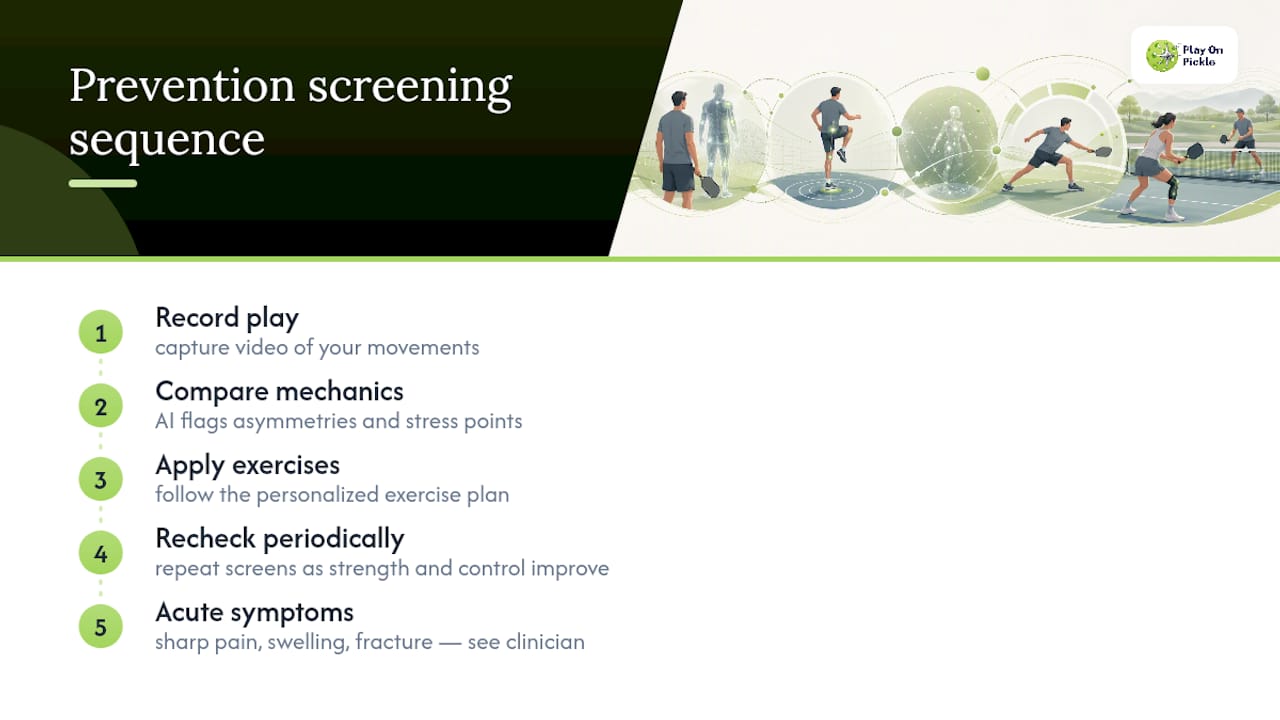
Movement-analysis tools work by recording your play and comparing your joint mechanics against patterns known to cause overuse injuries, flagging asymmetries like a knee that caves inward on pivots or a shoulder that overcompensates on serves. Some services provide AI-driven video analysis, identifying individual stress points and generating personalized exercise plans, with a free trial available for players who want a baseline read on their own mechanics.
This kind of screening works best as a complement to clinical care, not a substitute for it. The sequence that makes sense: screen your mechanics, apply the targeted exercises it recommends, then recheck periodically as your strength and control improve. If you're already dealing with sharp pain, swelling, or a suspected fracture, see a clinician first. Movement analysis is built for prevention and mechanics correction, not diagnosing an acute injury.
Do Paddle Grip and Stroke Mechanics Matter for Joint Stress?
Equipment and technique adjustments are some of the cheapest fixes available, and they're underused. A paddle grip that's too small forces excessive wrist flexion on every shot, which is a direct contributor to lateral epicondylitis, the tendon irritation players call pickleball elbow. Sizing your grip so your fingers wrap comfortably without excess space reduces that repetitive strain considerably.
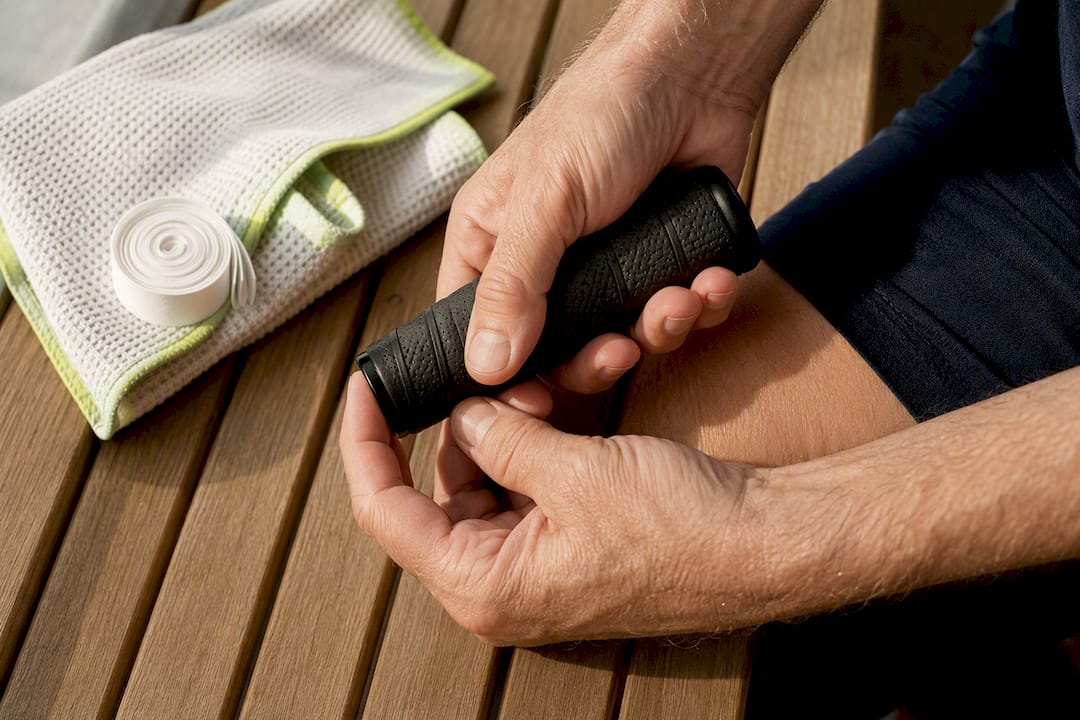
Grip weight matters too. A paddle that's too heavy for your swing speed puts extra load on the elbow and shoulder with every hit, especially over a long session. Lighter paddles with a slightly larger grip circumference tend to reduce wrist torque for players already managing elbow discomfort.
Stroke mechanics compound or ease all of this. Players who swing primarily from the wrist and elbow, instead of rotating the torso and using the legs, push far more force through the smaller joints of the arm. Shifting weight into the shot and letting the core and legs generate power takes pressure off the elbow and shoulder. This is one reason clinicians treating pickleball-specific overuse injuries emphasize whole-body mechanics over arm-only technique fixes.
Vibration-dampening paddle materials and slightly larger grip circumferences also reduce the jarring transmitted up the arm on off-center hits. None of these swaps require lessons or new skills, just attention to equipment that's often chosen on price or paddle pop alone.
Does the Court Surface Affect Joint Loading?
Surface matters more than most recreational players realize. Outdoor courts are typically poured concrete or asphalt with an acrylic coating, which is unforgiving compared to a sprung wood gym floor. That harder surface transmits more force directly back into your knees and ankles with every step and stop, particularly during long sessions.
Indoor gym floors with more give reduce impact loading, but they come with their own tradeoff: less traction, which raises slip risk if your shoes and the floor aren't matched. A court shoe with the wrong outsole for the surface undermines even good technique. Rubber compounds built for outdoor courts can feel sticky and grab too hard on indoor wood, increasing twisting force on the knee rather than sliding safely.
Cracked or uneven outdoor courts, common at public parks, add another variable entirely: a bad bounce underfoot on a pivot is a common way ankle sprains happen. If you regularly rotate between indoor and outdoor play, treat your footwear as surface-specific gear rather than a single pair for everything. Checking court condition before you warm up costs nothing and catches the kind of surface irregularity that turns a routine lunge into a rolled ankle.
What Long-Term Joint Health Habits Actually Pay Off?
The players who last decades in this sport treat joint care as a weekly habit, not a reaction to pain. That means building recovery days into your schedule the same way you'd schedule practice, not skipping them when a tournament or open-play slot comes up.
Cross-training carries real weight here. Low-impact activities like swimming or stationary cycling build the cardiovascular base and muscular endurance pickleball demands, without adding another layer of repetitive joint loading. This matters most for players over 50 or anyone managing existing arthritis, since it lets you stay conditioned between sessions instead of resting completely or overplaying.
Recovery practices beyond basic stretching are worth building into your routine too. Foam rolling and mobility work address tightness before it becomes compensation. Some players also use cold plunge therapy after intense sessions to manage inflammation and speed recovery between play days, though it's a supplement to good conditioning, not a substitute for it.
Prehabilitation, structured exercise aimed at correcting asymmetries before they cause pain, has shown real value in reducing recurrence of sprains and tendon irritation, according to the same 2025 clinical review referenced earlier. If you've had recurring elbow trouble, a targeted recovery guide for pickleball elbow is worth reading before your next flare-up rather than after.
A Prevention-First Take on Playing Longer
Most players treat joint pain as an inconvenience to push through until it forces a break. That's backwards. Forced rest after an injury costs you far more court time than the five minutes a proper warm-up takes, and it's almost always avoidable with consistent, boring habits done before pain shows up.
Pick one habit and stick with it for a month: a 5 minute mobility warm-up plus two strengthening moves, done three times a week, regardless of how you feel that day. That single habit does more for your knees and shoulders than any single piece of gear. If pain persists past a few days despite rest and basic care, see a clinician rather than guessing at what's wrong.
— Drona
Get a Personalized Read on Your Own Mechanics
Generic warm-up lists help, but they can't tell you that your left knee caves in on every pivot or that your serve is overloading your shoulder specifically. AI-driven video analysis that reviews your actual movement on court, flags individual stress points, and builds a personalized exercise plan around what your body is actually doing, not a generic average player's mechanics, can help close that gap.
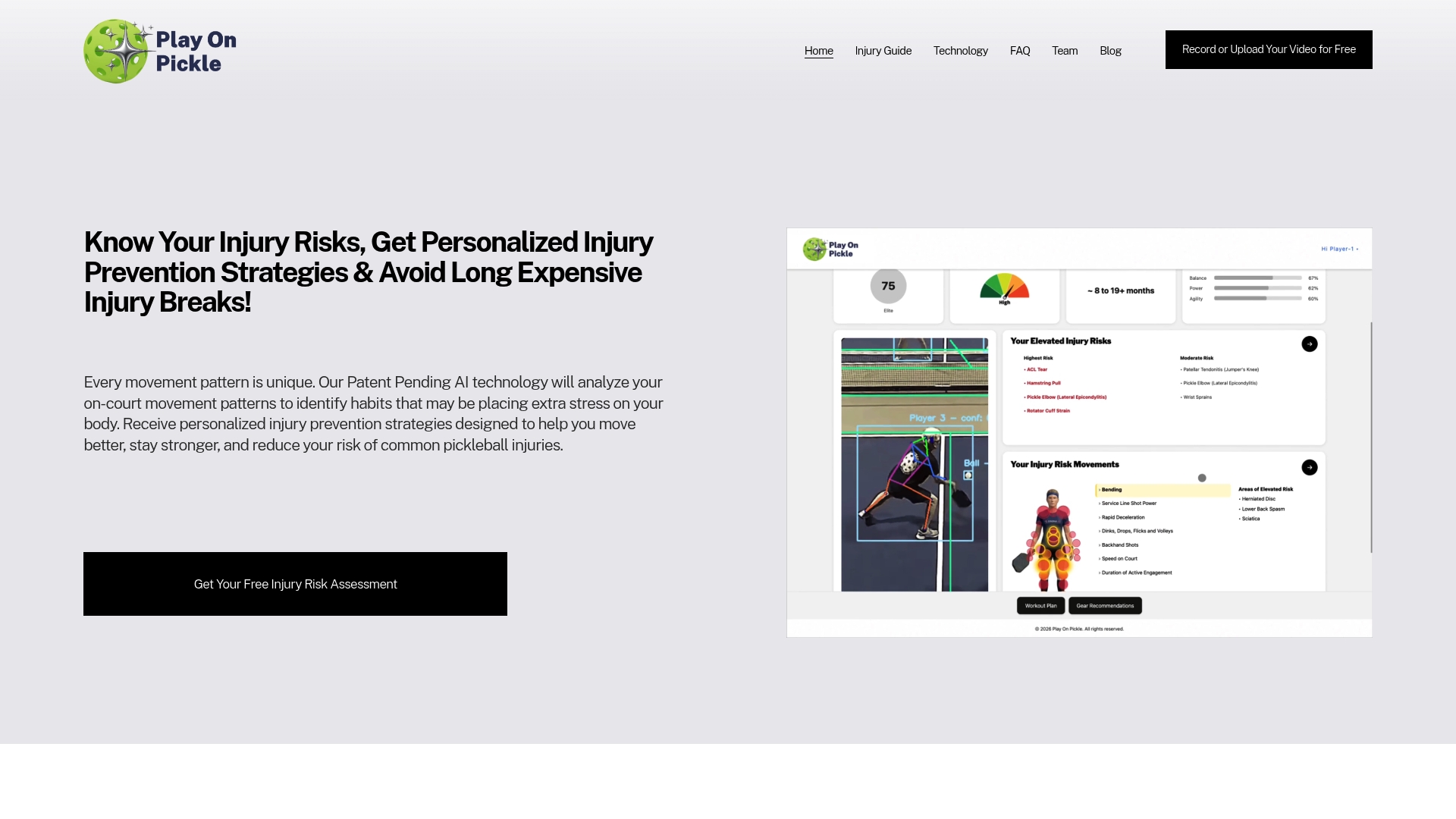
This fits best for recreational players dealing with recurring soreness, a lingering ache that never quite resolves, or a nagging sense that one side of the body works harder than the other. Rather than guessing which drills from a general list apply to you, a baseline movement screen tells you exactly where to focus. Playonpickle offers a free trial to get that first assessment, so start with a baseline movement screen and see what your own mechanics are telling you.
Sources
- Diagnosis and Management of Common Musculoskeletal Injuries in the Pickleball Athlete | Current Physical Medicine and Rehabilitation Reports
- Pickleball-related injury review (PMC article)
- 7 ways to protect your joints on the pickleball court | LCMC Health