
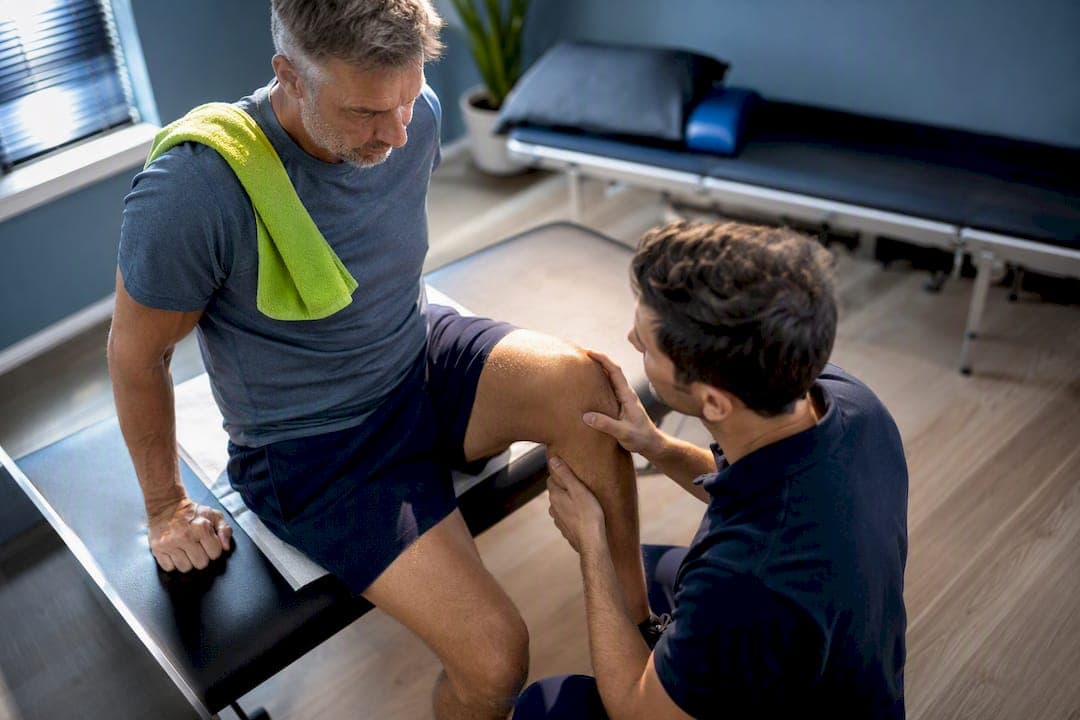
Most pickleball knee pain falls into one of three buckets: overuse tendon irritation at the front of the knee, mechanical strain along the outside of the knee from weak hip control, or an acute injury to a ligament or meniscus. Stop pivoting and lunging immediately, ice the joint for 15 to 20 minutes, and compress it if you notice swelling. If you can't bear weight, the knee looks deformed, or it locks up on you, skip the home remedies and get evaluated the same day.
TL;DR:
- Most pickleball knee pain stems from overuse tendinopathy, mechanical strain from weak hip control, or acute ligament or meniscus injuries.
- Symptoms like swelling, instability, locking, or pain worsening on stairs signal the need for prompt medical evaluation and possible imaging.
- Specific rehab focuses on eccentric loading, hip strengthening, and controlled movement to address root causes and prevent recurrence.
- Precautions include warming up dynamically, wearing supportive footwear, gradually increasing load, and following a staged return-to-play timeline.
- Video-based movement analysis can identify mechanical issues behind persistent pain and tailor personalized exercises for better long-term management.
Table of Contents
- Six Warning Signs of Pickleball Knee Pain and What They Mean
- What Causes Knee Pain After Pickleball: The Movement Mechanics Behind It
- When to See a Doctor or Get Imaging
- Immediate Self-Care: What to Do in the First 72 Hours
- Rehab Exercises That Actually Fix the Root Cause
- Preventing Knee Pain: Warm-Up, Footwear, and Load Management
- Return to Play: A Phased Timeline You Can Actually Follow
- Is It Really Your Knee? Ruling Out Referred Pain
- Long-Term Management: Keeping Knee Pain From Coming Back
- Managing the Mental Side of a Knee Injury
- How Movement Analysis Helps Catch What Generic Rehab Misses
- Play On Pickle: Personalized Movement Analysis for Recurring Knee Pain
- Sources
Six Warning Signs of Pickleball Knee Pain and What They Mean
Not every twinge means the same thing. The pattern of your symptoms tells you far more than the pain intensity alone, and learning to read that pattern is the fastest way to figure out whether you need rest or a referral.
- Pain that builds or worsens during play. This usually points to overuse and tendon overload, most often the patellar tendon just below the kneecap.
- Swelling that shows up during or right after a session. Fresh swelling signals joint inflammation, and in some cases a meniscus tear or ligament sprain.
- A feeling of the knee "giving way." Instability like this often means a ligament, commonly the ACL or MCL, isn't holding the joint the way it should.
- Locking or catching when you bend or straighten the knee. That mechanical snag is a classic sign of a torn meniscus and deserves a clinical look.
- Pain that spikes on stairs or after sitting for a while. This is the calling card of patellar tendinopathy, sometimes called jumper's knee even though pickleball players get it just as often.
- Pain intense enough to wake you up or keep you from sleeping. Yale Medicine flags this as a signal that goes beyond simple soreness and warrants a clinician's opinion.
If you're seeing more than one of these at once, especially swelling paired with instability, treat that combination as your body telling you to dial back the intensity before you play through it. For a broader look at whether your soreness is typical or a red flag, this breakdown of post-match pain walks through the distinction in more detail.
What Causes Knee Pain After Pickleball: The Movement Mechanics Behind It
Pickleball puts a specific set of demands on the knee that tennis or pickleball's other racket-sport cousins don't quite replicate. The short court, the constant split-stepping, and the sudden direction changes create repetitive load on tissues that were never built for that many stops and starts in an afternoon.
Patellar tendinopathy develops from repeated split-steps and lunges that load the tendon connecting your kneecap to your shin. Every dink return and every lunge to the kitchen line asks that tendon to absorb force, and thousands of reps later, it starts to complain, usually as pain right at the front of the knee that gets worse going down stairs.
IT band irritation and valgus collapse come from a different mechanism. When your hip abductors, the muscles on the outside of your hip and glute, are too weak to control your leg during a pivot, your knee tends to cave inward. FORWRD's clinical breakdown identifies this valgus collapse as a major driver of lateral knee stress, and it's cumulative: one bad pivot won't hurt you, but hundreds of them across a season will.
Meniscus tears and ligament sprains happen fast, usually during a hard plant-and-pivot to change direction or lunge for a wide shot. You'll often hear or feel a pop, and swelling tends to show up within hours rather than building gradually over days. Peer-reviewed research on pickleball injury patterns confirms these acute strains and sprains are among the most common injuries in the sport.
Arthritis flares are their own category, and an important one for players over 50. HSS notes that twisting and pivoting can aggravate existing cartilage wear without creating any new tissue damage. That distinction matters for how you treat it: an arthritis flare responds to activity modification and conditioning, not the same protocol you'd use for a fresh tear.
When to See a Doctor or Get Imaging
Some symptoms need attention today, not next week. If you can't put weight on the leg, the knee looks visibly out of place, you've lost feeling or pulse below the joint, or swelling is ballooning within an hour of the injury, go to urgent care or the ER. Those are signs of a serious structural injury that shouldn't wait.
Outpatient care is the right call when swelling sticks around past 72 hours, you're feeling locking or catching, the knee feels unstable, or conservative treatment at home hasn't moved the needle after 7 to 14 days. Scripps Health points out that most mild pickleball injuries do improve with rest and basic care, so if yours isn't improving on that timeline, something more is going on.
Start with your primary care doctor or a sports medicine physician if you're not sure how serious things are. They'll run you through a physical exam, testing your range of motion and joint stability, and refer you for an MRI if they suspect a meniscus or ligament tear. A physical therapist is also a reasonable first stop, particularly if your pain sounds more mechanical than acute. Many recreational players skip this step and just tape up a knee sleeve for months, which usually means the underlying weakness or asymmetry never gets addressed.
Immediate Self-Care: What to Do in the First 72 Hours
The first three days after knee pain flares up set the tone for how fast you recover. Overdo it and you'll extend the timeline; underdo it and you risk stiffness that slows rehab later.
- Modify activity, don't fully stop. Rest from pivoting and lunging, but keep walking short, flat distances if it's tolerable, since total immobility can stiffen the joint.
- Ice for 15 to 20 minutes after activity, and again a few times through the day if swelling is present.
- Compress moderately. A snug wrap or sleeve helps control swelling, but if your toes go numb or tingly, it's too tight.
- Elevate the leg above heart level when you're resting, especially in the evening.
- Use OTC NSAIDs short-term if you don't have cardiac, kidney, or gastrointestinal conditions that make them risky. Scripps Health lists this alongside rest and ice as a standard first-line approach for mild injuries.
- Choose the right support. A simple sleeve helps with mild soreness and swelling control; a hinged brace is better if you suspect instability, and crutches are appropriate if you can't bear weight comfortably.
Skip anything aggressive in these first few days. Deep-tissue massage, hard stretching, or heat can all increase local blood flow and swelling right when you want the opposite.
Pro Tip: Keep a simple pain log for the first week, noting your pain level right after play and again the next morning. A steady climb, rather than a spike that settles by the next day, is the clearest early sign you're dealing with something that needs more than rest.
Rehab Exercises That Actually Fix the Root Cause
Rest alone rarely solves pickleball knee pain, because rest doesn't fix the weak hip, the tendon that's lost its tolerance for load, or the asymmetry between your left and right leg that's been quietly building for years. FORWRD's research notes that eccentric loading is the evidence-backed intervention for tendinopathy, and skipping it in favor of rest alone is a common reason players keep getting reinjured once they return to the court.
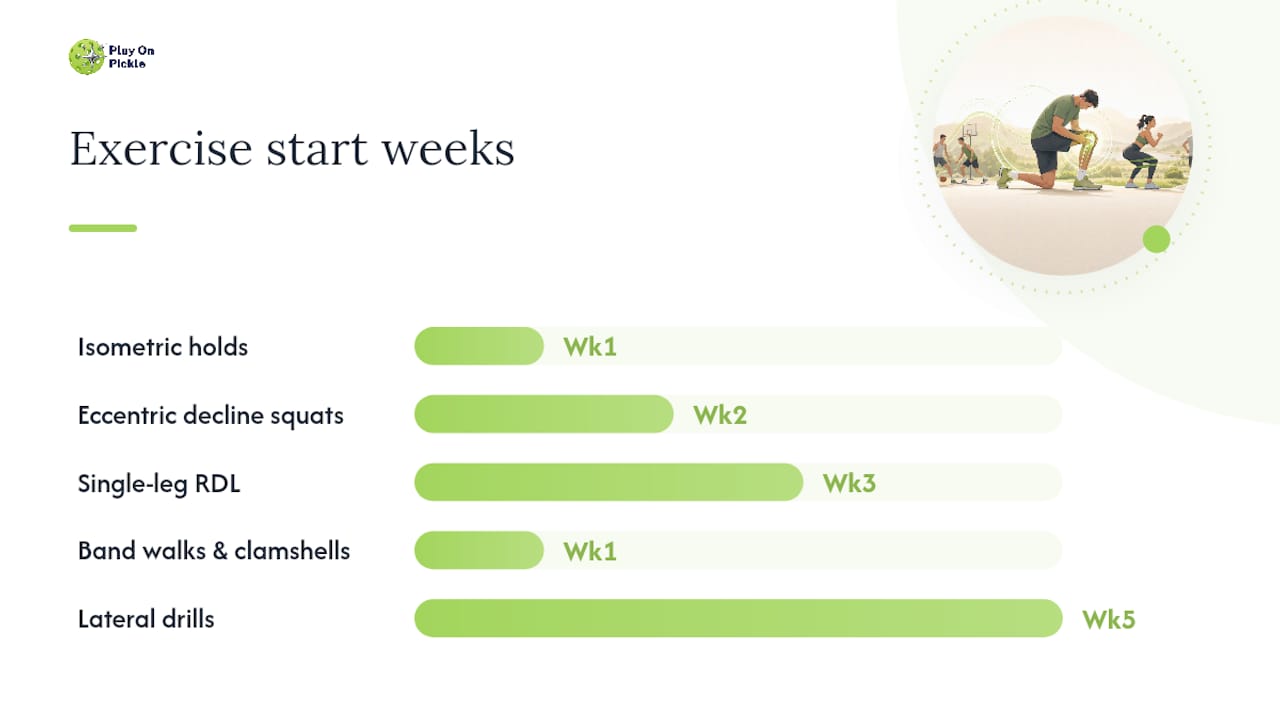
- Isometric quad holds (Weeks 1 to 2). Sit with your leg extended and press the back of your knee into a rolled towel for 30 to 45 seconds, 4 to 5 reps. Keep this pain-limited: mild discomfort is fine, sharp pain isn't.
- Eccentric decline squats (starting Week 2 or 3). Stand on a slant board or decline surface and lower slowly over 3 seconds, then push back up. Do 3 sets of 15, working from a half-range squat toward full range across several weeks. This "Spanish squat" style movement is specifically designed to reload the patellar tendon without the impact of jumping or lunging.
- Single-leg Romanian deadlifts (Weeks 3 to 4). Perform 3 sets of 8 per side, hinging at the hip while keeping the knee tracking straight over the toes. This targets the strength asymmetry between legs that often sets up overuse patterns in the first place.
- Band walks and clamshells (running alongside the above). Do 3 sets of 15 for each, focused on activating the glutes and hip abductors so your knee stops collapsing inward during pivots.
- Controlled lateral drills (Weeks 5 to 6). Add slow side shuffles and low-intensity, court-specific footwork. Watch how your knee feels the next morning before increasing intensity.
- Return-to-play checkpoints. You're ready for full-intensity sessions once you can complete pain-free bodyweight squats, hold a single-leg balance for 30 seconds, and perform a controlled lateral shuffle without pain or hesitation.
Pro Tip: If one leg fatigues noticeably faster during the single-leg Romanian deadlift, that's usually the same leg driving your knee pain. Weight training asymmetry almost always shows up on court as one-sided mechanical strain.
For players managing pain in more than one joint at once, it's worth checking whether hip weakness is also contributing to pickleball hip pain, since the same hip abductor deficits tend to show up in both places.
Preventing Knee Pain: Warm-Up, Footwear, and Load Management
A five to ten minute dynamic warm-up beats static stretching for pickleball, and it's not close. Light jogging, walking lunges, knee lifts, and lateral shuffles wake up the muscles you're about to ask to pivot hard, where static holds mostly just make you feel loose without preparing the joint for lateral force. Yale Medicine and Scripps both list dynamic warm-ups among the most practical steps players can actually stick to before every session.
- Footwear matters more than most players think. Look for court shoes with good lateral stability and cushioning, and replace them every 300 to 500 hours of play, not when they simply look worn out.
- Court surface changes your risk profile. Hard courts increase impact load compared to cushioned surfaces, so if you play mostly on concrete or asphalt, prioritize strength work to compensate.
- Increase load gradually. Bump your playing duration or intensity by no more than 10% to 20% per week. Jumping from two sessions a week to daily play is a fast route to tendon overload.
- Limit tournament frequency if you're an older player. Recovery between high-intensity matches takes longer past 50, and stacking tournaments back to back doesn't leave tissue time to adapt.
Return to Play: A Phased Timeline You Can Actually Follow
Rushing back to full intensity is the single most common reason knee pain becomes a repeat visitor. A staged return, similar to what FORWRD outlines for tendinopathy recovery, gives your tissue time to adapt at each stage before you load it harder.
- Weeks 1 to 2: Protected loading and isometrics only. Keep pain low and avoid any lateral or pivoting movement entirely.
- Weeks 3 to 4: Introduce slow eccentric exercises and limited lateral movement. Track your pain 24 hours after each session, not just immediately after.
- Weeks 5 to 6: Move to controlled lateral drills and low-volume court sessions at roughly 50% intensity, focusing on footwork over competitive play.
- Weeks 7 to 8 and beyond: Return fully once you pass the objective tests, pain-free squats, controlled step-downs, single-leg balance, and a clean lateral shuffle, without soreness the next day.
Older players often need the longer end of each window rather than the shorter one, and that's normal, not a sign of slower healing.
Is It Really Your Knee? Ruling Out Referred Pain
Knee pain doesn't always start in the knee. Hip and spine problems can send pain down the leg that feels exactly like a knee issue, and treating the knee when the actual source is somewhere else wastes weeks of rehab.
A hip problem, like early arthritis or a labral issue, often refers pain to the front or inside of the knee, and it typically comes with reduced hip rotation that you might not notice until a clinician tests it. A lower back issue, particularly a pinched nerve around the L3 or L4 level, can produce knee pain alongside numbness, tingling, or weakness that travels below the knee, which is a pattern true knee injuries rarely show. True knee pathology, by contrast, usually comes with tenderness you can point to directly over the joint, plus swelling or mechanical symptoms like locking that are specific to the knee itself.
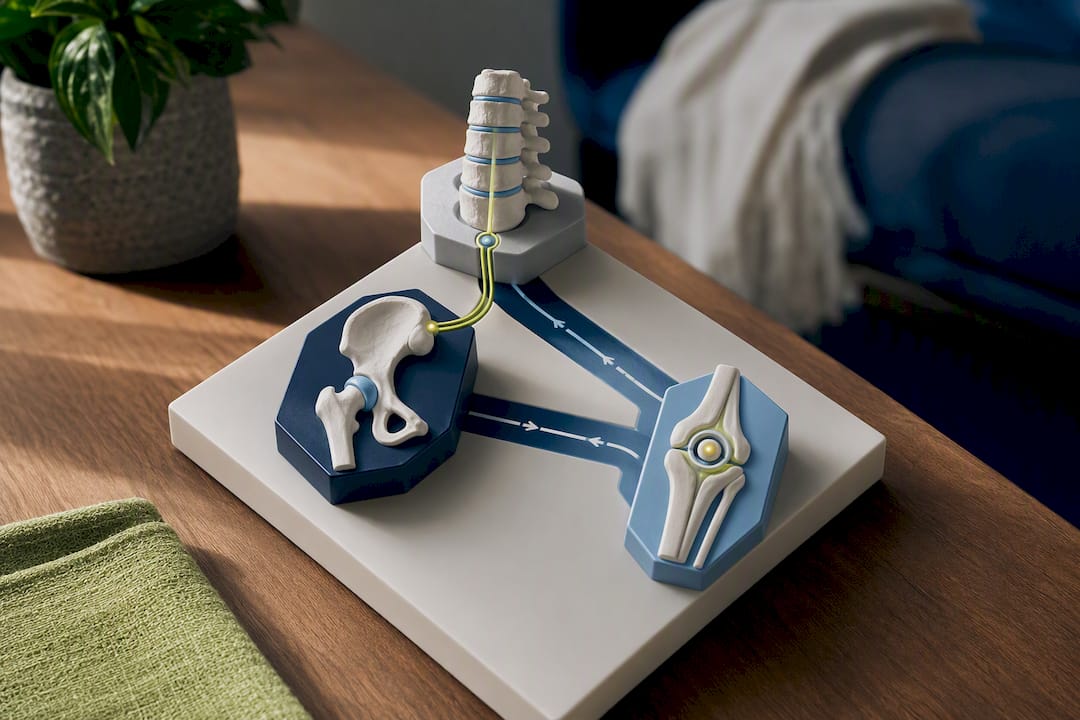
The simplest field test: press directly on the areas around your kneecap and joint line. If that reproduces the pain exactly, the knee is probably the real source. If pressing on the knee does nothing but certain back or hip positions bring the pain on, the knee might just be catching the blame for a problem happening somewhere else in the chain. A physical therapist or sports medicine doctor can sort this out quickly with a hip and spine screen, which is worth doing before you commit to months of knee-specific rehab that may not be addressing the actual cause.
Long-Term Management: Keeping Knee Pain From Coming Back
Fixing the acute flare-up is the easy part. Keeping it from returning next season is where most recreational players fall short, usually because they go back to the exact playing habits that caused the problem in the first place.
Build ongoing strength work into your week, not just your rehab phase. Two sessions a week of hip and glute strengthening, even 15 minutes each, maintains the gains you built during recovery and keeps the valgus collapse pattern from creeping back in. Keep tracking your load. If you're playing more matches, more tournaments, or more intense sessions than you did the previous month, that's worth noticing before pain forces you to notice it. Revisit your footwear on a schedule rather than waiting for it to fall apart, and if you're over 50, build in at least one full rest day between high-intensity sessions as a standing rule rather than an exception. Players who treat prevention as a permanent part of their routine, rather than something they do only after an injury, are the ones who stay on the court consistently year after year.
Managing the Mental Side of a Knee Injury
Getting sidelined by pain doesn't just hurt physically. Missing your regular games disrupts a social routine for a lot of recreational players, and that loss is real, even if it feels minor compared to the injury itself.
Fear of reinjury is common once you start rehab, and it can make you move stiffly or avoid the exact motions you need to retrain, like a controlled pivot. Working through graded exposure, doing an easier version of a feared movement before progressing to the full version, helps rebuild confidence alongside physical capacity. It also helps to separate normal rehab soreness from a genuine setback. Some discomfort during progressive loading is expected and even necessary; sharp, escalating pain is not. Knowing that difference keeps minor rehab-day soreness from turning into unnecessary anxiety about your recovery. If you find yourself avoiding the sport altogether out of fear rather than physical limitation weeks after you've cleared basic milestones, that's worth mentioning to whoever is guiding your rehab.
How Movement Analysis Helps Catch What Generic Rehab Misses
Video-based movement analysis looks at how you actually move on court, flagging things like side-to-side strength asymmetry, valgus collapse on landing, or an early trunk lean during pivots. These are exactly the mechanical patterns behind FORWRD's description of lateral knee stress and tendon overload.
Generic rehab programs treat every knee the same way. If your pain keeps recurring after you've done the basic exercises, and it's mechanical rather than acute, a personalized look at your specific movement pattern is often the missing piece that explains why standard advice hasn't stuck.
— Drona
Play On Pickle: Personalized Movement Analysis for Recurring Knee Pain
If you've done the basic rehab and the same knee pain keeps showing up every few weeks, the problem probably isn't your effort — check out the Blog — Rallio for additional sports-related insights that might help. It's that generic exercise lists can't see your specific pivot, your specific asymmetry, or the exact moment your knee caves inward on a wide return. That's the gap Playonpickle is built to close.
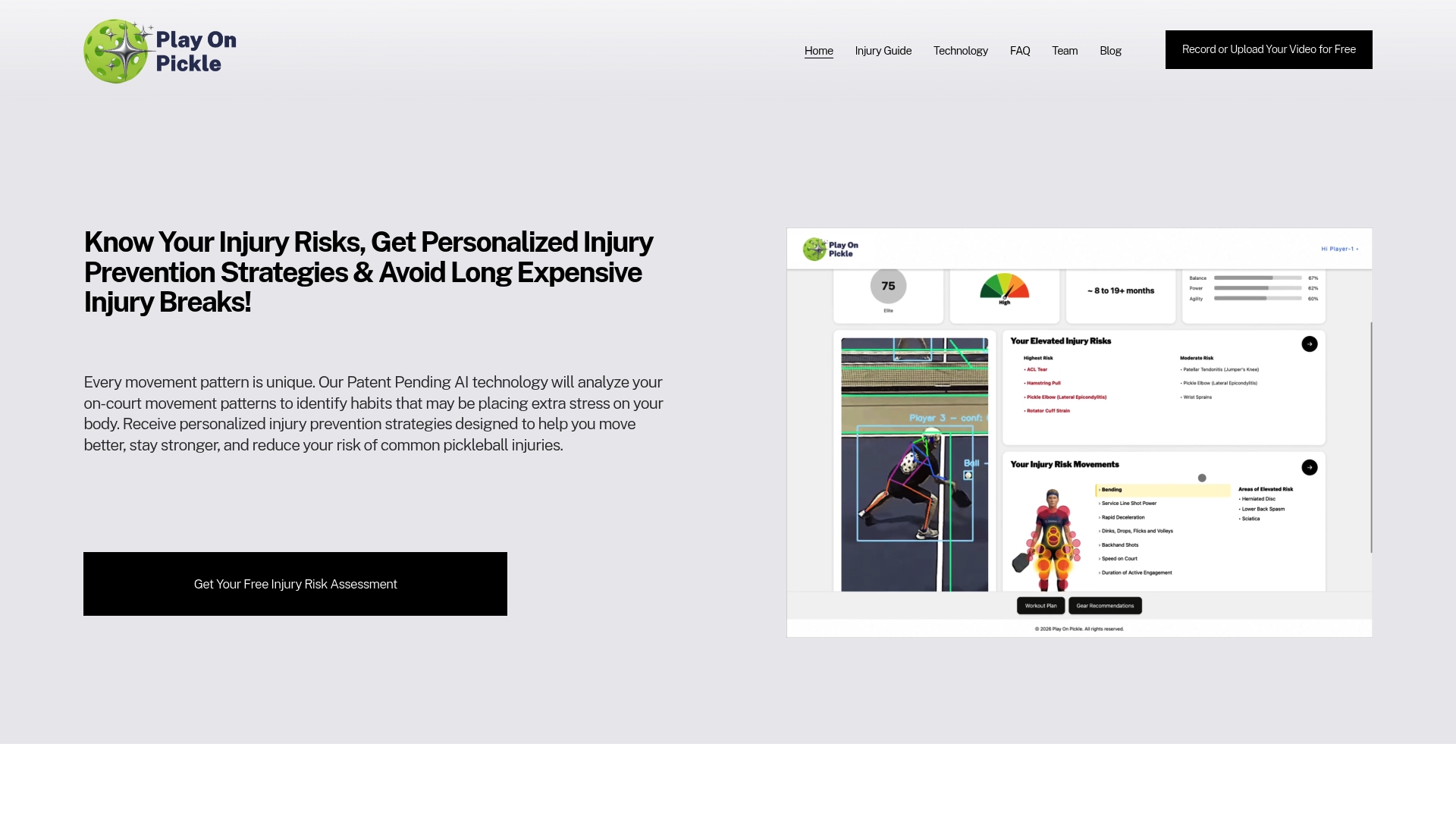
Playonpickle uses AI-driven movement analysis on video you upload from your own games, identifying the biomechanical stress points, the valgus collapse, the weak-side hip, the overloaded tendon, that generic advice can't spot. From there, it builds personalized exercise and equipment recommendations tailored to your own mechanics, rather than a one-size-fits-all list pulled from a blog post. This fits best for players who've already tried basic strengthening and warm-up changes but keep landing back in the same pain cycle. If that sounds familiar, you can try a free initial trial of a movement analysis service to see what your own movement pattern reveals before your next knee flare-up forces the decision for you.
This article is general information, not a substitute for advice from a qualified doctor. Consult a qualified healthcare professional about your own circumstances before acting on anything here.
Sources
- Pickleball Knee Pain: Causes, Prevention & Recovery | FORWRD Blog
- How to prevent pickleball injuries | Yale Medicine
- Pickleball: Injury Considerations in an Increasingly Popular Sport | PMC
- 7 Ways to Prevent Pickleball Injuries on the Court — Scripps Health
- Pickleball knee injuries — Hospital for Special Surgery (HSS)