
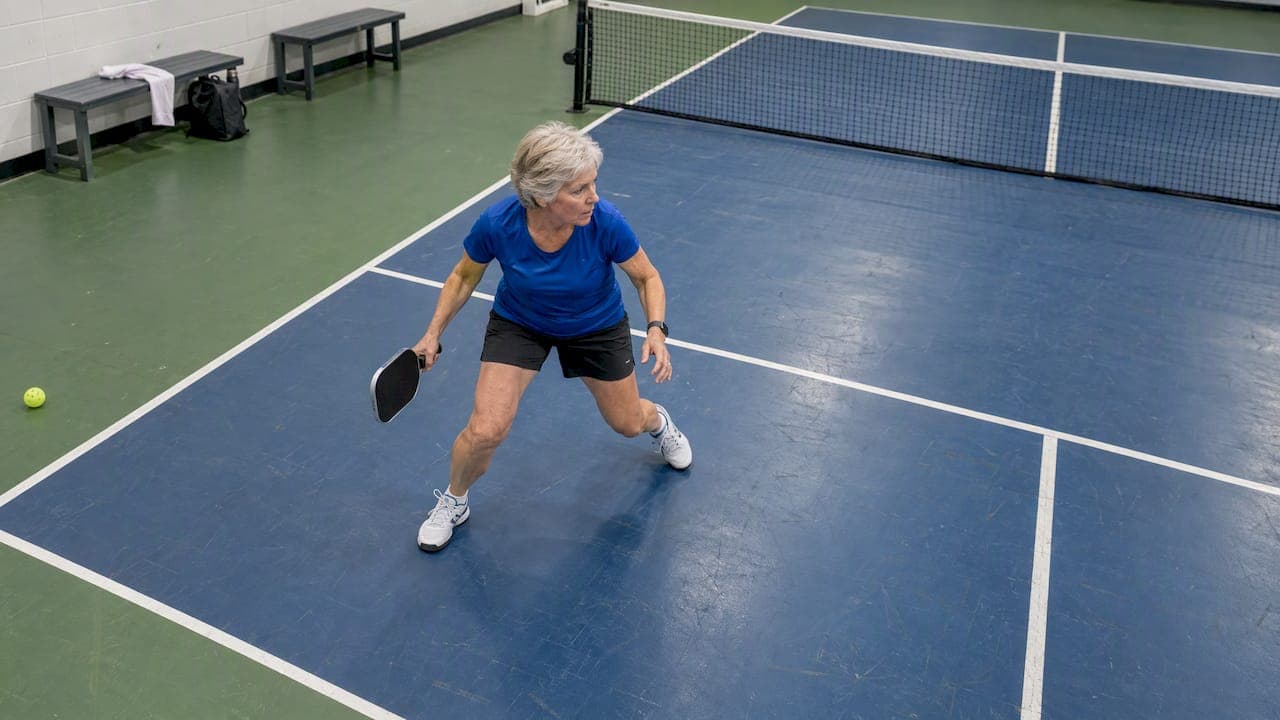
Short, sport-specific pickleball agility drills work best when they combine ladder or cone lateral work, split-step timing, and reactive drop drills. Do them for 10–15 minutes, three to four times a week, after a dynamic warm-up. Consistent practice builds balance and sharper movement, and you will feel the difference at the kitchen line within a few weeks.
TL;DR:
- Choose two or three drills per session, starting with ladder or cone footwork and ending with split steps or unpredictable partner ball drops.
- Warm up ankles, calves, glutes, and landing mechanics; players over 50 or with prior ankle or Achilles problems should spend two weeks moving slowly.
- Progress over eight weeks: begin with easy footwork, reach 80% speed in weeks three and four, then add reactions and short match simulations.
- For older adults, research suggests at least 12 structured sessions for lasting benefits; schedule rest days and reduce effort if pain or unstable landings persist.
Table of Contents
- Why does agility matter on a pickleball court?
- How should you warm up before agility work?
- Which court drills build pickleball agility fastest?
- What does a 6–8 week agility plan look like?
- What equipment do you need to set up the drills?
- What does the research say for older and recreational players?
- A practical checklist from an injury-prevention lens
- Can a movement check make these drills more personal?
- FAQ
- Sources
Why does agility matter on a pickleball court?
Agility is not just speed. It is four skills working together: reaction time, change of direction, short burst speed, and balance. Pickleball asks for all four skills within the confines of a court.

Think about how they show up in a match. At the kitchen, a fast exchange of volleys rewards the player who reacts first and stays low. At the baseline, you sprint wide for a deep drive, stop, and push back to center. Quick volleys demand tiny adjustments of the feet while your upper body stays steady.
That is why we build these drills around real court moments rather than generic gym circuits. Balance deserves special attention. An 8-week supervised pickleball program in older adult women improved balance and gait, which suggests structured movement practice pays off well beyond the court. Pick the drills below based on where you lose points: near the net, deep in the court, or in the transition between them.
How should you warm up before agility work?
Cold tissue and fast lunges are a bad mix. A retrospective review of foot and ankle injuries in pickleball players found that forward lunging, planting, and inversion were the most common injury mechanisms, so the warm-up should prepare exactly those motions.
Spend time on this sequence:
- Ankle mobility: 10 slow ankle circles and 10 ankle rocks against a wall per side.
- Calf raises: 2 sets of 12, slow on the way down.
- Glute activation: 10 bridges and 10 side-lying leg lifts per side.
- Light bounding: 2 passes of 10 easy skips, landing softly on the balls of your feet.
- Mini lunges: 6 shallow forward lunges per leg, stepping out only half your normal reach.
Pro Tip: Start every session at about half speed and add pace only when your landings feel quiet and balanced.
Follow a progressive intensity rule: slow first, fast later. Players over 50, and anyone with a past ankle or Achilles problem, should extend the slow phase for the first two weeks. Reduce the load if you feel sharp pain, calf tightness that lingers, or wobbly landings. Rest days matter too, and ACSM suggests one to two per week during heavy training volume. A foam roller or percussion device is optional, not required. For a deeper routine, try our prehab moves.
Which court drills build pickleball agility fastest?
Pick two or three drills per session. Start with footwork patterns, then finish with a reactive drill.
Ladder drills (warm-up or early main set)
- Two-feet-in-each-box: Step both feet into every square, quick and light. Do 4 passes, resting 30 seconds. Keep your chest tall and your cadence steady.
- Lateral stepping: Move sideways through the ladder, two feet per square. Do 3 passes each direction with 30 seconds' rest.
- In/out: Step in with both feet, then out to the sides, advancing one square at a time. Do 3 passes.
- Icky shuffle: Step in, in, out, and repeat down the ladder. Do 3 passes, focusing on short ground contact. ACE notes that ladder patterns like these help strengthen the joints, ligaments, and tendons of the lower body.
Cone drills (main set)
- Four-cone box: Place cones 10 feet apart in a square. Sprint forward, shuffle sideways, backpedal, shuffle back. Do 3 rounds each direction, resting 45 seconds.
- T-drill: Set three cones in a line 10 feet apart, with a fourth 10 feet out from the middle one. Sprint to the stem, shuffle to each side, return. Do 3 to 4 rounds.
- Baseline acceleration to lateral shuffle: Sprint 15 feet from the baseline, plant, then shuffle 10 feet sideways. Do 4 reps with a walk-back rest.
Split-step and reactive drills (finish the session)
- Split-step timing: Hop lightly just as a partner's paddle meets the ball, landing on both feet as the ball is struck. Practice 3 sets of 10.
- Micro-step recovery: After each shuffle, take two to three tiny steps to reset your balance. Do 3 sets of 8.
- Partner ball-drop: At the kitchen line, a partner drops a ball from shoulder height at random spots. React, split-step, and play it after one bounce. Do 4 sets of 6 drops.
- Dual-task variation: Have your partner call a color or number as they drop the ball, and you shout it back before you move.
- Solo option: Rebound a ball off a wall, or use a randomly timed beep app as your cue to move to a marker.
What does a 6–8 week agility plan look like?
Each session can include a warm-up, core drills, and a short cooldown. Train consistently, and shift the focus periodically.
- Form and slow tempo: Ladder two-feet and lateral stepping, plus the four-cone box at an easy effort. Quiet landings matter more than speed.
- Weeks 3–4, add speed: Keep the same drills but push the tempo to about 80%. Add the T-drill and the icky shuffle.
- Weeks 5–6, reactive elements: Add partner ball-drops, split-step timing, and the dual-task variation. Keep one pure footwork drill per session.
- Weeks 7–8, short-match simulations: Play 3-minute mini games or rally bursts, then drill again. Finish with baseline acceleration into lateral shuffles.
Track simple measures such as your lateral shuffle time and successful reactions to ball-drops. Test periodically. Add load conservatively: change only one thing at a time, either speed, reps, or complexity, never all three. Our conditioning guide covers the strength and power work that supports this plan.
What equipment do you need to set up the drills?
You can start with almost nothing:
- Ladder substitute: Chalk, painter's tape, or a row of lines on the court surface, spaced to create manageable squares.
- Markers: Cones, water bottles, or folded towels.
- Kitchen distance: The non-volley zone is 7 feet deep, as defined in the official rulebook, so use that line as a natural marker for ball-drop work.
- Tight space: Shrink cone boxes to 6 feet, and do the work along a fence or garage wall.
- Partner or solo: A partner makes reaction drills better, but a wall and a timer app are enough.
- Surface safety: Wear court shoes, avoid wet concrete, and skip hard sprints on slick indoor floors.
What does the research say for older and recreational players?
For older adults, the evidence supports consistent participation rather than relying on high-intensity sessions alone. A study of pre-frail older adults found an 8-week pickleball program improved balance and motor adaptability, and indicated that at least 12 structured sessions are often needed for lasting functional benefits.
Consistency, not intensity, is what sustains the gains: aim for at least 12 structured sessions, as researchers on pre-frail older adults suggest. The time needed to complete them depends on how often you train.
- Forward lunging, planting, and inversion are the leading injury mechanisms, so progress lunges and cuts slowly.
- Dual-task practice, such as calling out a cue while you move, better mimics a rally and supports fall prevention.
- Multicomponent activity that blends strength, balance, and aerobic work strongly reduces fall-related injuries.
- Jump and medicine ball work can be safe for older adults when progressed slowly.
For balance-specific guidance, see this overview of safe balance exercises for seniors.
A practical checklist from an injury-prevention lens
Most players skip the boring parts, and the boring parts help them stay on the court. Warm up, pick a mix of ladder, cone, and reactive drills, and keep sessions to 10–15 minutes. Track your shuffle time, protect your rest days, and still play real points. If pain keeps returning, get assessed rather than pushing through.
— Drona
Can a movement check make these drills more personal?
Drills help most when they match how your body actually moves. We built Play On Pickle for that: upload a video, and our AI analyzes your movement, flags possible stress points, and suggests exercises and progressions tailored to you. It complements this plan by showing which drill to emphasize and where your technique asks too much of one joint.
Our technology page explains how the analysis works, and you can start with a free trial. If you have recurring pain or want a personalized progression, see our plans and try a movement check.

FAQ
What are five good exercises for agility?
Ladder two-feet drills, lateral ladder steps, cone box drills, the T-drill, and split-step reaction drills cover the core skills. Together they train foot speed, direction changes, and reaction time. ACE lists ladder patterns among its agility exercises.
How often should I do pickleball agility drills?
Short sessions of 10–15 minutes, three to four times a week, are a practical target. Lancaster Orthopedic recommends this pattern for safer, steadier gains. Add rest days if soreness lingers.
What is the 7-11 pickleball drill?
The name usually refers to a practice game with set scoring targets rather than a footwork drill. Definitions vary by coach, so treat it as a rally-based game and use the drills above for agility itself. Pair it with the ball-drop work for realistic movement practice.
Are agility drills safe for players over 50?
Warm up and progress slowly. Injury reports identify lunging and planting among common injury mechanisms, so begin at a manageable pace and build up gradually. Our injury prevention guide goes deeper.
Sources
- Effects of an 8-week pickleball intervention on dual-task gait performance and inter-joint coordination in pre-frail older adults - PubMed
- Emerging Patterns of Foot and Ankle Injuries in Pickleball Players: A Short Report
- The Effect of 8 Weeks of Pickleball Program on Balance, Spatiotemporal Gait Parameters, and Psychosocial Factors in Older Adult Women: A Single-Blinded Randomized Controlled Trial
- Power for Older Adults - ACSM