
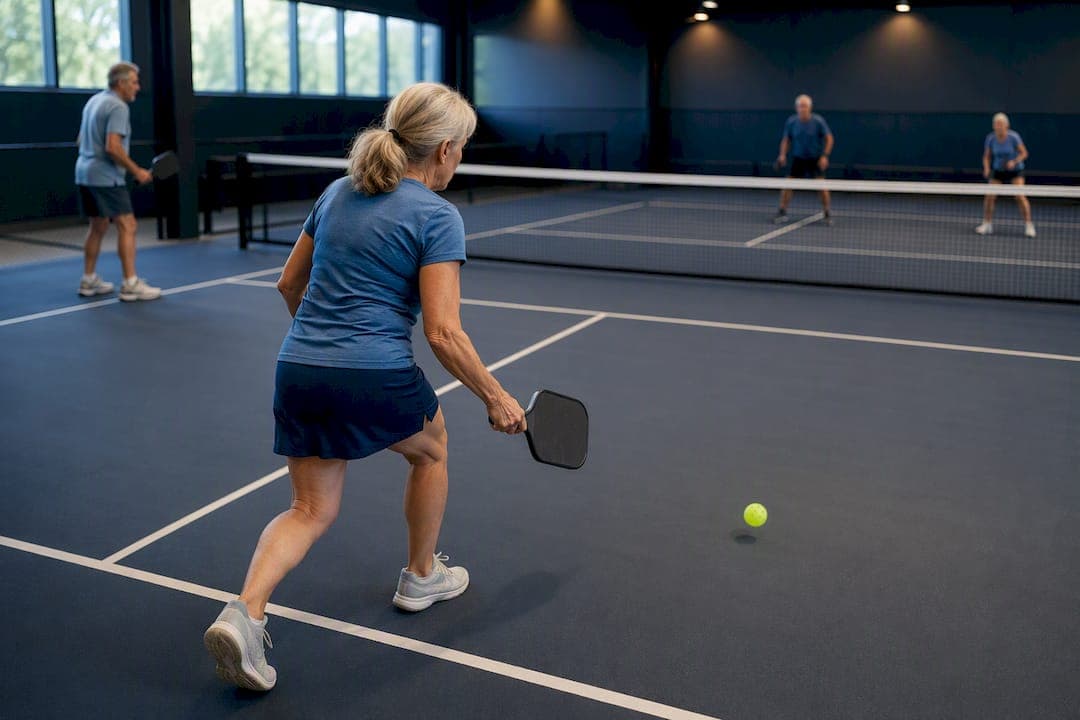
Pickleball is safe for most older adults when you treat the first few weeks like training, not just playing. The three things that cut your risk the most: court shoes with real lateral support, a five-minute dynamic warm-up before you serve, and stopping before fatigue wrecks your footwork. Stop and get checked immediately for a hard fall, a suspected fracture, chest pain, or any head injury with confusion.
TL;DR:
- Proper court shoes with lateral support are essential, and replacing them when the tread wears out can significantly reduce ankle injury risk.
- A five-minute dynamic warm-up, including leg swings, lunges, torso rotations, and shuffles, helps prevent muscle strains and joint injuries before playing.
- Falls and fractures among older players mainly result from quick direction changes, sudden backward movement, or collisions, emphasizing controlled play and safe techniques.
- Off-court strength and balance exercises, like sit-to-stand, single-leg stands, and hip hinges, improve stability and can prevent the overuse injuries common in pickleball.
- New technology analyzes players' biomechanics to identify stress points and personalize injury prevention routines, especially for players with recurring aches.
Table of Contents
- Senior Pickleball Safety Starts With the Right Gear
- Warm Up Right and Move Smarter on the Court
- The Injuries Older Players Actually Get
- Build Balance and Strength Off the Court
- Pace Yourself: The First Six Weeks Matter Most
- Check the Court Before You Check Your Serve
- What to Do When You Get Hurt
- Why Precaution Is Part of Playing Well
- A More Personal Way to Catch Injury Risk Early
- Sources
- FAQ
Senior Pickleball Safety Starts With the Right Gear
Running shoes are built for forward motion, not the sudden side-to-side cuts pickleball demands. Court shoes with firm lateral support and reliable traction keep your ankle stable when you plant and change direction, which is exactly where running shoes fail.
Paddle fit matters more than most players realize. A grip that's too small forces your forearm muscles to overcompensate, which strains the wrist over a season of play. A paddle that's too heavy transfers extra load into the shoulder on every swing.
Quick equipment checklist:
- Replace court shoes when the outsole tread flattens or the side panels feel soft under lateral pressure.
- Choose a grip size that lets your fingers wrap comfortably with no gaps, and a lighter paddle if you have any shoulder history.
- Wear safety glasses if you play doubles, where balls and paddles come from multiple angles.
- Add a wrist brace or ankle support if you have a prior sprain, not as a default for everyone.
Warm Up Right and Move Smarter on the Court
Cold muscles and stiff joints are a setup for a pulled calf or a rolled ankle in the first game. Yale Medicine's sports clinicians point to dynamic warm-ups as one of the simplest, most overlooked ways to prevent injury before a match even starts.
Run through this sequence in five to seven minutes:
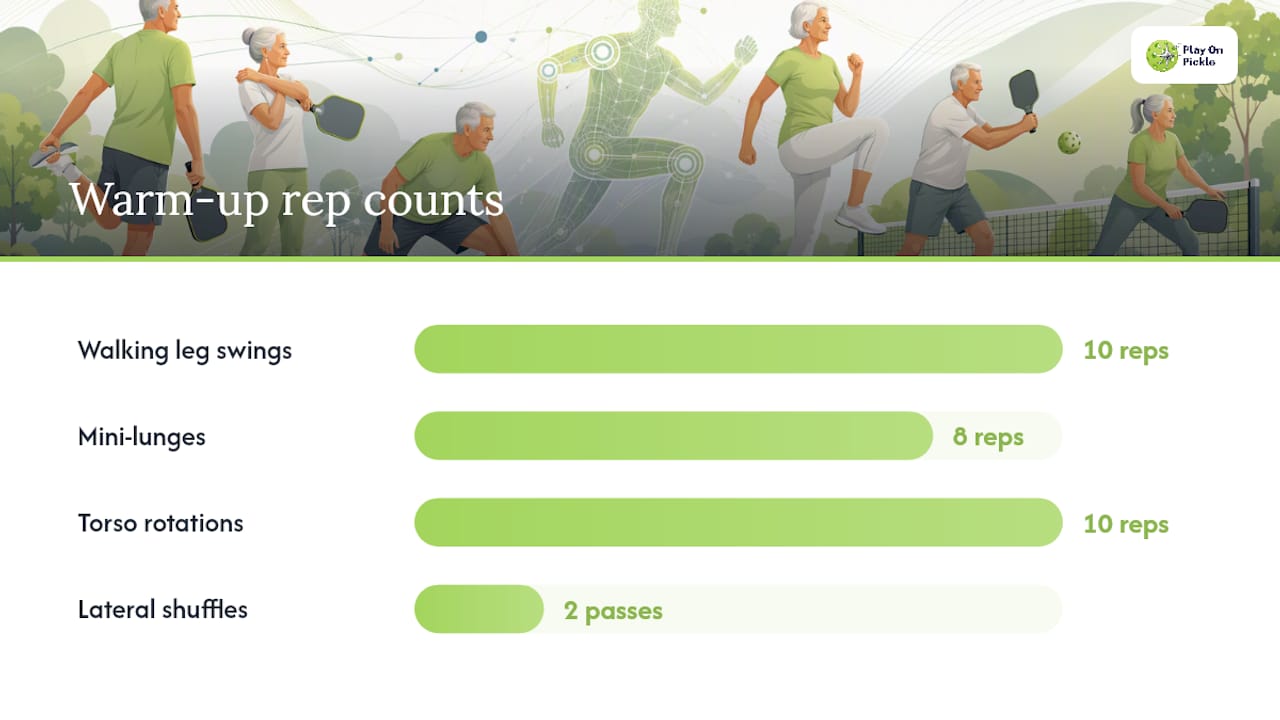
- Walking leg swings, front to back and side to side, ten each leg.
- Mini-lunges with a slow return to standing, eight per side.
- Torso rotations holding your paddle out in front of you, ten total.
- Light lateral shuffles across the width of the court, two passes.
On court, the biggest fix isn't strength, it's technique. Instead of backpedaling for a lob, use a drop-step and turn your hips to run it down. Backpedaling is how most backward falls happen. Drink water before you feel thirsty, and shorten sessions on hot or humid days.
Pro Tip: Play one shortened doubles game before jumping into a full singles match. It's a built-in warm-up that also lets you gauge how your knees and wind feel that day.
For a longer routine, Playonpickle's five and ten-minute warm-up guide breaks down variations for stiffer mornings versus evening play.
The Injuries Older Players Actually Get
A 10-year analysis of emergency department visits found a sharp rise in pickleball injuries as the sport exploded in popularity, with falls and fractures making up a large share of cases among older players. Wrist fractures from bracing a fall, ankle sprains from sudden direction changes, and shoulder strain from overhead shots are the pattern that shows up again and again.
Falls and fractures aren't rare outliers in pickleball injury data. They're the dominant pattern among older players, driven mostly by sudden stops, backward retreats, and collisions near the net.
Most of these injuries trace back to a handful of mechanisms:
- A quick direction change that outpaces ankle stability.
- Stepping backward to chase a lob and losing balance.
- A collision with a partner going for the same ball.
- Overuse strain in the shoulder or wrist from repeated overhead or backhand shots.
Get evaluated the same day for a suspected fracture, any head injury involving loss of consciousness or confusion, chest pain or shortness of breath during play, or a fall that leaves you unable to bear weight normally.
Build Balance and Strength Off the Court
The CDC recommends adults 65 and older get 150 minutes of moderate aerobic activity weekly, muscle-strengthening work at least twice a week, and regular balance practice, adapted to individual ability. Pickleball itself covers some of the aerobic piece, but it won't build the strength and balance base that keeps you upright when a shot pulls you off balance.
A short home routine covers the gaps:
- Sit-to-stand from a chair, 10 to 12 reps, to build the leg strength behind every split step.
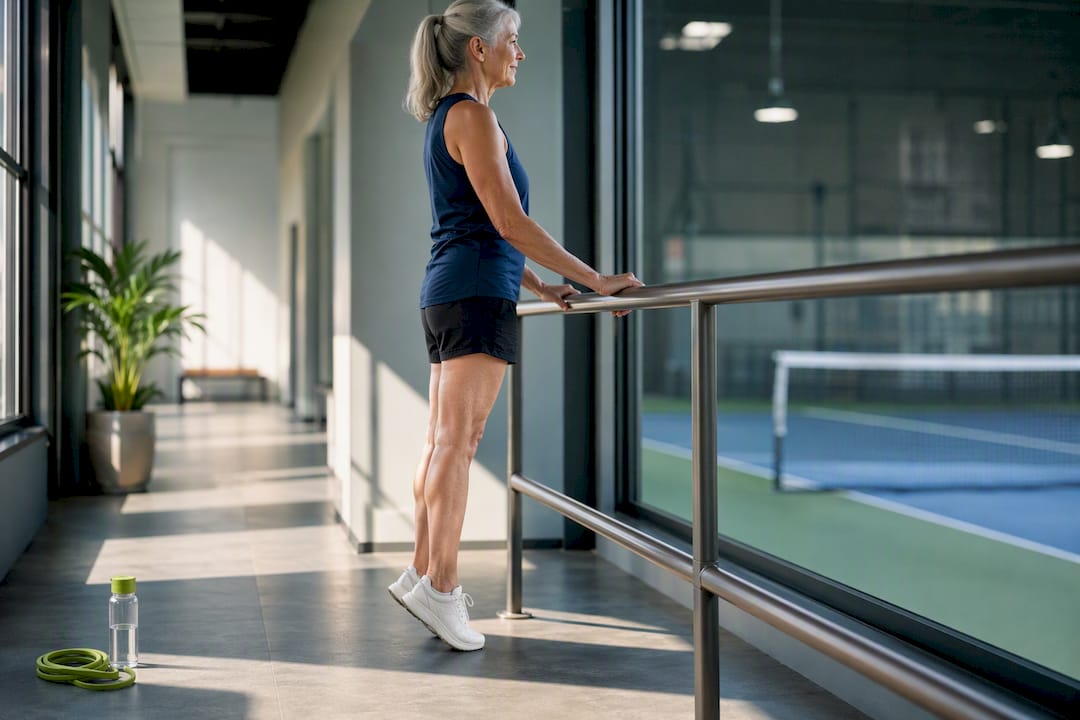
- Single-leg stands near a counter for support, 20 to 30 seconds per side.
- Hip hinges with a light resistance band to strengthen the glutes and lower back.
- Standing trunk rotations to support the twisting motion in serves and groundstrokes.
- Step-overs or lateral band walks to practice the change-of-direction control pickleball demands.
One feasibility study on an eight-week supervised pickleball program found measurable balance and gait improvements in older women, which suggests structured practice pays off fast, not just eventually.
Pro Tip: Do this routine in 10 to 15 minutes, three times a week, on non-playing days. Consistency matters more than intensity here. Playonpickle's conditioning guide has fuller progressions if you want to build toward more demanding drills.
Pace Yourself: The First Six Weeks Matter Most
Jumping from a sedentary winter into three games a week is how overuse injuries and hard falls happen. Clinicians at UC Davis Health advise against ramping straight from inactivity into demanding sessions, recommending shorter, lower-intensity sessions at the start instead.
- Weeks 1 to 2: doubles only, one 45-minute session, two rest days between.
- Weeks 3 to 4: two sessions a week, up to 60 minutes, still doubles.
- Weeks 5 to 6: add a third session or introduce short singles points if balance and recovery feel solid.
- Treat fatigue as your stop signal, not soreness. If your footwork or shot timing starts slipping, that's the point to sit down, per Yale Medicine's guidance on stopping when fatigue sets in.
Playonpickle's 90-day training plan lays out a longer arc if you're building toward more competitive play.
Check the Court Before You Check Your Serve
A few seconds of scanning the court before the first serve catches most preventable hazards. Look for standing water, sand or debris drifted in from wind, uneven seams in the surface, and dim lighting near the corners where lobs tend to land.
- Confirm the surface is dry, especially early morning or after rain.
- Check for loose debris near the baseline and sidelines.
- Verify lighting reaches all four corners if playing in early morning or evening.
- Test your shoe traction with a few quick side steps before serving.
- Flag persistent surface or lighting problems to facility staff rather than playing around them.
| Fall risk factor | Safer alternative |
|---|---|
| Backpedaling for a lob | Drop-step and turn hips to run it down |
| Wet or debris-covered surface | Delay play or move to a different court |
| Full sprint stop at the net | Controlled deceleration with knees bent |
| Poor corner lighting | Reschedule or request facility lighting fix |
What to Do When You Get Hurt
Minor sprains and strains respond well to the standard RICE approach: rest, ice, compression, elevation, started within the first hour or two. If a joint looks visibly deformed, won't bear weight, or swells rapidly, treat it as a possible fracture and get imaging rather than waiting it out.
- Ice for 15 to 20 minutes at a time, several times a day, for the first 48 hours.
- Seek same-day care for head trauma with confusion, chest pain, or an inability to walk normally.
- Don't return to full-speed play until pain-free range of motion is restored, ideally confirmed by a physical therapist for anything beyond mild soreness.
- Ease back in with the same doubles-first, shortened-session approach you used when you started.
Readers managing a longer recovery or navigating care coverage after a bigger injury may find guidance on combining Medicare with home care support useful for planning next steps.
Why Precaution Is Part of Playing Well
Pickleball's low-impact reputation is a little misleading. The sport is genuinely accessible, but it asks your body for sharp stops, quick pivots, and repeated overhead motion, the exact demands that catch up with unconditioned joints. The players who stay on the court for years aren't the ones who play the hardest early on. They're the ones who treat the warm-up and the off-court strength work as part of the game, not an optional extra.
For players dealing with a recurring ache in the same shoulder or knee, generic advice only goes so far. That's where a closer look at your own mechanics, rather than a one-size-fits-all checklist tends to matter more.
— Drona
A More Personal Way to Catch Injury Risk Early
A checklist tells you what to watch for. Advanced technology analyzes your movement from a simple video upload and flags the specific stress points in your joints and mechanics, whether that's an overloaded shoulder on your serve or a knee compensating for a weak hip.

This is built for recreational players who don't have a coach reviewing their footwork every week, the people this article is written for. You get a personalized set of exercises based on your own biomechanics, not a generic routine pulled from a general fitness app. New members currently get a free tripod with the $9.99 monthly subscription, or you can save with the $99 annual plan. Check current pricing and start your assessment on the Playonpickle pricing page.
This article is general information, not a substitute for advice from a qualified doctor. Consult a qualified healthcare professional about your own circumstances before acting on anything here.
Sources
- Older Adult Activity: An Overview | Physical Activity Basics | CDC
- Increasing Incidence of Pickleball Injuries Presenting to US Emergency Departments: A 10-year Epidemiologic Analysis of Mechanisms and Trends
- How to prevent pickleball injuries | Yale Medicine
- Staying strong and injury-free on the pickleball court | NCOA
FAQ
Is It Safe for Senior Citizens to Play Pickleball?
Yes, for most older adults, pickleball is safe when approached with proper footwear, a warm-up, and a gradual increase in play. Falls and fractures account for a meaningful share of injuries, according to a 10-year emergency department analysis, so the biggest safety gains come from conditioning and pacing rather than avoiding the sport.
What Is the Most Common Pickleball Injury for Seniors?
Falls resulting in fractures, particularly of the wrist, are among the most common serious injuries older players experience, along with ankle sprains and shoulder strain from overhead shots. Most trace back to backpedaling for a lob or a sudden stop.
What Is the 10 Second Rule in Pickleball?
The server has 10 seconds after the score is called to serve, and going over that limit is a fault under USA Pickleball rules. It's a pace-of-game rule, not a safety rule, but it does discourage rushing a serve before you're ready.
What Age Is Considered Senior in Pickleball?
Tournament brackets vary by event and organization. For safety purposes, the guidance in this article applies broadly to anyone 65 and older, matching the age range in CDC activity recommendations.