
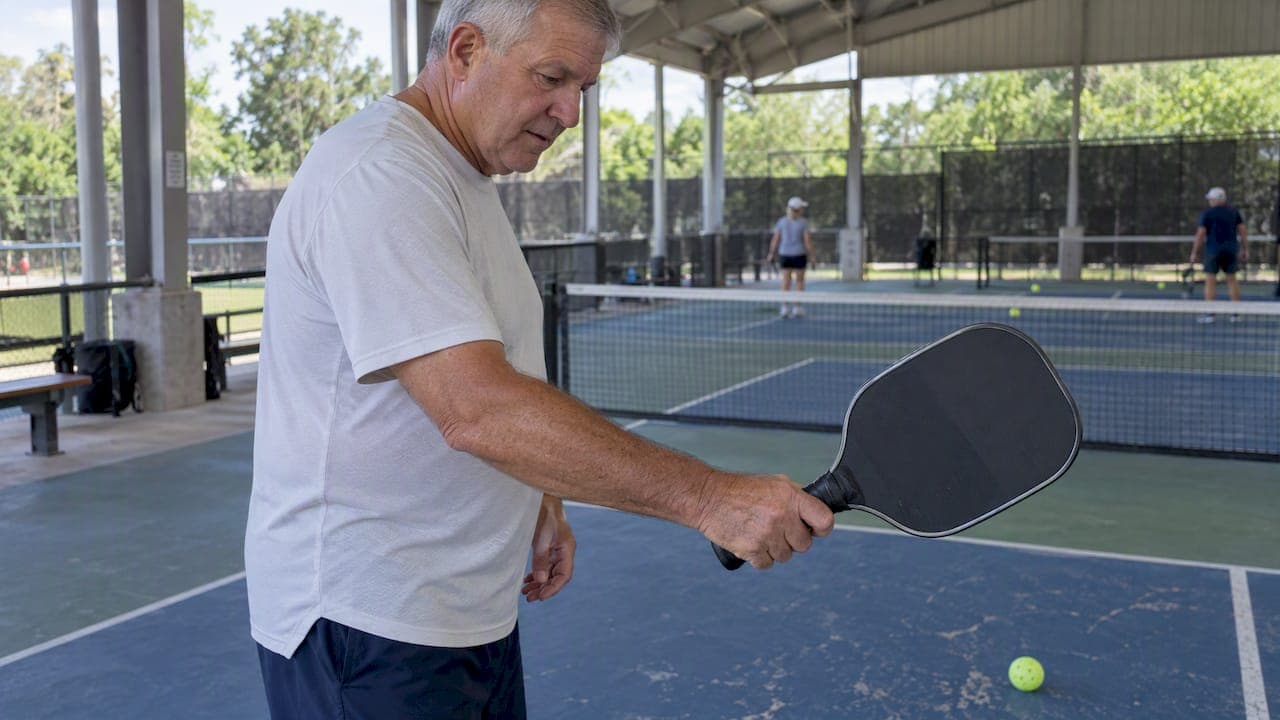
Start with a neutral handshake grip, the continental-style hold USA Pickleball recommends for beginners, and keep your hand loose rather than clenched. That single habit, holding the paddle with a very loose grip on a low tension scale, does more for your control than any other adjustment you can make early on. Grip tweaks for specific shots come later. Nailing the neutral grip first is what moves your game forward fastest.
TL;DR:
- Place the index knuckle on the top bevel, leave a small palm gap, and choose a handle that fits without overlapping fingers.
- Keep pressure around 2 to 3 out of 10 during dinks and resets; use a slightly firmer, relaxed hold for kitchen line volleys.
- A two handed backhand adds stability when your backhand feels awkward; try Western grips for topspin only after neutral grip and footwork are consistent.
- During rallies, make only a small finger rotation toward Eastern for drives, then return to continental; avoid full Western changes until the motion is automatic.
- Tight gripping and repeated wrist twisting contribute to pickleball elbow, so shake out your hand between points and pause when your forearm tightens.
Table of Contents
- Grip types explained: continental, Eastern, Western, pan-handle, and two-handed
- How to find and set your grip: step-by-step hand placement
- Grip pressure, common mistakes, and injury-aware adjustments
- When and how to change grips during play
- Practice drills and routines to build a reliable grip under pressure
- How biomechanics relate to grip technique and AI-assisted movement analysis
- Where beginners should spend their practice time
- How Play On Pickle can help refine your grip technique
- FAQ
- Sources
Grip types explained: continental, Eastern, Western, pan-handle, and two-handed
Pickleball borrows most of its grip vocabulary from tennis, and knowing the basic shapes helps you understand why coaches push beginners toward one in particular.
The continental grip, often called the handshake grip, is the neutral, do-everything hold. You form it by shaking hands with the paddle edge, which lands the base knuckle of your index finger on the top bevel of the handle. It works for volleys, dinks, and serves without requiring a change mid-point, which is exactly why it is the starting point most instructional resources recommend.
The Eastern grip sits close to continental but rotates slightly toward the forehand side, giving a bit more pop on groundstrokes at a small cost to backhand ease. Many players use "Eastern" and "handshake" almost interchangeably since the difference is a matter of a few degrees of rotation, and instructional materials from NC State describe it as the more versatile option for players still building their stroke mechanics.
Western and semi-Western grips rotate the hand further under the handle, which helps generate topspin on drives. These grips demand more wrist mobility and timing, and they make backhand transitions harder, so they are better suited to players who already have a reliable neutral grip and want to add power later in their development.
The pan-handle grip, where the hand sits on top of the handle like holding a frying pan, shows up often among beginners by accident rather than by choice. It limits wrist action and makes volleys and resets harder to control, which is why most coaching resources flag it as a habit to correct early.
A two-handed backhand, borrowed from tennis, adds the non-dominant hand to the handle for backhand shots only. It gives recreational players more stability and power on a stroke many find awkward, and it spreads the physical load across both arms instead of concentrating it on one wrist.
For early practice, prioritize in this order:
- Continental/handshake as your default grip for serves, volleys, and most rallies.
- Two-handed backhand as an optional tool if your one-handed backhand feels unstable.
- Western/semi-Western only after your neutral grip and footwork are consistent.
How to find and set your grip: step-by-step hand placement
Setting a reliable grip is a physical sequence you can repeat every time you pick up a paddle, not a one-time decision.
- Hold the paddle out in front of you with the face vertical, as if you were about to shake hands with it.
- Wrap your fingers around the handle so the base knuckle of your index finger rests on the beveled edge nearest your body, not flat on a side panel.
- Let your thumb rest diagonally across the back of the handle, slightly lower than your index finger. USA Pickleball's fundamentals guidance notes that keeping the index finger a touch higher than the thumb gives you a better range of motion for angling the paddle face.
- Check that there is a small gap between your palm and the butt of the handle rather than crowding your hand all the way down.
- Let the paddle hang loosely from your fingers for a few seconds before closing your grip, so you start from relaxed rather than clenched.
Grip size affects every one of these steps. A handle that is too thin forces your fingers to overlap and invites squeezing, while one that is too thick limits wrist snap. A simple check: hold the paddle in your grip hand and slide the index finger of your free hand into the space between your fingertips and your palm. A comfortable fit allows that finger to slide in with a little resistance, not a tight squeeze and not a loose rattle. Our guide to pickleball paddle grip size walks through this measurement in more detail if your current handle feels off.
If your paddle feels too small, an overgrip or a wrap of tennis-style grip tape adds bulk cheaply before you commit to buying a new paddle. If it feels too large, trying a few demo paddles with smaller handle circumferences is usually more effective than trying to compensate with hand position.
Pro Tip: Practice setting your grip with your eyes closed a few times before a session. If your hand lands in the same spot every time, the grip has become a habit instead of a conscious adjustment.
Grip pressure, common mistakes, and injury-aware adjustments
Grip pressure matters more than grip style once you have settled on continental or Eastern. A tight grip transmits more shock from ball contact straight into your wrist and forearm, while a loose grip lets the paddle absorb pace, which is especially useful on resets and dinks.
Think of grip pressure on a 1 to 10 scale, where 10 is squeezing as hard as possible. USA Pickleball's reset technique guidance recommends staying around 2 to 3 out of 10 during resets and dinks, just enough to keep the paddle from twisting in your hand. Coaching material from the PPA Tour echoes a similar range, around 3 out of 10, and warns that tighter grips tend to produce more errors on soft shots.
Common mistakes worth correcting early:
- Squeezing on contact, which stiffens the wrist and sends the ball flying long.
- Pan-handle drift, where the hand slowly rotates on top of the handle during a rally.
- Thumb riding too high, which crowds the index finger and limits paddle face control.
- Using a handle that is too small, which forces constant overlapping and tension in the fingers.
Grip choices connect directly to injury patterns. Biomechanics research on stroke mechanics links grip style and tension to wrist and forearm loading, noting that small differences in orientation can scale into meaningfully larger loads in paddle sports than in strung racquet sports. Harvard Health points to gripping too tightly and repetitive wrist twisting as contributors to lateral epicondylitis, commonly called pickleball elbow, and recommends correct grip size and technique as part of prevention.
A few in-session checks reduce strain without slowing down your game: shake out your grip hand between points, reset to a relaxed hold before every serve, and take short microbreaks if your forearm starts to feel tight rather than pushing through a long session. If wrist discomfort does show up, our guide to pickleball wrist pain covers conservative steps for a safe return to play.

When and how to change grips during play
Most recreational players do not need four different grips mid-match. What they need is a small, fast rotation between neutral and a slightly adjusted position for a handful of shots.
- Dinks and resets call for the loosest version of your continental grip, prioritizing control over power.
- Volleys at the kitchen line use the same neutral grip with a slightly firmer, but still relaxed, hold to block pace. Our volley mechanics guide covers ready-position cues that pair well with this grip.
- Drives and topspin shots benefit from a touch more Eastern rotation if you already have one, since USA Pickleball's topspin guidance emphasizes a relaxed arm and a low-to-high swing path that pairs naturally with a slightly rotated grip.
To swap grips without losing your ready position, keep the motion small: rotate the paddle in your fingers rather than regripping with your whole hand, and return to your neutral hold the instant the shot is finished. Avoid full Western-style changes during live play until the rotation feels automatic in practice, since fumbling a grip change mid-point costs more points than it saves.
A simple drill for building this reflex: have a partner feed you alternating dinks and drives, and focus only on the small grip rotation between the two, not on shot placement yet.
Practice drills and routines to build a reliable grip under pressure
A few short, repeatable drills do more for grip consistency than hours of unstructured play.
- Shadow-swing warm-up: spend two minutes forming your grip and taking slow practice swings without a ball, focusing on hand placement and a loose hold.
- Mirror check: set your grip in front of a mirror or your phone's camera to confirm your index knuckle sits on the bevel, not the flat side of the handle.
- Partner dink feed: have a partner feed 15 to 20 dinks while you keep tension low and track how many stay in the kitchen.
- Reset ladder: start with soft, slow feeds and gradually increase pace, keeping grip pressure around 2 to 3 out of 10 throughout.
- Live-point transition reps: play out short points focusing only on swapping between dink grip and drive grip smoothly, not on winning the point.
Record a short video of a few reps every week or two. Comparing clips side by side shows whether your knuckle placement and tension are staying consistent, or whether old habits like pan-handle drift are creeping back in under match pressure.
Pro Tip: Film your hand from the side, not from behind, so you can actually see where your index knuckle lands on the handle.
How biomechanics relate to grip technique and AI-assisted movement analysis
Grip choices show up in the body as repeated loading patterns. Research on stroke mechanics and grip strain ties grip orientation and tension to wrist and forearm loading, and Harvard Health connects tight grips and repetitive twisting to pickleball elbow. The trouble is that these stress patterns build up gradually, often too subtly to feel in the moment.
This is where video-based movement analysis becomes useful. Our computer vision and AI technology reviews footage of your play to flag repetitive stress patterns around the wrist and elbow that are hard to notice on your own. From there, a realistic correction might be reducing grip tension, adjusting wrist angle on volleys, or shifting toward a two-handed backhand to spread the load. The assessment stays focused on what we actually provide: individualized stress-point identification and exercises tailored to what your movement patterns show.
Where beginners should spend their practice time
If I had to pick one priority for a new player, it would be this: lock in the neutral grip and a loose hold before worrying about anything else. Drills come next, and shot-specific grip adjustments come last, once the neutral hold feels automatic.
Track progress by small signs: fewer popped-up resets, less forearm fatigue after a session, and a quick video check every couple of weeks to confirm your hand placement hasn't drifted. Incremental gains beat quick fixes here. A dependable neutral grip is what makes every other part of your game easier to build.
— Drona
How Play On Pickle can help refine your grip technique
AI movement analysis can review your own footage to spot grip-related stress patterns in your wrist and elbow that are easy to miss, then recommend exercises based on observed movement patterns.

- Record a short clip of your grip and swing from the side angle for the clearest read.
- Start with a free trial, and check our pricing page for the Monthly subscription at $9.99 per month or the Annual subscription at $99 per year.
- New sign-ups on the monthly plan currently get a free tripod to make filming easier.
If elbow or wrist pain has already shown up alongside your grip habits, non-surgical options like the regenerative treatments described by Nortex Tissue Regeneration are worth discussing with a medical provider. Upload a clip and see what your movement patterns show.
FAQ
Is it okay to hold a pickleball paddle with your finger up the handle?
Extending your index finger up onto the paddle face itself is not a standard grip and is not recommended, since it reduces your ability to angle the paddle and adds strain to a single finger. Keeping all fingers wrapped around the handle, with the index knuckle resting on the top bevel, gives you better control and spreads pressure more evenly.
What are the four basic grip styles in pickleball?
The commonly taught grips are continental (handshake), Eastern, Western or semi-Western, and pan-handle, with a two-handed backhand sometimes added as a fifth option for backhand shots. Instructional resources generally treat continental as the neutral starting point and Western as the most advanced.
Is pickleball or padel harder to learn?
Difficulty depends on the player's background, since pickleball has a smaller court and simpler scoring that many beginners pick up quickly, while padel's enclosed walls and different serve rules take time to adjust to. Neither sport is definitively harder across the board, and prior racquet sport experience tends to matter more than the sport itself.
What is the 10 second rule in pickleball?
The rule requires the serving team to serve within 10 seconds of the score being called, giving the server a brief window to get into position. It keeps play moving and is enforced as a fault if the server exceeds the time without a valid reason for delay.
How tight should my grip be in pickleball?
Most coaching guidance recommends a loose grip, around 2 to 3 out of 10 on a tension scale, especially for dinks and resets where the paddle needs to absorb pace. USA Pickleball's reset guidance and PPA Tour coaching material both point to this looser range as key for control and fewer errors.
Sources
- Pickleball fundamentals for beginners | USA Pickleball
- Scholarworks
- How to avoid this common pickleball injury | Harvard Health