
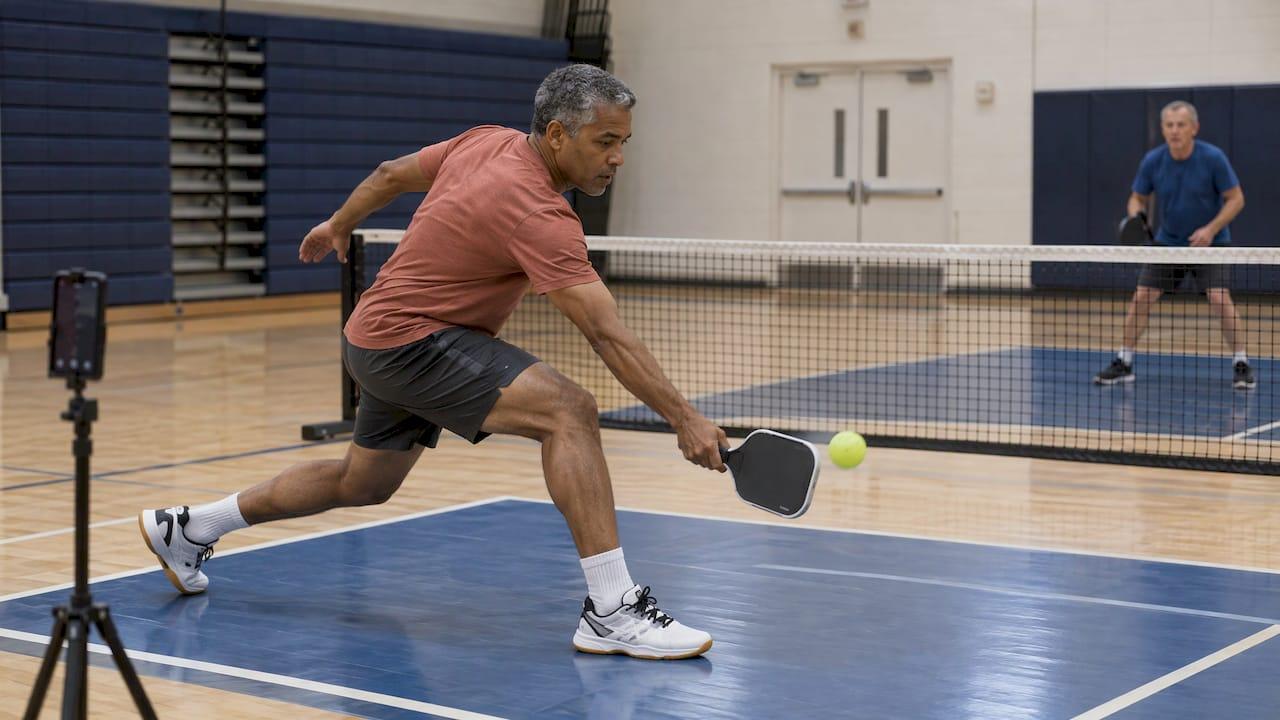
AI biomechanics accuracy is not one number. It depends on the joint, the plane of movement, the camera and the decision you want the analysis to support. For pickleball, the research is encouraging where it matters most: a single smartphone video can separate good movement patterns from risky ones, and that is the job of an injury-prevention assessment. Play On Pickle builds its assessments on markerless computer vision from uploaded video, so the rest of this guide shows you what the studies measure, what moves the results and how to film so your analysis is as reliable as it can be.
TL;DR
- Under controlled conditions, markerless AI typically lands within about 3–15° for sagittal-plane (side-view) joint angles, and top lab setups show very strong agreement with reference systems.
- Accuracy depends on setup: camera angle, lighting, frame rate, clothing and how fast the movement is. A clean side-on clip with good light gives the analysis its best input.
- For injury prevention, the question is whether the tool flags recognizable movement patterns, not whether it matches a lab to the last degree. Early pickleball research does exactly that for the forehand.
- Play On Pickle costs $9.99 per month or $99 per year, with a free initial trial.
- Older adults, coaches and facilities should match the tool to the decision: gross patterns and trends are where video AI is strongest.
Table of Contents
- What "accuracy" means in movement analysis
- What the research reports
- What moves the result up or down
- Uncontrolled settings: why consistency beats perfection
- Does it work for pickleball?
- Choose the tool by the decision
- How to film a clip that gives the best analysis
- What does pickleball video analysis cost?
- Promo: start with one clip
- Perspective
- FAQ
- Sources
What "accuracy" means in movement analysis
When researchers test an AI movement tool, they film people while a reference system (marker-based motion capture, the lab gold standard, or wearable sensors) records the same movement. Then they compare joint angles frame by frame. Three terms come up:
- Absolute error: how many degrees the AI is off, on average.
- Bias: whether the AI is consistently high or low, which matters because a steady offset does not hide a change over time.
- Agreement or correlation: whether the shape of the movement curve matches the reference, even if the numbers are offset.
A tool can be excellent at telling you that your knee collapses inward on a lunge and still be a poor choice for measuring your exact hip rotation to the degree. Those are different decisions, and the research says to choose a system by the decision it supports.
What the research reports
A 2026 systematic review of 18 peer-reviewed studies from 2020 to 2025 gives the clearest overview. It found that markerless sagittal-plane errors run at roughly 3–15°, with strong agreement (CMC above .90) in controlled testing with a multi-camera pipeline. It also reports that errors are larger in the transverse plane, meaning twisting movements seen from above, and that real-competition knee-angle waveforms agreed at about .73.

A separate review reports 3–8° mean absolute error for hip and knee flexion under controlled conditions. Those are the joints behind many pickleball moves: the split step, the lunge to a dink, the push off to retrieve a lob.
What do these numbers mean for you? A few degrees of error will not change whether a knee is tracking over the toes or a trunk is leaning hard to one side. They would matter if someone tried to certify an exact joint angle for a clinical measurement. That is a different use from spotting patterns and trends in a recreational or competitive player's movement.
Worked example
Say your front knee bends to 70° on a dink lunge, and the tool reports 74°. The 4° gap sits inside the range above. If your next clip, filmed the same way, shows 74° dropping to 60° after six weeks of strengthening, the change is what you act on. Consistent filming makes the comparison meaningful, which is why a repeatable setup matters more than any single reading.
What moves the result up or down
The reviews agree on the factors that shape accuracy. Think of them as a filming checklist.
| Factor | What the research says | What to do |
|---|---|---|
| Camera angle | Lateral and posterior views, and varied viewpoints, change joint localization | Film from a consistent, stable position at the same height each time |
| Lighting | Poor or variable lighting reduces joint detection | Film in even light, avoid backlighting from windows |
| Frame rate | Fast movements are hard to capture at common video sampling rates; around 30 Hz is on the low side | Use your phone's higher frame-rate setting for fast swings |
| Clothing | Loose or layered clothing hides joint landmarks | Wear fitted shorts and a fitted shirt for assessment clips |
| Occlusion | Limbs hidden by the body, the net or a partner reduce accuracy | Keep the frame clear of other players and obstructions |
| Movement speed | Rapid multi-planar movement is harder to track | Include slower drills (dinks, lunges, step-ups) alongside swings |
The same MDPI review notes that models trained on narrow datasets can overstate performance, which is why task-specific validation matters. A tool designed around one sport's movements has an advantage over a general-purpose model.
Why a tripod matters
The biggest single improvement most players can make is a fixed camera position. A phone propped on a bag shifts between sessions; a tripod does not. Play On Pickle runs a free tripod or selfie stick promotion with the $9.99 monthly plan, so the right setup comes with signing up.
Uncontrolled settings: why consistency beats perfection
A 2023 PLOS Computational Biology study of 2D video gait analysis outside the lab found anomalous range-of-motion estimates in nearly 70% of subjects, shifted by about 10° to 20° against sensors, using a general-purpose pose model on gait footage. The practical lesson is to control what you can: the camera position, the light, the clothing and the clip length. When you do, the setup resembles the controlled conditions where the 3–8° figures were reported.
A 2024 study on feasibility of an open-source pose model found poor agreement with manual analysis when it was applied to elite long jumpers filmed at championship events. That is an extreme case: a vigorous, explosive jump filmed from a distance. Pickleball drills filmed from a few feet away in good light are a far more forgiving setting, and a sport-specific tool is built for them.
Does it work for pickleball?
The pickleball evidence is young but pointed in the right direction. A SportRxiv preprint describes a low-cost markerless pipeline using one smartphone camera to analyze 715 forehand drive trials from 10 novice players. Clustering found three distinct pathological movement patterns, and expert evaluation confirmed each deviated from the expert baseline. The authors tied them to lateral epicondylalgia, the overuse condition commonly called tennis elbow.
That is the model of useful accuracy: not a perfect angle, but a reliable flag that a stroke pattern loads the elbow the wrong way. A single phone is enough for that kind of pattern detection.
There is also evidence that video-derived data helps with injury risk. A 2024 study trained a model on ACL-injury and control video scenes and reached an ROC AUC of 0.88; giving surgeons 3D poses improved their combined F1 score. The signal in movement is real, and this is why pose-based screening is a growing field.
If you want to see how these ideas apply to a stroke, our guide to pickleball video analysis walks through what a clip can show. For a deeper look at breaking a repeated arm movement into phases, this piece on stroke phases in paddle technique shows the same logic in another sport.

Choose the tool by the decision
The JRTI review advises working backward from the decision you need to make. Here is how that applies to each reader.
- Recreational players: you want to know which habits stress your shoulders, knees or elbows, and which simple exercises address them. Pattern detection from a phone clip is the right tool.
- Competitive players: you want consistent, repeatable comparisons session to session. Fixed camera placement and the same drill each time make trends reliable.
- Older adults: the review is clear that validated 2D setups suit gross displacement and timing, which covers balance, stance width and how you lower into a lunge. Pair feedback with strength and balance work.
- Coaches and facilities: use the same filming protocol across players so results compare cleanly, and treat rotational and high-speed readings as supporting detail to the main patterns.
- Physiotherapists: video AI adds objective, repeatable movement data between visits. The researchers note that acceptable error depends on use case: a clinician using video as one input in a broader exam has different needs from a lab studying one joint.
If you have pain, a past injury or a medical condition, see your doctor or a physical therapist before starting a new exercise plan. An AI assessment supports prevention; it does not diagnose.
How to film a clip that gives the best analysis
- Fix the camera. Use a tripod at about hip to chest height, the same spot every time.
- Film from the side first. Side-on views suit knee and hip flexion, where the reported error is smallest. Add a front view for stance width and knee tracking.
- Light it evenly. Face the camera away from windows and bright backgrounds.
- Dress for visibility. Fitted clothing lets joints show.
- Keep the frame clear. No partners crossing in front, no net post hiding your trail leg.
- Record several repetitions. Ten dinks, five lunges and a handful of overheads give the analysis patterns rather than one-off moments.
- Repeat monthly. Film the same drills the same way and compare. The JMMBS review notes session-to-session variance in AI estimates, which is why consistent setup is the best way to read trends.
Our movement assessment guide matches test results to one drill each, and the 10–12 minute coaching routine shows how the exercises fit into a normal week.
What does pickleball video analysis cost?
The price depends on what you are buying. In-person coaching reviews are billed by time, while an app subscription gives you repeat analysis for a flat fee. Play On Pickle's pricing is $9.99 per month or $99 per year, and a free initial trial lets you start before you pay. The subscription covers ongoing movement analysis, injury risk assessments and personalized exercise and equipment recommendations from your uploaded video.
A monthly plan means you can film every few weeks and see how your numbers change, which is where consistent measurement pays off.
Promo: start with one clip
Play On Pickle analyzes video you upload and identifies biomechanical stress points. It then generates a personalized injury risk assessment with exercises and equipment recommendations tailored to your movement. Our approach needs minimal equipment and time.
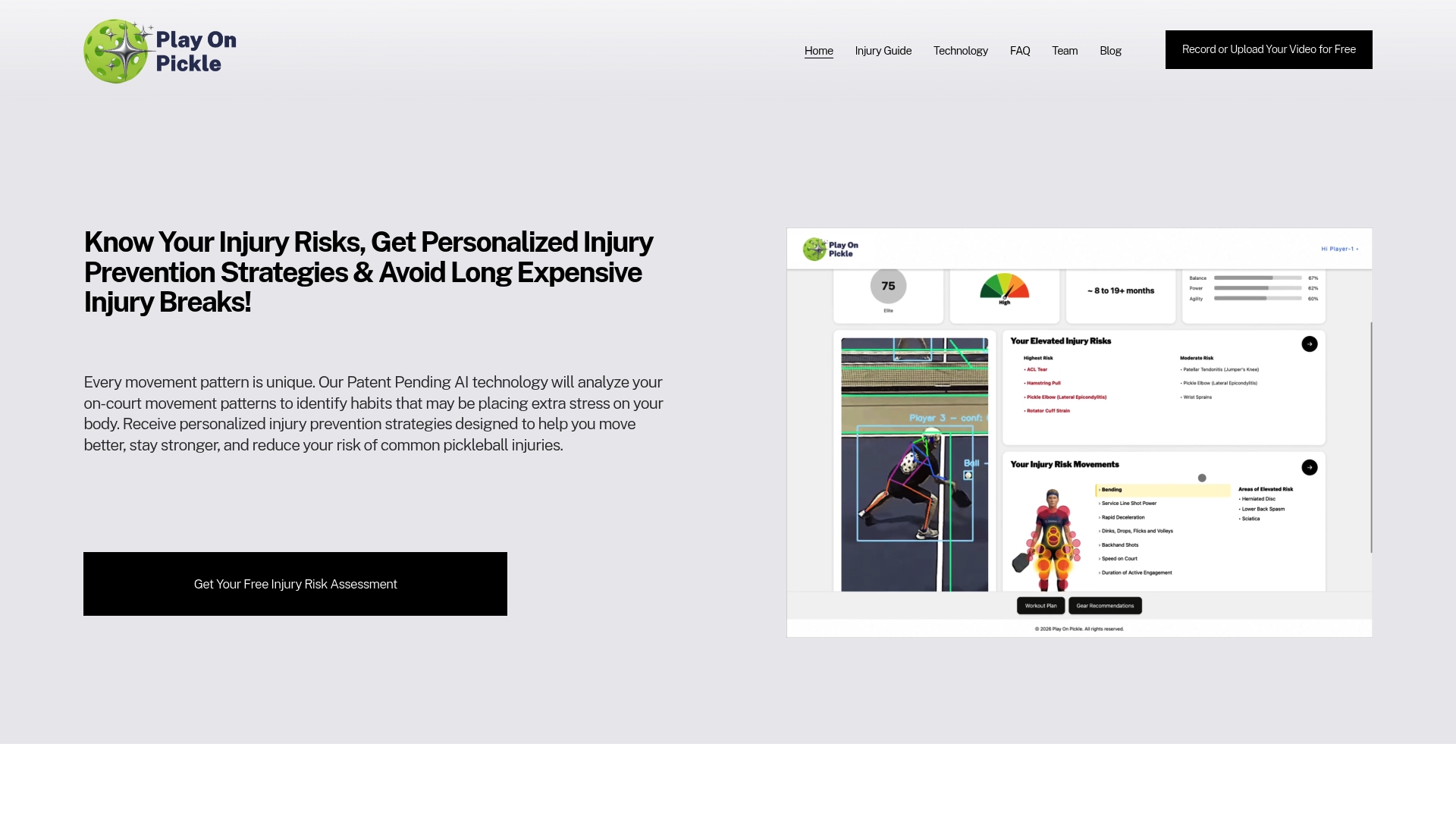
You can begin with the free trial, then choose the $9.99 monthly or $99 annual plan on the pricing page. The monthly plan comes with a free tripod or selfie stick, so your first clip is filmed from a steady position.
Perspective
We built Play On Pickle on a simple belief: accuracy only matters if it changes what you do on the court. A pickleball player does not need a lab report. They need to know that their trail knee drifts inward on every lunge, or that their elbow leads the swing, and they need one or two exercises that fix it.
That is why our patent-pending computer vision is designed around pickleball-specific biomechanics rather than generic workout tracking. Movement analysis from a single phone video, minimal equipment and a short routine make prevention something a recreational player will actually do. Our solution is designed to deliver clinically validated assessments and personalized plans that fit into the way people already play.
The research is clear that the best results come from consistent setup, task-specific design and repeated measurement. Film the same way each time, follow the plan, and let the trend tell you how your body is responding.
Drona
FAQ
How accurate is AI biomechanics analysis from a phone video?
Under controlled conditions, reviews report about 3–8° mean absolute error for hip and knee flexion and about 3–15° across sagittal-plane joints. Accuracy is highest with a steady camera, good lighting and fitted clothing. For spotting movement patterns, that range is well suited to the job.
Can AI predict whether I will get injured?
AI can flag movement patterns linked to higher stress on specific joints, and research on video-based injury models shows a real signal, such as an ROC AUC of 0.88 in one ACL study. It does not diagnose or guarantee an outcome. Use the results to guide exercises and talk to a doctor or physical therapist about pain.
Is video analysis worth it for older adults?
Yes, for the patterns that matter most to safe play: stance, balance and how you lower into a lunge. Gross movement is where 2D video setups are strongest. Combine the feedback with strength and balance exercises, and check with your doctor before changing your routine.
How much does pickleball video analysis cost with Play On Pickle?
Play On Pickle costs $9.99 per month or $99 per year, and there is a free initial trial. The monthly plan includes a free tripod or selfie stick offer. Plans are listed on the pricing page.
Sources
- From laboratory to field: accuracy constraints and practical guidance for markerless motion analysis (JRTI systematic review)
- AI Biomechanics Software review (JMMBS)
- The Applications and Trends of Artificial Intelligence in Sports (MDPI Applied Sciences)
- Applications of Pose Estimation in Human Health and Performance (PMC)
- Types of anomalies in two-dimensional video-based gait analysis (PLOS Computational Biology)
- Feasibility of OpenPose markerless motion analysis in a real athletics competition (PMC)
- Automated Diagnosis of Upper-Limb Kinetic Chain patterns in pickleball (SportRxiv)
- Identifying Anterior Cruciate Ligament Injuries Through video (PMC)
- Stroke phases in paddle technique