
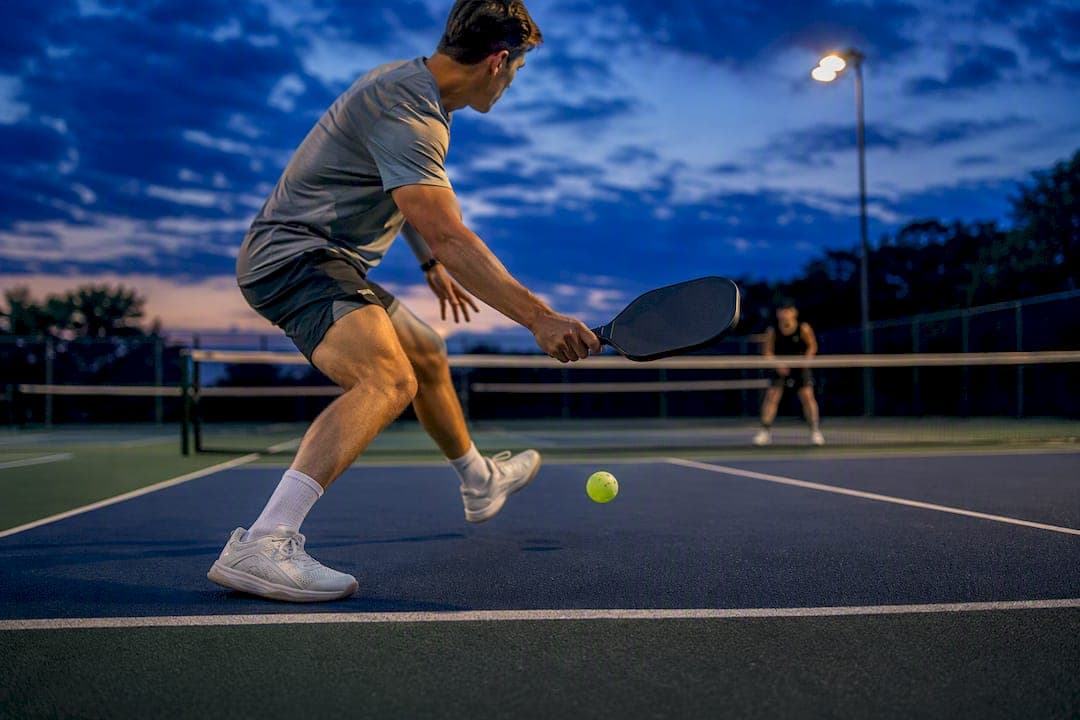
Pickleball movement analysis combines video capture with pose-estimation software to measure joint angles, stroke accelerations, and footwork patterns, then flags which motions carry the highest injury risk. The immediate payoff is specific: instead of guessing why your knee aches after tournaments, you get a ranked list of movement faults tied to actual load numbers. Start by filming a few rallies or running them through a validated tool like Play On Pickle to see where your body is absorbing the most stress.
TL;DR:
- Movement analysis reveals that repeated smashes generate over twice the impact load of serves, significantly increasing shoulder and wrist injury risk.
- Accurate filming at a perpendicular angle, at 60fps, in good lighting, and with court calibration is essential for reliable joint-angle and acceleration data.
- Field-based markerless AI analysis provides useful injury and performance insights, but higher-fidelity lab methods offer detailed joint-loading estimates at much higher cost.
- Play On Pickle combines automated video analysis with personalized injury risk reports and targeted exercises, enabling players to address their most critical movement faults efficiently.
Table of Contents
- What Does Pickleball Movement Analysis Actually Measure?
- How to Film Pickleball for Kinematic Analysis
- Markerless AI Versus Lab Motion Capture: What's the Trade-Off?
- Which Movement Faults Actually Lead to Pickleball Injuries?
- Turning Movement Data Into a Training Plan
- How Play On Pickle Applies This Workflow
- Pickleball Tools Versus Tennis and Padel Analysis Software
- How Do You Validate a Pickleball Movement Analysis Report?
- Where Movement Analysis Is Headed Next
- Get Your Own Movement Analysis Report
- Sources
- FAQ
What Does Pickleball Movement Analysis Actually Measure?
Movement analysis isn't a single test. It's a stack of measurements, each answering a different question about how your body moves during play, and each one connects to a specific injury pathway or performance gap.
Joint angles sit at the foundation. Analysts track flexion and extension at the hip, knee, ankle, and wrist across a swing or footwork sequence, building a time series that shows how a joint moves from the split step through contact and recovery. A MediaPipe-based pose estimation study found significant differences in femur angle between high-level and beginner players during dink shots, with a p-value under 0.001. That's not a marginal finding. It means the software can reliably tell a controlled dink from a rushed one just by watching hip and knee flexion, which is exactly the kind of signal a coach wants when deciding who needs footwork drills versus stroke drills.
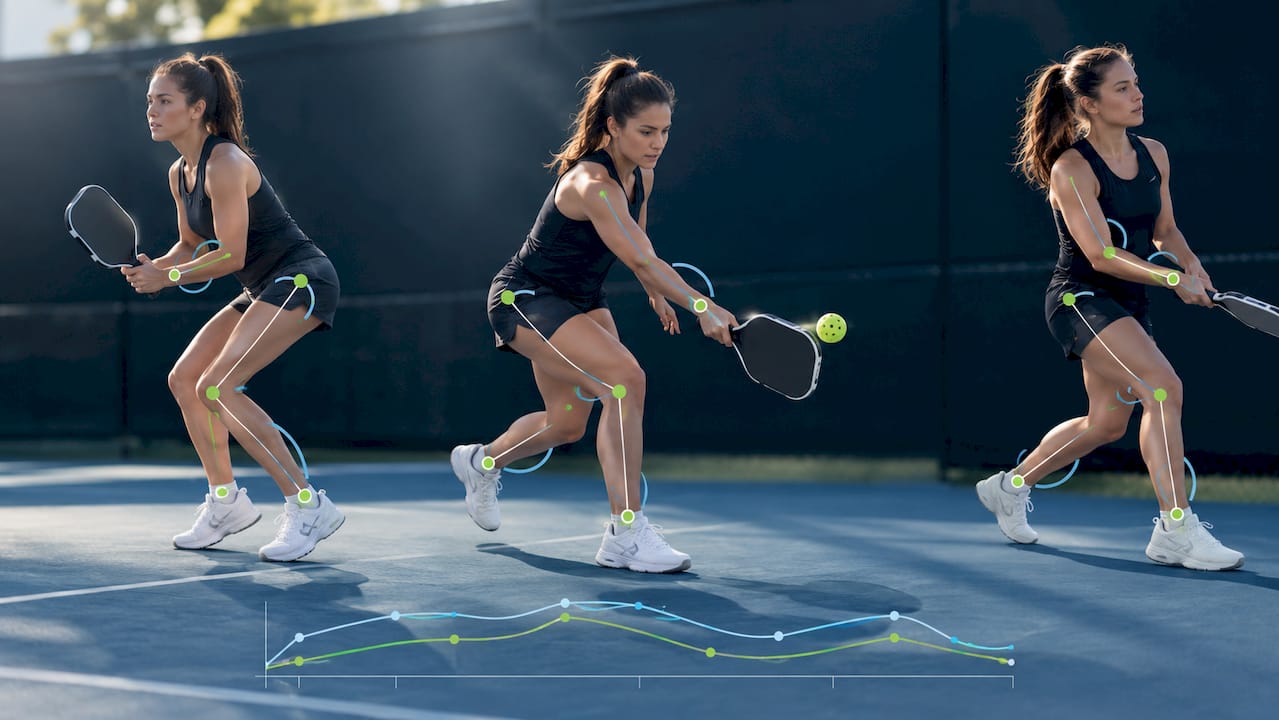
Peak acceleration by stroke is where things get concrete for injury prevention. Smashes generate significantly higher peak accelerations than serves. Research measuring impact loads found smashes averaging 11.4 ± 6.3 m/s², compared to 5.0 ± 2.6 m/s² for serves. That gap matters because repeated high-acceleration strokes stack cumulative load on the shoulder and wrist in a way a handful of serves never will. If your training session is heavy on overhead smashes, your joints are absorbing more than double the peak force of a serve-focused session, rep for rep.
Court-coverage metrics round out the picture. Time spent at the kitchen line, transition speed from baseline to net, and lateral coverage during doubles points all feed into tactical assessment, but they also reveal fatigue patterns. A player who takes longer to reach the kitchen as a match progresses is often compensating with sloppier footwork, which is precisely when ankle and knee faults show up.
Pro Tip: Don't just look at your fastest stroke. The strokes you repeat most often, usually dinks and drives, do more cumulative damage than the occasional big smash, even though the smash looks scarier on camera.
The same research documenting stroke-impact profiles also found a striking frequency figure: roughly 97.59 at-risk ankle movements per match. This is not a rare misstep. It's a near-constant background risk that most players never notice because no single movement feels dangerous in isolation.
A few core metrics show up in nearly every credible report:
- Joint angle ranges at contact and follow-through, benchmarked against skill-level norms
- Peak acceleration values broken down by stroke type (smash, drive, dink, serve)
- Time-in-zone data (kitchen, transition zone, baseline) across a match
- Frequency counts of at-risk movement patterns per set or match
- Asymmetry scores comparing dominant and non-dominant side mechanics
None of these numbers mean much on their own. What matters is how they combine. A player with a high smash-acceleration count and a high at-risk ankle frequency is a very different coaching case than one with clean strokes but slow transition times.
How to Film Pickleball for Kinematic Analysis
Bad footage produces bad analysis, no matter how good the software is. Pose-estimation models need a clean, stable view of the body to extract usable joint-angle data, and a few filming mistakes ruin that instantly.
- Pick the right angle for the question you're asking. A side-on view, shot roughly perpendicular to the baseline, captures the hip, knee, and ankle flexion needed for stroke mechanics. A diagonal angle from behind the baseline works better for tracking court coverage and lateral movement. If you have access to an elevated or overhead camera, that view is ideal for footwork patterns during kitchen exchanges, though few home setups have it.
- Shoot at 60 frames per second or higher. Standard 30fps video blurs fast strokes like smashes into a few frames, which destroys the acceleration data pose models rely on. Most modern smartphones support 60fps or 120fps in slow-motion mode; use it.
- Keep the resolution at 1080p minimum. Pose-estimation tools like MediaPipe need enough pixel detail to place joint markers accurately, especially at the wrist and ankle, which are the smallest and fastest-moving points on the body.
- Mount the camera. Don't hand-hold it. A tripod or fence mount eliminates the frame shake that confuses tracking algorithms. Even small hand tremors introduce noise that shows up as false acceleration spikes in the data.
- Watch your lighting. Backlighting, shooting toward the sun or a bright window, silhouettes the player and can cause pose models to lose track of limbs entirely. Shoot with the light source behind the camera whenever possible.
- Calibrate the court in frame. Include a visible baseline, sideline, or kitchen line in your shot. Analysts and software convert pixel distances to real-world feet or meters using those known court dimensions, which is how footwork speed and coverage distance get calculated accurately.
- Capture full points, not just the shot you care about. A clip that starts mid-rally misses the setup footwork that often explains why a stroke looked rushed or off-balance. Aim for 15 to 30 second clips that include the serve or return through the point's end.
This filming approach lines up with established video-analysis guidance built specifically around technique review, not just game footage.
Pro Tip: Name your clips with the date, opponent skill level, and stroke focus (e.g., "0312_vs_advanced_smash.mp4"). Six months from now, you'll want to compare footage, and a folder of "IMG_4471.mov" files will make that impossible.
One more thing worth a sentence: if you're filming other players, even casually at a public court, a quick heads-up before you start recording avoids awkward conversations later.
Markerless AI Versus Lab Motion Capture: What's the Trade-Off?
Every movement-analysis method sits somewhere on a spectrum between convenience and precision, and knowing where your options fall on that spectrum saves you from paying for accuracy you don't need or settling for accuracy that isn't enough.
Single-camera 2D pose estimation using models like MediaPipe or OpenPose is the most accessible entry point. These tools identify body landmarks (shoulders, elbows, wrists, hips, knees, ankles) from a single video feed and calculate joint angles in two dimensions. The MediaPipe pilot study referenced earlier used exactly this kind of setup, a single GoPro camera, and still detected statistically significant kinematic differences between skill levels. That's a meaningful result for something that requires no specialized hardware, just a phone or action camera and processing software.
Supervised AI pipelines built for tactical analysis go further, tracking not just individual joints but ball trajectory, player positioning, and rally states across a full match. A computer-vision tactical decision-support system validated on tournament footage reported a MOTA (multiple object tracking accuracy) score of 0.89 and a tactical recognition F1 score of 0.90, both strong results for a field deployment rather than a controlled lab.
Automated fault-classification pipelines push into diagnostic territory. Research using YOLO-based pose detection combined with unsupervised clustering managed to sort upper-limb movement patterns into distinct fault categories, separating rigid arm swings, constricted flexion, and kinematic lag automatically across hundreds of trials, without a human manually labeling each one.
Lab-grade motion capture paired with OpenSim modeling sits at the high-fidelity end. This approach uses reflective markers and multiple synchronized cameras to build a full 3D skeletal model, then runs that model through musculoskeletal simulation software to estimate actual joint loading and muscle forces. Open biomechanics projects applying OpenSim to pickleball can translate raw kinematics into estimates of tissue-level stress, information a 2D field setup simply cannot produce. The cost is real: specialized equipment, a controlled space, and processing time measured in hours rather than minutes.
Here's how the trade-offs typically break down:
- Single-camera markerless setups: low cost, fast turnaround, good for 2D angle trends and stroke comparisons, but vulnerable to occlusion when a limb passes behind the body or another player.
- Multi-signal AI tracking pipelines: moderate cost, strong for tactical and positional data, dependent on camera placement and lighting quality for accuracy.
- Lab motion capture with OpenSim: highest cost and setup time, but the only option that produces genuine joint-loading and muscle-force estimates rather than approximations.
Every markerless method shares the same weak points: motion blur from fast strokes, occlusion when a player's arm crosses behind their torso, and projection artifacts when a 3D movement gets flattened into a 2D camera view. None of these are fatal flaws, but they explain why a smash captured at an awkward angle sometimes produces a joint-angle reading that looks physically implausible. Good analysis tools flag those low-confidence frames rather than presenting them as clean data.
Which Movement Faults Actually Lead to Pickleball Injuries?
Not every awkward-looking movement matters. Some faults are cosmetic. Others are the direct mechanical cause of the injuries that sideline players for weeks. Knowing the difference is the whole point of running an analysis in the first place.
Lower-limb faults dominate the injury picture. A nationwide study of 1,758 pickleball players documented common injury sites and the movement behaviors linked to them, with rapid directional changes and abrupt decelerations showing up repeatedly as predictors. Three patterns show up constantly on video:
- Ankle inversion during lateral shuffles, where the foot rolls outward on quick direction changes, a direct precursor to sprains and a major contributor to the near-constant at-risk ankle count mentioned earlier.
- Delayed approach steps before smashes, forcing a last-instant lunge that overloads the Achilles tendon and calf on landing.
- Baseline locking, where a player plants flat-footed instead of staying on the balls of their feet, which slows reaction time and increases the force absorbed on the next direction change.
Players managing long-term Achilles sensitivity, particularly those over 50, tend to show these patterns more pronounced and more often, since reduced tendon elasticity amplifies the load from each delayed step.
Upper-limb faults center on the arm and wrist. Automated clustering research identified three recurring pathological patterns in amateur players: a rigid arm swing that transfers shock straight into the elbow instead of absorbing it through the shoulder, constricted flexion that shortens the swing's natural arc, and kinematic lag where the wrist trails the forearm by too wide a margin at contact. That rigid-swing pattern in particular tracks closely with lateral epicondylalgia, the tendon irritation better known as tennis elbow, which shows up constantly in pickleball players who never played tennis a day in their life.
Stroke choice changes the risk math directly. Since smashes produce peak accelerations more than double those of serves, a player grinding through smash-heavy drilling sessions is loading the shoulder and wrist at a rate their recovery time may not match. That's not a reason to avoid smashes. It's a reason to track how many you're hitting per session.
Pro Tip: Use this triage rule when reviewing footage: frequency × peak load × player vulnerability. A movement that happens rarely but hits hard (an occasional smash) ranks differently than one that happens constantly at moderate load (every kitchen approach step). Age and injury history shift the multiplier, a 55 year old with a prior ankle sprain needs a lower threshold before a fault gets flagged as urgent.
Turning Movement Data Into a Training Plan
A report full of joint angles and acceleration numbers is useless if it doesn't change what you do on the court next week. The fix is a simple three-step loop: identify, prescribe, monitor.
- Identify. Pull the two or three highest-priority faults from your analysis, using the frequency times load times vulnerability rule from the previous section. Don't try to fix everything at once. Trying to correct five movement patterns simultaneously usually fixes none of them.
- Prescribe. Match each fault to a specific drill or exercise, not a vague instruction like "work on your footwork."
- Monitor. Set a measurable target and a re-test date, then actually re-film to check progress instead of guessing.
Concrete drill pairings work better than generic advice:
- Ankle inversion on lateral shuffles pairs with a lateral ladder drill emphasizing controlled foot placement, done at low speed before adding game pace.
- Rigid arm swing pairs with an eccentric wrist-extension routine using light resistance bands, three sets of twelve, focused on slow, controlled lowering rather than the lift itself.
- Delayed approach steps before smashes pair with reactive split-step drills, where a partner or coach calls the smash cue randomly to train earlier anticipation.
- Baseline locking during rallies pairs with kitchen-hold footwork drills, staying on the balls of the feet for extended dink exchanges.
For measurable targets, tie the number to what the analysis actually reported. If time at the kitchen line is short compared to competitors at your level, aim to increase it by a similar margin, then re-test with fresh footage at the same court, same camera angle, so the comparison is clean.
Re-testing every four to six weeks gives most recreational players enough time to show measurable change without losing motivation waiting for results. Coaches working with competitive players often shorten that window to two to three weeks during active training blocks.
Not every fault is a training problem. If a joint-angle abnormality is paired with ongoing pain, swelling, or a noticeable loss of range of motion, that's a signal to bring in a physical therapist or sports medicine provider rather than pushing through a drill progression. Movement analysis is excellent at flagging risk. It is not a diagnostic replacement for a clinician, and a good report should say so plainly. For players managing existing wrist issues specifically, structured return-to-play guidance helps set realistic timelines before resuming full-intensity drilling. General conditioning work also supports whatever specific corrections your analysis flags, since better overall strength and mobility make every targeted drill more effective.
Pro Tip: Track one number per fault, not five. A player trying to simultaneously monitor ankle angle, wrist lag, smash acceleration, and kitchen time usually stops tracking anything after two weeks. Pick the highest-priority metric and watch it closely.
How Play On Pickle Applies This Workflow
Play On Pickle runs this exact pipeline for players who don't want to build a filming and analysis setup from scratch. The process starts with a video upload, either a practice session or match footage, which then goes through automatic pose analysis to extract joint angles and movement patterns across your strokes and footwork. From there, the system maps stress points across the body, essentially the same fault-identification step described earlier, and generates a prioritized plan ranking which movement issues carry the most injury risk for your specific patterns.
A typical report includes:
- Stroke-by-stroke breakdown of joint angles and estimated load
- A ranked list of flagged movement faults, prioritized by risk
- Personalized exercise recommendations targeting the top faults
- Equipment suggestions where footwear or paddle weight may be contributing to the pattern
Turnaround is designed to be fast enough that players get feedback while the session is still fresh in memory, rather than waiting weeks for a lab appointment. For a deeper walkthrough of the video-to-plan process, Play On Pickle's own video analysis guide covers the filming side in more detail, and the AI training breakdown explains how flagged risks turn into specific drill prescriptions.
Pickleball Tools Versus Tennis and Padel Analysis Software
Movement analysis isn't new. Tennis and padel programs have used video-based coaching tools for years, and it's worth understanding why pickleball needed its own approach rather than borrowing directly from those sports.
Tennis analysis software is typically built around a much longer swing plane and higher ball speeds off the racket, tuned to detect subtle differences in a serve toss or a two-handed backhand. Padel tools, closer in spirit to pickleball given the smaller enclosed court, focus heavily on wall-rebound positioning and doubles spacing, tactical concerns that show up in general racket-sport court etiquette discussions as well.
Pickleball's movement signature doesn't map cleanly onto either. The court is smaller, points are shorter, and the dominant strokes (dinks, resets, and the third-shot drop) involve compact, controlled arm motion rather than the full-extension swings tennis software is calibrated to detect. Generic tools also tend to miss pickleball-specific footwork patterns like the kitchen-line shuffle, since that movement barely exists in tennis and looks different in padel due to the wall.
That gap is exactly why pickleball-specific pose models matter. The MediaPipe pilot study referenced earlier was built and validated specifically on pickleball dink mechanics, not adapted from a tennis dataset, which is part of why it caught femur-angle differences a generic tool calibrated for a different sport might have missed entirely.
How Do You Validate a Pickleball Movement Analysis Report?
Trusting a number on a screen requires knowing where it came from. Validation in this field usually happens on two levels: how the underlying model was built, and how you personally check its output against reality.
At the model level, researchers validate pose-estimation and tracking systems against ground-truth measurements, comparing AI-generated joint angles to manually coded video or comparing tracking output to known player positions.
At the practical level, you can run your own sanity checks. Court calibration is the easiest one: if the software reports your baseline-to-net sprint at a speed that seems physically impossible, the pixel-to-distance conversion is likely off, often from a camera angle that wasn't square to the court lines. Cross-checking a few strokes against your own eye is another simple test. If a report flags a smash as your highest-load stroke and that matches how your shoulder actually feels after a heavy smash session, the model's output lines up with lived experience, which is about as good a field validation as a recreational player can run without lab equipment.
Consistency matters too. Filming from the same angle, distance, and frame rate each session keeps your longitudinal comparisons honest. Changing your camera setup between the "before" and "after" clips introduces measurement noise that can look like progress or regression when it's really just a different lens angle.
Where Movement Analysis Is Headed Next
Real-time tactical overlays are the clearest near-term shift. That's a genuinely different coaching experience than reviewing footage the next day.
The trap is treating every flashy overlay as gospel. A heatmap or angle reading is only as good as the tracking behind it, and low latency systems still occasionally lose a limb behind a body or misjudge a fast smash. Validated metrics, the kind backed by peer-reviewed accuracy numbers rather than marketing claims, deserve more weight than a slick visualization. Coach judgment still catches things a model misses, like a player favoring an old injury in a way that doesn't show up as an obvious kinematic outlier.
If you're a coach considering adopting one of these tools, pilot it in low-stakes practice sessions before rolling it into competitive prep. Watch whether the flagged faults actually match what you already see with your own eyes over a few weeks. Tools that pass that test earn a bigger role in your program. Ones that don't, no matter how good the AR graphics look, aren't ready yet.
— Drona
Get Your Own Movement Analysis Report
Play On Pickle turns the filming and interpretation work covered above into something you can do in one upload, no tripod calibration spreadsheet or pose-estimation software license required. Instead of piecing together a MediaPipe setup and learning to read joint-angle graphs yourself, you get a report built on the same kind of validated computer-vision approach discussed throughout this piece, translated into a prioritized list of the fixes that matter most for your specific movement patterns.
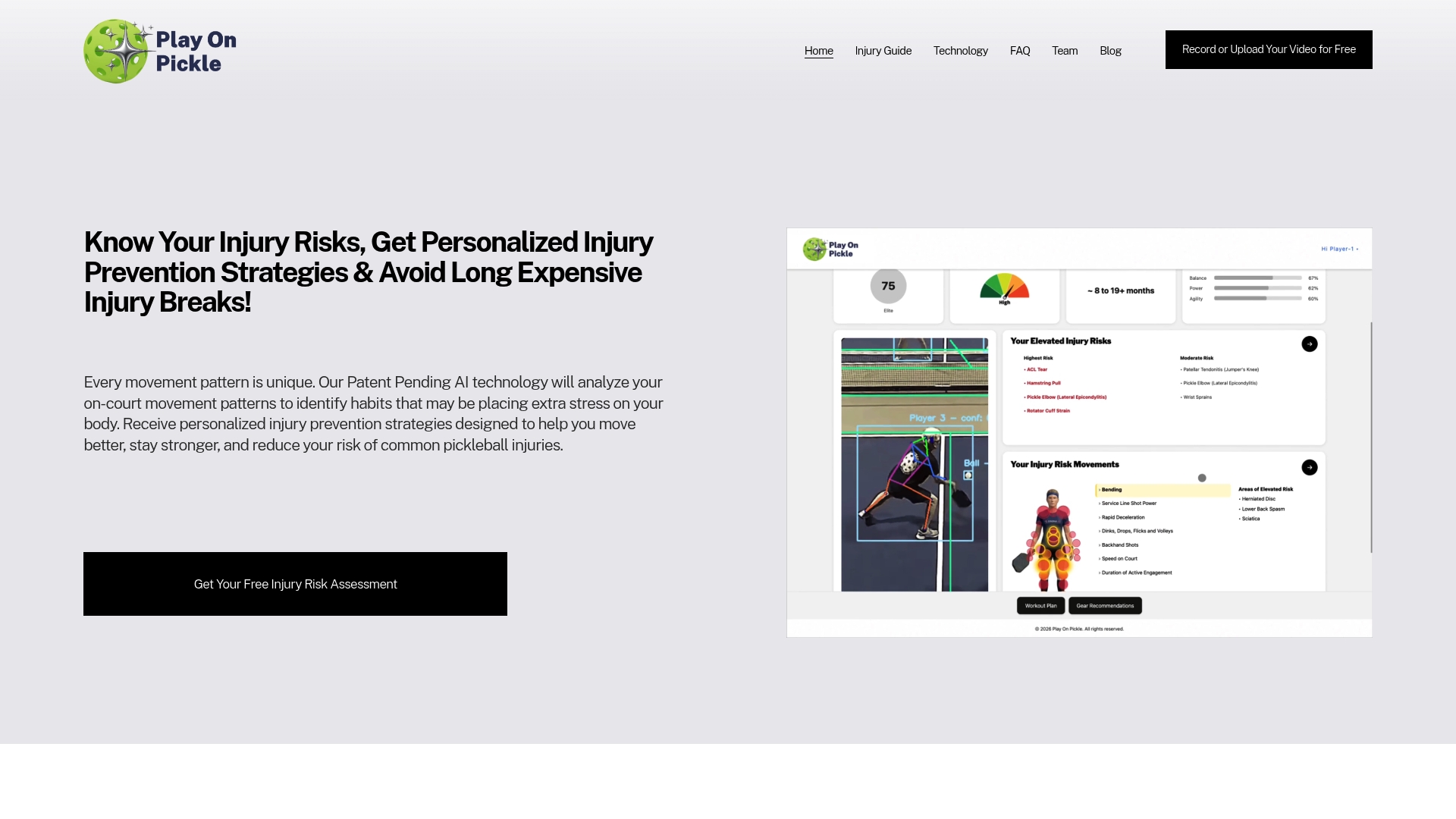
A free initial report is the easiest way to see what this looks like with your own footage. Upload a practice session or recent match clip, and expect a stress-point breakdown plus a short list of exercise and equipment recommendations tailored to what your movement actually shows, not generic advice pulled from a blog post. If ankle and lower-limb risk is your main concern, the injury prevention resources pair well with your first report's recommendations. Start your first upload at Play On Pickle and see which movement is quietly costing you the most.
This article is general information, not a substitute for advice from a qualified doctor. Consult a qualified healthcare professional about your own circumstances before acting on anything here.
Sources
- Doi
- Pose estimation for pickleball players’ kinematic analysis through MediaPipe-based deep learning: A pilot study
- Understanding Injury Patterns and Predictors in Pickleball Players: A Nationwide Study of 1,758 Participants
- Computer-vision-based tactical decision support system for pickleball doubles
FAQ
How Do I Know if I'm a 3.5 Pickleball Player?
Players typically show consistent dinks, a developing third-shot drop, and reliable footwork to the kitchen line, but still make unforced errors under pressure or against faster pace. Movement analysis can confirm this more objectively by comparing your joint-angle control on dinks to the femur-flexion patterns that research links to higher-level play.
What Are the Five P's of Pickleball?
The five P's commonly cited by coaches are positioning, patience, placement, power, and preparation, each describing a core skill area rather than a formal scoring or rules framework. They function more as a coaching mnemonic than a technical standard.
How Good Is a 3.0 Pickleball Player?
Players have basic stroke consistency and understand court positioning but often struggle with soft-game control, particularly at the kitchen line, and tend to hit with more power than the shot requires. This is exactly the skill range where footwork and stroke-mechanics analysis tends to show the clearest room for improvement.
What Is the 10 Second Rule in Pickleball?
The rule requires the server to serve within 10 seconds of the score being called, keeping match pace consistent and preventing stalling between points. It's a procedural rule rather than a movement or technique guideline.
Can Movement Analysis Actually Prevent Pickleball Injuries?
Movement analysis can't guarantee injury prevention, but it identifies high-risk patterns, like the near-constant at-risk ankle movements documented in stroke-impact research, before they cause a sprain or strain. Tools like Play On Pickle use that data to prioritize which specific exercises address your highest-risk movements first.