
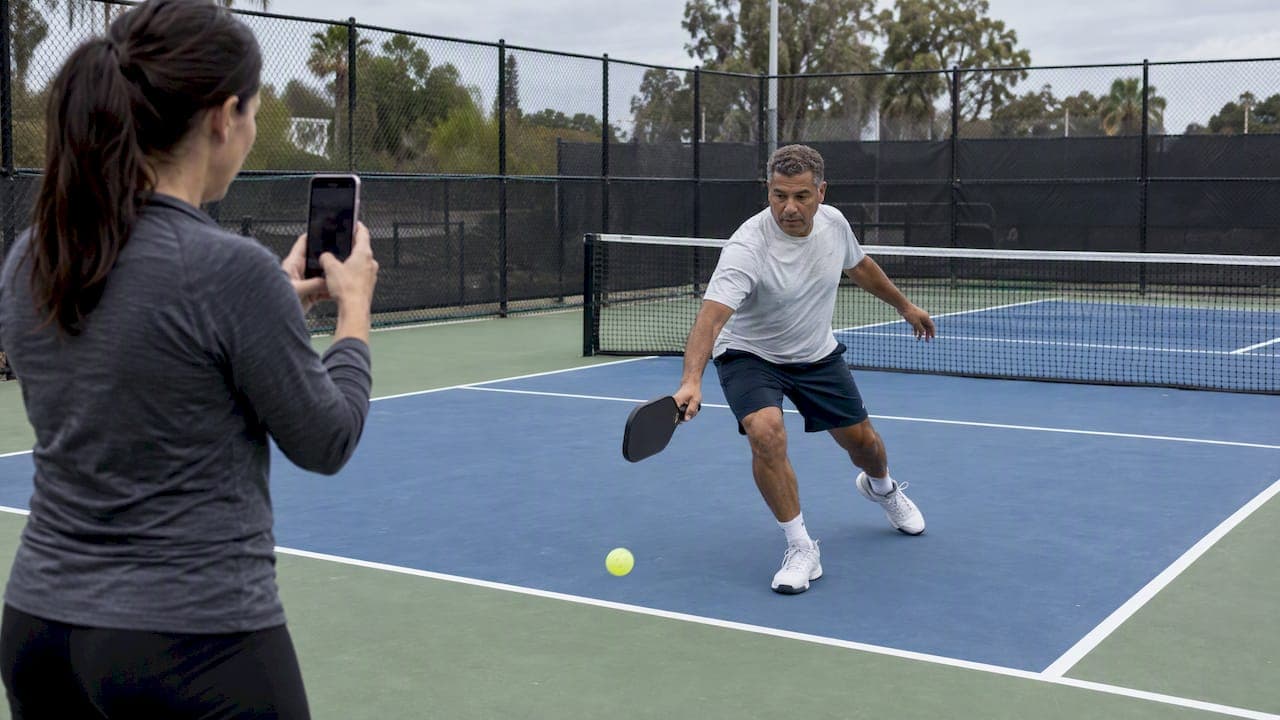
Markerless motion capture (MMC) estimates where your joints are from ordinary video, with no reflective markers, suits or lab. In pickleball, that means a phone on a tripod can show how your knee bends on a dink, how your shoulder loads on a drive, and where your movement habits put stress on your body. It is best at selected movements filmed under good conditions, and it works best as a way to spot patterns and plan training rather than as a medical diagnosis.
This guide explains how the technology works, what the research says about pickleball specifically, how to film so the results are usable, and how to turn the output into an injury-prevention plan.
TL;DR
- MMC uses pose-estimation software to find body joints in video, so you need a camera, not a motion lab.
- Early pickleball research has measured knee angles on dinks and classified upper-limb movement patterns from a single smartphone video.
- Accuracy is lower than marker-based systems and depends on camera angle, lighting and frame rate, so setup matters.
- Use the output to find patterns and choose strength, balance and warm-up work, not to self-diagnose an injury.
- Our own plans start at $9.99 per month or $99 per year, after a free trial.
Table of Contents
- What markerless motion capture actually is
- What it can measure in pickleball
- How accurate is it?
- How to film so the analysis is useful
- From movement data to fewer injuries
- Our perspective
- Try it on your own game
- Using markerless analysis well
- Who benefits most
- FAQ
- Sources
What markerless motion capture actually is
Traditional motion capture places reflective markers on the body and tracks them with several infrared cameras. It is accurate, and it lives in a lab. Markerless systems skip the markers. Software estimates the position of the body from video, and its outputs can include joint or segment coordinates and kinematics such as angles and speeds, according to a 2026 review of markerless motion capture in sport and exercise.
The engine under most of these tools is a pose-estimation model. Open frameworks such as MediaPipe and OpenPose find body landmarks (hips, knees, ankles, shoulders, elbows, wrists) in each frame. The software then connects the landmarks across frames and calculates angles and movement over time. A 2025 Frontiers paper on commercial vision sensors and AI-based pose estimation describes this approach, including a MediaPipe-based pickleball study that measured knee angles during dink shots.
That is the practical appeal for a sport like pickleball. Most players will never visit a biomechanics lab, but nearly all of them carry a phone.

What it can measure in pickleball
Pickleball is a good fit for video analysis because many of its demands repeat: split steps, lunges to the kitchen line, quick lateral shuffles, compact swings and constant low, bent-knee posture. Markerless tools can pull numbers from each of them.
Lower body
Knee flexion is the clearest example. The pickleball study described in the Frontiers paper above measured knee angles during dink shots, which is the shot that keeps players in a deep, repeated lunge. From the same kind of video, software can also estimate:
- how far the knee travels over the toes on a lunge
- whether the knee collapses inward on a push-off
- hip and trunk position when you reach low
- how much you favor one leg on landing and recovery
These matter because the knee and lower extremity are among the most common injury sites in a US study of pickleball injury patterns and predictors, alongside the shoulder, back and elbow.
Upper body
A preprint from SportRxiv describes a markerless 2D pipeline that used single-smartphone video and YOLO11-Pose to classify three pathological upper-limb kinematic patterns in novice pickleball players. It is early work and has not been through the full publication process, but it shows the direction: a phone video of a swing can be sorted into movement patterns a coach would want to correct, such as inefficient energy transfer up the arm.
Patterns over time
One clip tells you little. Several clips of the same movement, filmed the same way, let you see whether your lunge depth, knee alignment or swing mechanics are changing as you train. That repeatability is where most of the value sits for a recreational player.
How accurate is it?
Honest answer: accurate enough to be useful for selected movements, and less accurate than a lab.
The 2026 review mentioned above reports that MMC accuracy is generally lower than marker-based systems. In validation studies, the error in sagittal-plane joint angles (the side-view bend of the knee or hip) ranged from 3.20° to 16.41° root mean square error, and errors were significantly higher for rotations in the transverse plane, such as twisting of the trunk or lower leg. The same review notes MMC can give useful measurements for selected movements, while performance in competitive environments remains limited.
What that means in practice:
- Side-view bends are the strongest signal. Knee and hip flexion on a dink or lunge are the kind of movement that tends to be measured best.
- Rotations need more caution. Treat twisting numbers as rough indicators of a pattern, not precise degrees.
- Trends beat single numbers. The review also says validation is needed before MMC is used to detect longitudinal changes, so compare like with like: same camera position, same lighting, same drill.
A conceptual framework and review in the Journal of Sports Sciences adds that single-camera views are prone to occlusion, and depth estimation can lack precision for high-speed or complex multi-planar motion. The practical lesson is to film simple, repeatable movements, and to read results as a guide to what to work on.
How to film so the analysis is useful
The quality of the output depends on the quality of the input. Per the Frontiers paper, useful analysis depends on camera and device setup, video quality, frame rate, lighting and camera angle, and 2D systems have limits for movements that happen out of the camera's plane. The Journal of Sports Sciences review adds that performance depends on occlusion, with multi-camera setups reducing it and enabling more accurate 3D reconstruction.
For a single phone, that translates into a simple checklist:
- Use a tripod. A steady camera removes a major source of error. A tripod or selfie stick that holds the phone at roughly hip height works well.
- Pick the right angle for the question. Film from the side to see knee and hip bend on a dink or lunge. Film from the front or back to see knee alignment and left-right differences.
- Keep your whole body in frame. Include feet to head, with space for the full lunge or swing.
- Light the scene evenly. Avoid strong backlight, such as shooting toward an open door or a bright window, which can hide your outline.
- Wear fitted clothing. Baggy shorts and loose jackets blur the outline of knees and hips.
- Use a higher frame rate for fast movements. If your phone offers 60 frames per second, use it for swings. Slower, controlled drills are fine at standard rates.
- Keep other players out of the way. When two people overlap, the software can mix up their joints.
- Repeat the same setup each time. Mark where the tripod stands so your next clip is comparable.
Automatic tracking cameras that follow a match are great for highlights, but a fixed camera filming a deliberate drill is usually better for biomechanics, because the angle stays constant.
From movement data to fewer injuries
Movement data helps only if it changes what you do. Here is how that connects to what we know about pickleball injuries.
Know where the risk sits
In the US study of injury patterns and predictors, the injury predictors that reached significance included male sex, playing three or more times a week, having fewer than five years of experience, and being between 33 and 77 years old. The common injury sites were the knee, lower extremity, shoulder, back and elbow. The authors, Owoeye and colleagues, also note that because pickleball is viewed as less physically demanding, players may underestimate injury risk and skip warm-ups or other evidence-informed prevention routines.
If you play often, started recently or are over 33, movement analysis is a way to see your own habits instead of guessing. For a wider look at the numbers, see our pickleball injury statistics and the breakdown of emergency department cases and eight fixes.
Turn findings into training
A finding is only useful when it maps to an action. A few examples of how that works:
- Deep, unstable lunges on dinks point toward single-leg strength and control work. Our six-week single-leg plan is built around that need.
- Poor warm-up habits call for a short, repeatable routine. USA Pickleball recommends stretching after warm-ups and building balance with yoga and strength training to help prevent falls and other serious injuries. Our three-move prehab routine gives recreational and senior players a place to start.
- Falls and balance concerns call for strength, balance and agility work together. A US study of a multi-faceted training program found that this kind of program improved physical performance and reduced fear of falling among senior pickleball players. For general guidance on this, see these balance training exercises for seniors.
The same study's authors, Hanks and Myers, observe that injury and fall prevention advice for pickleball often borrows from other populations, which is a good argument for sport-specific training built around pickleball footwork and power transfer.
If you do get hurt
Pain that persists, swelling, a joint that gives way or any injury after a fall is a job for a physician or physical therapist, not an app. When you return after an injury, a structured process helps, and a sports injury report form with a six-step return to play is a useful way for coaches to document what happened and when a player is ready to come back.
Our perspective
Most recreational players do not get hurt in a dramatic moment. They get hurt by the thousandth dink taken with the same slightly collapsed knee, or the same stiff swing, on a body that never got a warm-up. That is an invisible problem, and it needs a tool that makes it visible.
We built Play On Pickle around that idea. A single video, filmed on equipment you already own, gives our patent-pending computer vision a way to look for stress points in your movement, and then we turn them into a short plan of simple exercises that fits into your routine. We design for convenience on purpose: if a plan takes an hour a day and a lab, most players will never start it.
We also think the research points in the right direction. The studies on markerless analysis are clear that setup, repeatability and sport-specific context matter, and that movement data should guide coaching and training rather than replace judgment. That is how we use it: as a consistent, personal look at your own biomechanics, paired with exercises matched to what we see.
For coaches and facilities, the same approach means a consistent way to screen many players without scheduling each one into a clinic. For players, it means knowing what to work on before something hurts.
Drona
Try it on your own game
If you want to see what markerless analysis says about your movement, Play On Pickle takes video you record yourself and returns an injury risk assessment with personalized exercise and equipment recommendations. Our plans are $9.99 per month or $99 per year, and you can start with a free trial. See the details on our pricing page.
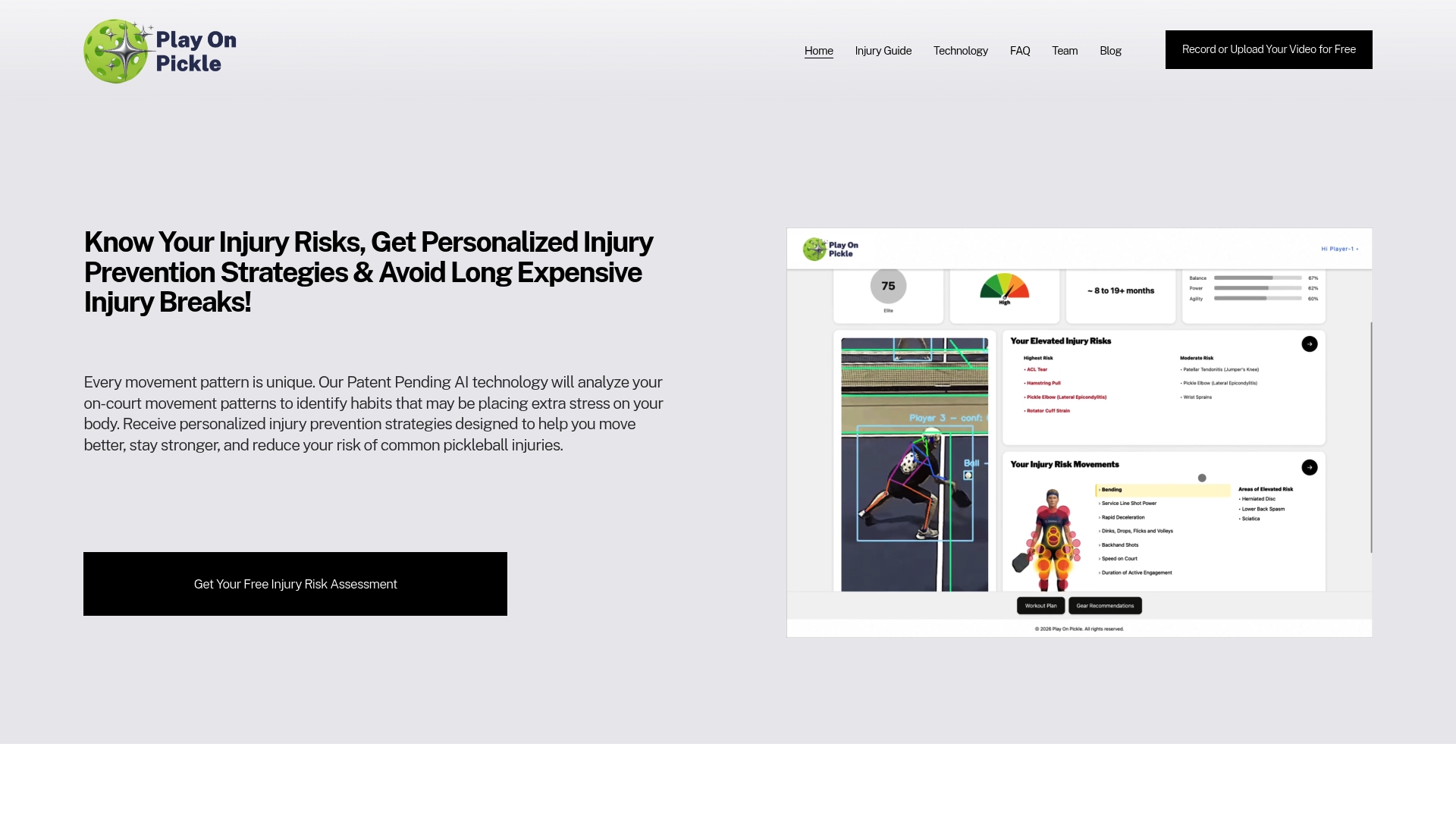
If you need a way to hold your phone steady, our free tripod offer comes with the $9.99 monthly plan. You can also read how our patent-pending technology works.
Using markerless analysis well
A few habits get the most out of any markerless tool, ours included.
Start with one question. "Why do my knees ache after long dink rallies?" is a better starting point than "analyze everything." It tells you which angle to film and which movement to repeat.
Film a baseline, then retest. Record the same drill before you start a training block and again after several weeks. Because researchers stress that reliability is task-dependent, a like-for-like comparison is the most trustworthy one.
Let coaches coach. Expert commentary in a Sports Biomechanics article on markerless motion capture suggests MMC can support coaching by identifying general movement patterns, while practitioners should avoid micro-managing technical details without understanding how movement organizes itself. In short: fix the big patterns first, and avoid chasing a single degree of knee angle. If you are a coach, our guides on markerless movement analysis for coaches and session templates with a short warm-up show how this fits into practice.
Keep the long view. A 2025 review of motion capture technologies for athletic performance points out that long-term reliability data are still limited for these systems. That is a reason to keep your method consistent and your expectations practical, and a reason to keep an eye on the research as it grows.
Pair the data with the basics. Strength, balance, a proper warm-up and sensible court-time habits do much of the work. Movement analysis helps you aim them. For a fuller walkthrough, see our AI video analysis guide and the piece on fixing dinks and injury risk in two to three sessions.

Who benefits most
Recreational players who have not done any physical training for the sport get a simple picture of their habits and a short exercise list. Our injury prevention guide for recreational and older players goes deeper.
Older adults benefit when the plan emphasizes balance and leg strength, given the age range flagged in the US injury study and the falls research above.
Competitive players can use repeated clips to track how their mechanics hold up as training volume rises.
Coaches and facilities can use a consistent video-based screen for many players, then spend lesson time on the movements that matter.
Developers and physiotherapists who want to understand the technical side can read our single-camera computer vision overview.
FAQ
Do I need special cameras or sensors for markerless motion capture in pickleball?
No. Single-smartphone video has been used in published pickleball research, and a steady phone on a tripod is enough to start. A clear side or front view, good lighting and your full body in frame matter more than expensive gear. Multi-camera setups can reduce occlusion, but they are not required for useful pattern-spotting.
How accurate is markerless analysis compared with a lab?
It is generally less accurate than marker-based lab systems. A 2026 review reported side-view joint angle errors of roughly 3° to 16° across validation studies, with higher errors for rotations. That is why repeatable filming and trend-watching are more reliable than reading any single number.
Can markerless motion capture diagnose a pickleball injury?
No. It describes how you move, which can point to patterns worth training. Diagnosing pain or an injury needs a physician or physical therapist. If you have persistent pain, swelling or instability, get it evaluated in person.
What movements should I film first?
Start with a dink lunge filmed from the side, then the same movement from the front to check knee alignment. Add a drive or serve afterward. Simple, repeatable movements give the cleanest results.
Is there pickleball-specific evidence for this?
Yes, but it is early. Researchers have measured knee angles on dinks with a MediaPipe-based approach and classified upper-limb patterns in novice players from smartphone video. Much of the wider validation evidence comes from other sports and movements, so use it as guidance and keep training fundamentals in place.
Sources
- Markerless Motion Capture in Sport and Exercise: A Review (MDPI, 2026)
- Commercial vision sensors and AI-based pose estimation (Frontiers in Physiology, 2025)
- Automated Diagnosis of Upper-Limb Kinetic Chain patterns (SportRxiv preprint)
- A conceptual framework and review of markerless motion capture (Journal of Sports Sciences, 2025)
- Markerless motion capture in sport: panacea or pitfall (Sports Biomechanics, 2025)
- Understanding Injury Patterns and Predictors in Pickleball (PMC)
- Effect of a Multi-Faceted Training Program on Falls in Senior Pickleball Players (MDPI)
- USA Pickleball Health and Safety Hub
- Motion Capture Technologies for Athletic Performance (MDPI, 2025)
- Sports injury report form with a six-step return to play
- Balance training exercises for seniors