
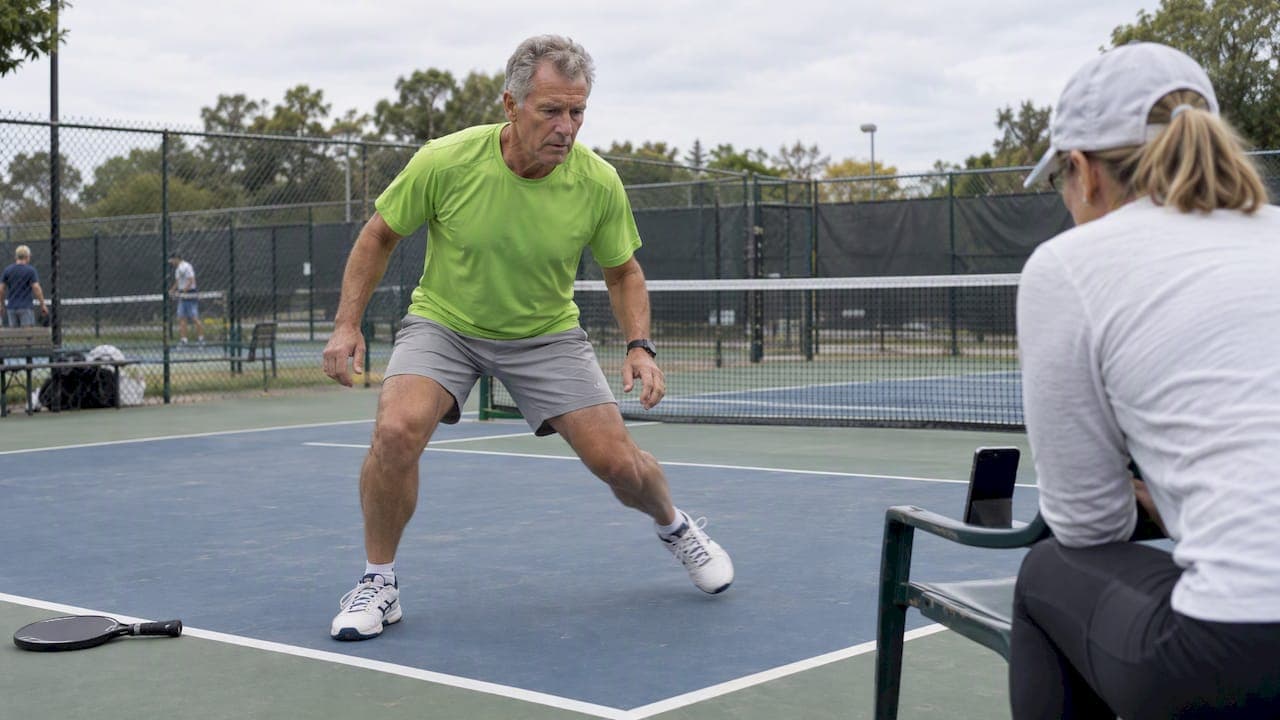
A pickleball movement assessment measures the mobility, stability, and change-of-direction skills that predict both on-court performance and injury risk. The core battery includes an ankle dorsiflexion wall test, a single-leg squat and balance check, and a pickleball T-test for lateral and backward speed. Run the quick version now, and if any test provokes pain or repeated instability, stop and see a clinician before you play again.
TL;DR:
- A baseline ankle dorsiflexion of less than four inches indicates restricted mobility that can impact low-stroke positions and increase injury risk.
- Repeated instability or pain during tests should prompt an immediate consultation with a healthcare professional before gameplay, especially for older or frequently playing players.
- A slow pickleball T-test time, combined with ankle or hip mobility deficits, signals the need for a targeted four- to twelve-week strength and change-of-direction training program.
- Conducting tests on a non-slip surface with proper rest and recording multiple trials helps track meaningful progress over time, ideally at six- and twelve-week intervals.
- Corrective exercises addressing test failures, such as ankle mobilizations or hip abductor strengthening, can prevent injuries and improve on-court movement efficiency.
Table of Contents
- Why movement assessments matter for pickleball players
- Core on-court movement tests to include in a pickleball movement assessment
- How to run a safe at-home movement assessment and record results
- How to interpret results and prioritize what to fix first
- Simple corrective exercises and drills mapped to common test failures
- How an AI-driven movement analysis augments a movement assessment
- Checking shoulder and upper-body control for pickleball strokes
- Bringing movement testing onto the actual court
- Guidance on frequency and timing of movement assessments for tracking progress
- Author perspective: practical next steps and realistic timelines
- Try a guided AI movement assessment: a practical next step
- FAQ
- Sources
Why movement assessments matter for pickleball players
Pickleball looks easy until you watch the footwork. Points are built on quick lateral shuffles, sudden stops, and backward retreats toward the baseline, often followed by an explosive push forward to the non-volley zone. That combination loads the ankles and knees in positions most recreational athletes rarely train for: low, wide stances with fast direction changes.
The injury numbers back this up. A nationwide study of 1,758 players found that 68.5% reported some injury complaint over 12 months, with non-time-loss, overuse-type injuries affecting about half the group. The same research describes pickleball's mix of lateral shuffling and rapid deceleration as a driver of higher knee and ankle loading compared to similar racquet sports.
Pickleball injuries frequently involve the knee, according to the PMC nationwide study, which signals where a movement screen should focus first.
These injuries rarely start where they show up. A stiff ankle forces the knee to absorb more rotational stress during a lateral lunge. A weak hip lets the trunk lean during single-leg loading, which shifts stress to the shoulder on an overhead reach. Movement assessments exist to catch these upstream and downstream compensations before they become sprains, strains, or fractures.
Age and play frequency change the risk calculus. Older players and those playing several times a week carry a higher fracture and fall risk, a pattern confirmed by an institutional injury review spanning 2017 to 2022, which found a sharp rise in treatment volume and a higher proportion of fractures among older patients. That is reason enough for anyone over 50, or anyone returning from a layoff, to treat a baseline screen as a priority rather than an afterthought.
Core on-court movement tests to include in a pickleball movement assessment
A useful assessment does not require a sports lab. It requires a handful of repeatable tests that mimic what actually happens on the court.
- Weightbearing ankle dorsiflexion wall test. Stand facing a wall with your toes a set distance away and try to touch your knee to the wall without lifting your heel. Less than about four inches of clearance, or a heel that pops up early, suggests restricted ankle mobility that limits low dinking positions and third-shot drops.
- Single-leg squat. Stand on one leg and lower into a quarter squat, watching for the knee drifting inward (valgus), the trunk leaning to one side, or a loss of balance. Record which side faults and how it faults, since that detail guides the corrective exercise later.
- Single-leg balance hold. Stand on one leg for 30 seconds with eyes open, then repeat with eyes closed if the first pass is clean. Hopping, arm-waving, or an early foot-down signals a stability gap that matters most for older players.
- Pickleball T-test (modified change-of-direction test). Set up a short T-shaped course scaled to pickleball court dimensions rather than a standard athletic T-test, since full-size course distances overshoot what the sport actually demands. Players sprint forward, shuffle laterally in both directions, then retreat backward to the start, with total time recorded by stopwatch or phone. A study of 92 recreational players found that 42% had fallen while playing, and those who fell were both older and notably slower on this test, making it one of the more telling checks in the whole battery.
- Lateral shuffle and backward reactive-step check. Shuffle five steps to one side, then react to a partner's verbal or visual cue to reverse direction backward. This captures the exact pattern involved in most pickleball falls: a backward scramble to cover a lob.
- Optional shoulder and upper-body screen. A simple overhead reach and a prone scapular squeeze test flag restrictions that affect serve and overhead smash mechanics, though they matter less for fall risk than the lower-body tests above.
The same hip strength and falls study found that hip abduction strength correlated with faster T-test times, while single-leg squat form and ankle dorsiflexion alone were not consistently tied to fall history in that sample. The lesson is not to discard any single test, but to read them together rather than treating one score as a verdict.
Pro Tip: Film every test from the front and the side with a phone propped on a chair. A slow-motion replay catches knee valgus and trunk lean that are nearly invisible at full speed.
How to run a safe at-home movement assessment and record results
Set aside twenty minutes, wear the shoes you actually play in, and test on a flat, non-slip surface, ideally the same court or a similarly firm floor. Skip the session entirely if you are currently nursing a sharp or swollen joint, since testing through acute pain only muddies the results.
Run through a short warm-up first: two minutes of easy shuffling, a few bodyweight squats, and ankle circles. Then move through the battery in order, from least to most demanding: dorsiflexion test, single-leg squat, single-leg balance, lateral shuffle, and finally the pickleball T-test last, since it is the most fatiguing.
- Perform each test twice per side and record both trials, not just the better one.
- Rest 60 to 90 seconds between trials so fatigue does not distort the later attempts.
- Use a partner or a phone timer for the T-test, and log the exact time to the nearest tenth of a second.
- Write down observable faults in plain language, such as "left knee caved on squat, right side clean."
- Keep a simple log, one row per test date, so you can compare numbers six weeks later instead of guessing whether you improved.
Stop a test immediately if it reproduces sharp pain, if you feel dizzy, or if you lose balance badly enough that you need to catch yourself on furniture or a wall more than once. Any of those signals is a reason to see a physical therapist or sports medicine clinician before continuing, not a reason to push through for a cleaner number.
How to interpret results and prioritize what to fix first
Test results only matter if they change what you do next. Work through priorities in this order: safety first, mobility second, strength and power third, and sport-specific integration last.
- Safety first: a positive fall history, repeated instability on single-leg balance, or pain on any test overrides everything else and should trigger a clinician visit before training changes.
- Mobility second: a restricted ankle dorsiflexion test, measured in inches of wall clearance, should be addressed before heavier strength work, since a stiff ankle changes how the knee and hip absorb load.
- Strength and power third: once mobility is reasonable, hip and leg strength work targets the change-of-direction speed that the pickleball T-test measures.
- Tactical integration last: only after the first three are underway should training shift toward applying the gains in live-ball drilling.
Rough result bands help set expectations. A dorsiflexion deficit under an inch of normal range is a low-priority fix handled with daily mobilizations. A deficit of one to two inches, paired with a slow T-test time, suggests a focused four to twelve week conditioning program is worth structuring around strength and change-of-direction work. Repeated falls, sharp pain, or a single-leg squat that collapses on every trial warrants a referral rather than a home program, particularly for older players where fracture risk is elevated.
Pro Tip: Pick one mobility fix and one strength fix at a time. Chasing five corrections at once makes it impossible to tell which one actually worked.
The payoff shows up in the parts of the game that feel the hardest to control. A player who gains two inches of ankle dorsiflexion can hold a lower, more balanced position during a dink exchange, which tends to reduce the popped-up return that gets punished at the net. Faster change-of-direction speed shows up in third-shot drops that land short instead of mid-court, since the extra half-second of court coverage buys more time to set up the shot properly. These same corrections also carry over into conditioning work covered in our injury prevention guide for recreational and older players, which structures progression around exactly these priorities.
Simple corrective exercises and drills mapped to common test failures
Each test failure has a direct, practical fix. None of these require a gym.
- Restricted ankle dorsiflexion: wall ankle mobilizations, three sets of ten per side, plus a daily 30-second calf and soleus stretch against a step.
- Knee valgus on single-leg squat: banded lateral walks and hip abductor sets, two to three sets of 12 to 15 steps, to build the hip control that keeps the knee tracking straight.
- Weak single-leg balance: single-leg Romanian deadlifts with light or no weight, focusing on a slow, controlled lowering phase rather than speed.
- Slow pickleball T-test time: short-step explosive lunges and resisted lateral bounds, followed by progressive T-test reps at increasing effort to build real change-of-direction speed rather than just raw leg strength.
- Backward instability or fall history: backward step drills and reactive catching drills, where a partner tosses a ball that forces an unplanned direction change, closely mirror the scramble that precedes most pickleball falls.
- General rotational power for overheads and serves: progressive multi-directional lunges combined with light rotational medicine-ball throws build the hip-to-shoulder power transfer used on overhead smashes.
For players focused specifically on fall prevention, our senior-focused exercise guide maps these same drills to specific court movements with more conservative progression timelines.
How an AI-driven movement analysis augments a movement assessment
Running the full test battery by hand works, but it depends on an honest eye for detail, which is where automated video analysis adds value. An AI-driven system can analyze uploaded gameplay or drill video, flagging biomechanical stress points and generating a personalized exercise plan based on what the footage shows. You can read more about the underlying computer vision and AI technology and how automated video analysis detects movement faults that are easy to miss in real time.

This kind of tool fits naturally as a baseline screen before a season starts, a progress check every few weeks, or pre-tournament preparation when you want an objective second look at your footwork. It also helps players training remotely or without regular coaching access get consistent feedback between sessions, a use case covered in our broader look at AI-driven training that catches issues early.
An app is the wrong tool, though, when pain, repeated instability, or a progressive decline in mobility shows up. Those signals call for an in-person evaluation by a physical therapist or sports medicine physician, not a video upload.
Checking shoulder and upper-body control for pickleball strokes
Lower-body testing gets most of the attention, but shoulder mobility and scapular control shape how safely and effectively you serve, drive, and smash overheads. A simple overhead reach check, standing with your back against a wall and raising both arms overhead, reveals whether your shoulders can reach full range without your lower back arching to compensate.

A prone scapular squeeze test, lying face down and lifting the arms slightly while squeezing the shoulder blades together, flags weak scapular stabilizers that often show up as a dropped elbow on serves or a flat, powerless overhead smash. Players who notice shoulder fatigue after long sessions, or a gradual loss of serve pace, often have a stability gap here rather than a strength problem.
These checks matter less for fall risk than the lower-body battery, but they directly affect stroke mechanics and the overuse elbow and shoulder injuries that show up in longer-term pickleball injury data. A few minutes of band-based external rotation work and scapular retraction exercises, done two or three times a week, usually resolves mild restrictions without any special equipment.
Bringing movement testing onto the actual court
A clean test score in a living room does not always translate to a clean movement pattern under game pressure, which is why the final step is applying the same checks during live play. Watch your own footage, or ask a partner to watch, during a dinking rally: does your knee cave the same way it did on the single-leg squat test when you reach for a low ball?
Notational analysis of competitive singles play shows that many points resolve near the non-volley zone or just behind the baseline, which means the exact low, balanced positions your mobility tests assess are the ones that decide points. If your ankle dorsiflexion score was limited, watch specifically for a popped-up return on low dinks, since that is the on-court signature of the same restriction.
Backward retreats toward the baseline to cover a lob are another direct link between test and game. If your backward reactive-step check was shaky, expect that same hesitation to show up when you have to scramble back under a lob during a real point, and treat repeated hesitation there as a sign the drill work needs more reps before the next tournament.
Guidance on frequency and timing of movement assessments for tracking progress
A single test tells you where you stand. Repeated testing tells you whether anything is actually changing, which is the real point of doing this at all.
A sensible cadence is a baseline test before starting any corrective work, a follow-up at six weeks, and another at twelve weeks. Six weeks is usually enough time to see a measurable change in a mobility score like ankle dorsiflexion, while strength and change-of-direction gains on the pickleball T-test often take closer to the full twelve weeks to show up clearly.
Retesting more often than every few weeks rarely shows meaningful change and can create frustration over noise in the numbers. Testing less often than every twelve weeks risks letting a correctable issue drift into a bigger one, particularly for players logging frequent court time. Tie retests to natural checkpoints, such as the start of a new season or a few weeks before a tournament, so the data actually informs a decision rather than becoming a box-checking exercise.
Author perspective: practical next steps and realistic timelines
Test, pick one or two priorities, retest, repeat. That is the entire system, and most players overcomplicate it by trying to fix everything at once. A baseline screen, a recheck at six weeks, and another at twelve weeks gives you enough signal to know whether your mobility work or your strength work is actually moving the needle, without drowning in data.
Pick one mobility fix and one strength or stability fix, not five. The ankle dorsiflexion test and the pickleball T-test together usually point to the highest-value starting place for most recreational players.
Older players deserve a more conservative approach. Fall-prevention drills, backward-step work, and slower progression matter more than chasing a faster T-test time, since the cost of a bad fall outweighs the benefit of a quicker scramble. Patience here is not caution for its own sake, it is the math that actually protects a season.
— Drona
Try a guided AI movement assessment: a practical next step
Running the full test battery by hand works, but tracking it consistently over months is where most players lose the thread. Play On Pickle turns the same process into something you can repeat in minutes: record a short video of your movement or gameplay, let the automated analysis flag stress points, and get a tailored set of drills built around what the footage actually shows, not a generic workout plan.
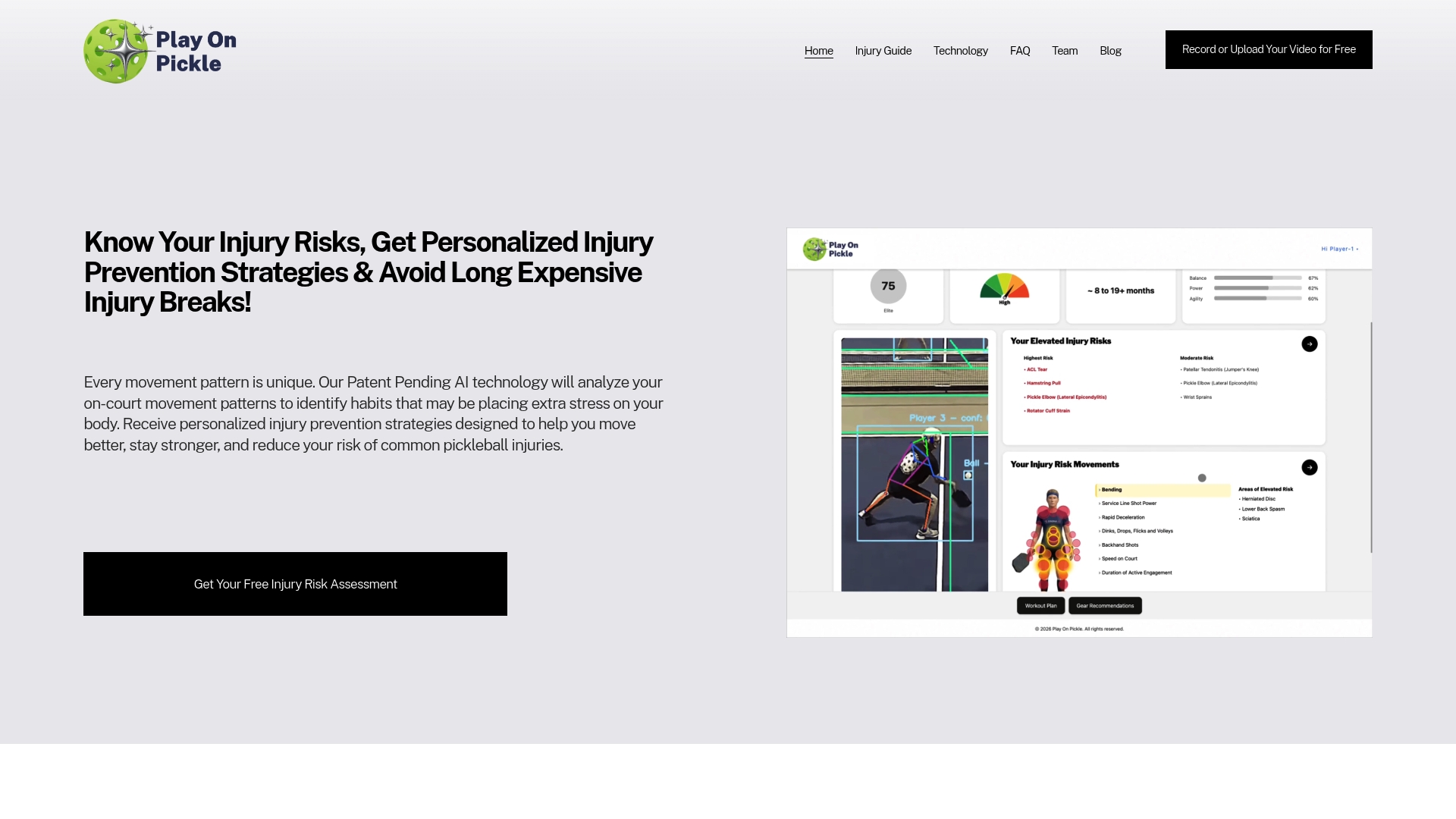
- Record a video during a drill or a match using a phone and tripod, no special equipment required.
- Get a breakdown of biomechanical stress points tied to the same movement patterns covered in this assessment.
- Receive a personalized exercise plan built around your specific results rather than a one-size list.
- Track changes over time with objective, repeatable metrics instead of guessing whether a drill is working.
New users can start with the monthly or annual subscription, and the current promotional offer includes a free tripod with the $9.99 monthly plan, useful if you do not already have a stable way to film your sessions. For players who want to understand the equipment basics first, a quick look at a paddle and shoe sizing guide helps rule out gear issues before blaming movement mechanics. Check the pricing page to start tracking your own baseline today.
This article is general information, not a substitute for advice from a qualified doctor. Consult a qualified healthcare professional about your own circumstances before acting on anything here.
FAQ
What are the five P's of pickleball?
The "five P's" is not an official USA Pickleball term, and definitions vary across coaching sources. A common version covers positioning, patience, placement, power, and preparation, used informally to teach shot selection and court sense rather than as a governing rule.
How do I know if I'm a 3.0 pickleball player?
USA Pickleball publishes official skill-level descriptions and a Player Skill Level Self Assessment that outline the consistency and shot range expected at each rating. Generally, players can sustain a rally, serve and return reliably, and have basic control of dinks and drives, though the official rulebook is the best source for the exact criteria.
What is the 10 second rule in pickleball?
Under USA Pickleball's official rulebook, Rule 6.D requires the server to serve within 10 seconds after the score is called. This keeps play moving and prevents excessive delay before each serve.
How good is a 2.5 pickleball player?
A 2.5 player is still developing consistency, typically able to keep a short rally going but with frequent unforced errors and limited shot variety. USA Pickleball's official skill descriptions place 2.5 near the lower end of its rating scale, below players who can reliably execute dinks, drives, and basic strategy.
How can a movement assessment help prevent pickleball injuries?
A movement assessment identifies mobility and stability deficits, such as restricted ankle dorsiflexion or poor single-leg control, before they cause pain or injury. Tools like Play On Pickle's video-based analysis can flag these patterns from gameplay footage and suggest targeted exercises, which complements in-person testing for players who want ongoing tracking.
Sources
- Understanding Injury Patterns and Predictors in Pickleball Players: A Nationwide Study of 1,758 Participants - PMC
- USA Pickleball official rulebook