
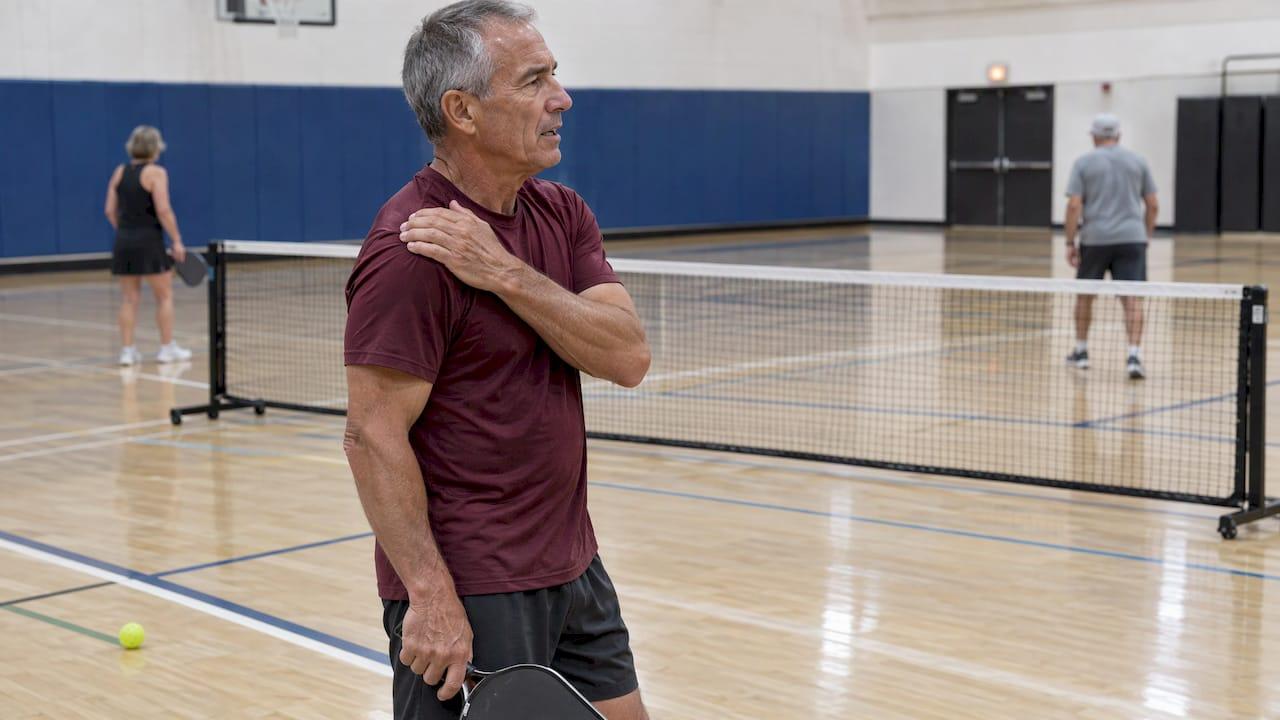
Biceps tendonitis is irritation of the tendon that anchors the top of your biceps to the shoulder, and pickleball's repeated overhead and swinging motions can bring it on. The typical sign is an ache at the front of the shoulder that gets worse when you reach, lift or serve. Most mild cases settle with load management and a gradual rebuild. Sudden, sharp pain or a pop needs a medical exam. Below you will find the symptoms, what a clinician checks, how rehab is staged, and how to lower your odds of a repeat.
TL;DR
- Biceps tendonitis shows up as pain at the front of the shoulder, often running down the upper arm, and it flares with overhead shots, reaching and lifting.
- Intense or sudden pain, or a snap or pop, means see a medical professional right away. Gradual, mild pain may calm down within about six weeks.
- Treatment usually starts with rest from aggravating activity, ice, anti-inflammatory medicine as your clinician advises, and physical therapy.
- Prevention comes down to gradual increases in playing time, shoulder and shoulder-blade strength, a compact swing and enough recovery between sessions.
- Video-based movement analysis can help you spot the habits that load the front of your shoulder.
Table of Contents
- What biceps tendonitis feels like
- Why pickleball can irritate the biceps tendon
- Is it biceps tendonitis or something else?
- How it is diagnosed and treated
- Rehab and returning to pickleball
- How to prevent biceps tendonitis
- See your own movement patterns
- FAQ
- Sources
What biceps tendonitis feels like
The American Academy of Orthopaedic Surgeons describes biceps tendinitis as inflammation of the long head of the biceps tendon. It lists pain or tenderness at the front of the shoulder that worsens with overhead lifting or activity, pain when reaching backward, an ache down the upper arm bone, and occasional snapping.
A sports medicine group in Florida adds a few more signs seen in pickleball players: deep, throbbing front-shoulder pain, tenderness, swelling, loss of strength and reduced range of motion. Another health system notes the pain tends to appear especially on overhead shots.
In practice, players often describe it this way:
- A dull ache in the front of the shoulder after a long session that lingers into the evening.
- A sharper twinge when you reach for a high ball, smash or serve.
- Discomfort when you reach behind you, such as grabbing a seat belt or putting on a jacket.
- Pain when lifting a gym bag or carrying groceries with the arm out in front.
The pattern matters more than any single symptom. Pain that is predictable, that builds with volume and that eases with a few days off is typical of an overloaded tendon. If you also have pain with pressing movements, the same loading logic applies, and a guide to shoulder-friendly pressing options can help you keep training the rest of your body without aggravating the front of the shoulder.
Why pickleball can irritate the biceps tendon
Tendons do not like sudden jumps in workload. Cleveland Clinic explains that biceps tendonitis can come from overuse or general wear and tear, and that tendons wear down with age and can get worse when overused. The AAOS specifically names pickleball among the sports with repetitive overhead motion that can put people at risk.
Three factors show up again and again.
Swing size and contact point
Because the ball is light, many players take a big swing to get it over the net. The Florida Orthopaedic Institute says that forceful paddle swings and repetitive ground strokes can strain the biceps tendon. A sports chiropractor in the same vein points to players from a tennis background who use a large backswing and hit late, behind the body's center of gravity, which puts heavy stress on the front of the shoulder. His fix is short, compact strokes.
How much and how often you play
In a 2025 study of 253 recreational players, 41% reported at least one upper extremity injury. The risk was roughly 1.5 times higher among people who played longer or more frequent sessions or on consecutive days. Acute injuries were more likely with sessions over two hours, back-to-back days or a tight baseline grip.
A separate study of 232 players at a South Korean championship found that 78% of reported injuries were overuse injuries, and shoulder or upper arm injuries made up 17.2%. The takeaway is not to play less forever. It is that volume spikes are the thing to manage.

Shoulder mechanics
If the shoulder blade does not move well or the rotator cuff is underpowered, the biceps tendon picks up the slack. That is why rehab for this problem looks a lot like shoulder rehab in general. Our guide to pickleball shoulder pain in older players covers the clues that a shoulder problem deserves attention.
Is it biceps tendonitis or something else?
Front-shoulder pain has several possible sources, including the rotator cuff, the joint itself and the neck. You cannot sort that out reliably on your own, and even clinicians rely on a combination of history and hands-on testing.
A 2024 review of the biceps exam reports that two classic bedside tests have only modest accuracy: in one study of 152 patients with shoulder pain, Speed's test had 32% sensitivity and 75% specificity, and Yergason's test 43% and 79%. The same review notes that MRI and arthroscopy each evaluate the biceps and labrum incompletely, so a careful physical exam remains central. In plain terms: a single sore spot or one test does not settle the diagnosis. A clinician should put the pieces together.
When to see a professional
UT Southwestern's guidance is practical. See a medical professional right away for intense or acute pain, or a snap or popping sound, because sudden pain can signal something more serious, such as a rotator cuff tear. If pain came on gradually, mild cases often take about six weeks to heal on their own, and it is worth seeing a provider if it has not improved by then.
See a doctor or physical therapist sooner if:
- You felt a pop and now have weakness or a visible bulge in the upper arm.
- Pain wakes you at night or does not ease with rest.
- You cannot lift your arm to shoulder height.
- Numbness, tingling or neck pain accompanies the shoulder pain.
How it is diagnosed and treated
According to the AAOS, a clinician typically examines range of motion, strength and stability, presses over the biceps tendon and performs specific tests. X-rays, MRI or ultrasound may help confirm the diagnosis or rule out other problems.
First-line treatment is usually nonsurgical and can include:
- Rest from the activities that provoke pain.
- Ice, in 20-minute sessions several times a day.
- Anti-inflammatory medicine such as ibuprofen, aspirin or naproxen, if your doctor says it is right for you.
- Steroid injections, often guided by ultrasound, in some cases.
- Physical therapy with specific stretching and strengthening.
Cleveland Clinic says that with noninvasive treatment, improvement should come within a few weeks. Surgery is the exception. If it is needed, recovery can take three to four months, and a sling is worn for one to four weeks depending on the procedure.
Rehab and returning to pickleball
Rest does not mean shutting everything down. A sports medicine practice in New Jersey frames the goal as calming the tendon while maintaining safe movement and rebuilding shoulder capacity, with progressive loading: too much too soon can flare symptoms, while too little can leave the tendon underprepared.
That same source describes three phases, and your own clinician will tailor the details.
| Phase | Goal | What it usually involves |
|---|---|---|
| Early | Calm symptoms | Relative rest from painful motions, gentle pain-free movement |
| Middle | Rebuild shoulder mechanics | Rotator cuff and shoulder-blade strength, gradual biceps loading |
| Late | Prepare for the sport | Sport-specific drills and demands |
A 2025 review of pickleball injuries agrees on the order: once pain is controlled, start with pain-free range of motion, then gentle mobilization, stability and gradual strength building, including core work such as planks and bridges and shoulder-specific exercises. A step-by-step rotator cuff rehab guide can give you more ideas on rebuilding capacity, and our own 20 to 30 minute rotator cuff routine is written for players who want to keep playing.
Signs you are ready to return
Return is based on symptoms, strength, motion and what the sport demands, not on the calendar alone. A sensible checklist before a full match:
- Everyday reaching and lifting no longer hurt.
- Your sore shoulder moves as freely as the other one.
- Strength feels equal side to side in your clinician's tests.
- You can hit overhead and serve at partial effort with no pain, during or the next morning.
Then come back in stages: shorter sessions, a day off between, and no tournament-length days until the shoulder has handled several normal weeks. Our piece on pickleball recovery days explains how to schedule rest so you keep progressing.
How to prevent biceps tendonitis
The research above points to a short list of habits.
Build up gradually. Cleveland Clinic advises that since overuse causes most tendonitis, you should start slowly, build activity gradually, limit repetitions and force, and stop if you feel unusual pain. Avoid sudden spikes in overhead work, especially after a layoff.
Strengthen the support system. The New Jersey practice recommends building rotator cuff and scapular strength, maintaining shoulder and thoracic mobility, balancing pushing and pulling volume and avoiding heavy pressing when fatigued. A pickleball-focused physician suggests resistance-band shoulder-blade and rotator cuff work, a paddle with the right grip size and weight, and cross-training.

Warm up and cool down. The Florida group lists warm-up and cool-down exercises, stretching, rest and recovery among its core advice.
Shorten the swing. Compact strokes and meeting the ball in front of your body reduce the leverage on the front of the shoulder.
Cap your sessions. Given the link between long sessions, consecutive days and injury, plan rest days and consider breaking a three-hour session into two shorter ones with a break between.
Check related joints. Shoulder trouble often travels with the elbow and wrist. If you notice those, see our guides to pickleball elbow prevention and pickleball wrist pain.
Our perspective
Most players only learn how their body moves when it hurts. We think that is backwards. A tendon rarely fails because of one bad shot. It gets overloaded by a pattern: a big backswing, a late contact point, a stiff upper back, too many consecutive days.
That is why we built Play On Pickle around your own video. Our patent-pending computer vision is designed to identify stress points in your movement and turn them into simple, personalized exercises that fit into your routine, so you can work on the cause and not just the sore spot.
We believe prevention should be easy enough for a recreational player to actually do. A few targeted minutes of shoulder work, a swing adjusted to your biomechanics, and equipment suggestions matched to you add up to more good days on the court.
Drona
See your own movement patterns
If you want to know which parts of your swing load your shoulder, Play On Pickle analyzes video you upload and generates a personalized injury risk assessment with tailored exercise and equipment recommendations. It starts with a free trial. After that, the plan is $9.99 per month or $99 per year.

You can learn more on the Play On Pickle homepage. Pair it with guidance from your doctor or physical therapist if you are already in pain.
FAQ
How long does biceps tendonitis take to heal?
Mild, gradual cases often improve within about six weeks, according to UT Southwestern. Cleveland Clinic says that with noninvasive treatment you should see improvement within a few weeks. If surgery is needed, recovery is measured in months, so ask your surgeon for a timeline.
Can I keep playing pickleball with biceps tendonitis?
Often you can stay active in a modified way, but pain is your signal to back off. Early care aims to calm the tendon while keeping safe movement, so a physical therapist can tell you which shots and how much volume are fine. Skip overhead smashes and long sessions until pain-free.
Is it biceps tendonitis or a rotator cuff tear?
They can feel similar, and only an exam can separate them. Sudden, intense pain or a pop can point to a more serious injury such as a rotator cuff tear, so get seen right away. A clinician may add imaging such as ultrasound or MRI.
What exercises help biceps tendonitis?
Rehab usually progresses from pain-free range of motion to rotator cuff and shoulder-blade strengthening and then gradual biceps loading. Your physical therapist should set the exact exercises, sets and timing for your shoulder. Doing too much too soon can bring symptoms back.
Sources
- Biceps Tendinitis, AAOS OrthoInfo
- Bicep Tendonitis, Cleveland Clinic
- Pickleball Shoulder Pain, Florida Orthopaedic Institute
- Pickleball-Related Shoulder Injuries, Baptist Health
- 7 Mistakes You're Making with Pickleball, Dynamic Spine and Performance Center
- Risk of Upper Extremity Injury in Recreational Pickleball, MDPI
- Injury risk and epidemiology of pickleball, Frontiers in Public Health
- A Comprehensive Review of the Physical Examination for the Biceps-Labrum Complex, PMC
- Tips to heal biceps tendonitis without surgery, UT Southwestern
- Biceps Tendonitis of the Shoulder, Princeton Sports and Family Medicine
- Diagnosis and Management of Common Musculoskeletal Injuries in Pickleball Athletes, Springer
- Pickleball: Preventing Shoulder and Elbow Injuries, Jason Klein, MD
- Shoulder Friendly Pressing: 7 Ways to Press Pain-Free
- Rotatormanchet blessure aanpak fysiotherapie: herstelgids