
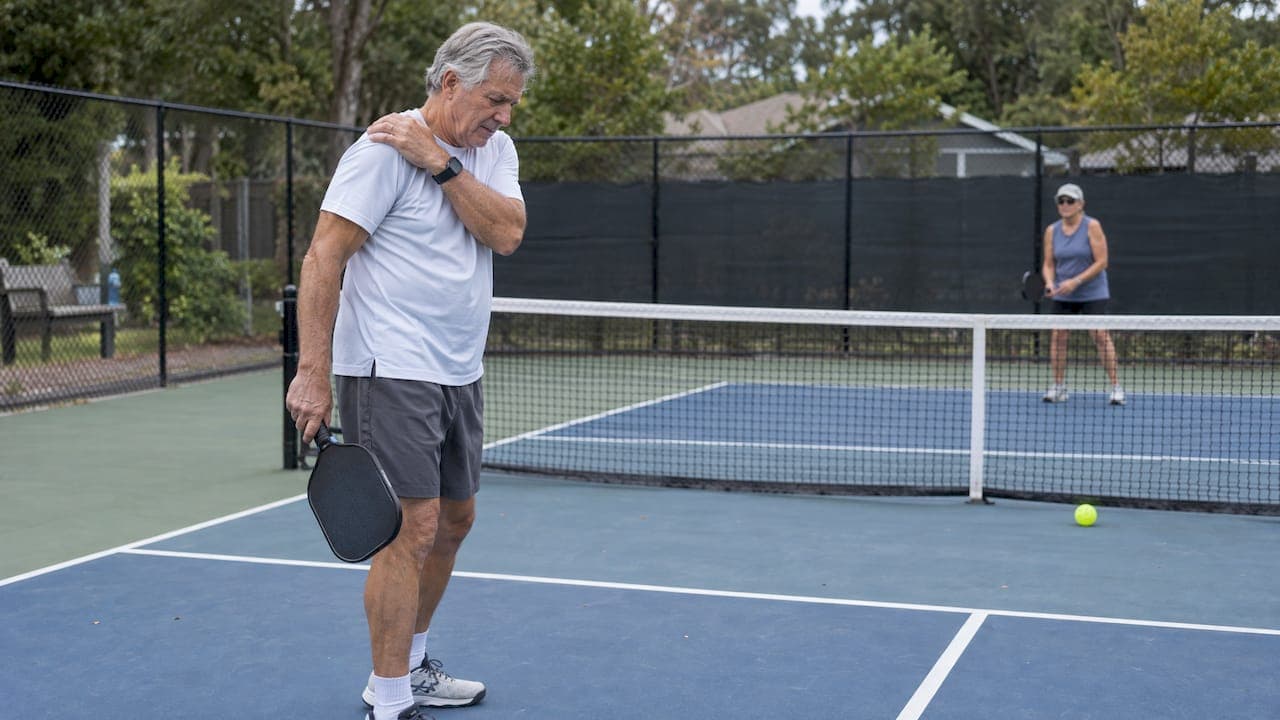
Most pickleball shoulder pain comes from overuse of the rotator cuff, either tendinopathy or impingement, often exposing age-related wear that was already there. Your first move is to cut back on overhead shots for a short stretch, ice the shoulder if it flares after play, and start a targeted rehab routine. See a clinician quickly if you have severe weakness, visible deformity, or night pain that will not settle.
TL;DR:
- A study of 1,758 players found shoulder injuries made up 22.2% of reports; frequent play and fewer than five years’ experience were linked to greater risk.
- Gradual pain with overhead reaching, night aching, or creeping weakness suggests rotator cuff trouble; sudden pain, deformity, or inability to lift needs urgent care.
- AAOS reports that 80 to 85% of rotator cuff tear patients improve with nonsurgical care, usually activity changes and structured physical therapy.
- Warm up before play, build weekly activity gradually, and strengthen the rotator cuff and shoulder blade muscles; avoid overhead power shots until your shoulder is pain free.
Table of Contents
- What causes shoulder pain in pickleball?
- How can you tell which shoulder injury you have?
- When should you see a clinician?
- What are the treatment options?
- Which exercises help your shoulder recover?
- How can you prevent shoulder pain from coming back?
- How common are pickleball shoulder injuries, and who is most at risk?
- How can AI movement analysis help protect your shoulder?
- What I would tell a friend with a sore shoulder
- FAQ
- Sources
What causes shoulder pain in pickleball?
Pickleball looks gentle, but your shoulder works hard in every rally. The paddle arm takes the load, and several movements can contribute to shoulder strain over time:
- Repeated overhead strokes. Serves, lobs, smashes, and high volleys all lift the arm into positions where the rotator cuff tendons squeeze against the bone above them.
- Fast rotational force. Swinging hard from the shoulder instead of the torso can place extra demands on stabilizing muscles.
- High volume with little recovery. Frequent or extended play may leave tendons less time to adapt.
- Falls and lunges. Reaching for a wide ball or catching yourself on an outstretched arm can strain or tear tissue in one moment.
These mechanisms produce a fairly predictable set of diagnoses. The most common are rotator cuff tendinopathy or tear, subacromial bursitis and impingement, and biceps tendonitis. Labral problems, including SLAP tears, show up less often, and instability or fracture is rarer still. A clinical series from a tertiary academic center found rotator cuff tears to be the most common shoulder diagnosis in its pickleball patients, followed by rotator cuff strain and impingement.
The split between wear and trauma matters. Rotator cuff problems are often degenerative, meaning they build slowly and flare when repetitive play overloads them. Fractures and dislocations can result from a fall or collision. Knowing which story fits you helps decide whether to self-manage or get checked.
How can you tell which shoulder injury you have?
Symptoms overlap, but patterns help. Use these as a rough guide, not a diagnosis:
- Rotator cuff tendinopathy or tear. Pain builds gradually, hurts when you reach overhead, and may wake you at night. Weakness tends to creep in over weeks. Many tears are degenerative and can stay quiet until a busy stretch of play overloads them.
- Impingement or bursitis. You may feel a painful arc as you lift your arm. The ache sits on the top or side of the shoulder and lingers after play.
- Biceps tendon irritation. Pain sits at the front of the shoulder and sharpens with rotation or when you lift or carry things.
- Labral problems. Clicking, catching, or a sense that the joint slips are the clues, often with pain during rotational movements.
- Urgent injury. Sudden severe pain after a fall, a visible deformity, or an inability to lift the arm needs urgent medical attention.
The numbers explain why this is worth sorting out early. A 2025 nationwide study of 1,758 players found that shoulder injuries made up 22.2% of reported injuries over a 12-month period.
Shoulder injuries accounted for 22.2% of pickleball injuries reported in a nationwide study of 1,758 players, with the average injured player between 63 and 68 years old. In plain terms, if your shoulder hurts, you are far from alone, and age plays a real part.
When should you see a clinician?
Some signs should not wait. Seek prompt care if you notice any of these:
- Severe pain right after a fall or collision
- Loss of the ability to lift your arm on your own
- A visible change in the shape of the shoulder
- Numbness or tingling down the arm
- Fever or feeling unwell along with a hot, swollen joint
For milder pain, start conservative measures and see a clinician if symptoms persist or worsen. Do not push through steady worsening, and do not assume rest alone will fix it. USA Pickleball has published guidance noting that shoulder pain may not resolve by itself, and early attention to persistent symptoms is the safer move.
A typical evaluation starts with a focused shoulder exam: range of motion, strength testing, and specific maneuvers that reproduce your pain. Many clinicians then try a period of conservative care before ordering anything. If a full-thickness tear or labral injury is suspected, they may use diagnostic ultrasound or MRI to confirm.
Pro Tip: Before your appointment, write down which shots hurt, when the pain started, and whether it wakes you at night. That short list often speeds up the diagnosis more than any single test.
What are the treatment options?
Care usually moves in steps, starting with the least invasive.
Conservative care comes first. The American Academy of Orthopaedic Surgeons notes that 80 to 85% of patients improve with nonsurgical treatment for rotator cuff tears. The usual toolkit is simple:
- Activity modification, meaning you avoid the shots that provoke pain rather than stopping all movement
- A short course of anti-inflammatory medication, if it is appropriate for you and your doctor agrees
- A structured physical therapy program built around rotator cuff and scapular strength
- Ice after play during flare-ups
Ohio State clinicians point out that many rotator cuff tears are degenerative rather than sudden, and that non-traumatic tears are often managed by improving the strength of the surrounding scapular and rotator cuff muscles.
Injections of corticosteroid can calm pain for a while, which makes it easier to rehab. They are not a long-term fix, and they are best used sparingly and with a clinician's guidance.
Surgery is generally held back for traumatic full-thickness tears, persistent loss of function after a fair trial of conservative care, or specific labral and instability problems. The broader AAOS overview of shoulder problems describes the same ladder: rest and activity changes, therapy, medication, injections when appropriate, and surgery when the earlier steps fail.
Which exercises help your shoulder recover?
This routine follows the structure of the AAOS rotator cuff conditioning program, which stresses warming up and strengthening both the rotator cuff and the muscles around the shoulder blade. Start with a brief warm-up of light cardio, such as walking or an easy stationary bike, plus gentle arm circles and shoulder rolls. Then work through these:
- Band external rotation. Elbow at your side, rotate your forearm outward against a light band. Do 2 to 3 sets of 10 to 15 slow repetitions.
- Band internal rotation. Same position, rotate inward. Keep the elbow tucked and the movement controlled.
- Scapular retraction rows. Pull a band toward your ribs while squeezing your shoulder blades together, as if holding a pencil between them.
- Prone T and Y raises. Lie face down and lift your arms into a T, then a Y, with thumbs up. Use no weight at first, since the muscles involved are small.
- Wall slides. Forearms on a wall, slide upward while keeping your shoulder blades gliding smoothly rather than shrugging.
- Resisted shoulder elevation. Raise your arm forward against light resistance, only as far as it stays comfortable.
Follow a consistent exercise schedule, adjusting it to your comfort and progress, as described in the AAOS rehab program. Stop any exercise that causes sharp pain, and add resistance slowly. Skip overhead power shots until the shoulder is pain-free, and talk to a clinician if weakness hangs on.
Pro Tip: Choose a band light enough that the last two repetitions feel hard but your shoulder blade never hikes up toward your ear. Quality beats resistance every time.

If you want a longer follow-up session, our 20 to 30 minute rotator cuff routine builds on these same movements.
How can you prevent shoulder pain from coming back?
Prevention is mostly about habits you can repeat, not gear you can buy.
- Warm up before you play and cool down after. Spend a few minutes on arm circles, band pull-aparts, and thoracic rotations before your first rally. Our pickleball prehab routine shows three moves built for recreational and senior players.
- Let your torso do the work. Rotate through your trunk to generate power, and favor form over force. Where you can, choose a controlled shot over a repeated overhead smash.
- Manage your weekly load. Frequent play and fewer than five years of experience were both linked to higher injury risk in the nationwide study mentioned earlier. Build rest days into your week and increase play gradually.
- Train between matches. Regular rotator cuff and core exercises may help. A weak core forces the shoulder to compensate on rotational shots, a point Franciscan Health highlights for overuse injury prevention.
- Recover on purpose. Easy movement on off days can ease stiffness, and this practical guide to active recovery techniques offers ideas worth trying.
- Protect against falls. Good footwear and sensible warm-ups reduce slips and lunges that end in shoulder trauma, as this guide to preventing sports injuries explains.
For a wider plan, see our overview of pickleball injury prevention for recreational and older players.
How common are pickleball shoulder injuries, and who is most at risk?
The research paints a consistent picture of who gets hurt and why.
In a nationwide study of 1,758 players, 68.5% reported at least one injury complaint over 12 months, and shoulder injuries made up 22.2% of reports.
- The same study linked higher weekly play frequency, fewer than five years of experience, and a lower sense that injury prevention matters to a greater chance of injury.
- Among shoulder diagnoses in the tertiary center series, rotator cuff problems led the list, and most injuries occurred on the paddle side. Older patients were overrepresented.
- Ohio State specialists note that many pickleball shoulder issues stem from degenerative changes that may be aggravated by repetitive overhead motion.
- A narrative review of geriatric sports injuries discusses strength, flexibility, and pacing for older recreational players.
- An institutional series of pickleball-related injuries from 2017 to 2022 reported a large rise in cases, with soft tissue and rotator cuff diagnoses among the most frequent.
For more on the numbers, our summary of pickleball injury risk and emergency department cases pulls together the evidence in one place.
How can AI movement analysis help protect your shoulder?
A rehab routine fixes what already hurts. Movement analysis looks for the mechanics that made it hurt in the first place. That is where we come in.
You upload a short video of your play, and our computer vision technology maps how your body moves through serves, volleys, and overhead shots. We look for stress points, such as an arm doing too much of the swing while the trunk stays quiet, or a shoulder blade that never settles into a stable position. From there, we build an injury risk assessment based on your own biomechanics, along with exercise and equipment recommendations that fit into a normal week.
This matters because the research above shows risk clusters around specific habits: heavy weekly play, limited experience, and little attention to prevention. Seeing your own movement on screen turns those general warnings into something you can act on. Our technology is designed to work with a phone and a tripod, and our overhead mechanics guide shows what a biomechanics-first plan looks like in practice.
If you want to try it, you can see how our AI movement analysis technology works, then pick a plan on our pricing page: $9.99 per month or $99 per year. Start with a free trial and send us your first video today.
What I would tell a friend with a sore shoulder
If I could give one piece of advice, it is to start rehab early and not wait for the pain to leave on its own. Resting alone rarely fixes a chronic shoulder, because the weak links, usually scapular control and rotator cuff strength, are still weak when you return. Keep a simple log of which shots hurt and how the shoulder feels the next morning, then adjust how much you play. Take that log, and your exercise plan, to a clinician or coach. Many shoulder problems can be managed with conservative care, so be patient and consistent while following guidance suited to your situation.
— Drona
This article is general information, not a substitute for advice from a qualified doctor. Consult a qualified healthcare professional about your own circumstances before acting on anything here.
FAQ
How do you fix shoulder pain from pickleball?
Start by cutting back on overhead shots, icing flare-ups, and beginning a rotator cuff and scapular strengthening routine. Most patients with rotator cuff problems improve with nonsurgical treatment. See a clinician if pain persists or worsens.
What is the best exercise for shoulder pain relief?
No single move works for everyone, but band external rotation can be one exercise for strengthening the rotator cuff. Pair it with scapular rows and wall slides. Keep the effort light and stop if you feel sharp pain.
How can you tell if shoulder pain is muscle or rotator cuff?
Rotator cuff trouble usually hurts when you reach overhead, aches at night, and brings gradual weakness. A muscle strain may follow a clear event, but symptoms can overlap with rotator cuff problems. If weakness or night pain lingers, have it examined.
What is the most common pickleball injury?
Across the studies we reviewed, strains, sprains, and rotator cuff problems rank among the most frequent, particularly in older players. In one clinical series, rotator cuff tears were the most common shoulder diagnosis.
Sources
- Pickleball-related injuries treated at a tertiary academic center over five years: a cross-sectional study - PMC
- Avoid common pickleball injuries | Ohio State Health & Discovery
- Rotator Cuff Tears - OrthoInfo - AAOS