
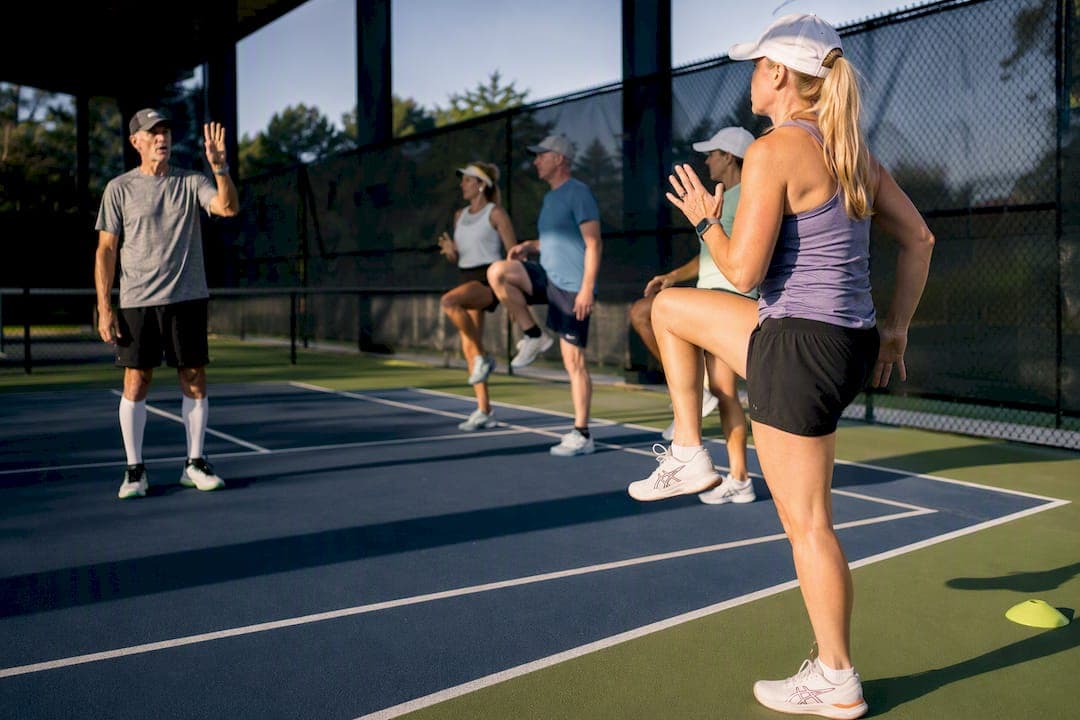
The coaching approach that prevents the most pickleball injuries combines four things done consistently: a real dynamic warm-up, targeted prehab for the shoulders and hips, deliberate footwork coaching, and conservative load management as players ramp up play. Lead a 5 to 10 minute dynamic routine before every session and hand out two prehab exercises to do between sessions. Tools like Play On Pickle can help by screening a player's movement on video and flagging exactly where their mechanics are loading joints unevenly, so the prehab you assign actually targets the right tissue.
TL;DR:
- Consistent dynamic warm-ups, targeting the shoulders and hips, are essential to prepare muscles and joints for quick movements in pickleball.
- Engaging in targeted prehab exercises two to three times weekly, especially for the rotator cuff, hips, and calves, can reduce injury risk by up to 39%.
- Coaches should emphasize proper deceleration techniques that involve bending the hips and knees rather than jamming the ankle to prevent common injuries.
- Wearing court shoes with lateral support and matching paddle weight and grip size help mitigate the risk of ankle rolls and overuse injuries.
- Using movement analysis tools like Play On Pickle can personalize injury prevention exercises by identifying biomechanical stress points in a player's mechanics.
Table of Contents
- Coaching Injury Prevention in Pickleball Starts With the Warm-Up
- Building Strength and Prehab That Actually Holds Up
- How Can Coaches Teach Safer Footwork and Movement?
- Do Shoes and Paddles Really Affect Injury Risk?
- Managing Load and Knowing When to Pull a Player Back
- Two Session Templates You Can Run This Week
- How Movement Analysis Tools Fit Into Coaching Injury Prevention Strategies for Pickleball
- Hydration and Nutrition Strategies That Reduce Injury Risk
- Mental Coaching Techniques That Help Prevent Injuries
- Court Surface and Environmental Factors That Raise Injury Risk
- Author Perspective: Making Prevention Stick in Real Coaching Sessions
- Try Play On Pickle for Personalized Injury Prevention
- Sources
- FAQ
Coaching Injury Prevention in Pickleball Starts With the Warm-Up
Static stretching before play does little to protect joints. A 5 to 10 minute dynamic warm-up built around light aerobic movement and mobility drills primes the shoulders, hips, and ankles for the sudden direction changes pickleball demands, and it beats holding a stretch for 30 seconds on a cold muscle.
Here's a sequence you can run court side in under 10 minutes:
- Two to three minutes of light jogging, skipping, or jumping jacks to raise heart rate and core temperature.
- Arm circles and shoulder rolls, 10 reps each direction, to loosen the rotator cuff before overhead swings.
- Walking lunges with a torso twist, 30 to 45 seconds, to open the hips.
- Leg swings (front to back, then side to side), 10 reps per leg, for hamstring and adductor readiness.
- Wrist circles and finger extensions, 15 to 20 seconds, since wrist strain shows up often in dink-heavy rallies.
- Three to five split-step rehearsals at the baseline, timing the hop to an imagined opponent's swing.
For players over 60 or anyone deconditioned, stretch the aerobic phase to four minutes and cut lunge depth until hips warm up. This mirrors the pre-activity structure clinical guidance recommends. A 5-minute compressed version works when court time is tight, as long as you don't skip the split-step rehearsal.
Pro Tip: Run the warm-up as a call-and-response. Say the movement, count the reps out loud, and players stay synced instead of drifting off to hit practice serves early.
Building Strength and Prehab That Actually Holds Up
Sport-specific prevention programs modeled on protocols like FIFA 11+ have cut injury rates by up to 39% in aggregated studies. Pickleball doesn't have its own equivalent yet, but the same principle applies: a short, targeted strength circuit two to three times a week does more for injury prevention than any amount of extra court time.
Prioritize these regions, since they match where pickleball injuries actually cluster:
- Rotator cuff endurance: band external rotations, 2 to 3 sets of 15 to 20 reps, light resistance.
- Scapular stabilizers: prone Y raises or wall slides, 2 sets of 12.
- Glutes and hip abductors: clamshells and lateral band walks, 2 to 3 sets of 15 per side.
- Calves (eccentric loading): slow heel drops off a step, 3 sets of 10, since Achilles and calf strains are common in players over 50.
- Core endurance: dead bugs and bird dogs, 2 sets of 8 to 10 per side, held with control rather than speed.
Older or deconditioned players should start with isometric holds (say, a 20 second wall sit instead of a lunge) before progressing to dynamic reps. Add load or speed only when a player can complete the full set with clean form.
Pro Tip: Pair each exercise with a "why" in one sentence. Players who understand that clamshells protect the hip they twist on every dink stick with the routine far longer than players just handed a sheet.
How Can Coaches Teach Safer Footwork and Movement?
Most acute pickleball injuries trace back to bad deceleration, not bad luck. A player who stops a lateral run by jamming a foot sideways loads the ankle and knee far more than one who absorbs the stop through bent hips and knees. Teaching players to decelerate through the hip and knee rather than the ankle is one of the highest-leverage things a coach can correct.
Build these drills into every practice:
- Reactive lateral shuffle: coach points left or right, player shuffles and holds a low, bent-knee stance on the stop.
- Controlled single-leg landings: step off a low box and land on one leg, absorbing through the knee instead of stiffening it.
- Deceleration ladder work: short sprints into a hard stop, checking that the front knee tracks over the toes, not caving inward.
- Progressive overhead practice: start with slow, controlled overhead volleys before adding pace, since shoulder strain often comes from rushing this progression.
Add reactive uncertainty gradually. Start with a called direction, then move to a visual cue (a tossed ball) once form holds under the easier version. On court, watch for knees caving inward on stops and shoulders shrugging on overheads. Both are corrective cues worth stopping the drill for on the spot.
Do Shoes and Paddles Really Affect Injury Risk?
Yes, and it's an easy fix most recreational players skip. Running shoes are built for forward motion; they lack the lateral support pickleball's side-to-side movement demands, which raises ankle-roll risk on quick direction changes. Court shoes with a wider base and better lateral traction address this directly.
- Check that shoes have a stable heel counter and haven't worn smooth on the outsole. Replace at the first sign of tread loss.
- Match paddle weight and grip size to the player. A grip too small or a paddle too heavy overloads the elbow and shoulder on repeated dinks, a common path to tennis-elbow-style pain.
- Inspect paddles for edge guard wear and grip tape fraying every few weeks, especially for players who play multiple times a week.
- Use tape or a brace short-term for a known, monitored issue, never as a way to keep playing through unexplained pain. A brace that masks a symptom instead of managing a diagnosed one is a warning sign, not a solution.
Managing Load and Knowing When to Pull a Player Back
Overuse injuries build slowly, which is exactly why they catch coaches off guard. A safe ramp for a new or returning player looks like one to two sessions in week one, adding a single session every one to two weeks as the player tolerates it, rather than jumping straight to daily play.
- Normal soreness fades within 24 to 48 hours and doesn't affect movement quality; pain that lingers past two days or changes how someone moves is the signal to cut volume.
- Sharp, localized pain during play (not general fatigue) means stop the session, not push through it.
- Return-to-play readiness includes pain-free sport-specific tasks, solid single-leg balance and control, and the ability to simulate real match demands like lateral cuts and overhead swings, criteria drawn from physical-therapy return-to-play guidance.
- A simple session log with a 0 to 10 pain scale, filled out after each practice, catches creeping overuse before it becomes a diagnosed injury.
Pickleball injury rates have climbed sharply alongside the sport's growth, and older adults account for a disproportionate share of them, which is exactly why load tracking matters more here than in most recreational sports.
Two Session Templates You Can Run This Week
A template beats a mental checklist. Here are two you can copy directly into your next practice plan.
Template A: 45-minute beginner session
- Warm-up (8 minutes): the full dynamic sequence above, including split-step rehearsal.
- Footwork and split-step skills (12 minutes): shuffle drills, deceleration ladder.
- Dinking and controlled volley practice (12 minutes): slow-to-fast overhead progression.
- Strength circuit (8 minutes): clamshells, band walks, dead bugs.
- Cooldown (5 minutes): easy walk, static stretching for hips and calves now that muscles are warm.
Template B: 60-minute maintenance clinic
- Warm-up (10 minutes), scaled up with two rounds of split-step rehearsal.
- Reactive movement drills (15 minutes): called-direction shuffles, then visual-cue shuffles.
- Targeted prehab circuit (10 minutes): rotator cuff bands, eccentric calf raises, core work.
- Simulated match play (20 minutes): games to 7, coach watching for form breakdown under fatigue.
- Cooldown (5 minutes).
Over four to eight weeks, add one drill intensity level every two weeks rather than every session, and check home-exercise adherence by asking players to log sets on their phone or report back verbally at the next session's warm-up.
How Movement Analysis Tools Fit Into Coaching Injury Prevention Strategies for Pickleball
Coaching from the sideline catches obvious flaws: a caved knee, a late split-step, a jerky overhead. It's much harder to catch the subtler stuff, like a shoulder that internally rotates two degrees more than it should on the backswing, repeated over 200 dinks a session. That's where objective movement assessment earns its place alongside a coach's eye, since prehab that's genuinely personalized to a player's own mechanics tends to outperform generic exercise sheets.
Play On Pickle's AI-powered video analysis reviews footage of a player's actual swings and movement, flags biomechanical stress points, and generates a personalized set of exercises built around what that player's own body is doing wrong.
- Use it for pre-season screening before ramping volume with a new group.
- Use it to tailor which two or three prehab exercises actually matter for a given player instead of assigning the same generic sheet to everyone.
- Use it to track whether a player's mechanics are actually improving between screenings, not just whether they feel better.
Pro Tip: Treat video-based movement analysis as a second opinion, not a diagnosis. Persistent or sharp pain still belongs with a physical therapist or sports medicine doctor, no matter what a screening shows.
Hydration and Nutrition Strategies That Reduce Injury Risk
Dehydrated muscle fatigues faster, and fatigued muscle is exactly where overuse and acute injuries start showing up in a session. Pickleball games often run long, with short rest between points, and players lose track of fluid intake because the sport doesn't feel as grueling as running or cycling in the moment. That's the trap: matches can stretch past 90 minutes of near-constant movement while players sip water only when they remember to.
Coaches should build hydration into the session structure rather than leaving it to chance. Have players drink 16 to 20 ounces of water in the two hours before a session, then take small sips during every changeover rather than waiting until they feel thirsty, since thirst usually shows up after some fluid loss has already happened. In hot or humid conditions, add electrolytes, since sweat losses on a 90-degree court day pull sodium and potassium levels down enough to trigger cramping, especially in the calves and hamstrings that already take a beating from lateral movement.
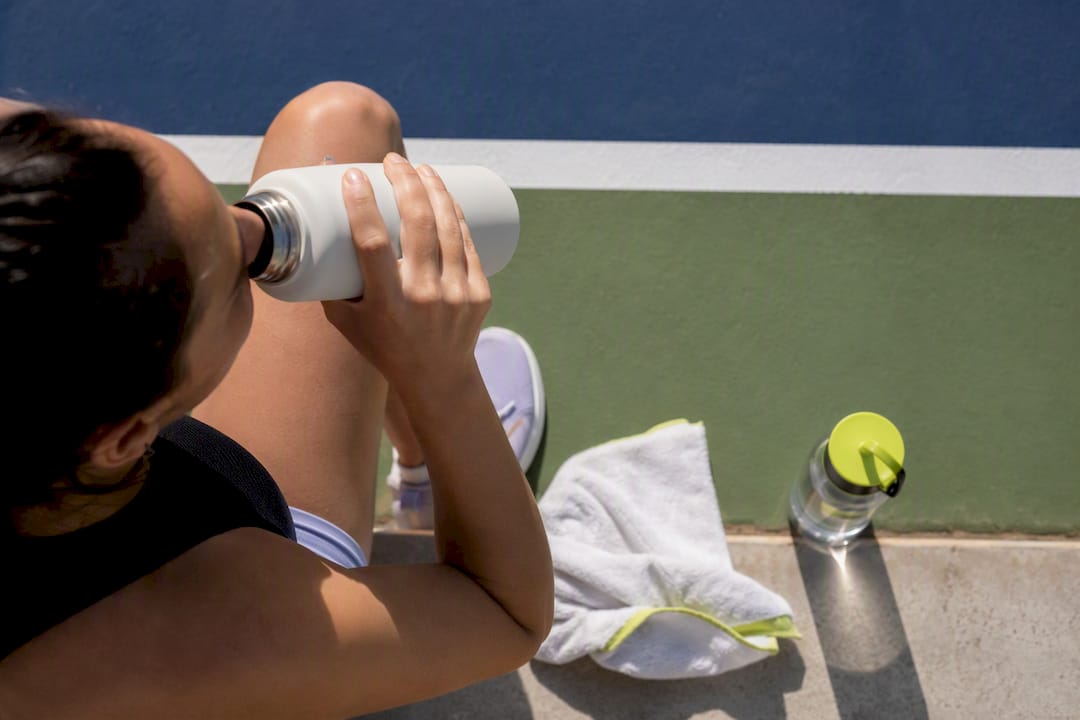
Nutrition matters most in the hours before and after play, not during a single match. A player who shows up under-fueled, having skipped a meal or run on coffee alone, tires faster and starts compensating with sloppier footwork by the second game. A light meal with carbohydrates and some protein one to two hours before play keeps energy steady; a post-session snack with protein supports the muscle repair that prehab work is trying to build in the first place. Coaches running back-to-back sessions or clinics should treat the 20 minutes after play as part of the recovery routine, not an afterthought, encouraging players to refuel before they drive home and forget.
Mental Coaching Techniques That Help Prevent Injuries
A tired, frustrated player moves worse than a calm one, and that shows up directly in injury risk. Late in a close game, fatigue and stress narrow a player's attention, and the first thing to go is exactly the footwork and split-step discipline you spent the whole warm-up building. Coaches who only train the body and ignore this are leaving an obvious gap.
Build a pre-point routine players can lean on: a breath, a quick check of stance, a reset of focus before each serve or return. This isn't about performance psychology theater; it's about giving players something to interrupt the rushed, sloppy movement that creeps in when frustration builds after a missed shot. Teaching players to recognize their own fatigue signals, like a split-step that's getting lazy or a knee that's not bending as deep as it did in game one, gives them permission to call their own break instead of pushing through out of ego.
Stress management matters especially in competitive or clinic settings where players push past their conditioning to keep up with a partner. Coaches can normalize this by naming it directly: telling a group that backing off a shot to protect a tired shoulder is the smarter play, not the weaker one. Players who feel judged for pacing themselves will hide fatigue instead of managing it, which is exactly the mindset that turns a manageable ache into a torn rotator cuff.
Court Surface and Environmental Factors That Raise Injury Risk
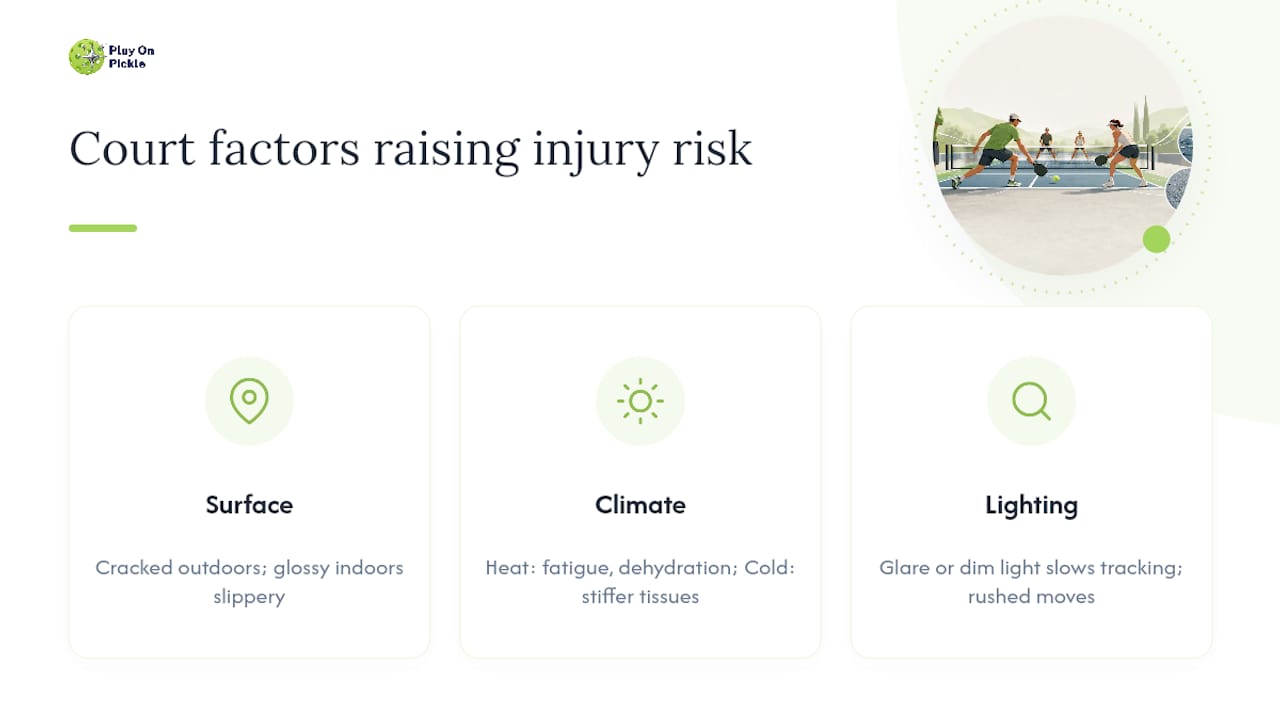
Not all courts play the same, and coaches who ignore that are missing a real variable. Outdoor courts with cracked or uneven asphalt create unpredictable footing, which raises the odds of a rolled ankle on a lateral cut that would be routine on a smooth surface. Indoor courts with high-gloss finishes can get slippery, especially early in a session before players have worked up any grip-improving sweat, or in facilities where dust accumulates between cleanings.
Temperature and humidity change the calculus too. Hot, humid conditions accelerate fatigue and dehydration risk, which circles back to the hydration guidance above, but heat also makes muscles feel looser than they actually are, tempting players to skip warm-up steps they'd normally take seriously. Cold conditions do the opposite: tissues stay stiffer longer, so a rushed warm-up on a chilly morning leaves players working near their range-of-motion limits from the first rally.
Lighting matters more than most coaches account for. Late-afternoon sun angling across an outdoor court, or dim gym lighting on an indoor one, slows a player's ability to track the ball and react to an opponent's position, which pushes them into rushed, off-balance movements exactly like the ones this guide has spent most of its space trying to eliminate. A quick walk of the court before a session, checking for surface damage, glare, or debris, takes two minutes and catches problems before a player finds them the hard way.
Author Perspective: Making Prevention Stick in Real Coaching Sessions
The programs that actually work aren't the elaborate ones. They're the two-exercise habit a player does without being told twice, and the 90-second video prompt that replaces a forgotten worksheet. Track who's still doing the work in six weeks, then adjust what isn't sticking.
— Drona
Try Play On Pickle for Personalized Injury Prevention
Play On Pickle gives coaches something a sideline view can't: an objective read on where a specific player's mechanics are creating stress, turned into a short list of exercises that player will actually do. It's built for exactly the gap this article keeps circling back to, generic prehab sheets versus prehab that matches someone's real movement.
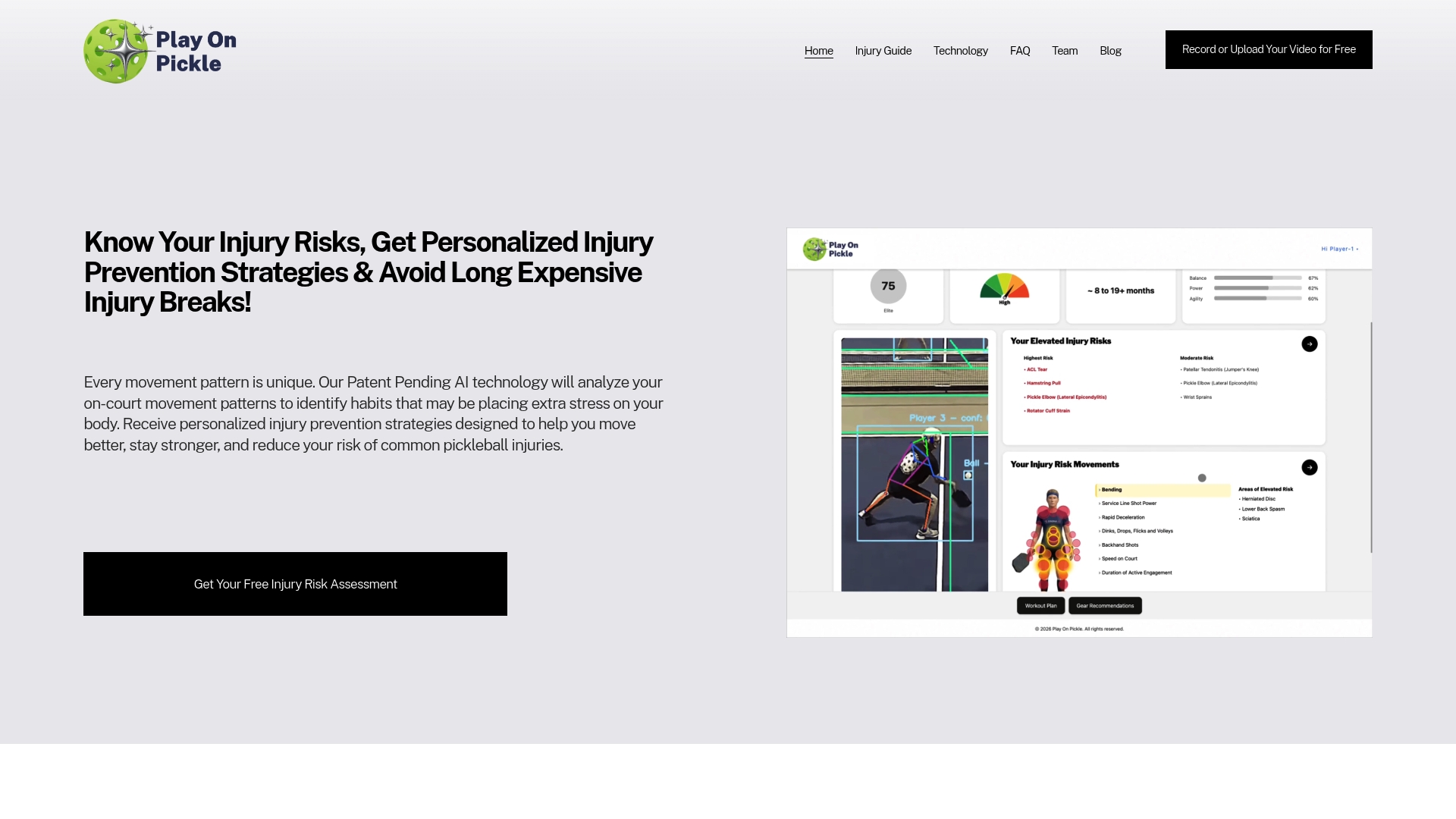
The monthly subscription runs $9.99, or $99 per year if you're committing a full season, and new subscribers can currently claim a free tripod with signup to make filming easier. Coaches working with recreational or older players will find the screening breakdown especially useful for building age-appropriate progressions. Treat the output as one more data point alongside your own eyes on court, and still refer anyone with persistent or sharp pain to a physical therapist or sports medicine provider. Head to the pricing page to start a plan and run your first screening this week.
Sources
- PMC article on warm-ups (2026 guidance)
- How to Prevent Pickleball Injuries | Yale Medicine
- Physitrack: Pickleball injuries — physical therapy guide
FAQ
What Is the Best Warm-Up for Preventing Pickleball Injuries?
A 5 to 10 minute dynamic warm-up combining light aerobic movement with mobility drills like arm circles, leg swings, and walking lunges works best, according to sports-medicine guidance. Static stretching alone before play doesn't offer the same protection.
How Often Should Players Do Prehab Exercises?
Two to three times a week is enough for most rotator cuff, hip, and calf prehab exercises to build real resilience without adding fatigue. Sport-specific prevention programs following a similar structure have shown injury reductions of up to about 39% in aggregated studies.
What Are the Most Common Pickleball Injuries Coaches Should Watch For?
Overuse injuries like rotator cuff strain and tendonitis, alongside acute injuries like ankle sprains and falls, make up most of what orthopedic reviews report. Age, prior injury, and insufficient warm-up are the biggest risk factors behind both categories.
How Does Play On Pickle Help With Injury Prevention Coaching?
Play On Pickle analyzes video of a player's movement to flag biomechanical stress points and generate a personalized exercise plan targeting that player's specific mechanics. Subscriptions start at $9.99 per month, with an annual option at $99 per year.
When Should a Player See a Doctor Instead of Just Resting?
Pain that lingers past 48 hours, changes how someone moves, or comes on sharply during play warrants a visit to a physical therapist or sports medicine provider rather than just rest. Clinical guidance recommends early evaluation for persistent or severe pain rather than waiting it out.