
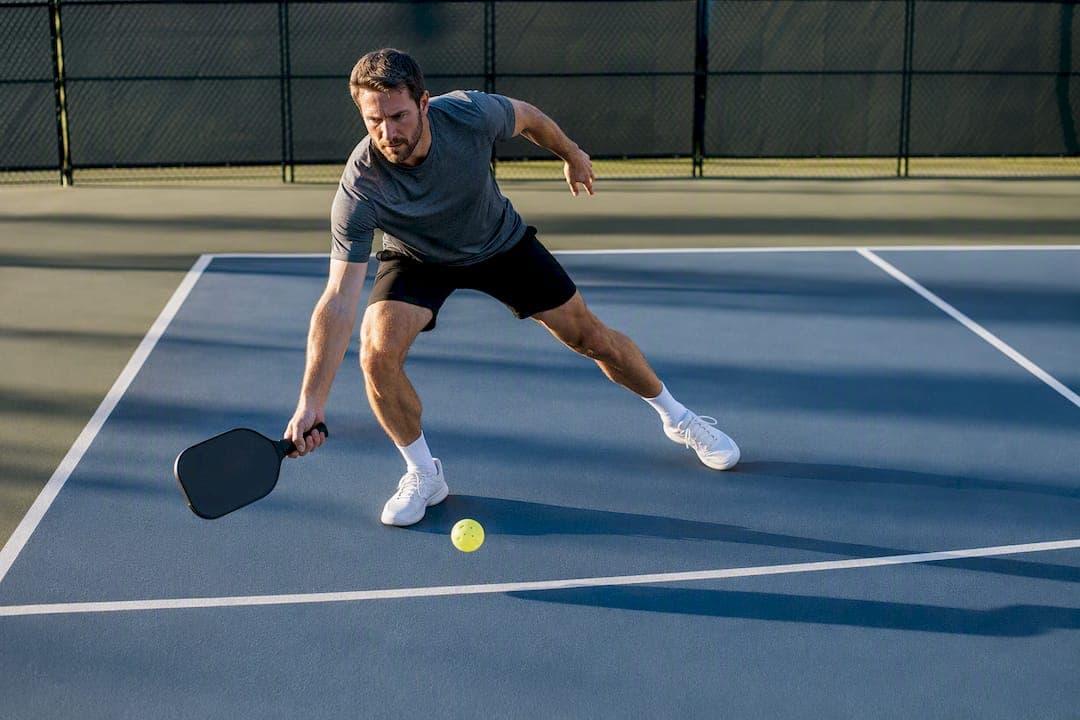
A hamstring strain is a tear in one of the three muscles running along the back of your thigh, usually caused by a sudden lunge or fast stop on the court. The moment you feel a sharp pull or pop, stop playing immediately. Start basic first aid (rest, ice, compression) and skip aggressive stretching. If you see swelling that spreads fast, a visible dent in the muscle, or you can barely walk, get evaluated by a clinician that day.
TL;DR:
- Most hamstring strains from pickleball occur during sudden overextensions or decelerations, especially in players with insufficient conditioning or muscle imbalances.
- Severity is graded from mild stretching to complete rupture, with healing times ranging from one week for mild strains to several months for tears involving tendons.
- Immediate care involves rest, ice, compression, elevation, and avoiding aggressive stretching to prevent worsening the injury.
- Rehabilitation should focus on sport-specific movements, progressive loading, and addressing weaknesses in lateral control to prevent re-injury.
- Movement analysis and proper warm-up routines play a critical role in injury prevention and detecting compensations before pain or injury occur.
Table of Contents
- What Is a Pickleball Hamstring Strain and Why Does It Happen?
- What Are the Symptoms and Warning Signs of a Hamstring Strain?
- What Should You Do in the First 72 Hours After a Strain?
- How Long Does a Hamstring Strain Take to Heal?
- How Can You Prevent a Hamstring Strain Before It Happens?
- How Movement Analysis Can Help Reduce Re-Injury Risk
- When Do You Need an MRI or Ultrasound for a Hamstring Strain?
- What Rehab Exercises Rebuild Hamstring Strength for Pickleball?
- What Risk Factors Make Pickleball Players More Likely to Strain a Hamstring?
- How Should You Modify Play at Each Stage of a Hamstring Injury?
- Why Recreational Players Keep Getting This Wrong
- Sources
What Is a Pickleball Hamstring Strain and Why Does It Happen?
Your hamstring is actually three separate muscles, the biceps femoris, semitendinosus, and semimembranosus, running from your sitting bones down to just below your knee. A strain means fibers in the muscle belly or, in more serious cases, near the tendon attachment up near your glutes have torn under load. That distinction matters for recovery time: tendon-area strains near the hip tend to heal slower than mid-muscle tears.
Pickleball puts unusual demand on this muscle group. You are not sprinting in a straight line like a runner. You are lunging sideways for a dink, then exploding backward for an overhead, then planting hard to change direction, all within a few seconds. Baptist Health notes that sudden overextension and rapid deceleration when reaching for a ball are common triggers, because the hamstring has to decelerate the leg and stabilize the hip at the same instant.
This is also a classic "weekend warrior" injury. Players who play once or twice a week, then suddenly enter a three-game tournament session, ask their hamstrings to do more explosive work than they have trained for. A clinical review of pickleball injuries found soft-tissue strains were the single largest injury category at one institution, and injury volume climbed sharply between 2017 and 2022 as the sport grew.
What Are the Symptoms and Warning Signs of a Hamstring Strain?
Most hamstring strains announce themselves with a sudden, sharp pain in the back of the thigh, sometimes described as feeling like you got kicked. Bruising often shows up within a day or two as blood pools under the skin. Weakness when you try to bend your knee or extend your hip is common and tends to track with severity.
Doctors grade hamstring strains on a simple three-tier scale:
- Grade 1: Mild fiber stretching. You can usually still walk, just with tightness or soreness.
- Grade 2: Partial tear. Noticeable pain, swelling, and a limp. Pushing off to walk feels weak.
- Grade 3: Complete rupture. Severe pain, often immediate inability to bear weight, and sometimes a visible gap in the muscle.
A few signs mean you should stop guessing and see someone right away: an audible pop at the moment of injury, a palpable indentation or visible deformity in the thigh, severe or rapidly spreading bruising, or numbness and tingling down the leg.
What Should You Do in the First 72 Hours After a Strain?
The first three days set the tone for how fast you heal. Overdo it and you risk turning a Grade 1 strain into something worse.
- Rest the leg immediately. Stop play, get off the court, and avoid weight-bearing that causes sharp pain.
- Ice for 15 to 20 minutes at a time, every 2 to 3 hours for the first 48 hours. Wrap the ice pack in a thin towel to protect your skin.
- Compress with an elastic bandage, snug enough to feel supportive but not so tight it numbs your foot or changes skin color.
- Elevate the leg above heart level when you can, especially while sitting or sleeping.
- Avoid aggressive static stretching in the acute phase, particularly for strains near the hip attachment. Stretching a fresh tear can pull the fibers further apart.
Baptist Health recommends R.I.C.E. as standard initial care, followed by a sports medicine evaluation because severity is hard to judge on your own. If you cannot walk without significant pain, see a clinician promptly rather than waiting it out.
Pro Tip: Keep a rotating set of two ice packs in the freezer during the first week. Swapping a fresh one in every few hours is far more consistent than trying to make one pack last all day.
How Long Does a Hamstring Strain Take to Heal?
Recovery time depends almost entirely on grade, and rushing it is the single most common reason players re-injure the same hamstring within a season.
- Grade 1 strains typically resolve in 1 to 3 weeks with basic rest, ice, and gradual reloading.
- Grade 2 strains often take 4 to 8 weeks, sometimes longer if the injury sits near the hip tendon rather than the muscle belly.
- Grade 3 strains, including tears near the tendon attachment, can take several months and sometimes require a surgical referral if the tendon has pulled away from the bone.
Rather than counting days on a calendar, track functional milestones. Research on pickleball-related injuries points to progression benchmarks tied to symmetry and control rather than time alone:
- Pain-free walking at normal speed
- Pain-free light jogging in a straight line
- Single-leg hop without pain or a drop in balance
- Sport-specific cutting and lunging at controlled, then game, speed
- Roughly 90 percent strength compared to your uninjured leg before full competitive return
Imaging or a specialist referral usually enters the picture when recovery stalls unexpectedly, when there is a large hematoma or palpable gap in the muscle, or when weakness persists well past the expected timeline for the grade you were given.
How Can You Prevent a Hamstring Strain Before It Happens?
Prevention beats rehab every time, and most of it comes down to habits you build weekly, not just what you do in the five minutes before a game.
Start with the warm-up. HSS recommends dynamic, movement-based warm-ups over static stretching before play, since static holds can actually reduce explosive power right when you need it most. A solid warm-up includes side shuffles, high knees, and walking lunges done briskly for a few minutes to raise your heart rate and prime the muscles you are about to load.
Weekly conditioning matters just as much. Prioritize eccentric hamstring work (Romanian deadlifts, slow-controlled leg curls), glute strengthening, and single-leg balance drills. Build load gradually rather than jumping from once-a-week casual games to daily tournament play; a nationwide study of pickleball injury patterns found players with fewer than five years of experience and those playing three or more times weekly carried notably higher injury odds, which points squarely at inadequate conditioning for the workload.
A repeatable pregame routine helps turn this into habit instead of guesswork:
- Five minutes of light cardio (jog in place, jump rope, or brisk walking)
- Walking lunges, 10 per leg
- Side shuffles, 30 seconds each direction
- High knees, 30 seconds
- Bodyweight squats, 10 reps
- A few practice serves and dinks at half speed before playing points
Pro Tip: Do your warm-up on the actual court surface whenever possible. Grass, sport court, and concrete all load your hamstrings differently, and your body adapts faster when the warm-up matches the surface you're about to play on.
Footwear and court shoes with good lateral support also reduce the sudden ankle and knee compensations that put extra strain on the hamstring during quick direction changes. For a fuller weekly breakdown, Playonpickle's conditioning guide walks through progressive loading in more detail, and its warm-up routines give both 5-minute and 10-minute versions depending on how much time you have before a game.
How Movement Analysis Can Help Reduce Re-Injury Risk
Most recreational players never get a real look at what their body is actually doing on court, and that blind spot is exactly where re-injury tends to happen. Certain video analysis services analyze movement to flag stress points and biomechanical patterns like an over-rotated hip or a lagging push-off leg that put extra load on the hamstring before pain ever shows up.
Three use cases stand out. Screening before a season starts can catch an asymmetry you have adapted to without noticing. After an injury, video analysis can highlight whether one leg is still compensating for the other, a common precursor to re-injury. And during rehab, repeated check-ins can track whether your movement pattern is actually returning to normal or just feels normal.
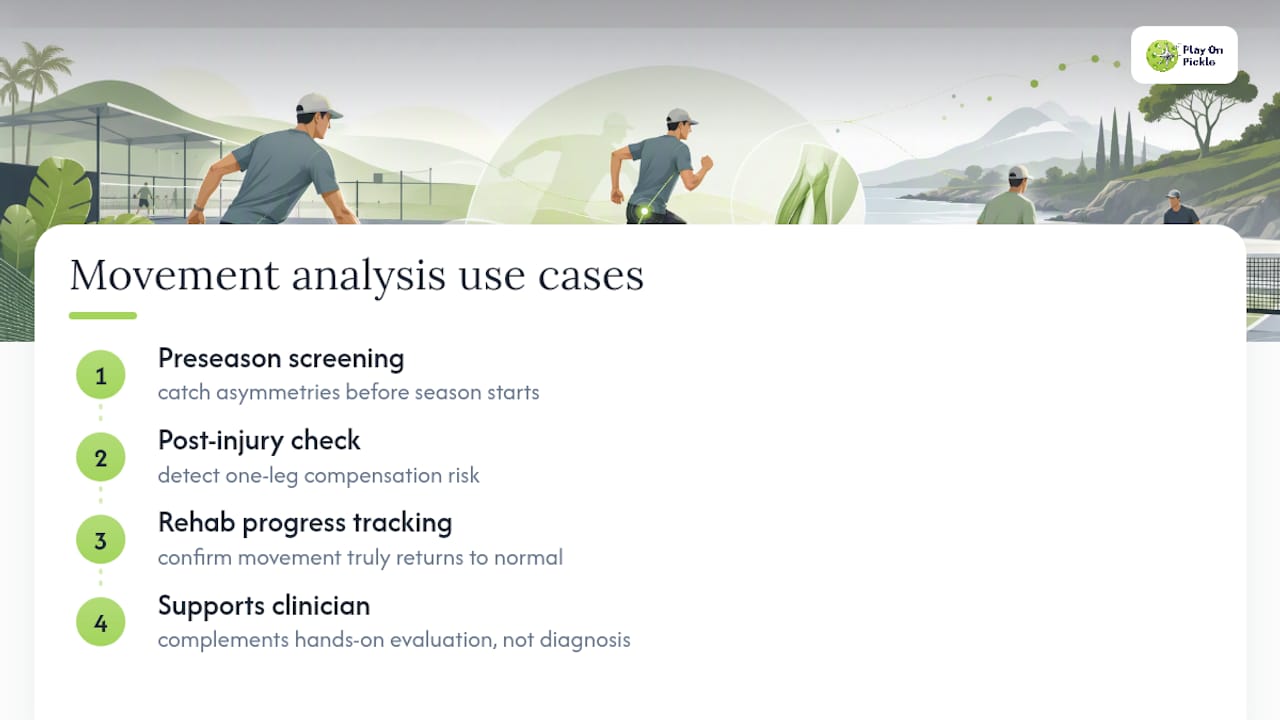
None of this replaces a clinician. If you have a suspected tear, you still need hands-on evaluation and, in higher-grade cases, imaging. Movement analysis works as a supporting layer, useful for prevention and for monitoring progress once a medical provider has cleared the basic diagnosis. Playonpickle's approach to AI-driven training analysis is built around that supporting role rather than acting as a diagnostic substitute.
When Do You Need an MRI or Ultrasound for a Hamstring Strain?
Most hamstring strains never need imaging. A clinician can diagnose a Grade 1 or mild Grade 2 strain through a physical exam alone, checking range of motion, palpating for tenderness, and testing strength against resistance.
Imaging enters the picture when the exam does not add up or when the stakes for getting it wrong are high. A palpable indentation, a large or rapidly expanding hematoma, or weakness that seems disproportionate to the reported pain level are the situations that typically prompt an MRI referral.
MRI is the gold standard for grading hamstring tears with precision. It shows exactly how much of the muscle cross-section is torn, whether the injury involves the tendon near the hip or knee, and whether there is a full rupture with retraction, information that changes the treatment plan significantly and helps decide whether surgery is on the table.
Ultrasound offers a faster, cheaper alternative that is useful for confirming a tear and estimating its size, though it is more operator-dependent and less detailed for deep or tendon-area injuries than MRI.
For a straightforward Grade 1 strain that is improving on schedule, most clinicians skip imaging entirely and just track your functional progress. Imaging becomes worthwhile when recovery stalls past the expected window for the grade you were given, when surgery might be needed, or when insurance and return-to-competition decisions hinge on knowing exactly how much tissue is involved.
What Rehab Exercises Rebuild Hamstring Strength for Pickleball?
Rehab has to match the demands of the sport, not just generic leg exercises. Pickleball asks your hamstrings to decelerate, stabilize laterally, and fire explosively, often within the same point.
Early-stage rehab, once acute pain has settled, usually starts with isometric holds: a gentle hamstring bridge held for 10 to 20 seconds, done pain-free, to reintroduce load without movement. As pain subsides, progress to slow, controlled Nordic curl progressions or standing leg curls with light resistance, focusing on the eccentric phase, the lengthening part of the motion, since that is where most pickleball strains actually occur.
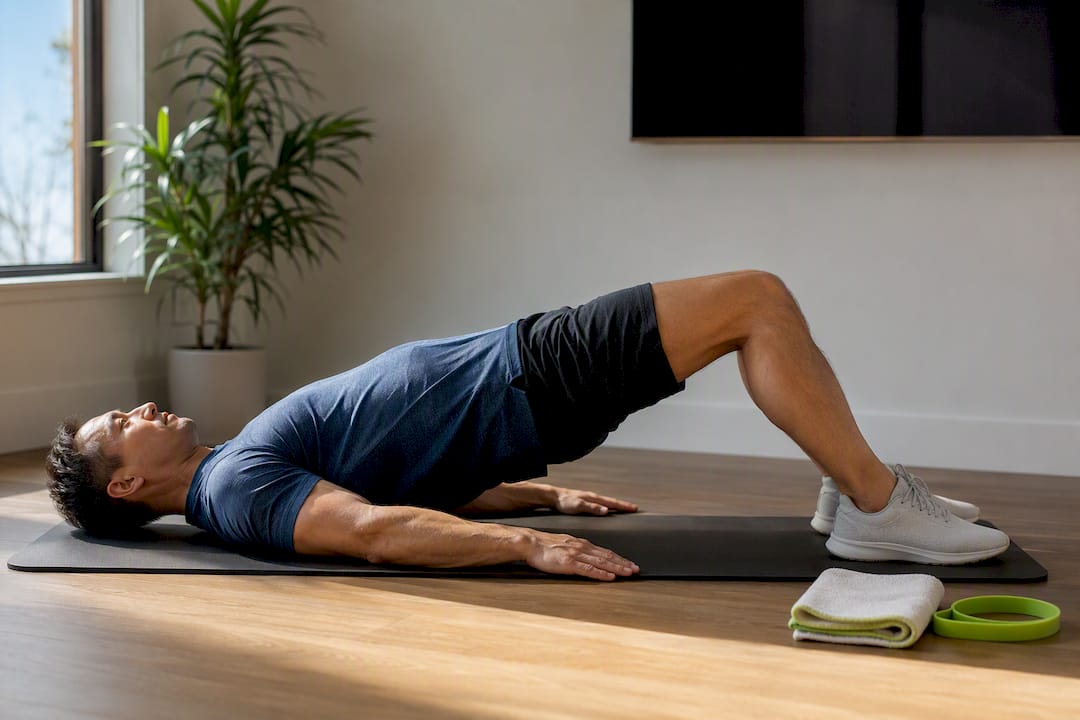
Mid-stage work should add hip hinge patterns like Romanian deadlifts and single-leg deadlifts, which train the hamstring alongside the glutes in a way that mirrors reaching for a low dink. Glute bridges and hip thrusts round this out, since a weak glute often forces the hamstring to overwork during lateral movement.
Late-stage rehab needs to look like pickleball. Lateral bounds, controlled shuffle-and-stop drills, and gradual introduction of split-step footwork rebuild the deceleration control that static gym exercises cannot replicate. Flexibility work matters here too, but through active, controlled ranges (like a slow standing hamstring stretch held after activity) rather than aggressive static stretching done cold.
Consistency across these stages, not intensity in any single session, is what actually rebuilds resilience.
What Risk Factors Make Pickleball Players More Likely to Strain a Hamstring?
Some players are simply more exposed to hamstring strain than others, and recognizing your own risk profile is half the prevention battle.
Muscle imbalance is the most common underlying factor. If your quadriceps are significantly stronger than your hamstrings, or one leg is noticeably weaker than the other, that imbalance shows up under the explosive loads pickleball demands. Previous hamstring injuries are another major flag. Scar tissue from an earlier strain does not have the same elasticity as healthy muscle, which is why the same hamstring so often gets hurt a second time.
Inadequate warm-up remains one of the most preventable risk factors, and it compounds with age since muscle elasticity naturally decreases over the decades. Newer players carry extra risk too. A nationwide injury study found players with under five years of experience had notably higher injury odds, likely because their movement mechanics and conditioning have not caught up to their competitive instincts yet.
Play frequency is a double-edged factor. That same study found players competing three or more times a week carried higher injury odds, particularly when that frequency jumps suddenly rather than building gradually. Overuse without adequate recovery windows shows up as fatigue-related form breakdown, and tired muscles absorb load far worse than fresh ones. Individual factors like sleep, hydration, and even hormonal cycles affect muscle readiness on a given day, a nuance covered well by The Monthlies' guide to training around your cycle.
How Should You Modify Play at Each Stage of a Hamstring Injury?
Trying to play through pain, or quitting cold for weeks when you did not need to, are the two most common mistakes recreational players make with a hamstring strain.
In the acute phase (days 1 to 3), stop playing entirely. Even doubles play at half intensity puts unpredictable load on a fresh tear. This is the window for rest, ice, and gentle range-of-motion work only, no court time, no hitting against a wall.
In the subacute phase (roughly week 1 to 3 for a Grade 1, longer for higher grades), controlled non-impact movement is usually fine once pain allows: stationary cycling at low resistance, pool walking, or light mobility work. Court activity should stay limited to dinking from a stationary position, no lunging, no sprinting, and stop immediately if you feel pulling.
In the return-to-play phase, reintroduce movement in layers. Start with half-court dinking rallies, then progress to controlled groundstrokes without lateral movement, then add light lateral shuffling, and only bring back full lunges and sprints once you can complete single-leg hops and cutting drills pain-free. Skipping straight from "feels okay standing still" to a full competitive match is the fastest route back to the same injury, often worse the second time.
Why Recreational Players Keep Getting This Wrong
Most hamstring strain advice online treats prevention and rehab as two separate problems. They are not. The same weak link, an underconditioned hamstring that cannot decelerate a lunge, is what causes the initial strain and what causes the re-injury three months later when someone declares themselves "healed" because the pain finally stopped.
The conventional advice leans too hard on rest and not hard enough on rebuilding the specific movement patterns pickleball demands. Pain-free walking is not the same as being ready to lunge for a cross-court dink at full speed. That gap is where most second injuries happen.
If there is one thing worth prioritizing over everything else in this article, it is honest movement assessment, before an injury and during recovery. Most players cannot see their own compensations. That is exactly the gap tools like Playonpickle are built to close, turning a vague sense of "my leg feels off" into a specific, trackable picture of where the actual stress is landing.
— Drona
This article is general information, not a substitute for advice from a qualified doctor. Consult a qualified healthcare professional about your own circumstances before acting on anything here.
Sources
- Orthopedic Concerns for Pickleball Players | Baptist Health
- Evaluation of Pickleball-Related Injuries at a Single Institution From 2017 to 2022
- Hamstring injuries — Hospital for Special Surgery (HSS)