
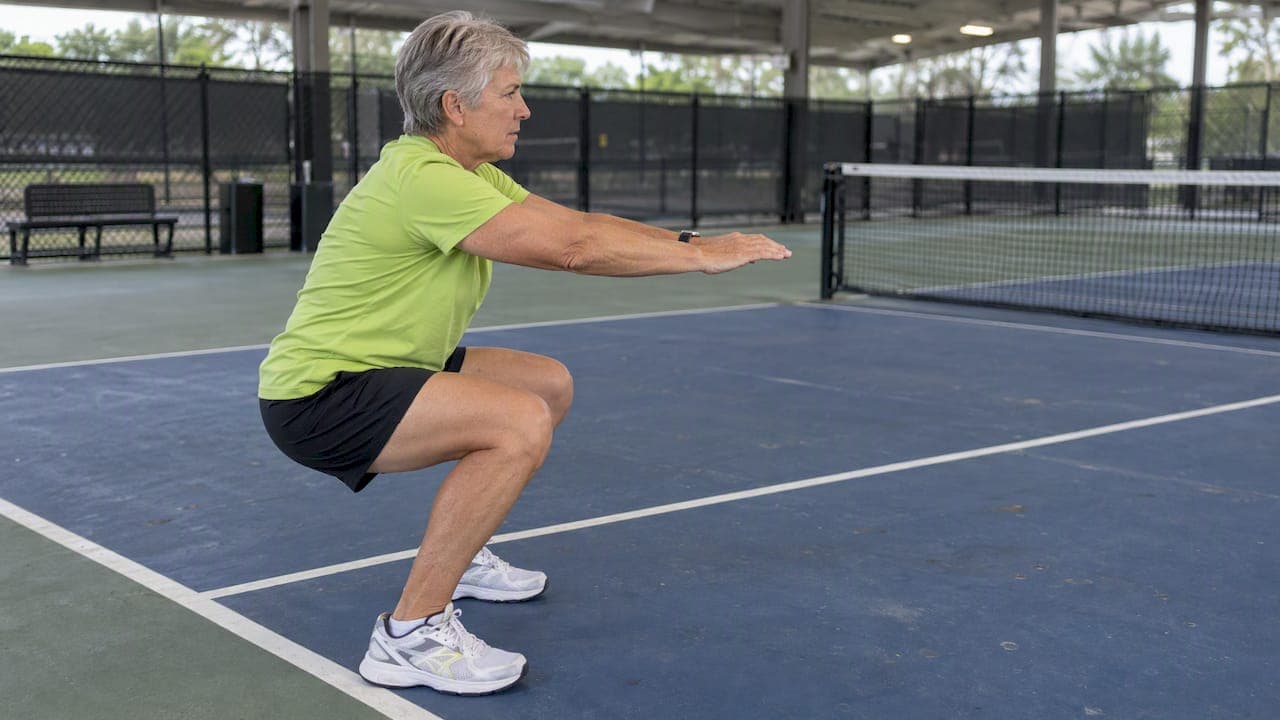
Yes, a movement screen will quickly reveal the movement faults that drive most pickleball injuries and point you to the few drills that fix them. Instead of guessing which stretch or exercise might help, a screen checks your ankle mobility, single-leg control, and deceleration mechanics directly, cutting out the trial and error that keeps players sidelined with knee, ankle, and tendon problems. Tools ranging from the classic Functional Movement Screen to markerless AI platforms like Play On Pickle now make this kind of targeted assessment available to recreational players, not just athletes with access to a sports medicine clinic.
TL;DR:
- A practical screen should compare both sides across ankle mobility, single leg control, deceleration, and reactive timing, using numeric results to track changes over several weeks.
- At home, test step downs, a wall ankle lunge, single leg balance for 20 seconds, and slow calf lowers; pain or side differences merit follow up.
- Practice split steps to a partner’s cue; start calf lowers at two to three sets of eight to twelve repetitions, then add load gradually.
- Sharp pain, instability, swelling, or no improvement after four to six weeks of consistent drills calls for clinical assessment; screens cannot diagnose injuries.
- A therapist screen takes 30 to 60 minutes, while video tools work at home; the Functional Movement Screen has mixed evidence for predicting injury.
Table of Contents
- Why pickleball movement patterns create particular injury risks
- What a practical pickleball movement screen tests
- Common movement faults screens find and the injuries they drive
- How to get screened: quick self-checks, clinics, and tech-enabled assessments
- Corrective program: drills and progressive loading mapped to common faults
- When a screen should lead to hands-on care or further testing
- Evidence and expertise: research context and Play On Pickle's approach
- A practical note for players
- Play On Pickle: try a pickleball-specific movement screen and personalized plan
- FAQ
- Sources
Why pickleball movement patterns create particular injury risks
Pickleball asks your body to do things few other activities demand in the same combination. You shuffle laterally, sprint a few steps, stop hard, and crouch low at the kitchen line, often within the same rally. A 2026 review comparing racket sports describes this as a hybrid movement pattern: frequent lateral changes of direction, short forward and backward bursts, and heavy deceleration loads that stress joints differently than a steady jog or a tennis baseline rally.
That mechanical profile lines up with what injury surveillance shows. Lower-extremity and overuse injuries tend to dominate the picture among recreational players, and play frequency and experience level shift the risk further. For screening purposes, this points to three priorities:
- Deceleration control during quick stops and direction changes
- Ankle dorsiflexion range, since limited mobility there changes how force travels up the leg
- Single-leg stability, given how much time is spent balancing briefly on one foot
What a practical pickleball movement screen tests
A useful screen does not need to be complicated, but it should cover a few specific categories rather than a single generic test.
- Mobility checks: ankle dorsiflexion (how far your knee travels over your toes in a lunge), hip internal and external rotation, and thoracic mobility for reaching and rotating shots.
- Stability and strength: a single-leg squat or step-down to watch knee tracking, trunk control during a lateral lunge, and a simple eccentric calf test (how controlled your heel lowers under load).
- Reactive timing: split-step readiness, meaning how quickly you load into a ready position when an opponent strikes the ball, and lateral shuffle timing under a visual cue.
- Asymmetry checks: comparing left and right sides on the same tests above, since a meaningful gap between limbs often matters more than either score alone.
A good screen produces simple numeric outputs, not just a pass or fail, so you can track whether a correction is working over several weeks.
Common movement faults screens find and the injuries they drive
Most pickleball injuries trace back to a short list of repeatable faults, and recognizing them in yourself is often the fastest path to fixing them.
- Late split-step: reacting a beat too slow forces a compensatory lunge instead of a controlled step, loading the joint awkwardly.
- Knee collapse or hip drop: the knee caves inward during a lateral move or landing, a pattern linked to patellofemoral pain and added tendon stress.
- Poor deceleration or weak eccentric control: struggling to slow down smoothly overloads the Achilles and calf, a mechanism tied to the rise in foot and ankle injuries tracked between 2015 and 2023, where lunging forward was a frequently reported cause.
- Limited ankle dorsiflexion: a stiff ankle shifts load up to the knee and increases sprain risk when you plant and pivot.
If your knee visibly wobbles inward on a step-down test, or your heel can't lower under control without shaking, those are the exact patterns a screen is built to catch.
How to get screened: quick self-checks, clinics, and tech-enabled assessments
You have three realistic options, and they are not mutually exclusive.
- A 10 to 15 minute self-screen: try a single-leg step-down (watch for knee cave), a wall ankle lunge (knee should touch the wall with heel down), a single-leg balance hold for 20 seconds, and a slow single-leg calf raise lowering over 3 seconds. Shaking, pain, or an obvious side difference on any of these suggests a deficit worth addressing.
- A physical therapist or sport clinic screen: typically runs 30 to 60 minutes and adds hands-on strength testing, a trained eye on movement quality, and a written plan; cost varies by provider and region.
- Markerless AI assessment: platforms that analyze video can measure timing and asymmetry more precisely than the eye alone, and they let you screen from home instead of booking an in-person session.
Pro Tip: Film your self-tests from the front and the side on your phone. Faults like knee collapse are often easier to spot on video than in the moment.
Corrective program: drills and progressive loading mapped to common faults
Once you know your fault pattern, the fix is usually a short, specific drill set rather than a full overhaul of your training.
- Split-step and timing: practice split-step activation off a partner's racket drop, then add lateral shuffle and cone-reaction drills; footwork drill resources built around these cues train the perceptual side of reaction, not just the legs, cutting down on false starts.
- Eccentric calf progressions: start with slow, controlled single-leg heel lowers, two to three sets of eight to twelve reps, then add light load or tempo variation over several weeks to build deceleration tolerance.
- Single-leg strength and balance: progress from basic step-downs to loaded single-leg squats as control improves, checking that the knee tracks in line with the foot throughout.
A reasonable weekly structure is two focused sessions of 15 to 20 minutes, monitoring for soreness that fades within a day rather than lingers. Our 90-day training plan and conditioning guide both walk through how to layer this kind of work into regular play without overloading a joint that's still adapting.
Pro Tip: Progress load only after a drill feels controlled and pain-free for a full week, not just one good session.
When a screen should lead to hands-on care or further testing
A screen is a starting point, not a diagnosis, and certain results mean it's time to see a clinician directly. Sharp pain during any test, visible joint instability, swelling, or no improvement after four to six weeks of consistent corrective work are reasonable red flags. Clinical follow-up typically means targeted rehab first, with imaging reserved for cases where symptoms don't track with a straightforward movement fault. Screens are also useful for staged return-to-play decisions after an injury, since repeating the same tests shows whether you've actually closed the gap before going back to full-speed play.

Evidence and expertise: research context and Play On Pickle's approach
The Functional Movement Screen has solid reliability but mixed predictive validity across sports, with a 2019 systematic review finding composite scores and asymmetry more useful for estimating risk in senior athletes than junior ones. That's a reason to treat any single screen as one input, not a verdict, and to pair it with sport-specific movement checks.
Pickleball's frequent direction changes and deceleration demands justify screening priorities that generic fitness tests often miss.
Our markerless AI technology builds on that gap, analyzing video to flag stress points and generate a personalized corrective plan tailored to your own biomechanics rather than a generic template.
A practical note for players
Small, focused screening paired with eight weeks of targeted drills prevents more downtime than sporadic, ad hoc training ever does. Run the self-checks today. If you hit a red flag, book a clinic visit. Otherwise, a short trial run of guided screening is a low-effort next step.
— Drona
Play On Pickle: try a pickleball-specific movement screen and personalized plan
We built Play On Pickle around a simple problem: most players know something feels off in their movement but have no efficient way to pinpoint it. Our markerless AI analyzes your movement from a short video, flags stress points specific to your biomechanics, and delivers a corrective plan built around real pickleball patterns, not a generic fitness template.
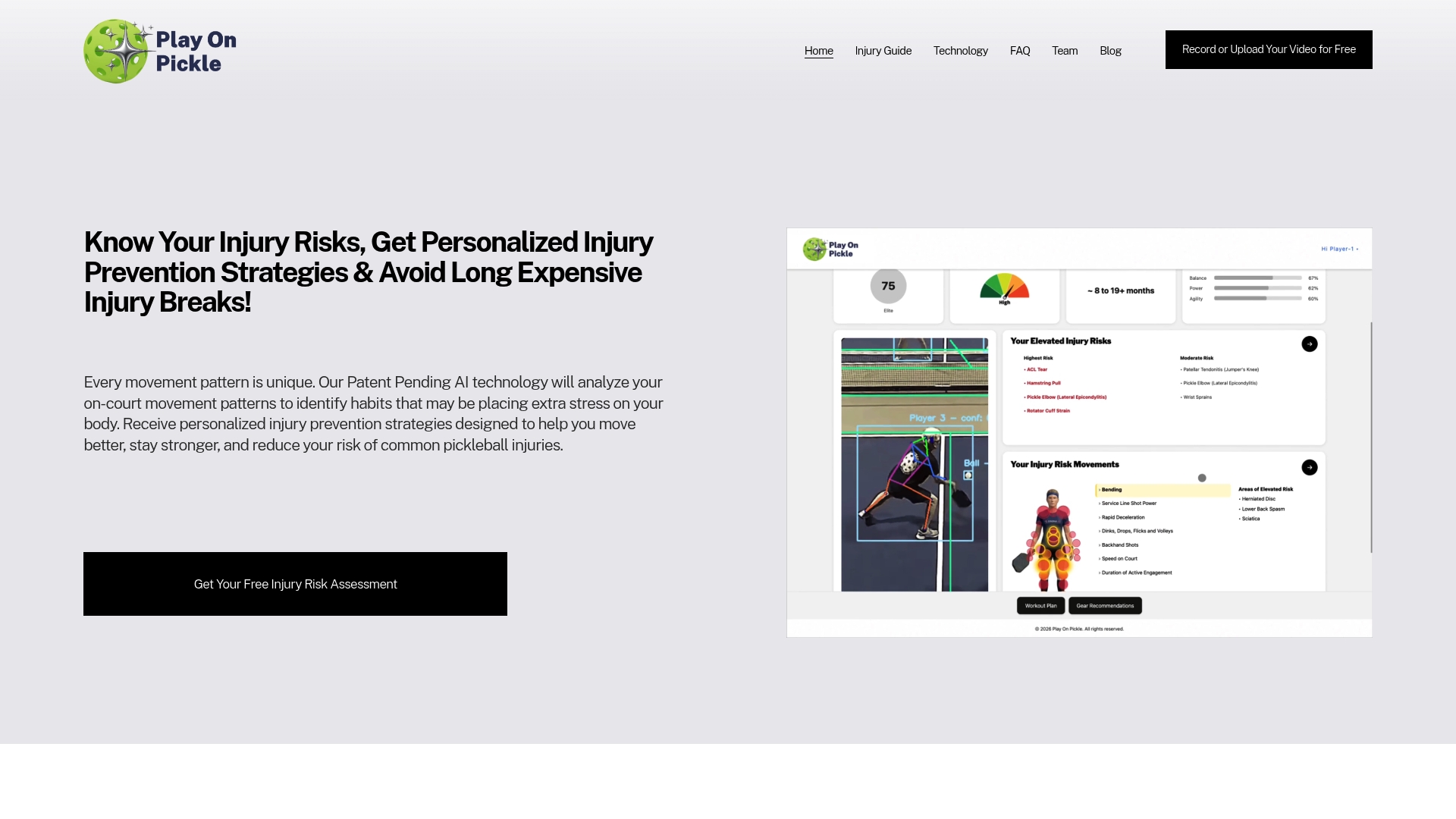
Getting started takes a few minutes:
- Start a free trial and upload a short clip of your movement
- Check our monthly or annual subscription plans to see what fits your schedule
- Claim a free tripod with the monthly plan to make filming easier
Pair your results with our prehab routine if your screen flags one or two weak spots, and you'll have a complete loop from assessment to correction.
This article is general information, not a substitute for advice from a qualified doctor. Consult a qualified healthcare professional about your own circumstances before acting on anything here.
FAQ
What is the 10 second rule in pickleball?
The 10 second rule is a gameplay rule requiring the serving team to serve within 10 seconds of the score being called, not a fitness or movement guideline. It has no direct connection to injury screening, though faster-paced play under time pressure can make poor split-step timing more costly.
How do I know if I'm a 3.0 pickleball player?
Skill ratings describe your consistency, shot selection, and court strategy rather than your movement quality, and are typically assessed through self-rating guides or a rated match. A movement screen is a separate tool: it tells you about injury risk and physical readiness, not where you rank competitively.
Is pickleball good for losing belly fat?
Pickleball is a moderate-intensity activity that combines cardio and short bursts of sprinting, which can support fat loss as part of a broader calorie and activity routine. Results depend heavily on frequency, intensity, and diet, so it works best alongside consistent play and basic conditioning rather than as a standalone fix.
Does Taylor Swift play pickleball?
There's no reliable public information confirming this, and it isn't relevant to movement screening or injury prevention. If you're looking for pickleball-specific fitness guidance, a movement screen is a more useful starting point than celebrity interest in the sport.
Sources
- Factors influencing the relationship between the Functional Movement Screen and subsequent injury (systematic review & meta-analysis)
- Comparative analysis of movement patterns and lower-limb biomechanical demands in pickleball and other racket sports
- Epidemiology of Pickleball-Related Foot and Ankle Injuries (2015–2023)
- Pickleball footwork drills and movement patterns