
The most effective way to train for pickleball is a two-part approach: a 7 to 10 minute movement-specific warm-up before every session, plus two to three weekly strength and stability workouts built around your own movement patterns. Beginners can start with bodyweight versions and one set per exercise; advanced players add load and speed. If pain keeps returning or your game has plateaued, a personalized movement assessment can pinpoint exactly which exercises matter most for your body.
TL;DR:
- Prioritize a 7 to 10 minute dynamic warm-up before every session, focusing on motion patterns specific to pickleball's demands.
- Build strength training into your routine with two to three weekly sessions targeting hips, core, shoulders, and wrists, using body weight and resistance bands.
- Follow a phased four-week training progression, gradually increasing volume, resistance, and explosive power to prevent fatigue and injury.
- Watch for persistent pain, swelling, or instability during play or exercises, and adjust training intensity, especially for older players or after injuries.
- Consider personalized movement analysis if recurring pain or plateauing performance suggests specific biomechanical issues that generic routines cannot address.
Table of Contents
- What Does a Pickleball-Specific Warm-Up Look Like?
- Which Strength Exercises Actually Transfer to Pickleball?
- How Do You Build a 4 to 8 Week Training Plan?
- What Injuries Should You Watch For, and Why Do They Happen?
- When Does Personalized Movement Analysis Make Sense?
- Making Training Stick When You're Short on Time
- Try a Personalized Movement Analysis of Your Own Game
- Sources
What Does a Pickleball-Specific Warm-Up Look Like?
A generic jog-and-stretch routine doesn't prepare your body for pickleball's real demands: short explosive steps, sudden lateral cuts, and rotational swings. A proper warm-up moves through four phases in sequence, each one building on the last.
Start with light cardio to raise your heart rate and core temperature for two to three minutes. Jumping jacks or high knees work fine. From there, move into lower-body mobility and activation, then upper-body rotation, and finish with drills that mimic actual court movement. A 7 to 10 minute dynamic warm-up built this way measurably reduces injury risk because it primes the exact tissues you're about to stress.
Here's a sequence that covers all four phases:
- Jumping jacks or high knees (60 seconds) — raises heart rate and core temperature.
- Leg swings, front and side (10 per leg) — loosens hip flexors and adductors for lateral coverage.
- Walking lunges with a twist (8 per side) — combines hip mobility with the torso rotation used in groundstrokes.
- Lateral lunges (8 per side) — rehearses the side-to-side footwork that dominates pickleball rallies.
- Arm circles, small to large (30 seconds each direction) — warms up the shoulder capsule before overhead shots.
- Wrist circles and flexor stretches (30 seconds) — prepares the wrist for dinks and volleys.
- Torso twists with arms extended (10 per side) — activates the rotational chain used in the serve and drive.
- Inchworms into a shoulder tap (5 reps) — links hamstring mobility with shoulder stability.
- Split-step hops (10 reps) — rehearses the ready position players use before every return.
- Short sprint and stop (3 reps, 10 yards) — simulates the quick acceleration and deceleration of a real point.
Stick to 7 to 10 minutes on a normal day. If you're over 50 or playing in cold weather, stretch that to 12 to 15 minutes and add balance work, since older joints and cold muscles both need more time to respond.
Pro Tip: Run this same sequence before every match, not just practice. Injuries cluster in the first few points of a session, before the body has caught up to the pace of play.
For a couple of ready-to-follow timed versions, check out this pickleball warm up routine.
Which Strength Exercises Actually Transfer to Pickleball?
Pickleball punishes players who skip strength work, especially in the hips, core, shoulders, and wrists. Lateral movement puts stress on tissues most gym routines ignore entirely, and conditioning research on the sport points to lateral strength as the biggest blind spot for recreational players.
Build a 20 to 30 minute session around these four movement categories:
- Lower-body lateral strength: lateral lunges, goblet squats into a calf raise, and curtsy lunges build the hip and ankle strength that supports quick direction changes.
- Rotational core work: wood chops, dead bugs, and anti-rotation holds (like a plank with a band pull) train the core to transfer force through your swing without straining your lower back.
- Shoulder stability: band external and internal rotations, plus row-and-fly combos, protect the rotator cuff from the repetitive overhead and dinking motions that cause shoulder fatigue.
- Wrist control: wrist curls, reverse curls, and grip squeezes build the tendon strength that prevents the nagging wrist pain many players develop from paddle grip.
You don't need a gym. A single resistance band and your own body weight cover almost every exercise on this list. A common baseline is 3 sets of 10 reps per exercise, done about three times a week, with beginners starting at one set and adding a set every couple of weeks as form solidifies.
Pro Tip: If you only have five minutes before a match, do one lateral movement drill and one shoulder stability exercise. Those two areas fail first under fatigue.
The Fitness Flow blog has solid guidance on structuring full-body strength volume if you want a deeper template to pull from.
How Do You Build a 4 to 8 Week Training Plan?
Progression matters more than any single exercise. Conditioning research consistently backs a phased approach: build an aerobic base first, layer in strength, then add power and speed work, which is what keeps players from crashing in the third game of a long session.
A simple four-week structure looks like this:
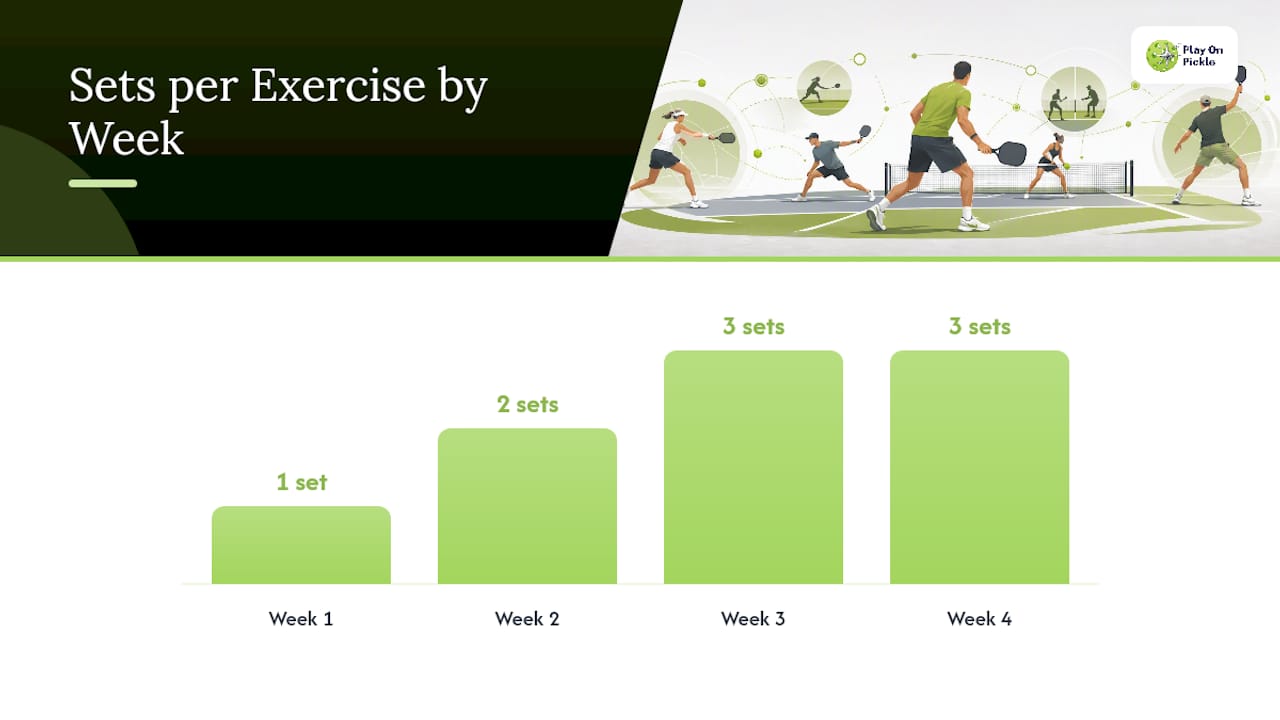
- Week 1, foundation: warm-up before every court session, plus two strength sessions at one set per exercise, focused purely on form.
- Week 2, volume: add a third strength session and move to two sets per exercise.
- Week 3, load: hold at three sessions, move to three sets, and add light resistance bands where you were using bodyweight.
- Week 4, power: keep the strength volume steady but add short sprint and hop drills at the end of your warm-up to build explosiveness.
Repeat the four-week block, adding small increases in reps or band resistance each cycle. If a tournament weekend or a heavy practice week leaves your legs dead, drop to one strength session and stretch your warm-up instead. Schedule strength work on non-consecutive days, and never stack a hard strength session the day before a big match. For more structured examples of this progression, pickleball conditioning resources walk through fuller cycles.
What Injuries Should You Watch For, and Why Do They Happen?
Most pickleball injuries trace back to a handful of repeated mechanical stresses rather than one bad step. Shoulder strain usually comes from repetitive overhead motion without rotator cuff support. Wrist pain, sometimes nicknamed pickle elbow when it radiates up the forearm, often comes from gripping too hard on dinks. Knee and ankle injuries tend to hit players who cut laterally without the hip and ankle strength to control the motion.
Watch for these red flags during any exercise or match:
- Sharp, localized pain that gets worse rather than better as you warm up.
- Visible swelling within a few hours of play.
- A joint that gives way or feels unstable under load.
- Pain that changes how you walk or hold your paddle the next day.
Older players face amplified fall and overuse risk, which is why longer warm-ups and balance drills matter more with age. The safest rule across every age group: prioritize movement quality over speed, add load gradually, and build at least one rest day between hard sessions.
When Does Personalized Movement Analysis Make Sense?
Generic routines work until they don't. If you keep getting the same shoulder twinge, or your lateral movement feels a step slow no matter how much you drill it, the exercises above may not be targeting your actual weak point. That's where individualized movement analysis earns its place.
Movement-signature analysis looks at how your body actually moves on court, not how a textbook says it should move. It flags things generic programs miss:
- Asymmetries between your dominant and non-dominant side during lateral steps.
- Repeated high-stress patterns in the shoulder or wrist during specific strokes.
- Compensations that show up only under fatigue, late in a match.
Personalized exercise plans differ from generic routines mainly in prioritization. Instead of ten exercises done evenly, you get the two or three that address your specific imbalance first, with progressions that adjust as that imbalance improves. Players with recurring discomfort, inefficient footwork, or a training plateau tend to benefit most, since they're the ones a one-size-fits-all program is least likely to help. For a closer look at how the reports translate into exercise choices, see this pickleball video analysis breakdown.
Making Training Stick When You're Short on Time
Recreational players don't fail at training because they lack information. They fail because thirty scattered minutes of "exercise" never turns into a habit. Short, specific sessions beat long, vague ones every time, because they're easier to protect on a busy week and easier to see results from.
If you take one thing from this: attach your warm-up to your court time so it's automatic, and pick two fixed slots a week for strength work, same days, same time. Then track one thing, maybe how your shoulder feels after a long rally, and let that single signal tell you if the plan is working.
— Drona
Try a Personalized Movement Analysis of Your Own Game
Everything above works as a general framework, but your shoulder, your knees, and your footwork aren't general. A personalized movement analysis can bridge the gap between generic advice and individual needs by using video to identify stress points in movement and recommend exercises tailored to specific risk areas.

It's built for players who've tried generic warm-ups and strength routines but keep hitting the same nagging pain or the same performance ceiling. A first assessment shows you where your movement diverges from efficient mechanics, whether that's a hip that doesn't rotate enough on your forehand or a wrist under more load than it should be during dinks. From there, you get a short list of exercises that actually matches your body instead of a generic template. Start with a free trial at Playonpickle and see what your own movement pattern says about where to focus first.
Sources
- Relevant conditioning literature — NCBI (PMC)
- 10 Pickleball warm up exercises to prevent injuries & play better — Pickle n' Life
- Pickleball
- 7 ways to prevent pickleball injuries — AARP