
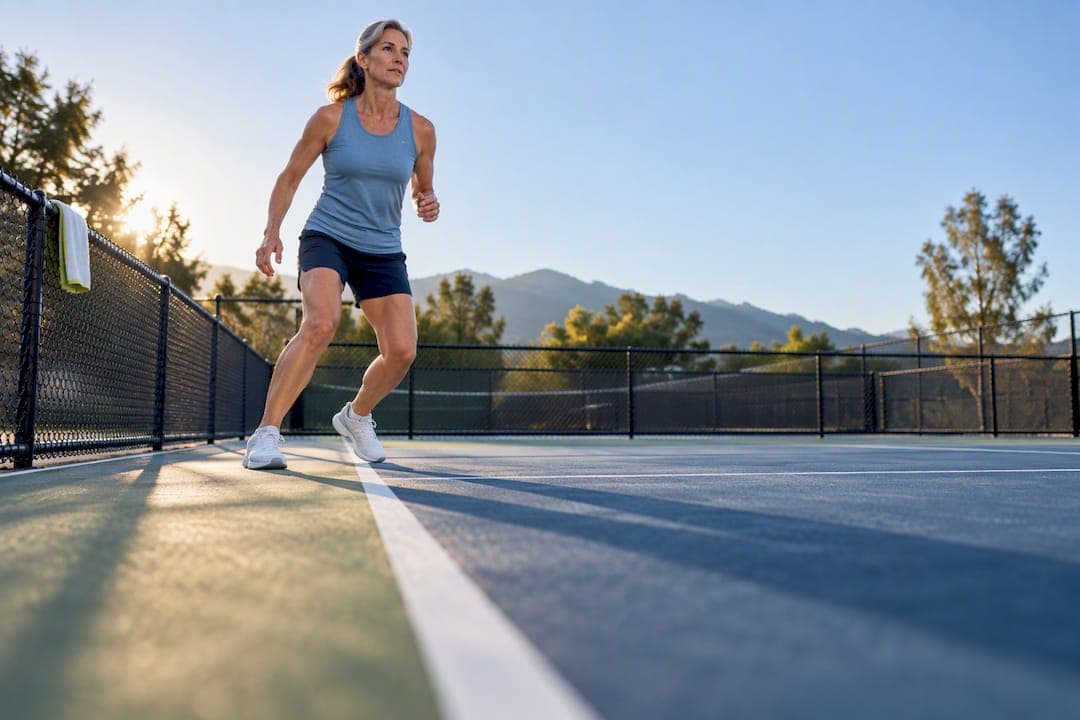
Start resistance training twice a week, add one or two pickleball-style interval sessions, and spend five to ten minutes daily on mobility and balance work. This combination gives the biggest on-court return for the least time invested. Prioritize low-equipment tools like resistance bands, bodyweight moves, and a FlexBar, and put fall-prevention items such as eccentric calf raises, hip abductor strength, and backward agility drills at the top of the list.
TL;DR:
- Resistance training combined with short interval cardio sessions significantly improves pickleball performance and reduces injury risk.
- Prioritizing hip abductor strength and backward movement drills can lower fall risk and address common injury sites like the knee, shoulder, and forearm.
- Starting with basic bodyweight exercises and simple protocols, such as jump rope and resistance band circuits, supports gradual improvement without extensive equipment.
- Consistent training twice weekly, including targeted mobility and balance exercises, yields measurable gains in reaction time, stability, and endurance over time.
- Incorporating movement analysis or personalized exercises can help address asymmetries and prevent persistent pain, especially for players with ongoing discomfort.
Table of Contents
- Why cross training matters for pickleball: performance and injury evidence
- Fitness components to prioritize for pickleball
- Practical exercises and protocols you can start this week
- Sample weekly schedules and where cross training fits around court time
- Injury prevention focus: falls, backward movement, and joint problems
- How to implement and progress safely using ACSM-backed rules
- How Play On Pickle's movement analysis complements cross training
- Realistic expectations and commitment
- Optional: Play On Pickle as an adjunct
- Sources
- FAQ
Why cross training matters for pickleball: performance and injury evidence
Pickleball asks the body to do things it rarely practices elsewhere: stop hard, change direction, and move backward without warning. That mismatch shows up in the injury numbers. A cross-sectional study of pickleball players in South Korea found that 34.2% reported an injury in the prior 12 months, with the knee, elbow and forearm, and shoulder accounting for most complaints. Overuse patterns were common, meaning the damage builds slowly rather than arriving as a single dramatic event.
The game's effort profile explains why. Points last seconds, not minutes, and players recover between them, which is closer to interval training than a steady jog. Conditioning that mimics this rhythm, short bursts followed by rest, prepares the muscles and joints for the actual demand instead of a generic fitness standard that does not match the sport.
The research also points to a simpler truth: consistency beats complexity. According to ACSM's 2026 resistance training guidance, the biggest jump in benefit comes from moving off the couch and into any resistance training at all, not from perfecting a program. That framing matters for recreational players who assume they need a coach, a gym membership, or hours of spare time before cross-training is worth starting.
- Knee, elbow and forearm, and shoulder are the three most commonly injured areas among pickleball players, per the South Korea injury study.
- Short, interval-style conditioning matches pickleball's stop-and-go demand better than long steady-state cardio alone.
- The single biggest fitness gain comes from starting resistance training, not from optimizing it.
Fitness components to prioritize for pickleball
Not every fitness component deserves equal time. Pickleball rewards a specific mix, and the minimal effective dose for each piece is smaller than most players assume.
Cardio. Interval work two to three times a week, paired with one longer, easier session, builds the repeated-sprint capacity pickleball actually uses. Think 30 seconds of hard effort followed by 30 seconds of rest, repeated for several rounds, rather than a 45-minute jog.
Strength. ACSM's 2026 guidance recommends training all major muscle groups at least twice a week. For pickleball, lower-body strength and hip abductor work deserve priority since they govern change-of-direction speed, and upper-back pulling exercises balance the shoulder-dominant, forward-reaching nature of dinking and volleying.
Power. Explosive movement does not require a barbell. Low-volume, moderate-load work or bodyweight alternatives like jump squats and skater hops train the fast-twitch response pickleball demands during a quick lunge or overhead smash.
Mobility and flexibility. A dynamic warm-up before play and static stretching afterward is the sequence backed by rehabilitation guidance from the Hospital for Special Surgery. Hips and calves need the most attention since they absorb the bulk of lunging and pushing-off stress.
Balance and reaction. Single-leg holds, Y-balance reaching drills, and backward-change-of-direction work train the exact skill that separates a controlled recovery step from a fall.
- Cardio: two to three interval sessions plus one easy, longer session weekly.
- Strength: major muscle groups trained at least twice weekly, with hips and lower body prioritized.
- Power: low-volume explosive movement, bodyweight or light-load.
- Mobility: dynamic before play, static after, with hips and calves emphasized.
- Balance: single-leg and reactive drills that include backward movement.
For a broader look at how these pieces fit together, see this overview of pickleball conditioning.
Practical exercises and protocols you can start this week
These templates need little more than a resistance band, a jump rope, and floor space. Start conservatively and progress only when a movement feels controlled, not effortful.
- Cardio intervals. Alternate 30 seconds of jump rope, cycling, or hill sprints with 30 seconds of rest for eight to twelve rounds. Do this two to three times a week, and add one longer, easy-paced session for aerobic base.
- Lower-body strength circuit. Pair bodyweight squats, glute bridges, and lateral band walks for two to three sets of 10 to 15 reps. Add a dumbbell or heavier band once the bodyweight version feels easy for three consecutive sessions.
- Upper-body pull and core circuit. Combine resistance-band rows, dead bugs, and side planks for two to three sets, focusing on control rather than speed. This balances the forward-dominant shoulder work pickleball creates and trains the core to resist rotation during off-balance shots.
- Alfredson eccentric calf protocol. Perform slow, controlled eccentric calf raises, three sets of 15 reps, twice daily, for 12 weeks. This is one of the most consistently cited protocols for Achilles tendon health, and it is worth starting well before symptoms appear, not after.
- Tyler Twist for forearm tendons. Using a FlexBar, perform slow twisting reps through pronation and supination to load the forearm tendons eccentrically. This targets the same overuse pattern behind pickleball elbow, detailed further in this guide to elbow pain recovery.
- Y-balance progression. Standing on one leg, reach the free leg forward, then diagonally back in each direction, keeping the standing hip stable. Progress by increasing reach distance or closing the eyes briefly once balance is solid.
- Pickleball-modified T-test. Shorten the standard agility T-test and add a backward run segment to replicate the backpedal-and-recover pattern common on court, per findings on hip strength and falls in recreational players.
- Skater hops and lateral lunges. Alternate lateral bounds with controlled lateral lunges for two to three sets of eight to ten reps per side, building the frontal-plane strength that pure forward-and-back training misses.
Pro Tip: Stop any new exercise the moment it produces sharp or lasting pain, and progress load or speed only after two clean sessions with no soreness the next day.
Warm-up sequencing matters as much as the exercises themselves. This five- and ten-minute warm-up routine fits directly before court time.
Sample weekly schedules and where cross training fits around court time
The right schedule depends on how many days a week you actually play, not on an ideal template pulled from a fitness magazine.
Recreational week: three court sessions, two strength sessions, one interval cardio session, and daily short mobility work. A simple layout: Monday strength, Tuesday court, Wednesday mobility only, Thursday court, Friday intervals, Saturday court, Sunday rest or light walking.

Competitive week: four to five court sessions with strength work compressed into two lighter sessions placed early in the week, and mobility inserted daily in small doses. Heavy lifting should stop five to seven days before a tournament to avoid residual fatigue affecting reaction time and power.
The tradeoff worth understanding: once weekly court time exceeds four or five sessions, adding a sixth or seventh session tends to produce diminishing returns and rising injury risk, while an added strength or mobility session at that point yields more durability and speed. Extra hours on court without matching structural work is often where overuse injuries start.
- Recreational players get the most benefit from two consistent strength sessions plus one interval session layered around three days of play.
- Competitive players should front-load strength earlier in the week and taper it off before tournament days.
- When court time plateaus in benefit, cross-training sessions usually offer a better return than another match.
Readers looking to scale this into a longer arc can see how these pieces build over time in this 90-day training plan.
Injury prevention focus: falls, backward movement, and joint problems
Falls are not a minor footnote in pickleball; they are a defining risk. Research on recreational players found that nearly half reported at least one pickleball-related fall, with slower change-of-direction times and weaker hip abductors both linked to fall risk.
A substantial portion of recreational players report a pickleball-related fall, according to research on hip strength and change of direction, and lunging or backward movement is a common trigger. That single figure justifies making backward-change-of-direction drills a permanent part of any routine rather than an occasional add-on.
Practical drills that address this directly include multi-directional lunges with a backward component, where the player steps forward, laterally, and backward in sequence, adding light resistance once the pattern feels stable. Hip abductor checks, such as a slow side-lying leg raise held for control rather than speed, expose weakness before it becomes a fall. Ankle stability drills, including single-leg balance on an unstable surface, round out the picture.
- Knee, elbow and forearm, and shoulder remain the most commonly reported injury sites among pickleball players.
- Backward and lateral lunging drills directly train the movement pattern most linked to falls.
- Hip abductor strength and change-of-direction speed are the two clearest predictors of fall risk identified in current research.
Persistent joint pain that does not settle within a week of rest, swelling, or a feeling of instability during a cut or lunge are reasons to consult a clinician rather than pushing through. For age-specific guidance, this injury prevention resource for recreational and older players covers additional screening cues.
How to implement and progress safely using ACSM-backed rules
The 2026 ACSM resistance training update offers a few rules that simplify programming for pickleball players who do not want to become gym experts.
The first rule: any resistance training beats none, and the jump from zero to something produces the largest measurable gain. The second: train major muscle groups at least twice a week, a frequency low enough to sustain year-round. The third: match the load to the goal, lighter and faster for power, moderate and controlled for strength, since these serve different on-court needs.
A minimal, workable prescription looks like two lower-body-focused sessions and one upper-body or core session weekly, each lasting 20 to 30 minutes. Monitoring does not require expensive equipment. Track single-leg hold time, how many interval rounds you can repeat at the same pace, and a simple perceived-effort rating after sessions. When hold time improves or intervals feel more repeatable at the same intensity, the program is working.
Recovery is part of the prescription, not separate from it. Adequate sleep supports both tendon repair and reaction speed, and a scheduled rest day each week prevents the slow accumulation of fatigue that precedes overuse injury. Around tournaments, reducing volume while keeping frequency light preserves fitness without adding fatigue on game day.
How Play On Pickle's movement analysis complements cross training
Self-screening with single-leg holds, Y-balance reaches, and basic strength checks catches a lot, but it has limits. Persistent asymmetry between sides, unexplained pain that will not resolve, or a performance plateau despite consistent training are signals that a more detailed look at movement mechanics might help.
An AI-driven movement analysis using computer vision technology can identify stress points in a player's body from video and generate personalized injury-prevention strategies based on individual biomechanics. The service is built for players, especially recreational ones, who benefit from targeted exercises that fit into an existing routine rather than requiring a separate training overhaul.
The practical order makes sense: run the basic self-screens first, since they are free and immediate. When something still feels off after weeks of consistent cross-training, a movement analysis can pinpoint what a mirror or a training log cannot, turning a vague ache into a specific, addressable pattern.
Realistic expectations and commitment
Cross-training results arrive on different timelines depending on the system. Cardio improvements show up in two to three weeks. Strength gains take six to eight weeks of consistent training to feel real. Tendon adaptations, the kind targeted by eccentric calf work, take 12 weeks or longer, which means starting early matters more than starting perfectly.

Track a few simple markers: single-leg hold time, how many interval rounds you can repeat without slowing, and how recovered you feel the next day. None of this requires a lab.
The players who improve are rarely the ones with the most complicated program. They are the ones who show up twice a week, every week, for months.
— Drona
Optional: Play On Pickle as an adjunct
Once the basics are in place, twice-weekly strength, a couple of interval sessions, daily mobility, some players want a sharper picture of what their own body is doing on court. There are services offering AI-driven movement analysis that flag stress points specific to your mechanics and turn them into a personalized exercise plan, often delivered through a subscription.
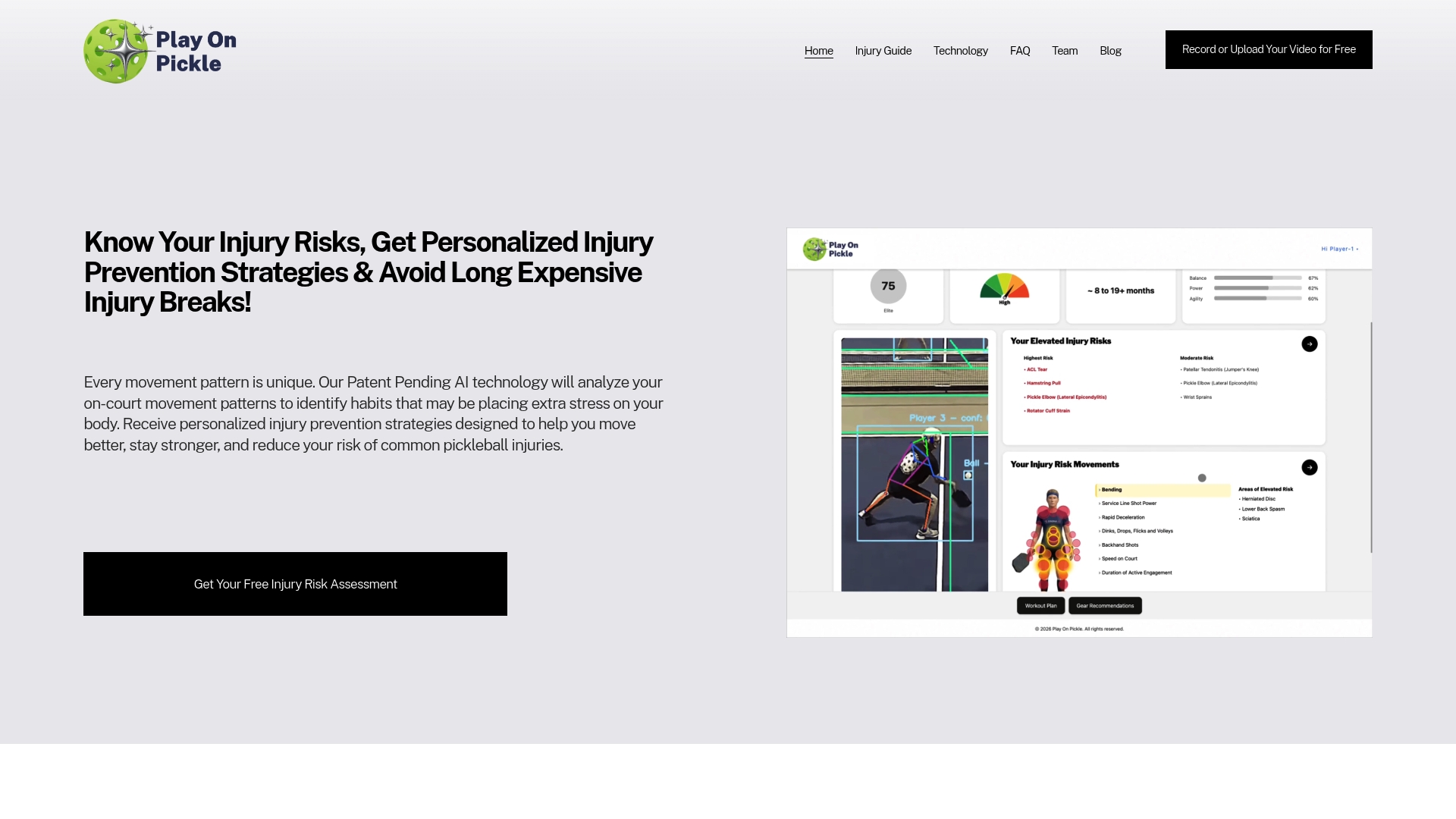
It fits best for players managing a recurring ache, an asymmetry that self-screening keeps flagging, or anyone who wants a targeted prevention plan instead of a generic one. Starting is simple: sign up through the Play On Pickle pricing page, where the Monthly subscription runs $9.99 per month and the Annual subscription runs $99 per year, upload video from a session, and get a report built around your own movement rather than an average player's.
Sources
- ACSM Publishes Updated Resistance Training Guidelines
- Hip Strength, Change of Direction, and Falls in Recreational Pickleball Players
- Injury risk and epidemiology of pickleball players in South Korea: a cross-sectional study
- Static vs dynamic stretching guidance — Hospital for Special Surgery
FAQ
What is the 3-3-3 rule for gym training?
There is no single, universally recognized "3-3-3 rule" tied to pickleball or gym prescription in current guidance, and definitions vary across fitness sources. For pickleball specifically, a more evidence-backed rule of thumb is training major muscle groups at least twice a week and pairing that with interval-style cardio, per ACSM's 2026 guidance.
Do cross trainers help with pickleball performance?
Cross-training in general, meaning structured strength, interval cardio, and balance work done off the court, directly supports pickleball performance by building the change-of-direction speed and hip strength linked to fewer falls, according to research on recreational players. If "cross trainer" refers to elliptical machines specifically, they can support aerobic base but do not replace interval or strength work suited to the sport's stop-and-go demands.
What are the disadvantages of cross training?
Cross-training can backfire if it is layered on top of a heavy match schedule without adjusting volume, leading to fatigue that raises injury risk rather than lowering it. It also takes time and consistency to see results, six to eight weeks for strength and twelve or more for tendon adaptation, so players expecting immediate change may abandon it too early.
What are the five P's of pickleball?
There is no standardized "five P's" framework established in peer-reviewed or official pickleball sources, so treating it as a fixed rule would be misleading. Players are better served focusing on the fitness components with actual evidence behind them: cardio, strength, mobility, balance, and reaction, each covered in this guide.
How often should I strength train for pickleball?
Aim for at least twice a week, training the major muscle groups with priority on the lower body and hip abductors, based on current ACSM resistance training guidance. Two consistent sessions produce more benefit than an inconsistent five-day plan that gets abandoned after a few weeks.