
Pickleball asks your hamstrings to brake you hard: every sprint to the kitchen line ends in a stop, and the muscle at the back of your thigh works while it lengthens to absorb that stop. That is eccentric work, and training it on purpose is one of the best-supported ways to protect the hamstrings. Pair it with calf strengthening and well-timed stretching and you cover the lower-body muscles pickleball loads most. Because every player's stride, stance and weak links differ, we built Play On Pickle to analyze your own movement from a video and turn it into a personalized plan. The progression below is where to start.
TL;DR
- Eccentric means the muscle lengthens under load. Pickleball stops and lunges create it constantly, so train it deliberately.
- A 2024 review reports that eccentric training reduces hamstring injury incidence by 56% to 70%.
- Progress in order: bridge variations, then slider curls, then the Nordic hamstring exercise. Stay pain-free and keep it light at first.
- Strengthen calves with step-based raises, and save long static stretches for after play.
- Older adults and anyone with a preexisting condition should check with a doctor before starting.
Table of Contents
- Why eccentric hamstring work fits pickleball
- A step-by-step eccentric hamstring progression
- Calf strengthening for pickleball
- Hamstring flexibility: when to stretch and when not to
- Adapting the plan to who you are
- Perspective
- See your own movement
- FAQ
- Sources
Why eccentric hamstring work fits pickleball
An eccentric contraction happens when a muscle produces force while it is being stretched, like lowering a weight slowly. In pickleball, forceful eccentric stops during sprints toward the nonvolley zone are a risk factor for lower-extremity muscle and tendon tears and ankle sprains. Cedars-Sinai sports medicine physician Dr. Kenton Fibel notes that hamstring strains happen with explosive court movements and can take longer to heal depending on severity.
The same 2024 review found that eccentric training also reduces strength differences between the legs and improves the balance between hamstring and quadriceps strength. That matters for a sport where many players always lunge off the same "power leg" and shuffle more in one direction.
Stanford's Michael Fredericson makes the broader point: lower-body strengthening is even more protective than stretching. Build strength first, then add flexibility.
A step-by-step eccentric hamstring progression
The principle in the research is to start submaximal, stay in a pain-free range and add difficulty gradually. A 2024 review of hamstring prevention describes moving from a two-leg slider curl to a one-leg version and then to the Nordic hamstring exercise. Here is how that looks for a recreational player.

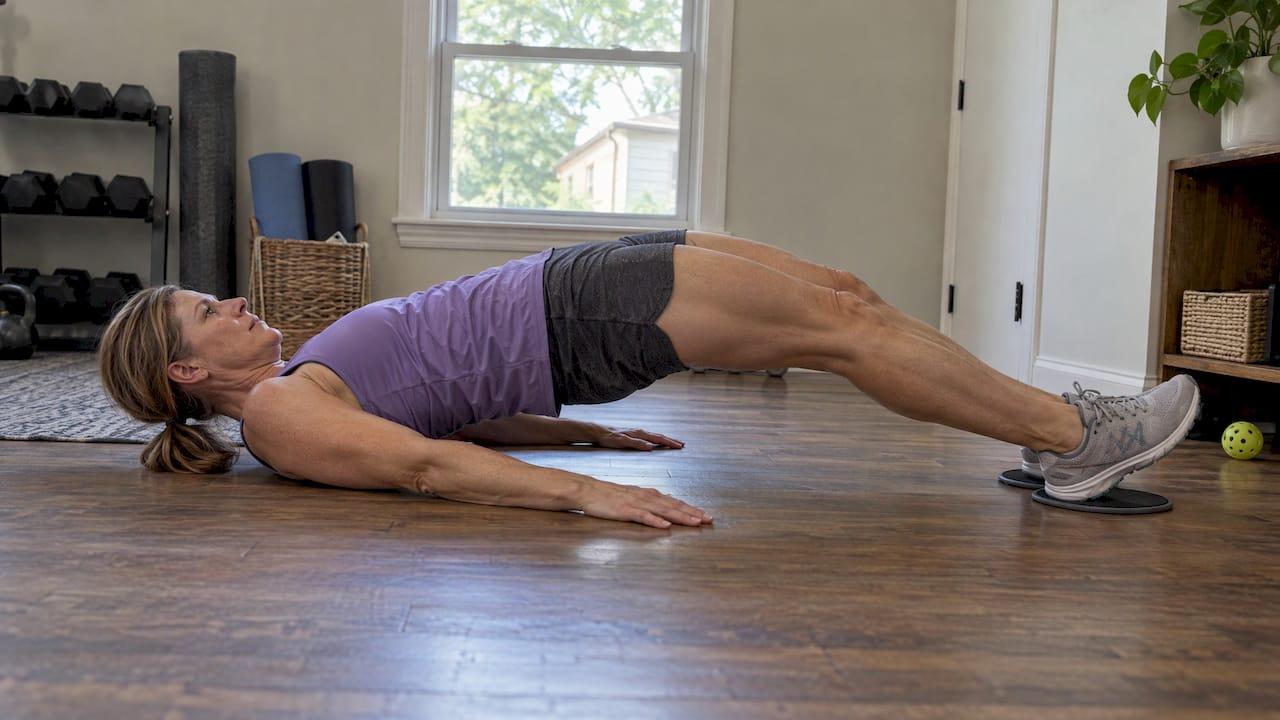
Step 1: Bridge walkouts and two-leg slider curls
Lie on your back, knees bent, and lift into a bridge. Walk your feet slowly away from your hips, then walk them back. For the slider version, put your heels on a towel or sock on a smooth floor and slowly slide them out, controlling the lengthening for three to four seconds. Do 2 to 3 sets of 6 to 8 reps. A physical therapist's five-step partner-free progression starts with bridge walkouts and notes that mild hamstring cramping is normal when you begin.
Where it goes wrong: letting the hips sag and shifting the work to the lower back. Squeeze the glutes and keep a straight line from shoulder to knee.
Step 2: Single-leg slider bridges
Once two-leg sliders feel easy, slide out with one heel while the other foot stays planted or lifts. This is the unilateral step, and it exposes the leg that is weaker. If one side shakes or shortens its range, that side is your priority. Keep the same slow tempo.
Step 3: Introduce the Nordic hamstring exercise
Kneel on a pad with your ankles held down, by a partner or a sturdy anchor. Keep your body straight from the knees to the head and resist falling forward for as long as you can. Catch yourself with your hands, then push back up. The same review notes that the Nordic curl should come in only after at least three weeks of preparation through deadlift, good-morning and Romanian deadlift variations, with minimal resistance and in a pain-free range. A university hamstring progression document also lowers partner assistance step by step until you can tolerate the full range.

Step 4: Add hinge patterns
Another review of functional hamstring strength lists unilateral Swiss-ball knee flexions, Romanian deadlifts and good mornings alongside the Nordic curl, and advises doing them under professional guidance. Increase sets and reps in bodyweight movements first. Then add resistance and drop the reps in more complex lifts.
A sample week
| Day | Work | Volume |
|---|---|---|
| Day 1 | Bridge walkouts or slider curls | 2 to 3 sets of 6 to 8 |
| Day 2 | Rest or a normal pickleball session | Light |
| Day 3 | Single-leg bridge or hinge pattern | 2 sets of 6 per side |
| Weekend | Play, then easy stretching | As tolerated |
Two hamstring sessions a week is enough to begin. Eccentric work causes soreness, so give the muscle a day or two before hard play. For a deeper walk-through of sets and progression, read our guide to eccentric training for pickleball.
Calf strengthening for pickleball
The calf takes the other half of every stop and push-off. Fredericson says that all potential lower-body injuries, particularly calf or Achilles, begin with a lack of proper stretching and strengthening. Physical therapists at Hinge Health report that strong, flexible calves help prevent Achilles tendonitis, calf strains, ankle sprains and hamstring issues, and suggest that someone starting pickleball should strengthen the calves first and keep going.
The simplest setup is a single stair:
- Straight-leg calf raise: rise onto the balls of both feet, then lower slowly over three seconds.
- Bent-knee calf raise: the same move with soft knees, which shifts load to the deeper calf muscle.
- Eccentric single-leg lower: rise on two feet, shift to one, and lower slowly on that leg only.
Ohio State Health says that calf strengthening and ankle balance work help both recovery and prevention, and that a stair or resistance bands are enough equipment. Aim for 2 to 3 sets of 10 to 12 reps, two or three days a week.
Calf strains can occur when you lunge explosively for a low shot. A sudden pop or sharp pain at the back of the lower leg needs a doctor's evaluation to rule out an Achilles tendon rupture.
Hamstring flexibility: when to stretch and when not to
Timing is the main point. Fredericson advises that prolonged static stretching before play can reduce power and explosiveness, so classic holds like the runner's stretch belong after play, when tissue is warm and more pliable. Before play, use about five minutes of dynamic movement: a light jog, lunges, leg swings and power skips.
A Rush orthopedics article recommends 5 to 10 minutes of warm-up plus 10 to 15 minutes of dynamic stretching before play, with only brief holds. Emory suggests a 5 to 10 minute warm-up and a gradual cool-down with low-intensity cardio and stretches for the major muscle groups.
A simple split:
- Before play: walking lunges, leg swings, hip hinges with no load, easy jogging. Our 5 and 10 minute pickleball warm-up routines lay this out.
- After play: seated or standing hamstring stretch, 30 seconds per side, easy tension only.
- Between sessions: Baptist Health suggests daily stretching of the hamstrings, quadriceps, calves and hips to support the knees.
Warm-up filming also helps you see how you actually move. A filming plan for practice sessions shows how to set up and use footage so you can review your preparation.
Adapting the plan to who you are
Recreational players. Northwell Health advises starting with one game per week and moving to two if you feel fine, and checking with a doctor if you have a preexisting condition. Our pickleball prehab routine gives three moves that fit this level.
Older adults. Northwell also notes that pickleball can aggravate knee arthritis in players over 65, who should go slowly and listen to their bodies. Skip the Nordic curl until you have built the earlier steps, and work with your doctor or physical therapist on anything involving a joint condition. Balance is part of staying upright on court, and a guide to balance training for seniors covers safe exercises for preventing falls.
Competitive players. A 2025 review recommends prehabilitation with eccentric strengthening of the lower extremities, balance and proprioceptive training, and core stabilization, plus structured warm-ups. Add single-leg work and compare left and right sides.
Coaches and facilities. Build the first five minutes of each session around dynamic mobility, then finish with a short hinge or slider block. Our coaching templates show how to fit this in.
Don't forget the hips. Ohio State's Dr. Vasileff says many players have weak core, low-back and gluteal muscles that need more specific training with smaller movements.
Perspective
Most players who strain a hamstring were not unlucky. They had one leg that did more of the braking, a stride that loaded the same side every time and no plan for the muscle that absorbs every stop.
That is why we think generic stretching lists fall short. A video of you moving shows which side lunges deeper, where the knee drifts inward and which muscle is being asked to do too much. Our approach is designed to identify those stress points from your own footage and turn them into a short plan of simple exercises for your biomechanics, with minimal equipment and time.
The eccentric progression above is the right foundation. Personalized analysis tells you which step to start on and which side needs more attention.
Drona
See your own movement
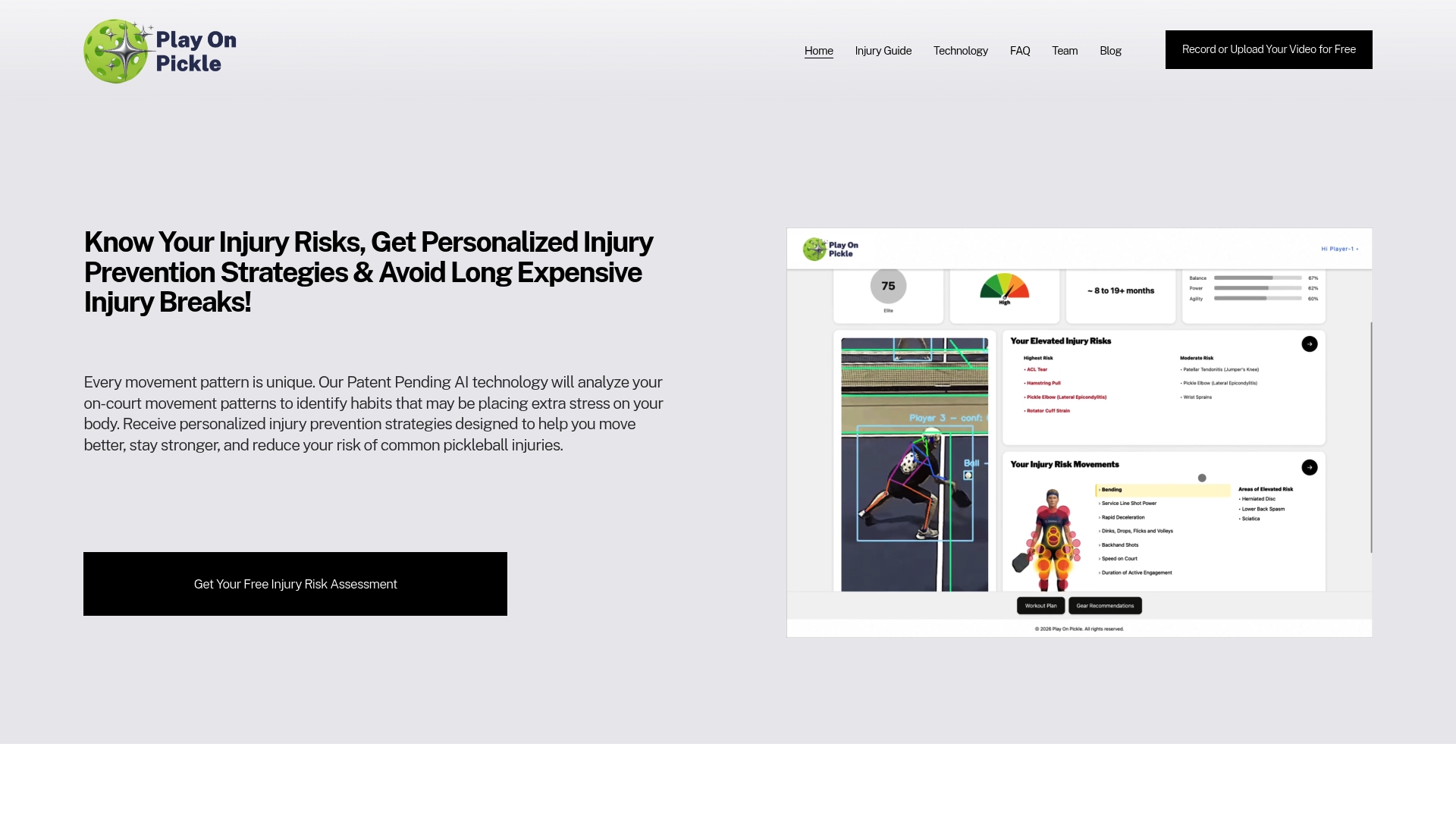
Play On Pickle analyzes video of your play with patented computer vision, flags the biomechanical stress points in your body and gives you tailored exercise and equipment recommendations. Plans start at $9.99 per month or $99 per year, with a free initial trial. See plans and pricing, or read how our technology works.
If you have had a hamstring strain, our guide on movement checks to prevent hamstring reinjury goes further.
FAQ
How often should I do eccentric hamstring exercises for pickleball?
Two sessions a week is a sensible start, with a rest day between and not right before a hard match. Begin with 2 to 3 sets of 6 to 8 slow reps and add volume gradually. Mild cramping can occur at the start, but sharp pain means stop.
Are Nordic hamstring curls safe for beginners?
They are best treated as the third step, not the first. A 2024 review describes introducing them after at least three weeks of bridge, deadlift and good-morning work, in a pain-free range with minimal resistance. Anyone with a past hamstring injury should have a physical therapist or doctor review the plan.
Should I stretch my hamstrings before playing pickleball?
Use dynamic movement before play, such as leg swings, lunges and easy jogging, and keep the longer static holds for afterward. Prolonged static stretching beforehand can reduce power, according to Stanford Medicine.
What is the best calf exercise for pickleball?
Step-based calf raises in three versions: straight-leg, bent-knee and slow eccentric lowering. A single stair is all you need. Do them two or three days a week, and have a doctor check any sudden sharp calf pain.
Sources
- Pickleball: Review and Clinical Recommendations (ACSM, 2020)
- Prevention and Rehabilitation of the Athletic Hamstring (PMC, 2024)
- Muscle Imbalances: Testing and Training Functional Eccentric Hamstring Strength (PMC)
- Hamstring Exercise Progression (University of Delaware)
- 5 Step Hamstring Eccentric Progression
- Stanford Medicine: How to avoid serious pickleball injuries
- Hinge Health: Calf strengthening exercises
- Ohio State Health: Avoid common pickleball injuries
- Cedars-Sinai: Pickleball injuries
- Northwell Health: Pickleball injuries
- Baptist Health: Pickleball-related knee pain
- Emory Healthcare: Pickleball wellness and injury prevention
- Rush: Pickleball injuries and prevention tips
- Springer: Diagnosis and Management of Common Musculoskeletal Injuries in Pickleball