
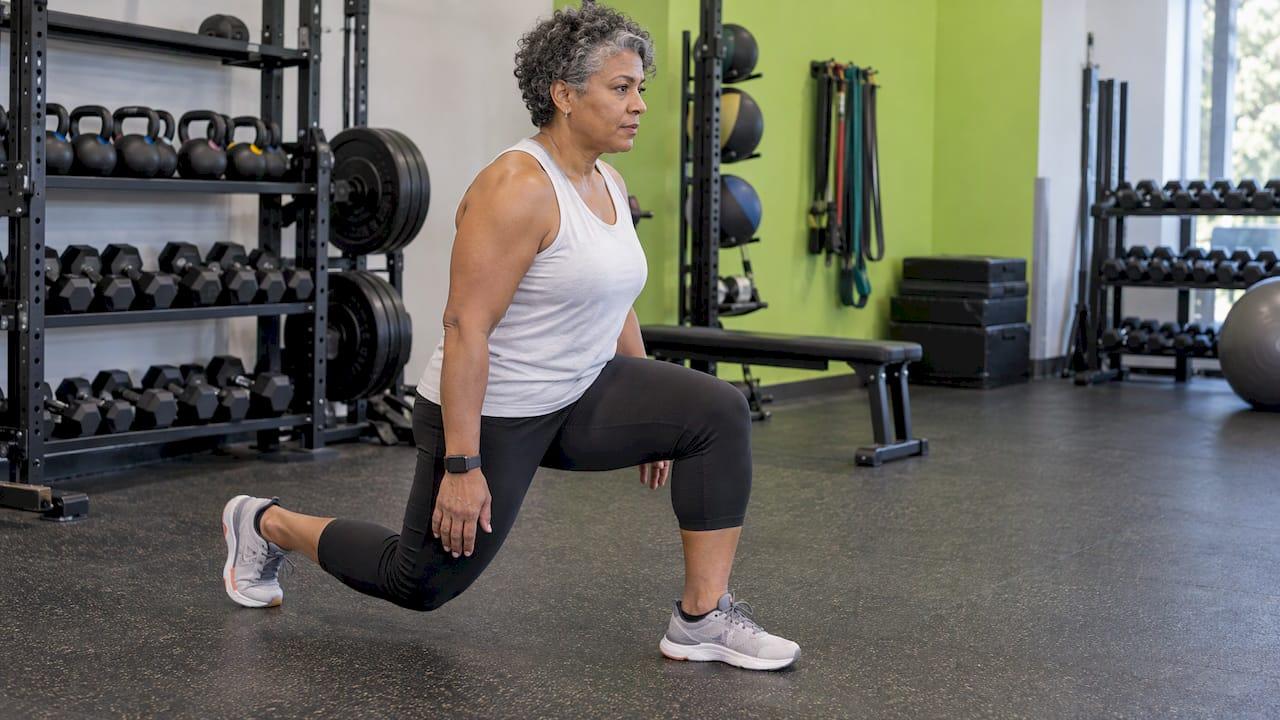
Eccentric training means lifting a weight or your body with control and then lowering it slowly, so the muscle works while it lengthens. In pickleball that is the braking muscle action behind every split step, lunge, stop and landing, and training it deliberately is one of the most practical ways to prepare knees, Achilles tendons and elbows for the demands of the game. This guide shows what to do, how many sets and reps to use, how to avoid being wrecked by soreness, and how to scale it if you are over 50 or new to strength work.
TL;DR
- Eccentric work trains the lowering, braking phase of a movement, which is what your legs and arms do every time you stop, lunge or absorb a ball.
- Start with step-downs, split squats and slow calf lowering, two sessions a week, with a 3 to 5 second lowering phase.
- Add volume gradually. Heavy eccentric work you are not used to causes delayed-onset muscle soreness.
- Pain that lasts over a week, changes how you walk or swing, or comes back with play needs a physiotherapist.
- Movement analysis from your own video can show which joints take the most load, so you know which eccentric exercises to prioritize.
Table of Contents
- What eccentric training is, in plain terms
- Why pickleball players need it
- Five eccentric exercises that match the court
- Sets, reps and tempo
- Soreness: what is normal and how to avoid too much
- Scaling it for players over 50 and beginners
- A simple two-day weekly plan
- Our perspective
- Try it on your own movement
- FAQ
- Sources
What eccentric training is, in plain terms
Every muscle action has two directions. In a concentric action the muscle shortens, like standing up out of a squat. In an eccentric action the muscle lengthens while it resists, like lowering yourself into that squat or letting a dumbbell down slowly. Cleveland Clinic's explainer describes eccentric movements as the controlled lowering phase against gravity, and notes it should be controlled rather than treated as a rest.
The reason it matters for training: muscles can handle more load eccentrically. The National Strength and Conditioning Association (NSCA) notes that eccentric actions can produce 20 to 60% greater force than concentric actions, which is why they are a strong stimulus for strength and muscle size. It is also why they can leave you sore if you add too much too soon.
Why pickleball players need it
Pickleball looks gentle, but the movement is not. The National Academy of Sports Medicine (NASM) points out that the game is built on acceleration, deceleration and quick lateral changes of direction, and lists the shoulder, knee, Achilles and lower back as common injury sites.
Think about one point at the kitchen line. You push off to reach a dink, plant, lunge, then stop and reverse. The pushing part is concentric. The stopping part, where your quad, calf and glutes absorb your body weight and decide how much stress reaches the knee and tendon, is eccentric. Players who only practice the pushing part, by playing more games, arrive at the braking part under-prepared.
The same logic applies to the arm. When your forearm muscles absorb the shock of a paddle meeting a fast ball, they work eccentrically. That is why slow, loaded lowering is a standard part of rehab for pickleball elbow.
A fair note on the evidence: there is little published research on injury prevention programs designed specifically for pickleball. Coaches and clinicians rely on the movement demands of the game and on what is known from other racquet and paddle sports, as one 2025 injury webinar from a sports physical therapy group put it. Eccentric work fits that reasoning well, and the exercises below are the ones sports medicine bodies already recommend for the same movement demands.

Five eccentric exercises that match the court
NASM recommends single-leg squats, Bulgarian split squats, eccentric step-downs and landing-mechanics work to build lower-body strength and deceleration. Here is how each looks in practice, with the court movement it covers.
1. Eccentric step-down
Stand on a step or the bottom stair on one leg. Slowly bend that knee and lower the other heel toward the floor over 3 to 5 seconds, tap lightly, and return using both legs. Keep the knee tracking over the middle of your foot. This mirrors the controlled landing after a lunge.
Where it goes wrong: the knee collapses inward or the hips drop. Use a lower step and hold a rail until the knee stays steady.
2. Split squat and Bulgarian split squat
Start with a regular split squat, back foot on the floor. When that is easy, put the rear foot on a bench. Lower for 3 seconds and stand up at normal speed. This builds the lunge position you use for low dinks and wide balls.
Where it goes wrong: the front heel lifts or you lean so far forward that the load shifts to the lower back. Take a longer stance.
3. Slow calf lowering
NASM recommends progressive calf loading and controlled eccentric work for the Achilles. Rise onto both toes at the edge of a step, shift onto one foot, then lower the heel below the step over 3 to 4 seconds. Begin with body weight only.
Where it goes wrong: bouncing at the bottom, or adding load fast. Increase one variable at a time, either reps or weight, never both in the same week.
4. Single-leg squat to a chair
Stand in front of a chair and lower yourself on one leg to touch the seat for 3 to 5 seconds, then stand using both legs if needed. It trains the same braking skill as the step-down in a position many people find easier on the knee.
5. Slow wrist extension lowering
For the elbow, a physiotherapy clinic's pickleball injury guide describes dumbbell wrist extensions, lowering the weight over 3 to 4 seconds for 8 to 10 repetitions, 2 to 3 times a day. Use a very light weight. Rest your forearm on a table palm down, use the other hand to help lift, and lower with the working hand only. For a full low-equipment plan, see our guide to preventing pickleball elbow.

Where it goes wrong: using a weight that makes the wrist shake. If the lowering is not smooth, the weight is too heavy.
Sets, reps and tempo
There is no single prescription. The NSCA describes different eccentric methods with different volumes, such as 3 to 5 repetitions per limb for 2/1 training, or 4 to 5 sets of 5 with a 5-second lowering phase in the two-movement technique. Those are programs for trained lifters using heavy loads. A recreational player does not need that.
A sensible starting framework for most players:
| Level | Exercises per session | Sets and reps | Lowering tempo | Weekly frequency |
|---|---|---|---|---|
| New to strength work | 2 to 3 | 2 sets of 6 to 8 | 3 seconds | 2 sessions |
| Some lifting experience | 3 to 4 | 3 sets of 5 to 8 | 4 to 5 seconds | 2 sessions |
| Competitive, in season | 2 to 3 | 3 sets of 5 | 3 to 5 seconds | 1 to 2 sessions, away from match days |
This table is a general starting framework, not a medical prescription. The principle that matters is progression: the last rep of each set should be slow and controlled, never a collapse.
How to progress
Change one thing at a time, in this order: tempo (3 seconds to 5), then reps, then sets, then load. Move up when you finish every set cleanly for two consecutive sessions.
Soreness: what is normal and how to avoid too much
Eccentric work is the classic cause of delayed-onset muscle soreness (DOMS), the aching that peaks a day or two after an unfamiliar workout. The American College of Sports Medicine (ACSM) explains that high-intensity eccentric exercise can cause it, but the risk can be minimized by light-intensity eccentric exercise 1 to 14 days beforehand or by gradually increasing intensity and volume.
In practice: your first week should feel too easy. Do two sets, stop with reps in reserve, and keep the tempo at 3 seconds. Do not schedule a hard eccentric leg session the day before a tournament or a long play day.
Muscle ache in the worked muscle that eases over a few days is expected. Joint pain, sharp tendon pain or pain that alters your movement is not the same thing.
When to get professional help
A physiotherapy clinic's guidance suggests seeing a physiotherapist if pain lasts over a week, changes your walking or swing, or recurs with play. The same guidance lists reasons for urgent care: being unable to bear weight, a pop in the calf or heel with weakness, visible deformity, head-injury symptoms, chest pain or severe shortness of breath. If any of those happen, stop and seek care before returning to exercise.
Scaling it for players over 50 and beginners
Older adults benefit from resistance training, and the ACSM's position on older adults recommends resistance training at least twice weekly, with sedentary or functionally limited people starting more conservatively and adjusting intensity and duration. ACSM also notes that eccentric-only contractions may appeal to older adults because of their low metabolic, heart and breathing demands.
Here is how to adapt:
- Use a support. Hold a counter or rail for step-downs and chair squats.
- Shorten the range. Lower only a few inches at first, then go deeper as control improves.
- Keep sets low. One to two sets of 5 to 6 is enough for the first two weeks.
- Space sessions. Leave at least a day between leg sessions.
- Pair it with balance work. Slow lowering teaches control, and balance training for seniors helps you stay steady on the court when a ball pulls you off line.
If you have a diagnosed heart, joint or bone condition, or you have not exercised in years, check with your doctor before starting. If Achilles soreness is your concern, our guide for players over 50 on Achilles pain goes deeper, and the prehab routine for recreational and senior players gives you a short starting set.
A simple two-day weekly plan
Here is a practical week that fits around games. Do each session after a 5 to 10 minute warm-up.
Day A (lower body):
- Eccentric step-down, 2 to 3 sets of 6, 3 to 4 second lowering
- Split squat, 2 to 3 sets of 6 per leg
- Slow calf lowering, 2 to 3 sets of 8
Day B (balance and arm):
- Single-leg squat to chair, 2 sets of 5 per leg
- Slow wrist extension lowering, 1 to 2 sets of 8 to 10 with a very light weight
- Landing practice: small, soft hops landing quietly on both feet, 2 sets of 5
Keep both days away from your hardest play. After four weeks, move one variable up. If you coach, the coaching session templates show how to fit this into a group warm-up.
Our perspective
Most recreational players come to us with the same pattern: lots of play, little strength work, and no idea which part of the body is carrying the load. Eccentric exercises are a good answer, but the right ones depend on how you move.
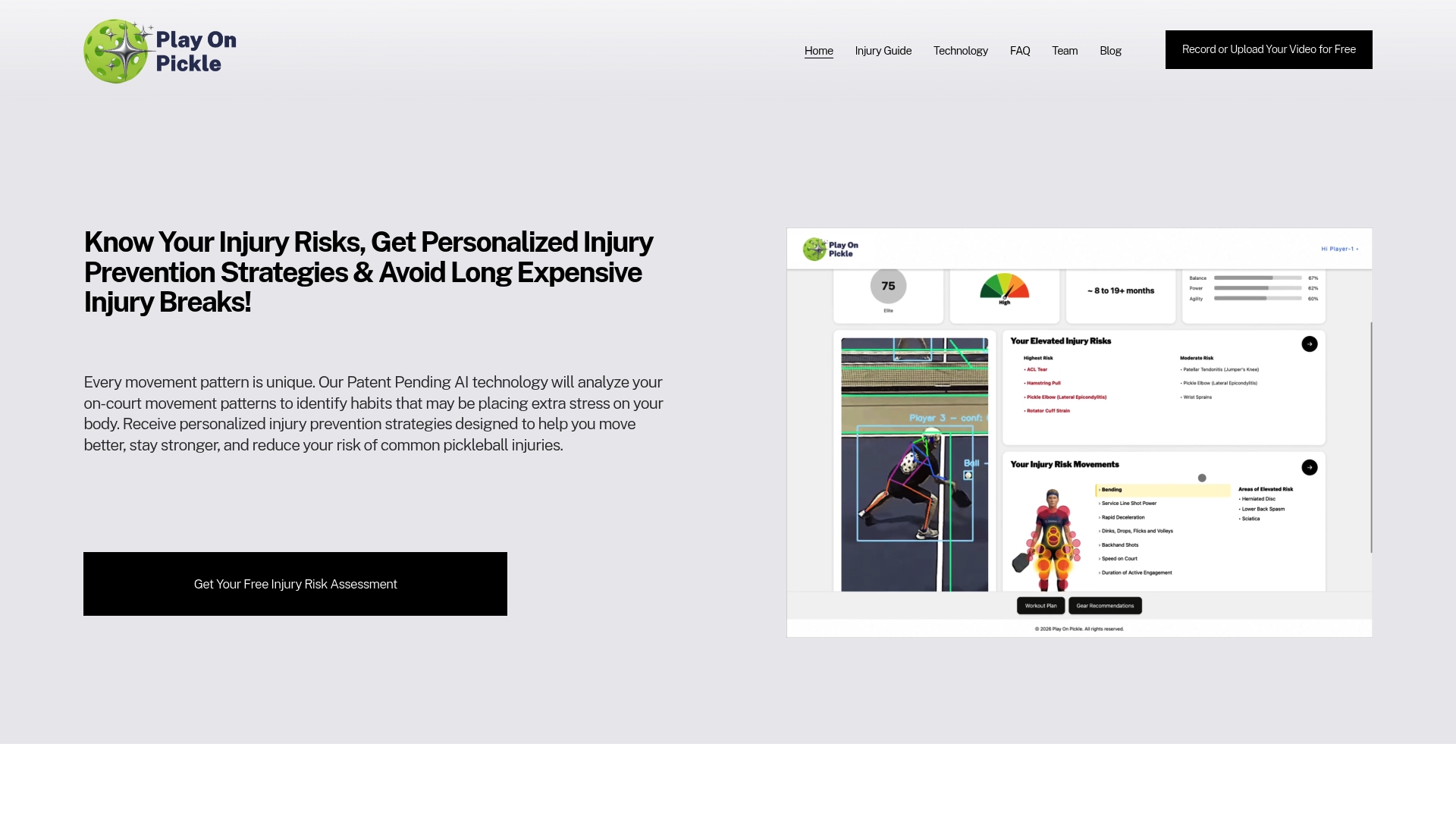
That is why we built Play On Pickle around movement analysis from video. Our patent-pending computer vision is designed to identify the stress points in your own biomechanics and turn them into simple exercises that fit into your routine, with personalized plans rather than a generic workout list.
A knee that drifts inward on a lunge, a stiff ankle, a shoulder that rides up on overheads: each points to a different priority. Starting with your own movement means your step-downs, calf work and arm exercises go where they matter for you, and the plan stays short enough to actually be done twice a week.
Drona
Try it on your own movement
If you want the exercise list tailored to how you actually move, Play On Pickle analyzes your uploaded video, identifies biomechanical stress points and delivers a personalized injury risk assessment with exercise and equipment recommendations. A monthly plan is $9.99 per month and an annual plan is $99 per year, with a free initial trial. See plans and pricing or read how the technology works.
The monthly plan currently comes with a free tripod or selfie stick, which makes it easier to record your movement from a good angle.
FAQ
Is eccentric training the same as negatives?
Mostly, yes. "Negatives" is gym slang for the lowering phase of a lift, performed slowly. Eccentric training is the broader term and includes slow lowering, step-downs and other controlled braking movements. For pickleball, the step-down is the most useful everyday version.
How often should I do eccentric exercises for pickleball?
Two sessions a week is a solid base, in line with the ACSM's twice-weekly resistance training recommendation for older adults. Start with two sets of 6 to 8 reps and a 3 second lowering phase. Add volume only after two clean sessions in a row.
Will eccentric exercises make me sore?
Probably a little, especially at first. Soreness comes from doing more eccentric work than your muscles are used to. Starting light and building volume gradually keeps it manageable. Pain in a joint or tendon, or soreness lasting beyond a week, is a reason to see a physiotherapist.
Can eccentric training help pickleball elbow and Achilles problems?
Slow loaded lowering is a standard part of rehab for both. For a tendon that already hurts, get a physiotherapist's assessment first so the load fits the injury. For prevention, our guides on pickleball elbow and Achilles pain show low-equipment plans.
Sources
- Eccentric vs. Concentric Movement, Cleveland Clinic
- Pickleball Fitness: Training the World's Fastest-Growing Sport, NASM
- How to Incorporate Eccentric Training Into a Resistance Training Program, NSCA
- Eccentric Contractions Are Responsible for Muscle Damage, ACSM
- Exercise and Physical Activity for Older Adults, ACSM
- Pickleball Injuries: Prevention and Recovery, Natural Motion Physio
- Pickleball Is Life: Injury Risk, Prevention and Rehabilitation, Evidence in Motion