
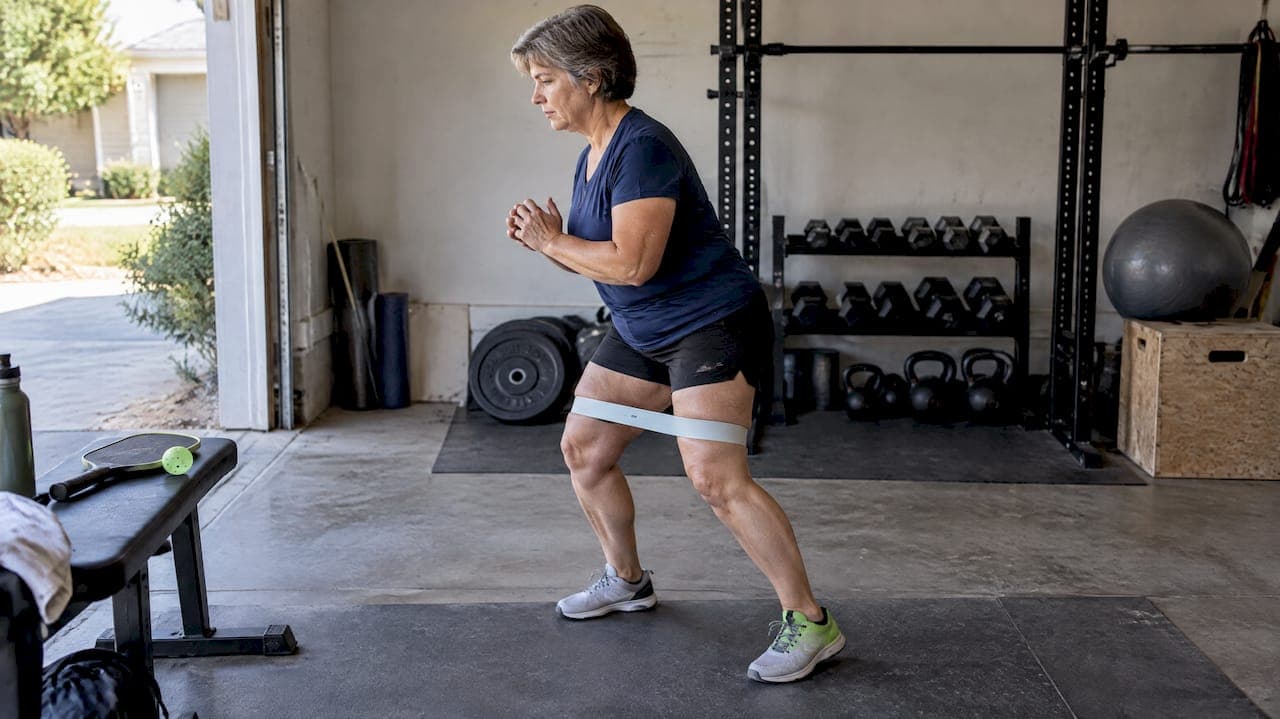
The most effective approach combines a short pre-court activation routine with twice-weekly glute-focused strength training. Start with three moves: banded side-steps and single-leg bridges before you play, and goblet squats on strength days. A 5-minute activation flow before matches plus two 20-minute strength sessions a week builds the lateral stability and power pickleball demands.
TL;DR:
- Focusing on unilateral glute exercises like resisted side-steps and single-leg bridges can specifically strengthen the stabilizers crucial for lateral court stability.
- Weak glutes increase stress on the kneecap joint and lower back, potentially leading to pain and injury over a pickleball season.
- A short activation routine before matches, combined with two targeted strength sessions weekly, improves glute function and prevents compensation patterns.
- Proper progression from bodyweight to loaded unilateral exercises, with attention to technique, optimizes strength gains and reduces injury risk.
- Video analysis can help identify individual movement patterns, guiding tailored exercises to address specific biomechanical weaknesses.
Table of Contents
- Why glutes matter for pickleball performance
- Which glute muscles to train and what each one does
- Activation and pre-court warm-up drills for your glutes
- Progressive strength work for stronger, more resilient glutes
- Mobility and recovery to keep your glutes working between sessions
- Sample routines for pre-court, strength days, and a six-week build
- What the evidence says and how movement analysis fits in
- The glute training advice most players get wrong
- FAQ
- Sources
Why glutes matter for pickleball performance
Every split-step, lateral shuffle, and hard deceleration on a pickleball court asks your glutes to do real work. The gluteus maximus drives the explosive push-off when you chase a drop shot; the gluteus medius and minimus control the side-to-side stability that keeps your knee tracking properly when you plant and change direction. When these muscles underperform, your body finds other ways to produce the same movement, and those workarounds come with a cost.
Research on experimentally weakened glute muscles found that joint reaction forces shift significantly when gluteal function drops, with the patellofemoral joint absorbing notably higher loads as a result. That extra stress on the kneecap joint is a plausible contributor to the knee pain many recreational players develop over a season. Weak glutes also tend to push more work onto the lower back during lateral movements, since the spine compensates for hips that cannot stabilize the pelvis on their own.
A few signs suggest your glutes are not doing their share:
- Your knee caves inward when you plant to change direction.
- You feel lower back fatigue or tightness after matches rather than leg fatigue.
- Your first step toward a wide shot feels slow or hesitant.
- You notice one side feels noticeably weaker or less stable than the other.
Catching these patterns early is more useful than waiting for pain to force the issue. Our guide to pickleball hip pain covers how these mechanics show up as hip discomfort specifically.
Which glute muscles to train and what each one does
Treating "the glutes" as one muscle misses the point. Three distinct muscles share the name, and each plays a different role on court.
- Gluteus maximus: the largest and most powerful of the three, responsible for hip extension, the force behind your push-off, and overall acceleration.
- Gluteus medius: sits on the outer hip and controls hip abduction and pelvic stability, which is what keeps your pelvis level during single-leg movements like lunging for a shot.
- Gluteus minimus: the smallest of the group, working alongside the medius to stabilize the hip during lateral and rotational movement.
A systematic review of exercises that generate high EMG activity in the gluteus medius and minimus identified specific variations, including hip hitch and pelvic drop movements, single-leg bridges, side-lying hip abduction with internal rotation, lateral step-ups, and resisted side-steps, as reliable activators for these segments. Compound lower-body moves like squats train the gluteus maximus well but do comparatively little for the medius and minimus. That distinction matters for pickleball specifically, since lateral control depends more on those smaller stabilizers than on raw hip-extension strength.
Activation and pre-court warm-up drills for your glutes
A short activation routine before you step on the court wakes up the glutes without fatiguing them, so you walk into your first point with better lateral control. This takes between three and six minutes.
- Mini-band monster walks: Loop a resistance band around your ankles or just above your knees, sink into a quarter squat, and take 10 to 15 steps forward, then 10 to 15 steps back.
- Resisted side-steps: Keep the band on, hinge slightly at the hips, and step sideways for 10 to 15 reps per direction, maintaining a neutral pelvis throughout.
- Standing lateral leg raises: Holding onto a wall or chair for balance, raise one leg out to the side for 12 to 15 reps per side, focusing on a slow, controlled tempo.
- Single-leg bridge activation: Lying on your back with one foot planted, lift your hips for 10 to 12 reps per side, pausing briefly at the top.
Run through each exercise for one to two sets, keeping reps submaximal since the goal is activation, not fatigue. If balance is a limiting factor, do the lateral raises and side-steps holding a chair or wall for support, and skip the band for a bodyweight-only version until your stability improves.
Pro Tip: Keep a slight bend in your knees and a neutral pelvis during side-steps. Letting your hips rotate forward shifts the work to your hip flexor (TFL) instead of your glute medius.
For a fuller pre-match warm-up that pairs with this activation flow, see our 5- and 10-minute pickleball warm-up routines.

Progressive strength work for stronger, more resilient glutes
Activation drills prepare your glutes to work. Strength training is what actually builds the capacity that prevents injury and improves your push-off power over a season. The 2026 ACSM resistance-training position stand recommends training major muscle groups at least twice weekly, and it specifically confirms that elastic bands and bodyweight exercises produce meaningful strength and functional gains, so you do not need a gym membership to see results.
A sensible progression moves from bodyweight to loaded, unilateral work over several weeks:
- Single-leg bridge: 3 sets of 10 to 12 reps per leg, pausing at the top for a one-count squeeze.
- Lateral step-up: using a low step or stair, 3 sets of 8 to 10 reps per leg, controlling the descent.
- Bulgarian split squat: 3 sets of 8 to 10 reps per leg once step-ups feel comfortable, holding dumbbells once bodyweight gets easy.
- Romanian deadlift or goblet squat: 3 sets of 8 to 12 reps, prioritizing a flat back and controlled hip hinge over heavy load.
A review on strengthening the gluteus medius recommends pairing heavily loaded compound exercises early in a session with single-joint accessory moves later, and suggests 3 to 5 sets per exercise for athletes training for strength. Two sessions a week, spaced with at least one rest day between them, fits the ACSM frequency guidance and gives your muscles time to adapt.
If you are an older player or have a history of knee or back complaints, start every unilateral movement with support nearby, a chair or wall you can touch lightly for balance, and emphasize a slow, two to three second lowering phase rather than adding weight. Technique first, load second. Watch for your knee drifting inward during step-ups and split squats; that drift is often the clearest sign that your glute medius is losing the stabilization battle to your quad or TFL.

Pro Tip: When a single-leg exercise starts feeling easy at 12 reps with good form, that is your cue to add load, not reps. More reps at a sloppy pattern trains the compensation, not the glute.
Our senior-focused exercise guide maps several of these progressions to specific court movements if you want more regression options.
Mobility and recovery to keep your glutes working between sessions
Strength training only pays off if your hips stay mobile enough to use that strength through a full range of motion. A few minutes of daily mobility work, separate from your strength days, keeps things moving.
- Hip flexor stretch: 30 to 45 seconds per side, done daily, especially if you sit for long stretches.
- 90/90 hip mobility drill: a few slow rotations per side to improve internal and external rotation at the hip.
- Dynamic leg swings: 10 to 15 per direction, ideally right before you play.
- Foam rolling the glute medius: 30 to 60 seconds per side, a few times a week, to manage tightness along the outer hip.
- Lacrosse ball work: targeted pressure on specific trigger points for 20 to 30 seconds, useful when one spot feels persistently tight.
Some soreness after a new exercise or a harder session is normal and usually fades within a couple of days. Sharp pain, swelling, or soreness that gets worse rather than better over a week is a different signal, and it is worth pausing training and getting it looked at rather than pushing through. Our article on recognizing normal post-play pain versus a warning sign walks through that distinction in more detail, and our injury prevention guide for recreational players covers recovery strategies beyond the glutes specifically.
Sample routines for pre-court, strength days, and a six-week build
Turning exercises into an actual schedule is what makes the difference between reading about glute training and doing it consistently.
- Pre-court activation (5 minutes): monster walks (12 steps each direction), resisted side-steps (12 reps each direction), single-leg bridges (10 reps per side). Keep tempo controlled and reps submaximal.
- 20-minute strength session (twice weekly): 3 minutes of dynamic warm-up, then single-leg bridge (3x10 per side), lateral step-up (3x8 per side), and Romanian deadlift or goblet squat (3x10) as your three priority moves, finishing with 2 accessory sets of side-lying hip abduction.
- Six-week progression: weeks 1 and 2 focus on bodyweight versions with strict form; weeks 3 and 4 add light load (a dumbbell or kettlebell) to the step-up and deadlift; weeks 5 and 6 slow the eccentric (lowering) phase to 3 seconds and increase load again if form holds. Track whether single-leg balance and knee tracking improve, not just whether the weight goes up.
Once this six-week block is done, a longer structured plan helps you keep building. Our 90-day pickleball training plan picks up roughly where this progression leaves off, and our conditioning guide pairs well with glute strength work if power and speed are your next targets.
What the evidence says and how movement analysis fits in
The research behind this article points in one direction: targeted, unilateral glute work, not just squats and lunges, builds the lateral stability and hip-extension power pickleball actually requires, and that work measurably reduces injurious joint loading patterns. The harder part for most players is knowing which pattern they actually have. Some players are knee-dominant, relying on the quad and knee joint to do work the hip should be doing, while others are hip-dominant but weak specifically in the medius and minimus.
Video-based movement analysis can surface that distinction more reliably than guesswork. An AI-powered platform can analyze a player's movement patterns from uploaded video, flag biomechanical stress points, and generate a personalized assessment with exercise and equipment recommendations suited to what the footage shows. For a recreational player unsure whether their glute medius or their knee mechanics need the most attention, that kind of individualized read can save weeks of training the wrong pattern.
The glute training advice most players get wrong
Most pickleball players who train their glutes at all default to squats and lunges and call it done. That covers the gluteus maximus reasonably well and almost entirely ignores the medius and minimus, the muscles actually responsible for the lateral control that prevents the knee-cave injuries so common in this sport. The conventional wisdom treats glute training as a single box to check rather than three distinct muscles with three distinct jobs.
The bigger gap, though, is consistency, not complexity. The exercises in this routine are simple on purpose. What changes outcomes is doing a short activation sequence before most sessions and a real strength session twice a week for months, not finding the perfect exotic exercise. If you take one thing from this article, prioritize the resisted side-step and single-leg bridge before anything fancier. They target exactly the muscles your lateral movement depends on, and they take minutes, not hours.
— Drona
FAQ
What muscles are worked when playing pickleball?
Pickleball engages the gluteus maximus, medius, and minimus for push-off power and lateral stability, along with the quadriceps, hamstrings, calves, and core for deceleration, balance, and rotational power during shots. The hip stabilizers get particularly heavy use during the frequent side-to-side movement the sport demands.
What are the top 3 glute exercises for pickleball?
Resisted side-steps, single-leg bridges, and lateral step-ups are among the most effective, since they target the gluteus medius and minimus segments that control lateral stability on court. A systematic review of EMG activity identified these variations as reliable activators for those specific muscles.
What are the five P's of pickleball?
Definitions of the five P's vary depending on the source, and there is no single agreed-upon framework. Some coaches use it to describe positioning, patience, placement, power, and practice, but this is not a standardized term across the sport.
Why do my glutes hurt so much after pickleball?
Soreness after a match often reflects how much lateral and explosive work your glutes did, especially if your training has not matched the demands of the sport. Persistent or sharp pain, rather than typical muscle soreness, is a different signal worth getting checked rather than training through.
Sources
- ACSM resistance-training position stand (2026)
- A systematic review of therapeutic exercises generating high EMG activity in GMed/GMin
- The effect of experimentally induced gluteal muscle weakness on joint kinematics and reaction forces