
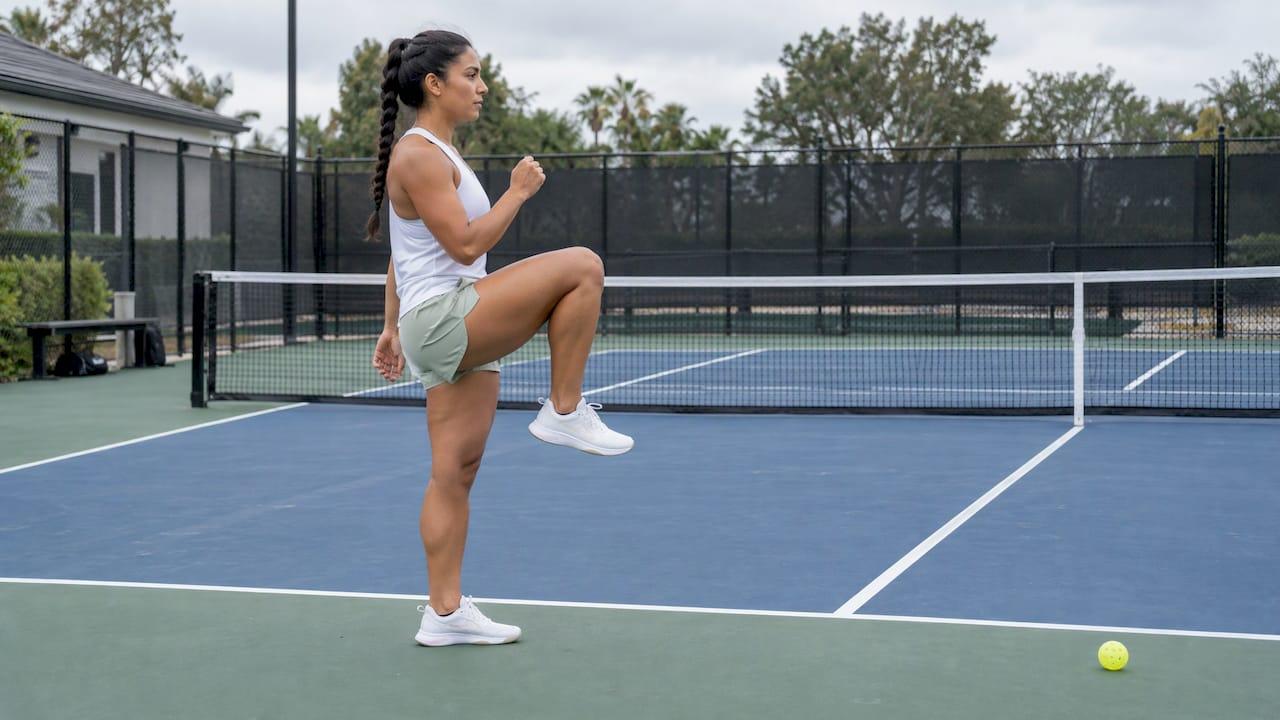
Good hip mobility for pickleball comes down to three habits: a short dynamic warm-up before you play, a few targeted hip drills on non-play days, and a way to see how your own hips move instead of guessing. Every lunge, split step and backpedal on a 20-by-44-foot court runs through your hips. When they are stiff, the knee, low back or a fall pays for it. Play On Pickle analyzes video of your movement and builds a personalized plan around the stress points it finds, so you know which of the drills below matter most for you.
TL;DR
- Hips do the hard work of pickleball movement: in one 2024 study of recreational players, 42% reported falling, and lunging was the leading cause.
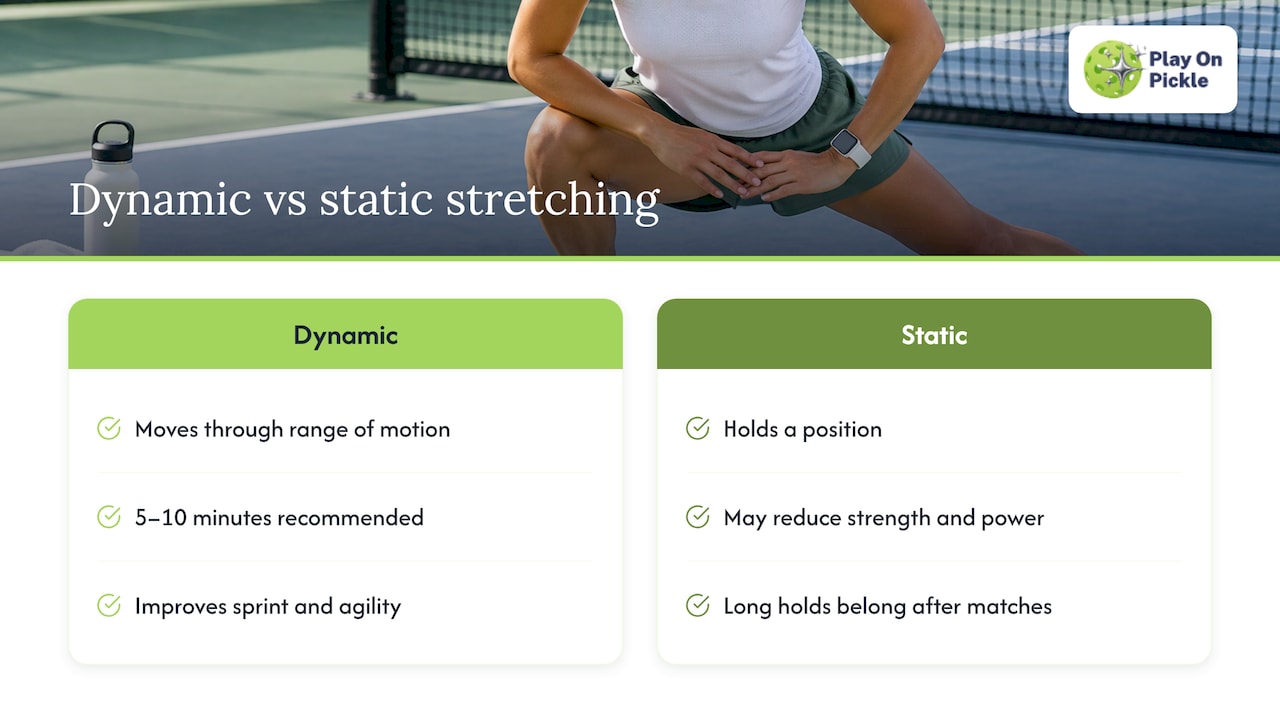
- Warm up 5 to 10 minutes with dynamic moves (leg swings, hip circles, lateral lunge walks). Save long static holds for after play.
- Three drills cover most players: 90/90 hip switches, half-kneeling hip flexor work, and hip airplanes or lateral band work for strength at the end range.
- Some hip limits come from bone shape, not tight muscle. Build control inside the range you have rather than forcing more.
- Pain that lingers for hours, sharp pain, clicking or locking needs a physical therapist or physician.
Table of Contents
- Why your hips decide how safely you move on court
- A warm-up that actually prepares the hips
- Three hip drills worth doing on non-play days
- A weekly plan you can actually keep
- Not every tight hip can be stretched
- Older adults and players with limited range
- When to see a physical therapist or physician
- What we believe about hip mobility
- See your own hip movement
- FAQ
- Sources
Why your hips decide how safely you move on court
Pickleball looks gentle, but the footwork is not. Dr. Jim Hsu of Yale Medicine describes the sport as deceptively casual-looking, which is why many players jump in without preparing. Dr. Jamie Confino of Keck Medicine of USC says that quick lateral movements on a small court ask a lot of neuromuscular control, meaning how well your nervous system coordinates muscles to stop, start and change direction.
The clearest numbers come from a 2024 study in the International Journal of Sports Physical Therapy of 92 recreational players:
- 42% reported falling during play.
- Lunging (57%) and moving backward (24%) were the leading causes.
- Fallers were older and slower on a pickleball-specific agility test.
- Hip abduction strength (the muscles that move your leg out to the side) tracked with faster change-of-direction times.
Mobility and strength work together here. Noe Sariban, PT, DPT, writing in Pickleball Magazine, lays out a sequence of mobility, then stability, then strength, then power and agility, and warns that building strength on a poor mobility base raises injury risk. So the order matters: get your hips moving, then load them.
A warm-up that actually prepares the hips
The research on warm-ups is consistent. Yale Medicine's Dr. Andrew Jimenez recommends 5 to 10 minutes of dynamic stretching such as lunges, wide arm circles and knee lifts, with light stretching and a slow walk afterward. Dr. Confino gives the same window and names hip mobility as part of it, alongside light jogging, shoulder activation and practice strokes.
Dynamic means moving through a range of motion rather than holding a position. A 2025 meta-analysis summarized by The Dink found that static stretching before activity can temporarily reduce strength and power, while dynamic warm-ups improved sprint and agility performance. That is why the long holds belong after the match.
A 7-minute pre-play sequence
Use your own timing, but this order works for most players:
- Light cardio, 1 to 2 minutes. Easy jogging, side shuffles or jumping jacks to raise body temperature.
- Leg swings, 10 to 15 per leg. Front to back, then side to side, holding a fence or net post. Stevens Point Orthopedics uses this count.
- Hip circles, 8 to 10 each direction. Stand on one leg and draw big circles with the knee.
- Lateral lunge walks, 8 to 10 per side. Sit back into the hip, keep the chest up and the trailing leg straight.
- Lunge with rotation, 8 to 10 per side. The same orthopedic group lists it as a dynamic option that mimics reaching wide.
- Practice strokes and a few split steps. Start at half speed.
If you are new to the sport or returning after a break, ease in. Physical therapist Shelby Schaefer at Luminis Health suggests that players who are not typically active begin with once or twice a week and add from there. Dr. Confino calls gradual progression the biggest prevention strategy.
Three hip drills worth doing on non-play days
The warm-up gets you ready for one session. These drills build range and control over weeks. Two or three short sessions a week is plenty. The Dink suggests a full 15-minute block on rest days.
1. The 90/90 hip switch
Sit on the floor with both legs bent at 90 degrees, one knee in front and one to the side. Drop both knees to one side, then rotate to the other. This trains internal and external rotation, the twisting range you use when you turn to chase a lob.
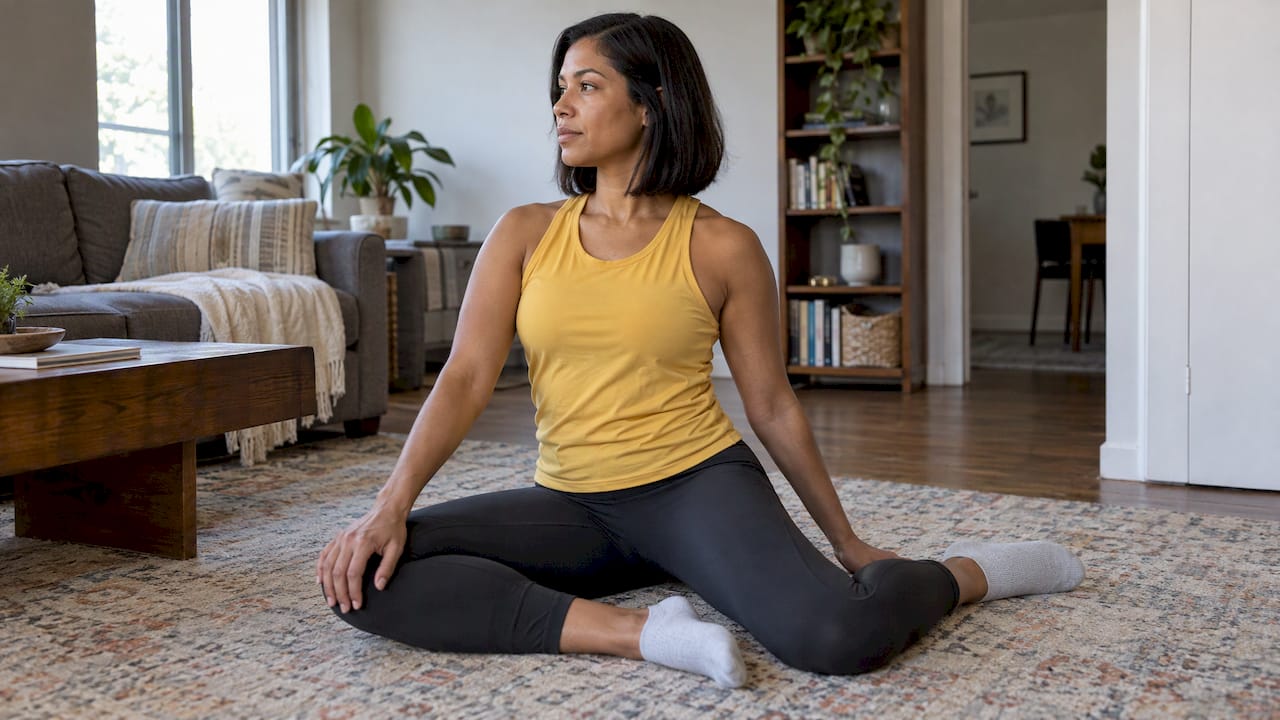
Selkirk Sport performance coach Connor Derrickson progresses it from seated, to upright with a band, to holding a kettlebell, to adding a 3-second foot lift-off. Stay at the first level until you can switch without using your hands.
Where it goes wrong: collapsing the torso to one side or letting the hips rock backward. Sit tall and move from the hip joint.
2. Half-kneeling hip flexor stretch
The hip flexors run along the front of the hip and shorten when you sit all day. Tight ones can pull the pelvis forward and leave the lower back working harder than it should. Cleveland Clinic physical therapist Rebecca Justen, DPT, includes the low lunge in her hip-opening stretches: step one foot forward with the knee over the ankle, lower the back knee, and ease into the range gently.
Hold for five to eight breaths, per the same page, and repeat two or three times a side. Tuck your tailbone slightly and squeeze the glute of the back leg. You should feel the stretch at the front of the hip, not a pinch in the low back. Arching the back to go deeper is the common mistake.
The Pickleball Physio routine on the same theme pairs this stretch with low back relief, which is a sign of how often the two problems show up together. If back stiffness after play is your main complaint, our guide on what causes pickleball hip pain and how to fix it goes further.
3. Hip airplanes and lateral strength work
Mobility you cannot control is not much use on court. Pickleball Union lists hip airplanes (3 sets of 8 per leg: hinge at the hip on one leg, then rotate the torso up) and banded clamshells (2 sets of 10 to 15 per side) among its four hip exercises. Those build strength at the end of your range, which is where lunges land.
The lateral strength matters: in the 2024 falls study, hip abduction strength correlated with faster change-of-direction times. Add a band around the thighs for side steps once the clamshell feels easy.
A weekly plan you can actually keep
| When | What | Time |
|---|---|---|
| Before every session | Dynamic warm-up (swings, circles, lateral lunge walks) | 5 to 10 minutes |
| After play | Slow walk, light static holds of 20 to 30 seconds | 5 to 7 minutes |
| Two non-play days | 90/90 switches, half-kneeling stretch, airplanes, clamshells | 10 to 15 minutes |
| Once a week | Balance or single-leg work | 5 minutes |
The post-play hold time follows the 20 to 30 seconds that Stevens Point Orthopedics and The Dink both use. For balance work, our proprioception drills for pickleball fit well on the same days. If you play several days in a row, plan a proper recovery day, and some players add options like hyperbaric oxygen for recovery to a cooldown routine.
Not every tight hip can be stretched
This point saves many players months of frustration. Sariban notes that some hip limits are anatomical, tied to the shape of the hip socket, and cannot be stretched away. In that case the goal is to build compensation strategies: control, strength and good positioning inside the range you have, rather than forcing the joint.
This is why copying a pro's routine can disappoint. Two players with the same stiffness may need different work, one a stretch and the other stability. Looking at how you actually move on court is the fastest way to tell which you are.
Older adults and players with limited range
The injury numbers explain why this group should take hips seriously. Keck Medicine of USC cites a study showing an 88% rise in pickleball injury rates since 2020, with 91% of injuries in players 50 and older. Yale Medicine reports a 90-fold increase in pickleball-related fractures from 2002 to 2022, most in players aged 60 to 69.
Training helps. In a 2025 cohort study of players 55 and older, a 10-week program of strength, balance, change-of-direction and agility work improved change-of-direction time by 0.7 seconds and reduced fear of falling. At five months, 25% of the training group had fallen versus 44% of controls.
Practical changes for older players:
- Do the 90/90 switch seated in a chair or with hands behind you for support, and keep the range comfortable.
- Hold a wall or fence during leg swings and hip circles.
- Start the half-kneeling stretch with a cushion under the knee.
- Make your first lateral strength work band-free, then add resistance.
If you have had a hip replacement, your surgeon sets the plan, and our article on pickleball after hip replacement explains why a calendar window alone is not clearance. For a short routine built for this group, see pickleball prehab for recreational and senior players.
When to see a physical therapist or physician
Stretching should feel like tension, never like damage. Cleveland Clinic advises contacting a healthcare provider or physical therapist if you feel sharp, pinpoint pain, or pain that persists for more than a few hours. Also get assessed for:
- Clicking, catching or locking in the hip
- Pain that shoots down the leg or into the back
- Swelling, or trouble comfortably bearing weight
- Night pain that disrupts sleep
- A pop with sudden pain during a lunge or pivot
A clinician can examine the joint and order imaging where needed. Do not play through these.
What we believe about hip mobility
Most hip advice for pickleball is a list: ten stretches, do them all. The trouble is that a list treats every player the same. A 68-year-old who plays three mornings a week and a 35-year-old tournament player need different things, and the same stiff hip can come from very different causes.
We built Play On Pickle around that difference. You upload video of your play, and our patent-pending computer vision identifies stress points in how you move. You get a personalized injury risk assessment, and exercise and equipment recommendations tailored to your biomechanics. Our approach is designed so the exercises fit into a routine you already have, with minimal equipment and time.
The routine in this article is a solid start. Seeing your own movement is how you make it yours: which hip needs rotation, which needs control, and which drill to do first.
Drona
See your own hip movement
Play On Pickle works from video you upload, finds the stress points in your movement and turns them into a personalized plan. The monthly subscription is $9.99 per month and the annual subscription is $99 per year, both listed on our pricing page, with a free initial trial to start.

We also run a free tripod offer with the $9.99 monthly plan, which makes filming your own sessions easier. Coaches and facilities can use the same approach with the players they look after, alongside our coach warm-up and session templates.
FAQ
How long should a hip mobility warm-up for pickleball take?
Five to ten minutes is the range both Yale Medicine and Keck Medicine of USC give. Use dynamic moves such as leg swings, hip circles and lunges, and finish with a few practice strokes. If you are short on time, a focused five minutes beats skipping it.
Should I stretch before or after playing?
Do movement-based drills before and longer holds after. A 2025 meta-analysis summarized by The Dink found static stretching before activity can temporarily reduce strength and power. Hold static stretches 20 to 30 seconds once you are warm.
What are the best hip exercises for pickleball?
The 90/90 hip switch, a half-kneeling hip flexor stretch, hip airplanes and banded clamshells cover rotation, front-of-hip range and lateral strength. Do them two or three times a week. Choose the one that matches your limitation first rather than doing everything at once.
Can hip mobility exercises prevent pickleball falls?
They are one part of it. Falls in the 2024 study were linked to lunging and backward movement, and hip strength tracked with faster direction changes. A broader program that adds balance and agility work cut fall rates in a 2025 study of players 55 and older.
Why does my lower back hurt after pickleball?
Tight hip flexors can be one contributor, since they affect pelvic position. Work on the half-kneeling stretch with a tucked pelvis. If the pain is sharp, shoots down the leg or does not settle, see a physical therapist or physician.
Sources
- Hip Strength, Change of Direction, and Falls in Recreational Pickleball Players (IJSPT, 2024)
- How to Prevent Pickleball Injuries (Keck Medicine of USC)
- How to Prevent Pickleball Injuries (Yale Medicine)
- The Basis of Mobility and Stability (Pickleball Magazine)
- Pickleball Stretching Routine for Better Court Movement (The Dink)
- Avoiding Pickleball Injuries (Stevens Point Orthopedics)
- Pickleball Injuries Rise With the Sport's Popularity (Luminis Health)
- How to improve your hip mobility in pickleball (Selkirk Sport)
- The 4 Best Hip Exercises For Pickleball (Pickleball Union)
- Effect of a Multi-Faceted Training Program on Falls in Pickleball Players (PMC)
- Tight Hips? Try These 11 Hip-Opening Stretches (Cleveland Clinic)