
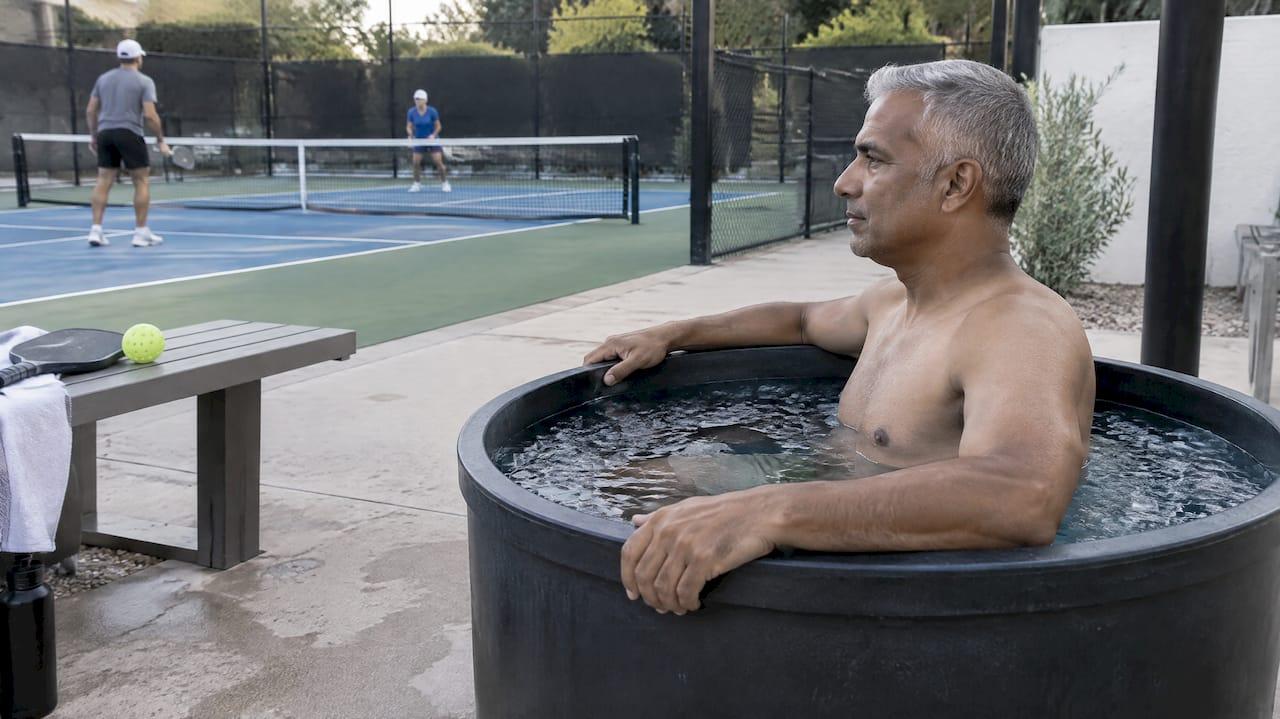
An ice bath can help you feel better after a hard day of pickleball, mainly by easing muscle soreness. It works best when you play back-to-back matches, and it is a poor fit if you are chasing strength gains or have heart, lung or circulation problems. Water around 50 to 59°F for about 11 to 15 minutes is the range the research keeps landing on. Here is what the evidence says, how to do it safely, and where an ice bath fits next to the rest of your recovery.
TL;DR
- Cold water immersion reduces soreness and perceived fatigue in the first day or so after exercise, according to a 2023 meta-analysis of 20 studies.
- A common protocol is 11 to 15 minutes in water at 52 to 60°F, or two 5-minute dips at 50°F with a 2-minute break, per the American College of Sports Medicine.
- Do not make it a daily habit all season. Regular use may blunt strength and muscle adaptations.
- Heart disease, high blood pressure, Raynaud's disease, nerve problems and chronic lung disease are reasons to talk to your doctor first.
- Sore for days, swollen or hurting in one spot? That is a question for a clinician, not a tub.
Table of Contents
- When an ice bath makes sense for pickleball
- What the research says about cold water immersion
- When to take one after playing
- How cold and how long
- How often is too often
- Who should talk to a doctor first
- Ice bath after an injury versus after a long day
- A simple ice bath routine for pickleball players
- Recovery options that work alongside or instead of ice
- Our perspective: recovery starts before the ice
- Find out why you are sore in the first place
- FAQ
- Sources
When an ice bath makes sense for pickleball
Pickleball is a start-stop sport. Sprinting to the kitchen line, lunging for a dink and pivoting on a wet shoe all load your calves, Achilles tendons, knees and shoulders. A physical therapist writing about the sport names calf strains, Achilles problems, patellar tendon stress and rotator cuff irritation as frequent culprits.
An ice bath is most useful in a few situations:
- Tournament days or league nights with several matches close together. The same physical therapist notes that 10 to 15 minutes of cold water immersion has shown benefits for soreness and readiness when your next game is within 24 hours.
- A long, hot session when your legs feel heavy and you have to be back on court tomorrow.
- Sore legs after an unusually big day, such as your first round-robin of the season.
It is less useful after a casual hour of dinking, when a walk, a snack and some water will do the job. Our guide to a pickleball recovery day covers what to do and how often on days when you are not in a tub.
What the research says about cold water immersion
The honest summary: cold water helps with how you feel in the short term, and the evidence for everything beyond that is mixed.
A 2023 meta-analysis pooled 20 studies. Cold water immersion reduced delayed-onset muscle soreness and perceived exertion right after exercise, lowered creatine kinase (a marker of muscle stress) at 24 hours, and lowered lactate at 24 and 48 hours. It did not change C-reactive protein or IL-6, two inflammation markers, during the 48-hour window.
A 2024 network meta-analysis of 57 studies and 1,220 healthy participants ranked cryotherapy highest for relieving soreness and for recovering jump ability. Contrast water therapy, which alternates hot and cold, ranked highest for creatine kinase recovery.
A 2025 review agrees that cold water immersion decreases muscle swelling after strenuous exercise and eases soreness. The same authors say conclusive evidence that cold beats other recovery methods is limited, and that some of the effect may come from athlete preference. They add that used responsibly it should not cause severe harm.
Mayo Clinic Press makes a similar point: much of the cryotherapy research is too weak to support many of the bolder claims you see online.
What that means for you: expect less soreness and a fresher feeling tomorrow. Do not expect a cure for tight hips, a fix for a bad knee or protection against injury.
When to take one after playing
Timing matters more than most players realize. The ACSM says cold water immersion improves neuromuscular performance for up to 24 hours after exercise, but not beyond. It also notes that many people have shifted the dip to four to six hours after exercise to limit interference with strength and muscle-building goals. A delayed dip gives somewhat smaller but still useful results.
The BASES expert statement adds a caution for tournament players. When two sessions are less than four hours apart, cooling may hinder the second performance, so it is not recommended between them.
Practical rules of thumb:
- Playing again within a few hours: skip the ice bath until your last match is done.
- Playing again tomorrow: a dip within the evening is reasonable if you are healthy and your doctor is fine with it.
- Next game is days away and you are working on strength: you may not need it at all.
One more timing note from the pediatric sports medicine guidance at HealthyChildren.org: do not use ice immediately before physical activity.
How cold and how long
The numbers differ a little between organizations, but they cluster tightly.
| Source | Temperature | Duration |
|---|---|---|
| ACSM (2023) | 50°F, or 52 to 60°F | Two 5-minute dips with 2 minutes between, or one 11 to 15-minute dip |
| Narrative review, Driller and Leabeater (2023) | 50 to 59°F | 11 to 15 minutes |
| BASES (2021) | 8 to 12°C (about 46 to 54°F) | About 8 to 12 minutes, waist or mid-torso |
| AARP, adults over 50 (2026) | 50 to 59°F | 2 to 5 minutes, no more than four times a week |
A 2025 network meta-analysis of 55 trials found that 10 to 15 minutes at 52 to 59°F was most effective for soreness. Colder water (41 to 50°F) for the same time did best for jump performance and creatine kinase. A 2019 systematic review also found cold water immersion helped more than passive rest, especially in the first 24 hours.
For most recreational players, a sensible starting point is the milder end: water in the low 50s to 59°F, a few minutes the first time, building toward the research range only if it feels fine. Colder is not better. It is just colder.

How often is too often
This is where players go wrong. Mayo Clinic Press quotes sports performance researcher Dr. Jagim as advising against ice baths every day throughout a season because they may hinder long-term adaptations, particularly strength and muscle growth.
The BASES statement explains why. Cooling appears to be fine, even helpful, after high-intensity and endurance-style sport. It may be harmful if used right after strength or resistance training, and a meta-analysis it cites found regular cold water immersion hurt resistance training adaptation while aerobic performance was unaffected. A 2026 article in The Conversation makes the same point: dampening inflammation with regular ice baths may limit long-term training gains.

If you lift to stay strong for pickleball, keep the ice bath away from those days. Use it for tournaments and congested weekends rather than every session. The Driller and Leabeater review suggests it is a worthwhile tool at certain times of the season, such as in-season or during competition events.
Who should talk to a doctor first
Cold water is a real physical stress. Plenty of pickleball players are over 50, and this is where age and health history matter.
The American Lung Association explains that cold shock can cause rapid, uncontrolled breathing, which may lead to dizziness or fainting, and that cold water constricts blood vessels and raises blood pressure. People with chronic lung disease or existing heart conditions are particularly vulnerable. It also recommends talking to a healthcare provider before adding cold plunges or saunas to a routine, especially if you are pregnant.
The ACSM lists conditions that rule out or complicate cold water immersion, including prior cold injury, Raynaud's disease, hypothyroidism, claustrophobia, serious cardiovascular disease, uncontrolled hypertension and nervous system disorders. Harvard Health adds poor circulation and neuropathy in the legs or feet to its list of reasons to avoid whole-body cold therapy.
If any of that sounds like you, ask your primary care doctor or cardiologist before you try it. The BASES statement goes further and says all athletes should seek guidance from a physician before any therapeutic cooling.
Safe-use habits for everyone:
- Never plunge alone, as the AARP interview with a sports medicine physician advises.
- Keep your head out of the water. Mayo Clinic Press warns that gasping from sudden submersion can lead to drowning if the head is underwater.
- Ease in. A cool shower first, then slow entry with calm, steady breathing, reduces the initial shock response.
- Get out if you feel dizzy, numb, short of breath or your heartbeat feels irregular.
- Skip ice on skin with open wounds, bleeding or infection, per HealthyChildren.org.
Ice bath after an injury versus after a long day
Soreness all over is different from an injury in one spot.
The 2025 review notes that cold is most effective in the acute phase, right after an injury, to reduce swelling, inflammation and pain. Heat generally works better later, once the acute phase has passed or peak soreness has eased. HealthyChildren.org describes immersing a sprained ankle or wrist for 20 to 30 minutes per session to reduce swelling.
But long-term icing is not a good plan. Dr. Jagim cautions that icing a muscle or joint strain for days may slow healing by repeatedly reducing blood flow and the signals tissue needs to repair.
A few pickleball-specific cases from the physical therapist at Peak Swing:
- Acute calf or Achilles strain: ice with compression in the first hour and avoid heat for the first 48 to 72 hours.
- Sore knee tendon: avoid aggressive icing and favor progressive loading.
- Players 60 and older: stiffness is often the issue rather than inflammation, and 15 minutes of moist heat on the hip, knee or shoulder before play can improve early mobility.
An ice bath does not prevent injuries, and it is not a treatment plan. If pain lingers, wakes you at night, comes with swelling or a pop, or changes how you walk, see a physician or physical therapist. Our guide on whether your pain after pickleball is normal or a warning sign helps you sort out which is which, and the 4-stage return to pickleball plan covers getting back on court.
A simple ice bath routine for pickleball players
- Check the clock. Wait until your last match of the day is finished, and ideally a few hours after hard strength work.
- Hydrate and eat something. Our pickleball hydration strategy breaks down what to drink for a one-hour session, a longer day or a tournament.
- Set the temperature. Aim for 50 to 59°F. Use a thermometer rather than guessing from the amount of ice.
- Rinse in cool water first, then lower yourself slowly to the waist or mid-torso. Keep your head and shoulders out.
- Time it. Begin with 2 to 5 minutes. Work up to 11 to 15 minutes, or use two 5-minute dips with a 2-minute break.
- Breathe slowly. Long exhales help blunt the shock response.
- Get out, dry off and warm up gradually. Walk around, put on dry layers and have a warm drink.
- Log how you feel the next morning. If you are not noticeably less sore, the dip is probably not doing much for you.
If you want to compare tubs, chilled water setups and other home options, a guide on cold water therapy for athletes is a good place to start. For players who like alternating hot and cold, sauna recovery frequency is worth reading alongside the contrast therapy findings above. Remember that the American Lung Association warns that switching between a sauna and icy water can raise blood pressure, so the doctor conversation applies there too.
Recovery options that work alongside or instead of ice
If cold water is not for you, or your doctor says no, you have good options.
- Active recovery. Light to moderate movement below the lactate threshold is proposed to help clear lactate and reduce perceived soreness. Think an easy walk or a slow bike ride.
- Heat for stiffness. Especially for older players, warm moist heat before playing can loosen joints.
- Foam rolling. Our guide to foam rolling for pickleball covers how, when and how long.
- A proper warm-up. A 5- or 10-minute pickleball warm-up prepares calves, hips and shoulders for the sudden changes of direction the sport demands.
- Prehab. A short prehab routine builds the strength that makes soreness less likely in the first place.
Notice what these have in common: they work before and between sessions, which is where most pickleball injuries are shaped. An ice bath only deals with the aftermath.
Our perspective: recovery starts before the ice
We see the same pattern in recreational players. Someone plays four or five times a week, feels sore, and reaches for a recovery gadget. The tub gets the attention, while the movement habits that created the soreness go unexamined.
Cold water can be a fair tool for a heavy weekend. But soreness is a signal, and we think it is worth reading that signal rather than only numbing it. Two players can feel the same ache for very different reasons: one has weak calves, another rotates through a stiff hip, a third swings with a shoulder that is working overtime.
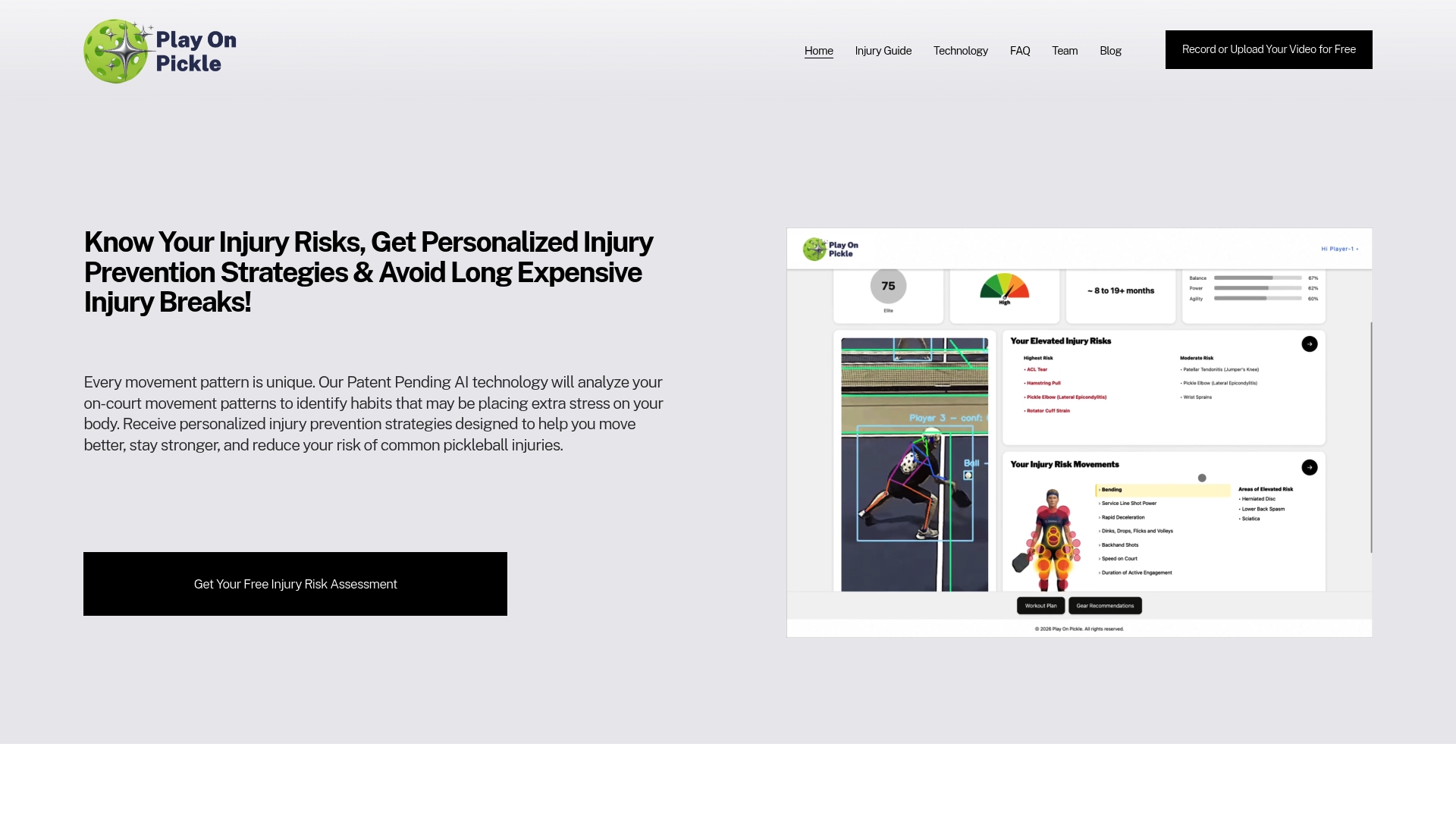
That is why we built Play On Pickle around movement analysis. You upload video of your play, and our computer vision technology is designed to identify stress points in your body and turn them into a personalized injury risk assessment, with simple exercises and equipment recommendations that fit into your routine. The goal is to reduce the load on the tissue that keeps complaining, so you need fewer rescue measures afterward.
Use an ice bath when the situation calls for it and your doctor agrees. Then put your real effort into the preparation that keeps you playing.
Drona
Find out why you are sore in the first place
If you are reaching for ice after every session, the better question may be what your body is doing on court. Play On Pickle analyzes your movement from a video you upload, pinpoints biomechanical stress points and gives you a plan of targeted exercises built around your own mechanics. It is built for recreational players who want something simple, as well as competitive players, coaches and facilities.
Plans are $9.99 per month or $99 per year, and there is a free initial trial. You can also read how the patent-pending computer vision technology works, or see the current free tripod offer for filming your games. Start at playonpickle.com.
FAQ
Is an ice bath good for pickleball recovery?
For many players, yes, in the short term. Research shows cold water immersion reduces soreness and perceived exertion in the first day after exercise. It is best saved for tournaments or packed schedules rather than every session, and it will not prevent injuries.
How long should I sit in an ice bath after pickleball?
The ACSM suggests either one 11 to 15-minute dip at 52 to 60°F or two 5-minute dips at 50°F with a 2-minute break. If you are new or over 50, start with 2 to 5 minutes at 50 to 59°F. Never go alone, and keep your head out of the water.
Should I take an ice bath right after playing or wait?
If you play again within a few hours, wait, because cooling between close sessions may hurt the next performance. If you want to protect strength gains, many people now delay the dip four to six hours. Dipping within 24 hours still helps with soreness.
Can I use an ice bath for a pickleball injury like a sprained ankle?
Cold is most useful in the first hours and days of an acute injury to reduce swelling and pain. Pediatric sports medicine guidance describes 20 to 30 minutes of immersion for a sprained ankle. Repeated icing for days can slow healing, so see a physician or physical therapist if the pain does not settle.
Are ice baths safe for older pickleball players?
They can be risky for people with heart disease, high blood pressure, circulation problems or lung disease, because cold shock raises blood pressure and can cause fainting. Talk to your doctor first. If cleared, use water at 50 to 59°F for two to five minutes, ease in slowly and never plunge alone.
Sources
- Effects of cold water immersion after exercise on fatigue (2023 meta-analysis)
- The effects of hydrotherapy and cryotherapy on recovery (2024 network meta-analysis)
- Thermal Modalities Including Hot Baths and Cold Plunges (2025 review)
- Cold Plunge Benefits, Mayo Clinic Press
- The workout recovery techniques backed by science, The Conversation
- Ice Bath, Heat Pack, or Neither? Peak Swing PT
- Cold Water Immersion: Friend or Froze? ACSM
- BASES Expert Statement on the use of cooling therapies
- Fundamentals or Icing on Top of the Cake? Narrative review
- Impact of different doses of cold water immersion (2025 network meta-analysis)
- Cryotherapy duration is critical in short-term recovery (2019 systematic review)
- Cold Plunges: What Adults Over 50 Should Know, AARP
- Ice Baths and Saunas, American Lung Association
- Cryotherapy: Can it stop your pain cold? Harvard Health
- Treating Sports Injuries with Ice and Heat, HealthyChildren.org