
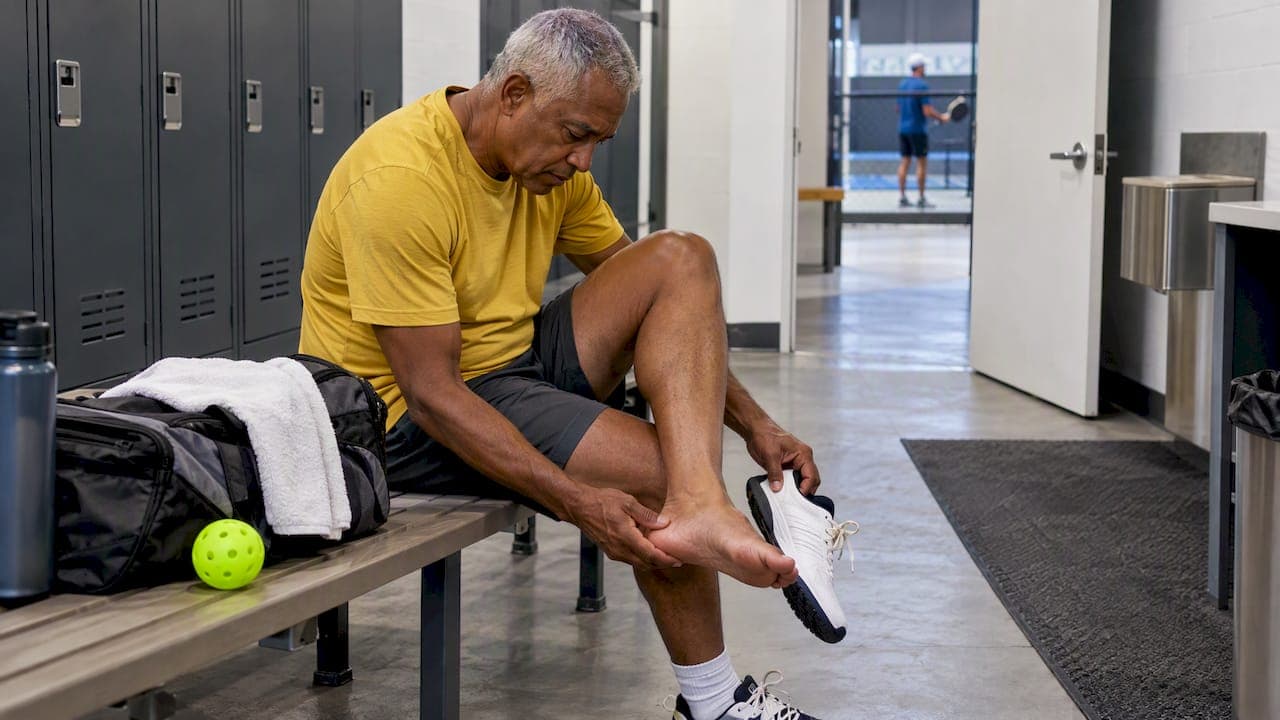
Most pickleball foot pain comes from repeated stops, pivots and lunges on a hard court, and most of it is manageable with smarter footwear, calf and foot care, and a few weeks of lighter play. The exception is a sudden pop at the back of the ankle or pain that keeps getting worse. Those need a clinician. Below is how to tell which one you have, what helps, and how to keep your feet under you for the long run.
TL;DR
- Sharp heel pain that is worst with your first steps in the morning points toward plantar fasciitis, a common and usually treatable overuse problem.
- A sudden pop or a "kicked from behind" feeling in the ankle is a medical emergency-level warning sign for an Achilles rupture. Stop playing and get evaluated.
- Court shoes with lateral support, moisture-managing socks and a calf routine prevent more problems than any gadget.
- Pain that persists or worsens over a couple of weeks deserves a professional look before it becomes a chronic injury.
- Video movement analysis can show how you load your feet during play, so your prevention plan fits your body.
Table of Contents
- Why pickleball is hard on your feet
- Match your symptom to the likely cause
- Heel pain and plantar fasciitis
- Achilles pain: the one not to tough out
- Blisters, hot spots and skin problems
- Your shoes may be the biggest lever
- What the evidence says about playing through pain
- A simple prevention routine
- Our perspective: your feet are only part of the chain
- Try a movement analysis before pain becomes a habit
- FAQ
- Sources
Why pickleball is hard on your feet
Pickleball looks gentle. The court is small, the ball is light and the pace feels social. But your feet do a lot of unglamorous work: short sprints, hard stops at the kitchen line, split steps, sideways shuffles and sudden direction changes. Equipment maker Selkirk describes the pattern as repetitive movement, quick direction changes and high-impact footwork that can strain your feet.
The numbers back up what many players feel. A 2025 nationwide study of 1,758 players with an average age of 62.7 found a 12-month injury prevalence of 68.5%. Injuries to the thigh, leg and foot region made up 26.9% of complaints, second only to the knee at 29.1%.

Clinic data shows the same direction of travel. One institution's database recorded a 6.5-fold increase in pickleball foot and ankle injuries between 2019 and 2023. Across its 198 patients, the average age was 58.3 years. Many of these players are adults returning to sport, not lifelong athletes, which matters because tissue that has not been loaded in years does not adapt overnight.
The same nationwide study found that players with fewer than 5 years of experience were at higher risk, and so were players who placed low or moderate importance on injury prevention. In plain terms: players who treat conditioning as optional get hurt more.
Match your symptom to the likely cause
No article can diagnose you. But the location and timing of pain narrow the field a lot, and that helps you decide whether to rest, adjust or call someone.
| What you feel | Where | Likely suspect | What to do |
|---|---|---|---|
| Sharp pain with the first steps of the day, easing as you warm up | Underside of the heel | Plantar fasciitis | Home care, footwear review, see a clinician if it lingers |
| Aching or stiffness along the back of the heel, worse after play | Back of the heel or lower calf | Achilles tendon irritation | Reduce load, calf work, get checked if it persists |
| Sudden pop, sense of being kicked, trouble pushing off | Back of the ankle | Possible Achilles rupture | Stop, get immediate medical evaluation |
| Pain after a roll or twist, swelling, bruising | Outside of the ankle | Ankle sprain | Rest, protect, get evaluated if you cannot bear weight |
| Burning or stinging spots, fluid pockets | Toes, heel edge, ball of foot | Friction blisters | Fix fit and socks, protect the skin |
If your pain does not fit any row, or you are unsure whether it is normal soreness or a warning, our guide to pain after pickleball and what counts as a warning sign walks through the signals.
Heel pain and plantar fasciitis
The most common form of heel pain in players is plantar fasciitis, irritation of the thick band of tissue along the arch that attaches at the heel. The American Academy of Orthopaedic Surgeons says it is one of the most common causes of pain on the bottom of the foot, with approximately 2 million patients treated each year, and that it often shows up in athletes who put repeated stress on the heel.
The clue most people miss
The classic signature is sharp heel pain that is worst with your very first steps in the morning or after sitting for a while, then eases a bit as the foot warms up. UTHealth Houston's orthopaedics team lists this pattern as a telling clue. If your heel hurts most when you stand up from the car after a long drive, and less after ten minutes on court, that is worth noting.
Be careful with the "it warms up" part. Pain that fades during play can tempt you into playing through it. It often comes back worse the next morning.
What helps, and how long it takes
The AAOS reports that over 90% of patients improve within 10 months with conservative treatment. Its home measures include calf stretching, ice, and supportive footwear or orthotics. Ten months is a long time, so patience matters, and so does not making it worse in the meantime.
A sensible approach for a recreational player with typical heel pain:
- Cut back, do not quit by default. Fewer sessions, shorter sessions, and a day off between play days while symptoms are active.
- Stretch the calf daily. Tight calves pull on the heel. A straight-leg and a bent-knee wall stretch cover both major calf muscles.
- Check your shoes. Worn-out midsoles stop doing their job. More on this below.
- Ice after play if it feels better, as the AAOS lists.
- Book an appointment with a podiatrist, sports medicine physician or physical therapist if pain has not clearly improved in a few weeks, or if it is stopping you from walking normally.
If you search for plantar fasciitis exercises, you will find dozens of variations. Rather than collect them all, ask the clinician who examines you to choose the two or three that suit your foot, then do those consistently. A physical therapist can also tell you whether your heel pain is actually the fascia, the fat pad, a nerve or something else.
Achilles pain: the one not to tough out
Achilles problems deserve their own warning. In the foot and ankle clinic data above, Achilles tears and ruptures accounted for 39.4% to 50% of foot and ankle injuries in some clinical groups. That is a figure from specific clinics, not a rate for all players, but it shows how serious this injury is in a sport with many players over 50.
The warning sign is a sudden "pop" at the back of the ankle, often described as feeling kicked when no one is near you. The researchers note it requires immediate medical evaluation, even if pain is not severe at first. Do not walk it off, and do not wait to see how it feels tomorrow.
For the slower version, a stiff, sore tendon that nags after play, early load management makes a difference. Our article on Achilles pain for players over 50 covers that in depth. If the problem is a persistent tendon complaint and you are exploring recovery options with your clinician, it can also help to read about red light therapy for tendonitis and how clinics approach it, then bring your questions to a medical professional rather than self-treating a possible serious injury.
Blisters, hot spots and skin problems
Blisters are the least dangerous foot problem and one of the most annoying. They come from friction, moisture and poor fit, and pickleball's constant stop-start movement supplies all three.
What tends to work:
- Fit the shoe at the end of the day, when feet are slightly swollen, and leave room for your toes to spread.
- Choose socks built for sport. Cushioned, moisture-managing socks with a snug heel pocket reduce slipping. Cotton holds sweat.
- Break in new shoes with a couple of short sessions rather than a three-hour round robin.
- Treat a hot spot immediately. The burning feeling before a blister forms is your cue to stop and cover it.
- Leave intact blisters alone when you can, and cover them. If one becomes red, swollen, warm or oozing, or if you have diabetes or poor circulation, have a clinician look at it.
Selkirk's foot care guidance mentions blisters among the issues that can follow if you skip proper care after play, which fits what most players report.
Your shoes may be the biggest lever
The most common preventable mistake is wearing running shoes on court. Running shoes are built for forward motion. Pickleball asks for side-to-side stops and pivots. UTHealth Houston's team points to court-specific shoes with reinforced lateral stability and says that missing support in sideways movement is a leading, preventable cause of chronic ankle and tendon strain.
A quick shoe checklist:
- Built for court sports. Look for a firm heel counter and a stable, wider platform, not a soft, tall running midsole.
- Not worn out. If the tread is smooth in the ball-of-foot area, the midsole is creased, or the shoe tilts when you set it on a table, replace it.
- Right size. Toes should not touch the front when you lunge.
- Compatible with orthotics if your clinician recommends them.
Players who play three or four times a week go through shoes faster than occasional players. Keep a rough note of when you bought yours.
What the evidence says about playing through pain
Many players fear that any pain means they must stop for good. Research from a single-institution review of pickleball injuries points to a more nuanced picture: most non-traumatic overuse problems, such as mild tendonitis, can be managed successfully with activity modification and proper conditioning. The dividing line is whether pain persists or worsens, which signals the need for a professional evaluation before a chronic issue becomes an acute injury.
A practical way to use that:
- Green light: mild, general soreness that fades within a day and does not change how you walk.
- Yellow light: pain in one specific spot that shows up every session or each morning. Reduce volume, review shoes, start calf work, and set a short deadline, such as two weeks, to reassess.
- Red light: a pop, sudden severe pain, inability to bear weight, visible swelling or deformity, numbness, or pain at night. Get evaluated.
A simple prevention routine
Prevention is boring on purpose. A few minutes before and after play, plus a couple of strength sessions a week, shifts your risk more than most gear purchases.
- Warm up your feet and calves. Walk briskly, do ankle circles, and do some gentle heel raises before the first game.
- Stretch calves after play when the tissue is warm.
- Strengthen the calf and foot muscles with slow heel raises. Add single-leg balance for ankle control. Ask a physical therapist to progress these if you have a past injury.
- Vary your surfaces and schedule. Back-to-back days on hard courts with no rest add up.
- Rotate in rest days as your play volume rises.
Our prehab routine for recreational and senior players has three moves that fit into a normal week, and our broader injury prevention guide covers the rest of the body.
Our perspective: your feet are only part of the chain
We built Play On Pickle around a simple observation: foot pain is rarely only a foot problem. Heel pain can trace back to how you land after a lunge, how far your knee collapses inward, or how stiff your ankle is. Two players with the same heel pain can need different fixes.

That is why generic advice has limits. "Stretch your calves and buy better shoes" is good advice, and we repeat it above. But it does not tell you whether your own movement is loading one foot harder than the other, or where your stress points are.
Our service analyzes video of you playing, using patent-pending computer vision, to identify biomechanical stress points and turn them into an injury risk assessment and tailored exercise and equipment recommendations. We aim for simple, targeted exercises that fit into a routine, because recreational players will not follow a 14-exercise program. We do not diagnose medical conditions, and we are not a substitute for a clinician. If you have a pop, severe pain or symptoms that do not improve, see a medical professional first.
— Drona
Try a movement analysis before pain becomes a habit
If your feet hurt after play and you want to know why, you can upload a video and get a personalized assessment. Plans are $9.99 per month or $99 per year, with a free initial trial. Right now there is also a free tripod offer with the $9.99 monthly plan, which makes filming yourself on court easier. You can read how the computer vision technology works before you decide.
FAQ
Does pickleball cause plantar fasciitis?
It can contribute. Plantar fasciitis is a common overuse problem in athletes who put repeated stress on the heel, and pickleball involves a lot of stopping and pivoting. Poor footwear, tight calves and a sharp jump in playing time raise the odds. A clinician can confirm whether your pain is plantar fasciitis.
Why does my heel hurt after pickleball?
The two usual suspects are the plantar fascia under the heel and the Achilles tendon behind it. Pain on the bottom that is worst with first steps in the morning points to the fascia. Pain at the back points to the tendon. If the pain is sudden, severe or does not settle in a couple of weeks, get it examined.
Can I keep playing with foot pain?
Often you can play less, not zero, if the problem is a mild overuse issue and pain is not getting worse. Reduce frequency, fix your shoes and add calf work. Stop and seek care for a pop, major swelling, inability to bear weight or pain that keeps increasing.
How do I stop blisters when I play pickleball?
Use court shoes that fit well at the end of the day, moisture-managing sport socks, and break shoes in gradually. Cover hot spots as soon as they start burning. If a blister looks infected, or you have diabetes or circulation problems, see a clinician.
Sources
- Emerging Patterns of Foot and Ankle Injuries in Pickleball Players: A Short Report (PubMed)
- Understanding Injury Patterns and Predictors in Pickleball Players: A Nationwide Study of 1,758 Participants (PMC)
- Plantar Fasciitis and Bone Spurs (OrthoInfo, AAOS)
- Pickleball Foot and Ankle Injuries: Prevention Tips (McGovern Medical School)
- Evaluation of Pickleball-Related Injuries at a Single Institution From 2017 to 2022 (PMC)
- How to care for your feet after pickleball (Selkirk)