
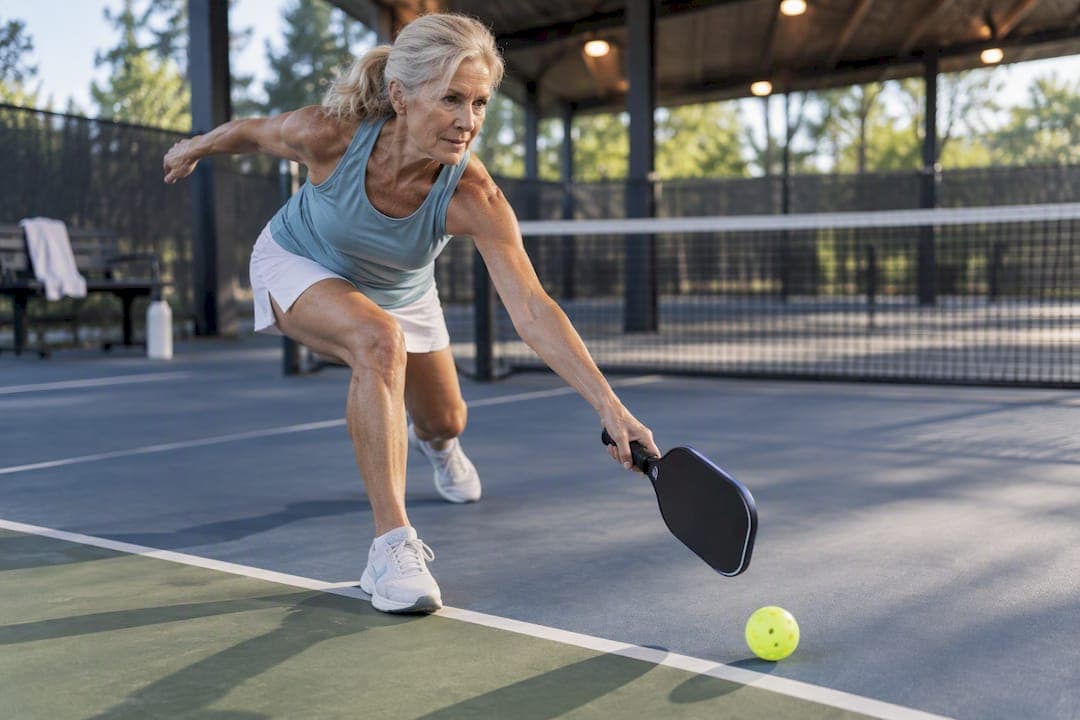
Pickleball carries a real but manageable injury risk: most injuries are sprains, strains, or overuse conditions. Fractures show up disproportionately in older players. The two moves that cut harm the most are reducing fall risk through better balance and footing, and managing how much you play so your tendons and joints get time to adapt. If you're over 60 or have low bone density, add a fracture risk check to that list.
TL;DR:
- The median injury age in pickleball is around 64 to 65 years, with fractures accounting for nearly one-third of emergency-treated injuries, especially in players over 60.
- Most injuries among older players result from falls, often on hard courts with inadequate balance or bone health, leading to more fractures than soft-tissue injuries.
- Prevention strategies that reduce injury risk include warming up properly, managing play volume, using supportive court shoes, and practicing balance and strength exercises.
- Overuse injuries such as tendinopathy develop gradually, while acute trauma from falls or collisions are immediate injuries, each requiring different preventive approaches.
- Video-based movement analysis and individual biomechanical assessments can help identify personal injury risks before they cause harm, especially for older or high-risk players.
Table of Contents
- How common are pickleball injuries, really?
- Common pickleball injuries by body region and how they happen
- Who is most at risk, and what raises the odds
- Preventing pickleball injuries: what actually works
- What to do if you get hurt: care and return to play
- How movement analysis can flag risk before it becomes an injury
- The mental side of injury risk on the court
- Playing safe without playing scared
- Get a personalized read on your own injury risk
- Sources
- FAQ
How common are pickleball injuries, really?
The clearest national picture comes from emergency department data. A 10-year epidemiologic analysis of pickleball injuries treated in emergency rooms found a steep climb between 2013 and 2022, with an estimated 66,350 injuries nationally over that period. The average age of injured players in that dataset was around 64 to 65 years old, a detail that says a lot about who is actually getting hurt on pickleball courts.
Fractures made up 32.7% of ED-treated pickleball injuries nationally between 2013 and 2022, according to the national ED analysis, and falls drove about two-thirds of injuries in older players. That combination, an aging player base plus a fall-prone sport, explains why so much of the clinical conversation around pickleball safety centers on balance and bone health rather than sprained ankles alone.
A single-institution review covering 2017 to 2022 tells a complementary story at a smaller scale. Researchers documented a 6.8-fold increase in pickleball-related injuries treated at that institution over the study window, with 618 confirmed cases. Fractures, while less common than soft-tissue injuries in raw numbers, were more concentrated among players over 60, and the same study flagged older female players as disproportionately represented among fracture cases.
Put those two data sources together and a pattern emerges. Younger and middle-aged recreational players are more likely to walk away with a strain, sprain, or tendon flare-up. Older players, especially those in their sixties and beyond, face a meaningfully higher chance that an injury will be a fracture rather than a soft-tissue problem, largely because falls are more frequent and bone density is lower. Neither group is exempt from the other type of injury, but the odds shift with age in a way that should shape how you train and how seriously you take a fall on the court.

The trend itself matters almost as much as the raw numbers. Both datasets describe injuries rising over the study periods, tracking the sport's rapid growth in the same window. More people on courts naturally means more injuries in absolute terms, but the rate of increase documented in these reviews suggests something beyond simple population growth, possibly a mix of inexperienced players, insufficient conditioning, and the sport's demand for quick lateral movement among players who haven't done that kind of movement in years.
Common pickleball injuries by body region and how they happen
Pickleball injuries fall into two broad categories: acute trauma from a fall, collision, or sudden movement, and overuse conditions that build up over weeks of repetitive stress. Knowing which body regions are involved and how the injury typically occurs helps you recognize a problem early and understand why certain prevention steps matter more than others.
Lower extremity. Ankle sprains happen most often when a player plants a foot and rolls it while changing direction toward the net or scrambling to cover a lob. Achilles injuries, including partial and full ruptures, tend to occur during forward lunges or sudden sprints toward a short ball. A foot and ankle specialty review found Achilles tendon rupture to be the leading diagnosis in its series, with a mean patient age of about 58.3 and incidence rising 6.5-fold between 2015 and 2023 in that dataset. Knee sprains and occasional meniscal tears also occur, usually from pivoting on a planted foot rather than direct contact.
Upper extremity. Wrist fractures from a fall onto an outstretched hand are common enough that clinicians use the shorthand FOOSH injury. Lateral epicondylitis, often called pickleball elbow, develops gradually from repeated wrist extension during shots, and it's closely tied to grip technique and shot volume. Rotator cuff strains show up in players who serve or overhead-smash frequently without adequate shoulder conditioning.

Back. Lumbar strains stem from the trunk rotation involved in groundstrokes and reaching shots, and weak core muscles make this worse by shifting load onto the lower back instead of distributing it through the hips and trunk.
Head and face. Contusions and lacerations occur from collisions with a partner, a fall, or a stray paddle or ball, and eye protection is a reasonable precaution given the ball's speed at close range during kitchen-line exchanges.
- Acute injuries result from a single traumatic event: a fall, a hard plant, a collision with a doubles partner.
- Overuse injuries build gradually from repetitive stress: tendinopathy in the elbow, shoulder, or Achilles from thousands of repeated motions over weeks or months.
The distinction matters for prevention. Acute injuries respond best to balance training, safer movement patterns, and court awareness. Overuse injuries respond best to load management, technique adjustments, and adequate recovery time between sessions, which is a different toolkit entirely.
Who is most at risk, and what raises the odds
Certain habits and traits show up repeatedly across the research as measurable predictors of injury. None of these guarantee a problem, but they shift the odds enough to be worth a honest self-assessment.
- Play volume matters more than most players think. Session lengths beyond two hours and playing three or more times a week are both associated with higher injury odds, and consecutive days without rest compound the effect further.
- Newer players face higher risk in some studies, likely because technique and court awareness haven't caught up with enthusiasm yet.
- Grip tightness is a specific, fixable risk factor. A tight baseline grip has been linked to higher acute upper-extremity injury risk, probably because it transmits more shock through the wrist and elbow on contact rather than absorbing it.
- Age and sex shape the type of injury, not just the likelihood. Older adults and women show higher fracture incidence, largely tied to bone density and fall frequency, while younger players trend toward soft-tissue sprains and strains.
- Court surface, footwear, and paddle grip all affect stability. Hard, unforgiving court surfaces increase joint loading on every stop and pivot, and the wrong shoes or an overly slick paddle grip can turn a routine movement into a fall or a mishit that strains a joint.
None of these factors act alone. A newer player with a tight grip playing three long sessions a week on a hard court is stacking several risk factors at once, which is exactly the profile that shows up disproportionately in clinic visits.
Preventing pickleball injuries: what actually works
Prevention doesn't require an overhaul of your game. A handful of specific, low-effort changes address most of the risk factors described above.
- Warm up on the court, not just off it. A five to ten minute dynamic warm-up that includes lateral shuffles, leg swings, and light footwork prepares the ankles, calves, and hips for the sport's specific demands better than static stretching alone. A short warm-up routine built around these movements takes less time than most players spend chatting before the first serve.
- Build strength and balance around the moves you actually make. Eccentric calf raises support Achilles resilience, single-leg balance work reduces ankle sprain risk, and core stabilization exercises protect the lower back during trunk rotation. These don't need a gym: a set of resistance bands and ten minutes a few times a week covers the basics.
- Manage your workload like an athlete, not a hobbyist. Cap sessions at a reasonable length, avoid stacking multiple long days in a row, and rebuild volume gradually after any break longer than a week or two.
- Wear real court shoes. Running shoes are built for forward motion, not the lateral cutting and stopping pickleball demands, and that mismatch increases inversion stress on the ankle. Court shoes with lateral midsole support and a supportive upper reduce that risk.
- Loosen your grip. A death grip on the paddle transmits more shock to the wrist and elbow with every shot. Aim for a grip firm enough for control but relaxed enough that your forearm isn't tense between points.
- Practice your ready position. A balanced stance with weight centered over the feet, rather than leaning back on the heels, makes the difference between a controlled lunge and a stumble when you're pulled wide for a shot.
- Check the environment before you play. Wet spots, loose equipment near the baseline, and uneven court seams are avoidable trip hazards that take seconds to scan for.
- Consider a bone health check if you're in a higher-risk group. Players over 60, especially women, may benefit from a DEXA scan and a conversation about bone density, since fracture risk in this group is tied as much to skeletal health as to the fall itself.
Pro Tip: Rotate your warm-up focus by day: ankles and calves before matches you know will involve a lot of net play, hips and core before longer baseline rallies.
Older players in particular benefit from structured, supervised training rather than jumping straight into competitive play. A structured pickleball program report found that an eight-week program improved balance and gait adaptability in older adults, suggesting that guided conditioning isn't just protective, it can actively improve the skills that prevent falls in the first place. For players building this kind of routine, a set of senior-focused exercises mapped to actual court movements gives a practical starting point.
What to do if you get hurt: care and return to play
Most pickleball injuries respond well to prompt, sensible care, but knowing when to escalate matters.
- For minor sprains and strains, relative rest, ice, compression, and elevation in the first 48 hours reduce swelling and speed early recovery. Avoid pushing through pain.
- Seek urgent care or an ED visit for visible deformity, inability to bear weight, numbness or tingling, or any suspected head injury with confusion, dizziness, or loss of consciousness.
- For tendinopathy (elbow, shoulder, Achilles), physical therapy with progressive loading tends to outperform rest alone, since tendons need graded stress to remodel properly.
- Bracing or a short immobilization period may be appropriate for moderate sprains, but prolonged immobilization without any movement often slows recovery rather than helping it.
- Surgical referral is uncommon for most sprains and strains but becomes relevant for complete Achilles ruptures, significant meniscal tears, or displaced fractures.
- Return-to-play readiness generally hinges on regaining full range of motion, comparable strength to the uninjured side, and the ability to perform sport-specific movements like lateral shuffles and lunges without pain.
A primary care visit or orthopedic referral covers most non-emergency injuries. Reserve the ED or urgent care for the red flags above rather than routine soreness.
How movement analysis can flag risk before it becomes an injury
Much of what raises injury risk on the court, weight transfer that lands too far back, knee valgus during a pivot, asymmetric loading between the left and right side, or a grip that's tighter than it needs to be, is hard to spot in yourself mid-rally. Video-based movement analysis can catch these patterns by breaking down footage of actual play rather than relying on a player's self-report.
An AI-driven video analysis service can identify biomechanical stress points and generate exercise recommendations aimed at the specific pattern detected, rather than a generic conditioning plan. The goal is to connect a movement fault directly to the mechanisms described earlier, an unstable plant, an overloaded shoulder, a tight grip, and suggest a targeted fix a player can actually do between sessions.
This kind of screening works best as a complement to clinical evaluation, not a replacement for it. Suspected fractures, red-flag symptoms, or persistent pain still call for a medical assessment first. For readers curious about the mechanics behind this approach, a breakdown of how video analysis detects movement faults covers the process in more depth.
The mental side of injury risk on the court
Injury risk on a pickleball court isn't purely physical. Fatigue changes how carefully a player moves, and a player pushing through the last games of a long tournament day is more likely to plant awkwardly or skip the mental check that normally precedes a lunge toward the kitchen line.
Social pressure plays a role too. Pickleball's doubles format and tight-knit local groups create a strong pull to keep playing past the point of comfort, whether that's finishing a match with a nagging ankle or joining a fourth game when the first three already left your legs heavy. Competitive drive compounds this: players who see the sport as a contest rather than exercise tend to underreport pain and delay addressing early warning signs like elbow soreness or calf tightness.
Confidence and skill level interact with risk in a less obvious way. Newer players sometimes overcommit to shots or positions beyond their current movement ability, chasing a ball their balance can't actually support. More experienced players occasionally show the opposite pattern: overconfidence in aging joints that no longer move the way they did years earlier. Recognizing these tendencies in yourself, rather than only tracking physical conditioning, is part of a realistic risk picture.
Playing safe without playing scared
Pickleball's popularity comes from real benefits: it's social, it gets people moving who might otherwise skip exercise, and it scales to almost any fitness level. None of that should get lost in a conversation about injury risk.
What the evidence actually supports is narrower and more encouraging than it might seem: a handful of small, consistent habits, warming up, choosing real court shoes, managing session length, and paying attention to grip tension, address most of the modifiable risk. You don't need to overhaul your game. Pick one change from this article and start this week rather than waiting for an injury to force the issue.
— Drona
Get a personalized read on your own injury risk
A general prevention checklist helps, but it can't tell you whether your own plant foot, grip tension, or shoulder mechanics are the specific thing putting you at risk. Play On Pickle's AI-driven movement analysis reviews video of your actual play, flags the biomechanical patterns tied to common injuries, and builds a set of exercises around what it finds rather than a one-size-fits-all routine.
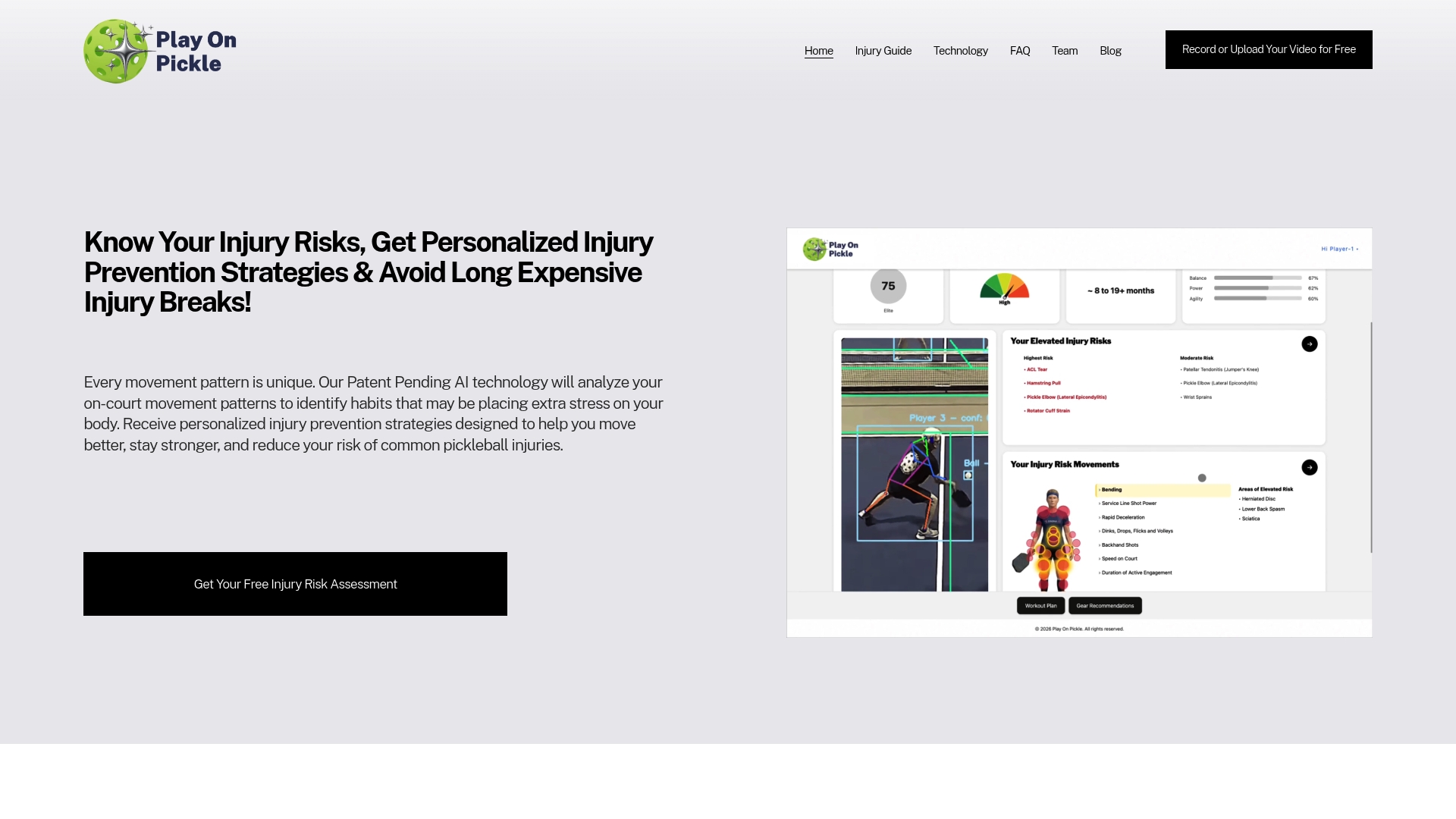
- Upload match footage and get a personalized breakdown of movement patterns linked to injury risk.
- Receive tailored exercise recommendations that target your specific stress points, not generic drills.
- Track progress over time as your mechanics improve.
The Monthly subscription runs $9.99 per month, and an Annual subscription is available at $99 per year for players ready to commit longer term. New users can also claim a free tripod with the monthly plan to make filming easier from the first session. Check current pricing and plan details to get started.
FAQ
What is the most common injury in pickleball?
Soft-tissue strains and sprains are the most common injury overall, making up nearly half of cases in a single-institution review, though fractures are more common specifically among players over 60. The exact type depends heavily on age, with younger players skewing toward soft tissue and older players toward fractures from falls.
What are the top three most injury-prone sports?
There is no single, universally agreed ranking of the most injury-prone sports, since methods and injury definitions vary widely across studies. What the pickleball-specific research does show is a sharp rise in ED visits and institutional injury counts over the past decade, driven largely by falls and overuse patterns rather than direct contact.
Who should not play pickleball?
There is no blanket rule against playing pickleball for any group, but players with significant balance impairments, uncontrolled cardiovascular conditions, or very low bone density should talk to a doctor before starting, given the fall risk and fracture patterns seen in older players. A DEXA scan and fall-risk conversation is a reasonable step for anyone in a higher-risk category rather than avoiding the sport outright.
Is pickleball more prone to injury than tennis?
Direct head-to-head injury rate comparisons between pickleball and tennis are not well established in the current research, so a clean answer isn't available. What is clear is that pickleball's injury profile skews older, with falls and fractures playing a larger role than in most racquet sports, based on the age distribution seen in the national ED data.