
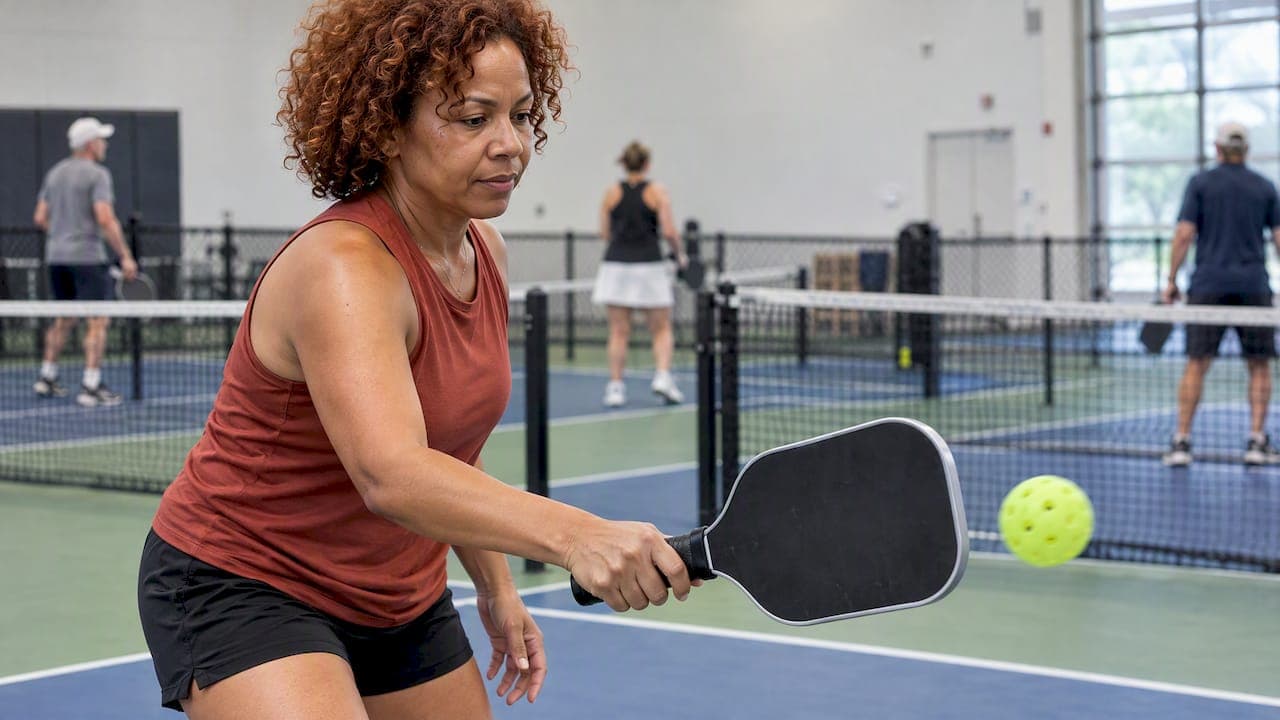
Hold the paddle loosely, around 3 to 5 on a 1-to-10 scale, for dinks, drops and resets. Add firmness only in the instant before contact on drives and overheads, then let go again. That one habit improves touch, and a 2025 study of recreational players also linked a tight baseline grip to more acute upper-body injuries. The rest of this guide shows what each number feels like, how to find yours, and where grip pressure fits in a wider injury-prevention picture.
TL;DR
- Start every point relaxed. Think 3 to 5 out of 10 for soft shots, and squeeze harder only at contact on power shots.
- In a survey of 253 recreational players, those who reported a tight baseline grip had a relative risk of acute injury of 2.67. That is an association from self-reported grip, not proof of cause.
- Your number is personal. Test the same bounce or dink at about 3 to 4, 5 and 7 to 8, and pick the level where your wrist moves freely and the paddle face stays stable.
- Grip is one risk factor among several. Long sessions and playing on consecutive days showed even stronger links to injury.
- Persistent forearm, elbow, wrist or hand pain calls for a clinician, not just a looser grip.
Table of Contents
- What grip pressure actually means
- Why a loose grip gives you better touch
- Grip pressure by shot
- A five-minute drill to find your number
- What the injury research says
- Beyond grip: what else to check
- Our perspective: grip is a symptom, movement is the cause
- Get a look at your own movement
- FAQ
- Sources
What grip pressure actually means
Grip pressure is how hard your hand squeezes the handle. Coaches almost always describe it on a 1-to-10 scale, where 1 is barely holding the paddle and 10 is the hardest squeeze you could manage. The Dink Pickleball frames it as a percentage of your maximum squeeze, then simplifies it to that same scale.
Two things are worth knowing before you chase a number:
- The scale is a feel cue, not a measurement. Nobody is reading pounds off your hand. A 4 for you may be a 5 for the player next to you.
- The grip itself matters less than the squeeze. Most players start from a neutral, continental-style handshake grip because it moves between forehand and backhand without a change. What decides your touch is how tightly you hold it. If you are still working on hand position, our guide to pickleball grip technique covers loose-first, power-later habits for beginners.
Why a loose grip gives you better touch
The soft game is a game of feel. A rigid hand sends vibration and tension up the forearm and makes the paddle face harder to steer. A relaxed hand lets the paddle absorb pace and lets you direct the ball instead of pushing it.
Wayne Dollard, founder of Level-Up Pickleball Camps, makes the same point in coaching advice published by DICK'S Sporting Goods: loosening your grip increases feel and consistency when dinking. That source also reports that many new and intermediate players hold the paddle at 8 or 9 out of 10 without realizing it.
There is a common misreading here. Loose does not mean floppy. The goal is a stable paddle face with a wrist that is free to move, not a paddle that wobbles at impact. If the face twists when the ball arrives, you have gone too light for that shot.
It also helps to know where bad advice comes from. Some players take lessons from people who learned a tight racket grip in tennis and carry it over. A former tennis pro writing for Sarah Ansboury Pickleball Academy calls that out as a worry for exactly this reason: pickleball rewards a softer hand.
Grip pressure by shot
The table below pulls together the commonly taught ranges. Treat them as starting points to adjust, not rules.
| Shot | Suggested pressure (1-10) | What you want to feel |
|---|---|---|
| Dink | 3 to 5 | Soft hands, paddle face steady, ball lifted gently |
| Third-shot drop | 3 to 5 | Same softness, a smooth lift with legs and shoulder |
| Reset | 3 to 5 | Paddle absorbs pace, nothing pushed |
| Block or counter | Moderate | Firm enough to hold the face, no swing |
| Volley at the net | Moderate, firming at contact | Quick tighten, quick release |
| Drive | Firmer at contact | A short squeeze as you strike, relaxed before and after |
| Overhead | Firmer at contact | Same pattern, with the grip loosening on the follow-through |
The dinking range comes from DICK'S Sporting Goods coaching guidance, which puts it between 3 and 5. Some instructors teach a 4 out of 10 baseline, and some go as low as 1 to 3 for the softest touch shots. The spread is normal. It shows these are personal cues.
Squeeze late, release early
The pattern that matters more than any single number is modulation. Between shots, keep the hand relaxed. Add firmness late, near contact, and only as much as the shot needs. Maximum squeeze is rarely necessary, even on a hard drive. Players who clamp down for the whole rally tire their forearm and lose the ability to switch between touch shots and power shots.

If you play at the kitchen line, you already know how quickly the ball changes speed. A relaxed baseline is what gives you room to react to a hard speed-up and then drop the next ball softly.
A five-minute drill to find your number
You do not need a coach for this. You need a paddle, a ball and a wall or a partner.
- Set a baseline. Hold the paddle at about 5 out of 10. Bounce the ball on the paddle face a few times. Notice any wrist stiffness or paddle wobble.
- Go lighter. Repeat at 3 to 4. Does the ball feel easier to control? Does the face stay still?
- Go firmer. Repeat at 7 to 8. Notice what changes in your wrist and forearm.
- Add shots. Hit dinks, then volleys, then a few drives. Relax between contacts and firm up only as needed.
- Repeat while moving. Step into the shot, shuffle, recover. Grip tends to creep tighter when your feet are busy.
What you are looking for is wrist freedom, a stable paddle face and no forearm fatigue. Do not try to copy someone else's exact number. This is the same self-audit approach suggested in the 2025 recreational-player study discussion of coaching cues.
Signs your grip is too tight
- Forearm burn after only a few games
- Dinks that pop up or sail long
- Knuckles that whiten under pressure, especially when you are behind on the score
- A stiff wrist that cannot absorb a fast ball
- Nagging soreness at the outside or inside of the elbow
Grip tightens under stress. A tied game at 10-10 is when most players squeeze. A cue that works is to breathe out and open your fingers slightly before each serve or return.
What the injury research says
This is where grip pressure stops being only a performance tip. In a peer-reviewed 2025 study by June Hanks and Betsy Myers, 253 adult recreational players were surveyed. Forty-one percent reported at least one upper-extremity injury. Acute injury was more likely among players who reported a tight baseline grip, with a relative risk of 2.67.
Two cautions keep that finding honest:
- Grip was self-reported. Players judged their own tightness. Nobody measured force with an instrument.
- It is an association. The authors note that more research is needed. Squeezing hard may not be the cause by itself. Tight grippers may also play longer, play more often or use poorer technique.
The same study points to workload as a bigger signal. Acute injury risk was 2.38 times higher for sessions of at least two hours, and 4.97 times higher for playing on consecutive days. If you are thinking about prevention, how long and how often you play deserves as much attention as how hard you squeeze.
More broadly, pickleball injuries have risen with the sport. A 10-year analysis of pickleball-related hand injuries estimated 12,021 injuries between 2013 and 2022 in the wrist, hand and finger category. Research into pickleball-specific prevention advice is still thin, according to a 2024 orthopaedic review, so loosening your grip is a sensible habit rather than a proven cure.
For a wider look at preventing common problems, preventing sports injuries comes down to sensible loading, recovery and listening to early warning signs, all of which apply on a pickleball court.

Beyond grip: what else to check
If your arm hurts, a lighter grip alone will not fix it. Screen these too:
- Session length. Break up two-hour blocks with rest or a lighter drill session.
- Back-to-back days. Add a rest day, or switch one day to low-impact work.
- Paddle fit. Handle size and weight affect how hard you have to hold on. If you are curious about equipment changes, read our low-equipment plan to prevent pickleball elbow.
- Technique. A stiff, arm-only swing loads the elbow and wrist. Footwork and body rotation share the work.
- Strength and mobility. Short routines like our three-move pickleball prehab routine prepare forearms and shoulders.
- Recovery and sleep. Fatigue makes everything tighter.
If you already have pain
Use symptoms as feedback. If forearm, elbow, wrist or hand pain keeps coming back, stop or reduce your load and get evaluated by a qualified clinician, such as a sports medicine physician or physical therapist. Do not assume a looser grip will solve it. Our guides on pickleball wrist pain and pickleball elbow pain explain common causes and a safe return to play.
Older players
If you are over 50 or returning to sport, pair grip advice with load management and fall prevention. Injury literature, including a Cureus review of pickleball injuries, emphasizes that injuries rise with age and that falls are an important mechanism. A soft grip cannot offset fatigue, overlong sessions or playing every day. Our injury prevention guide for recreational and older players goes deeper.
Our perspective: grip is a symptom, movement is the cause
At Play On Pickle we look at pickleball through movement. When a player squeezes the paddle too hard, the tension rarely starts in the hand. It often shows up alongside a stiff upper body, late preparation, or a swing that relies on the arm because the legs and trunk are not helping.
That is why we do not give one magic number. Players differ in hand size, strength, paddle and style, and a number copied from a pro rarely fits. What helps is seeing your own pattern: where you tense, when you tense, and what your body does on the shots that hurt.
Our approach uses patent-pending computer vision to analyze video of your play, identify stress points in the body, and turn them into simple exercises and equipment suggestions that fit your routine. We pair that with the honest limits: movement review complements clinical care and progressive conditioning, and it does not replace a clinician when you have pain.
For most recreational players, the best first step is free. Try the drill above, notice which shots make you squeeze, and then look at the rest of your movement.
— Drona
Get a look at your own movement
If you would like feedback beyond a self-test, Play On Pickle analyzes video you upload and returns a personalized injury risk assessment with tailored exercises and equipment recommendations. There is a free initial trial. After that, plans are $9.99 per month or $99 per year. You can read how the computer vision technology works before you sign up, and the free tripod offer comes with the $9.99 monthly plan.
FAQ
How tight should I hold a pickleball paddle?
For dinks, drops and resets, aim for about 3 to 5 out of 10. For drives and overheads, firm up briefly at contact and relax again right after. Your best number depends on your hand, paddle and style, so test it with the drill above.
Can gripping too hard cause pickleball elbow or wrist pain?
It may contribute, but nobody has proven it is the sole cause. A 2025 study found that players reporting a tight baseline grip had higher odds of acute injury, though grip was self-reported. Session length, back-to-back days, technique and paddle fit also matter. See a clinician if pain persists.
What grip do most professional pickleball players use?
Most start from a neutral or continental-style handshake grip because it handles forehand and backhand without a change. Some pros use variations, including two-handed backhands. No governing body prescribes one universal grip, and pressure matters more than the label.
Does the same grip pressure work for every shot?
No. A relaxed baseline with a short squeeze at contact is the usual advice. Soft shots stay in the 3 to 5 range, while power shots need more firmness for a moment. If you hold the same pressure all the time, you lose either touch or stability.
Sources
- Risk of Upper Extremity Injury in Recreational Pickleball Players (MDPI, 2025)
- Pickleball 101: Grip Pressure When Dinking (DICK'S Sporting Goods)
- Check Your Grip Pressure (Sarah Ansboury Pickleball Academy)
- Pickleball Grip Pressure: The One Fix That Adds Control (The Dink Pickleball)
- Quite a Pickle: A 10-Year Increase in Pickleball-Related Hand Injuries
- Pickleball: A Standard Review of Injury Prevalence (JAAOS, 2024)
- Pickleball injuries review (Cureus)