

Overhead loading in pickleball concentrates at three points: the shoulder's rotator cuff during deceleration, the elbow when timing breaks down, and the thoracic spine when it can't rotate enough to share the work. The three modifiable drivers behind most overhead injuries are kinetic-chain deficits, rotator cuff weakness, and rapid jumps in play volume. Before your next session, add a dynamic warm-up, activate your external rotators, and check that this week's play hasn't spiked far past last week's.
TL;DR:
- Overhead injuries often stem from deficits in mobility and strength within the kinetic chain, especially if play volume spikes more than 60% in a week.
- Proper screening to detect asymmetries in shoulder rotation, core stability, and thoracic mobility can prevent most injuries without professional help.
- Common faults like early trunk rotation, shoulder shrugging, and limited hip drive contribute to both poor performance and increased tissue stress.
- Training that focuses on hip-initiated rotation and controlled deceleration reduces injury risk and improves swing efficiency over 4 to 6 weeks.
- AI video analysis effectively identifies biomechanical flaws from smartphone footage, helping personalize injury-prevention strategies.
Table of Contents
- What Drives Pickleball Overhead Mechanics at the Joint Level?
- How Do You Screen for Overhead Injury Risk on the Court?
- What Do Common Overhead Faults Look Like on Video?
- What Exercises Actually Improve Overhead Stroke Mechanics?
- How Much Pickleball Is Too Much, Too Soon?
- Where AI Video Analysis Fits Into Overhead Screening
- What's a Realistic Timeline for Fixing Overhead Mechanics?
- Breaking Down the Three Phases of the Overhead Swing
- Which Technical Errors Hurt Both Your Swing and Your Shoulder?
- Which Conditioning Exercises Build a More Efficient Overhead Swing?
- How Do You Prevent Overhead Injuries Specific to Pickleball?
- Does Paddle Weight or Grip Size Change Overhead Loading?
- A Note From Drona on What Actually Moves the Needle
- Get a Personalized Read on Your Own Overhead Mechanics
- Sources
- FAQ
What Drives Pickleball Overhead Mechanics at the Joint Level?
The overhead swing runs on a kinetic chain: legs and hips generate force, the core transfers it, and the shoulder and arm deliver it. In overhead throwing athletes, more than half of the energy reaching the arm originates below the trunk, in the legs and core. Pickleball's overhead shot follows the same principle, just compressed into a shorter, faster window than a baseball throw.
When hips, core, or thoracic spine can't rotate fast enough or far enough, the shoulder tries to make up the difference. Clinicians call this the "catch-up" phenomenon: the pelvis and trunk lag, so the shoulder muscles fire harder and longer to generate the same swing speed, absorbing loads they weren't built to carry alone.
The rotator cuff's real job here isn't power. It's braking. During the deceleration phase after contact, the cuff muscles (especially the external rotators) work eccentrically to slow the arm down and keep the humeral head centered in the socket. A scapula that doesn't rotate upward properly changes that geometry, narrowing the space under the acromion and raising impingement risk. Timing errors, like swinging before the hips finish rotating, force the shoulder to generate speed AND absorb the resulting torque in the same motion, which is exactly the combination that spikes tendon loading.
How Do You Screen for Overhead Injury Risk on the Court?
You don't need a physical therapist's office to catch most of the warning signs. A few five-minute checks, done consistently, flag the deficits that matter most before they become pain.
- External rotation range of motion: compare shoulders side by side. A meaningful side-to-side difference, especially combined with a tight posterior capsule (test with the sleeper stretch or cross-body adduction), signals restricted internal rotation that stresses the cuff.
- External rotation strength: a resistance band or hand-held dynamometer can reveal a weak or asymmetric external rotator group, one of the modifiable risk factors tied most closely to overuse shoulder injury.
- Thoracic mobility: seated rotation against a fixed pelvis. Limited turn on one side often shows up later as compensatory shoulder strain.
- Single-leg balance and core control: a shaky single-leg stance or a hip that drops during a step-and-reach predicts the "catch-up" pattern under game speed.
- Weekly play volume: log sessions and estimated high-intensity points for four weeks. A jump of more than 60% over your rolling average is the threshold tied to elevated injury risk.
What Do Common Overhead Faults Look Like on Video?
A ten-second smartphone clip of your overhead swing, viewed from the side or behind, usually reveals which fault is driving the problem. Here's how to read it.
- Trunk rotation fires too early or too late. If the shoulders open before the hips, or lag well behind them, the timing chain is broken, and the arm ends up generating force the legs should have supplied.
- The shoulder shrugs instead of rotating. A visible hike of the shoulder toward the ear during the backswing, instead of smooth upward scapular rotation, points to scapular dyskinesis, a common precursor to impingement.
- The front leg or hip barely moves. Minimal hip drive or a wobbly plant leg is the on-video signature of the catch-up pattern described earlier.
- The arm finishes high and stiff. A follow-through that stops abruptly rather than decelerating through the trunk often means a tight posterior capsule is forcing compensatory elevation at contact.
Pro Tip: Film yourself from behind at 0.25x speed on your phone. Watch just the hips for the first half-second after the backswing starts. If they're not already turning, your shoulder is compensating.
What Exercises Actually Improve Overhead Stroke Mechanics?
Fixing overhead mechanics is a layering problem: warm-up, then activation, then strength, then control under speed. Skip a layer and the higher ones don't hold.
Warm-up (5 to 10 minutes, every session):
- Arm circles and band pull-aparts, 2 sets of 15
- Walking lunges with a trunk rotation, 10 per side
- Shoulder external rotation with light band, 2 sets of 15
Strength progression (build over 4 to 6 weeks):
- Isometric external rotation holds against a wall, 3 sets of 20 seconds
- Concentric band external rotation, 3 sets of 12
- Eccentric-focused external rotation (slow release, 3 to 4 seconds down), 3 sets of 10
- Plyometric deceleration drills, like overhead ball drops caught and controlled, once strength progressions are pain-free
Scapular and thoracic control (3 times a week):
- Y-T-W-L raises with light dumbbells, 2 sets of 10 each letter
- Serratus punches against a wall or with a band, 2 sets of 15
- Open-book thoracic rotations, 10 per side
Kinetic-chain drills (2 to 3 times a week):
- Rotational medicine ball throws against a wall, 3 sets of 8 per side
- Hip-drive step-and-reach drills mimicking the overhead swing without a paddle, 3 sets of 6
Programs combining rotator cuff strengthening, scapular balance work, and posterior capsule stretching have shown measurable improvement in overhead athlete outcomes, and broader strength-and-conditioning protocols targeting the same deficits produced modest reductions in shoulder problems even among symptom-free players. For a full pre-play sequence you can follow step by step, this warm-up routine walks through timing and pacing in more detail.
How Much Pickleball Is Too Much, Too Soon?
Injury risk climbs sharply when weekly play jumps more than 60% above your prior four-week average, a threshold drawn from research on overuse shoulder injuries. Track it with a rolling average: total sessions, minutes played, and a rough count of high-intensity points (drives, smashes, aggressive net exchanges). A tournament weekend after a slow month is exactly the scenario that trips this threshold.
Watch for these red flags, and stop or scale back if any appear:
- Night pain that wakes you or won't settle with rest
- A catching, popping, or locking sensation on overhead motion
- Noticeable strength loss on one side compared to the other
- Soreness that persists more than 48 hours after play
A conservative ramp for anyone returning from a break or building volume: 2 to 3 sessions a week for 4 to 6 weeks before adding a fourth, letting tissue adapt before load increases again. Consistent session tracking, the same principle organizers use to manage pickup game attendance and rhythm, makes rolling averages easier to spot without a spreadsheet.
Where AI Video Analysis Fits Into Overhead Screening
Markerless, single-camera video analysis has been validated for pulling out genuine biomechanical fault patterns, not just guesswork. A 2D motion-capture pipeline using a smartphone camera successfully classified pathological kinematic patterns in pickleball players without any wearable markers.
That's the same category of data Play On Pickle's analysis works with: timing between hip rotation and arm acceleration, joint-angle sequences through the swing, and scapular movement proxies that flag shrug patterns or restricted upward rotation. Automated flags on those metrics map directly onto the screening checklist above, helping prioritize which exercise progression matters most for your specific pattern, detailed further in this video analysis breakdown. It's best suited to catching timing errors and side-to-side asymmetries early. Persistent pain, catching sensations, or anything suggesting a structural tear still needs an in-person exam, not an app.
What's a Realistic Timeline for Fixing Overhead Mechanics?
Most players notice meaningful change within 4 to 6 weeks of consistent corrective work, though full resolution of a nagging shoulder issue can take 6 to 10 weeks or more depending on severity and how consistently you stick with the program.
Judge readiness by performance, not the calendar. You're ready for full overhead play when range of motion is pain-free, external rotation strength is roughly symmetric side to side, and you can complete sport-specific progressions (plyometric catches, full-speed swings) without soreness the next day. If pain persists past six weeks of proper loading, or you notice ongoing weakness or a mechanical catch in the joint, that's the point to get imaging or a specialist referral rather than pushing through.
Breaking Down the Three Phases of the Overhead Swing
The overhead stroke splits into three biomechanical phases, and each one loads tissue differently.
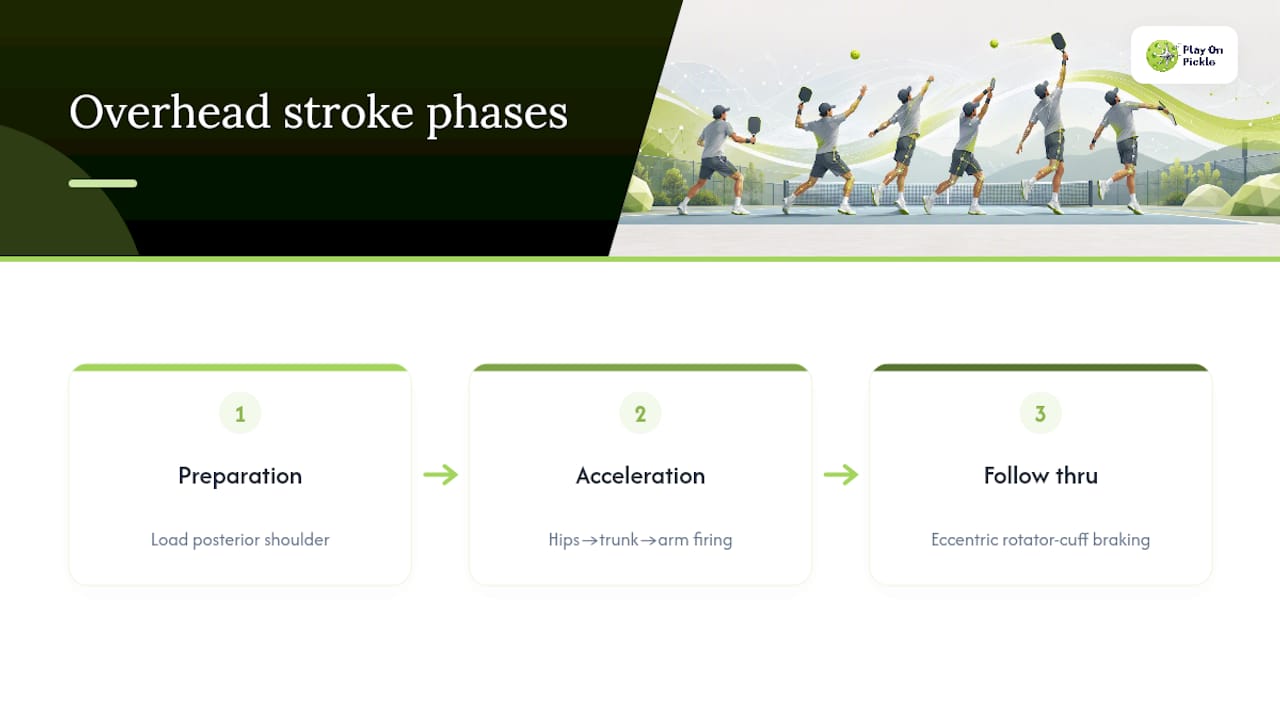
Preparation starts as you track the ball and rotate your trunk away from the net, loading the posterior shoulder and building elastic tension in the rotator cuff and posterior capsule. Hip and shoulder separation, sometimes called the X factor, gets set here: the more the hips lead and the shoulders lag behind, the more rotational energy gets stored for the next phase. Cut this separation short and you lose power before the swing even starts.
Acceleration is where the stored energy releases. Hips fire first, the trunk follows, then the shoulder and arm whip through last, a sequence biomechanists call proximal-to-distal timing. Get that order wrong, arm moving before the hips finish, and the shoulder has to generate speed on its own instead of riding the chain, spiking internal rotation velocity and joint torque.
Follow-through is deceleration, not an afterthought. The arm decelerates across the body while the rotator cuff's eccentric braking absorbs the leftover momentum. This phase generates some of the highest loads on the posterior shoulder in the entire swing, which is exactly why cuff endurance, not just strength, matters so much for players who hit dozens of overheads a match.
Which Technical Errors Hurt Both Your Swing and Your Shoulder?
Certain mechanical flaws show up as both weaker shots and higher injury risk, because the same broken timing that costs you power also redirects load onto tissue that isn't built to absorb it.
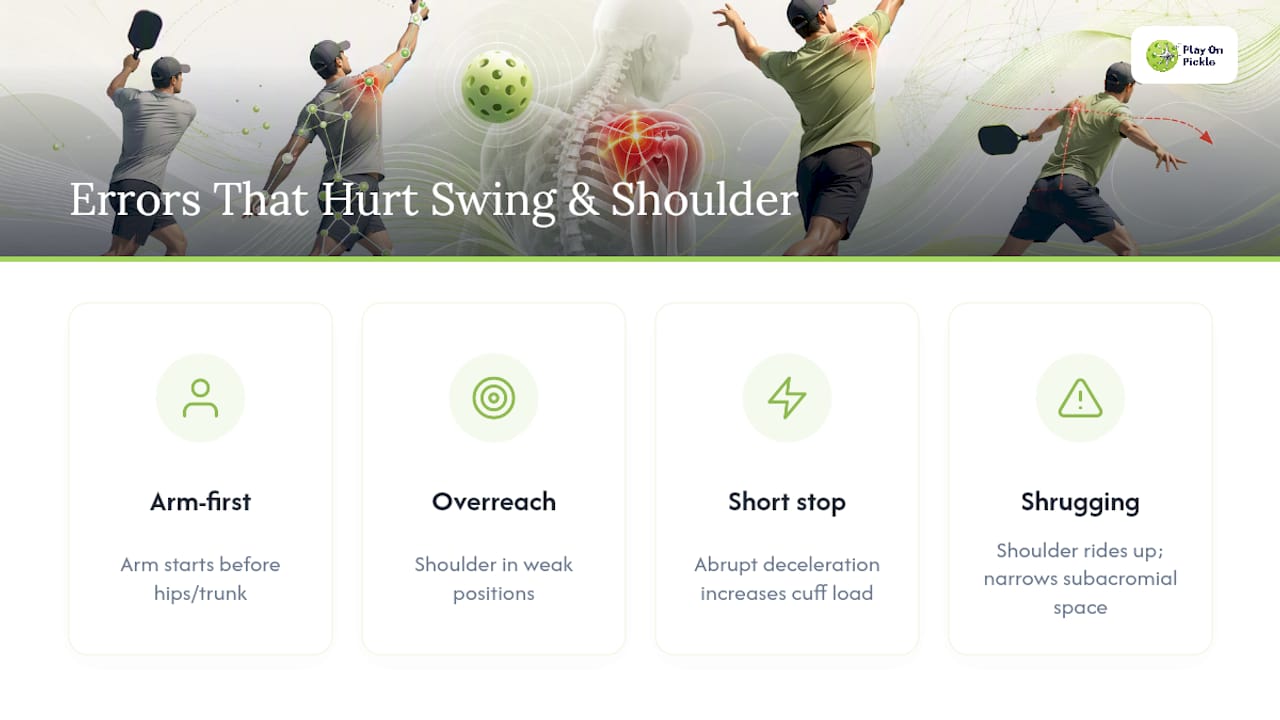
Arm-dominant swinging (starting the arm before the hips and trunk rotate) is probably the single most common error recreational players make. It feels natural because the arm is the part you can see moving the ball, but it strips out the kinetic chain's contribution entirely and forces the shoulder to supply speed it wasn't designed to generate alone.
Overreaching on wide or high balls stretches the shoulder into positions where the rotator cuff has little mechanical advantage, often forcing compensatory trunk lean that throws off the whole sequence.
Incomplete follow-through, stopping the arm abruptly instead of letting it decelerate across the body, denies the cuff its natural braking runway and concentrates deceleration forces into a shorter, harder stop.
Chronic scapular shrugging, visible as the shoulder riding up toward the ear during the backswing, narrows the subacromial space and sets up repeated micro-impingement on every single overhead, match after match.
Each of these errors compounds the others. A player with poor hip drive often overcompensates with more arm shrug and a harder follow-through stop, stacking three risk factors into one swing. That's also why fixing timing tends to fix power and pain at the same time, rather than trading one for the other.
Which Conditioning Exercises Build a More Efficient Overhead Swing?
Efficiency in the overhead stroke comes from sequencing, not raw shoulder strength, so the most useful conditioning work trains the chain, not just the joint.
Rotational medicine ball throws against a wall or with a partner train the hip-to-shoulder handoff directly, teaching the body to generate speed low and transfer it up rather than starting the swing at the arm. Three sets of 8 throws per side, twice a week, builds this pattern without any paddle-specific fatigue.
Split-stance cable or band rotations mimic the overhead's trunk rotation under light resistance, reinforcing the same hip-leads-shoulder sequence at a controllable speed. Lateral bound and stick drills build the single-leg stability that underlies a strong plant leg during the swing, directly addressing the catch-up pattern described earlier.
For raw shoulder capacity, cuff endurance work matters more than heavy lifting: high-rep band external rotation (3 sets of 15 to 20) trains the muscle to sustain repeated deceleration across a long match, which is a different demand than a single maximal effort. Pairing that with the thoracic rotation drills from the exercise section keeps the spine mobile enough to keep contributing its share of the rotation instead of handing more work to the shoulder. A structured conditioning routine built around these movement patterns, outlined in more depth in this conditioning guide, tends to produce steadier gains than isolated shoulder work alone.
How Do You Prevent Overhead Injuries Specific to Pickleball?
Prevention in pickleball differs from baseball or tennis prevention in one key way: matches involve far more overhead repetitions in a shorter, more explosive window, with less recovery time between points. That changes the priority list.
Build the screening checks from earlier into a weekly habit rather than a one-time assessment. Range of motion and strength asymmetries drift over a season, and catching a new deficit early is far cheaper than rehabbing an established one. Layer your warm-up and strength work as prescribed, in that order, since jumping straight to eccentric loading without first restoring range of motion and basic activation tends to aggravate rather than protect.
Rotate your practice focus so you're not hammering overheads every single session; mixing in groundstrokes and footwork drills gives the shoulder recovery windows within the week, not just within a day. And treat any recreational player who "overlooked physical training" for years as starting from zero: a light 10 to 15 minute activation routine three times a week, done consistently, outperforms an occasional intense session by a wide margin for actual injury reduction. Movement screening paired with targeted correction based on the specific deficits found has been shown to lower re-injury rates compared with players who skip assessment entirely.
Does Paddle Weight or Grip Size Change Overhead Loading?
Equipment doesn't cause overhead injuries on its own, but it can amplify an existing mechanical flaw. A heavier paddle increases the torque your shoulder and elbow must control during deceleration, which matters most for players who already show late trunk rotation or a stiff follow-through, since they're absorbing that extra torque with worse mechanics to begin with.
Grip size affects forearm and wrist loading more directly than shoulder loading, but a grip that's too small forces a tighter, more effortful hold that can translate up the chain into extra shoulder tension during the swing. Players managing elbow or wrist soreness alongside shoulder issues should check grip fit first. This wrist pain guide breaks down how those distal issues interact with the same kinetic chain problems discussed here.
The practical takeaway: if you're already working through mechanical faults, drop to a lighter paddle temporarily while you rebuild sequencing, then reassess. Equipment changes work best as a supplement to fixing the swing, not a substitute for it.
A Note From Drona on What Actually Moves the Needle
Static stretching before play won't fix a broken kinetic chain. Neither will treating volume as an afterthought; the accumulation of reps is often the real driver, not any single bad swing. What works is measurement: film your swing, check your external rotation strength side to side, and track your weekly volume honestly. Ten to fifteen minutes, three times a week, spent on activation and control work will do more for your shoulder than any single equipment change.
— Drona
Get a Personalized Read on Your Own Overhead Mechanics
Screening checklists and warm-up routines get you most of the way there, but they can't tell you exactly which fault pattern is driving your specific shoulder strain. Play On Pickle analyzes your own swing from a video upload, using AI-powered movement analysis to flag the same timing errors, scapular patterns, and asymmetries covered in the screening checklist above, then builds a personalized injury-prevention plan around what it finds in your mechanics specifically.

That's the gap between a generic exercise list and a plan built around your own hip drive, your own scapular control, and your own follow-through. Instead of guessing which drills from this article matter most for you, the analysis prioritizes them based on your actual movement data. Start a free trial at Play On Pickle and upload a swing video to see where your own overhead mechanics need the most attention.
Sources
- Risk factors of overuse shoulder injuries in overhead athletes: a systematic review
- Mechanisms and treatments for shoulder injuries in overhead throwing athletes
- Prevention of shoulder injuries in overhead athletes: a science-based approach
- Automated markerless 2D motion capture pipeline to identify upper-limb kinematic fault patterns in pickleball
FAQ
What Is the Main Cause of Shoulder Pain From Pickleball Overheads?
Most shoulder pain traces back to a breakdown in the kinetic chain, where the hips and core fail to lead the swing, forcing the shoulder to generate and absorb more force than its rotator cuff is built to handle.
How Often Should I Do Shoulder Strengthening for Pickleball?
Three sessions a week of 10 to 15 minutes, cycling through activation, strength, and scapular control work, is enough to meaningfully reduce risk without adding fatigue that hurts your game.
Can a Phone Video Really Catch Overhead Mechanics Problems?
Yes. Validated markerless 2D analysis pipelines can extract real kinematic fault patterns from a single smartphone camera, which is the same principle behind AI tools like Play On Pickle that flag timing and asymmetry issues from an uploaded swing video.
When Should I See a Doctor Instead of Just Doing Exercises?
See a doctor if you have night pain, a catching or locking sensation, noticeable one-sided strength loss, or soreness lasting more than 48 hours after play, since these signs suggest something beyond simple overuse.