

Training load is the cumulative stress your body absorbs from pickleball plus everything else in your week, and spikes in that load, not steady play, cause most overuse injuries. The single most useful first step is to start logging session RPE multiplied by minutes played, right after your next session. Avoid making two-hour-plus sessions routine and avoid stacking high-intensity days back to back. If you wake up with new, lingering pain, that is a signal to cut volume and follow the monitoring steps below.
TL;DR:
- Playing sessions longer than two hours significantly increases the risk of upper-extremity injuries, especially if scheduled on consecutive days.
- Tracking session RPE multiplied by minutes provides a practical way to monitor and manage weekly training load effectively without specialized equipment.
- Combining internal measures like perceived exertion with external proxies such as drill volume and session duration offers a comprehensive picture of strain.
- Increasing weekly play volume gradually and incorporating off-court strength training for key joints can help prevent both acute and chronic injuries.
- Video biomechanical analysis can identify movement patterns contributing to overuse injuries and guide personalized technique improvements.
Table of Contents
- What training load means for pickleball players
- How to measure your pickleball training load simply
- What the evidence says about pickleball workload and injury risk
- Practical rules to manage training load and avoid spikes
- A simple 4-step monitoring system for recreational and competitive players
- When to rest, modify, or consult a professional
- How Play On Pickle's AI movement analysis complements load monitoring
- Recovery strategies tailored to pickleball players to optimize training load
- Psychological factors affecting training load management in pickleball
- Examples of training load periodization specific to pickleball competitive seasons
- Sport-specific considerations for pickleball training load
- Keeping pickleball social and sustainable
- Try Play On Pickle: how to start and what it adds to your load-management routine
- Key studies and reading
- Sources
- FAQ
What training load means for pickleball players
Training load has two sides, and mixing them up is where most players go wrong. External load is what you can count from the outside: minutes on court, number of drills, distance covered chasing balls, and how many sharp accelerations or direction changes you made during a session. It is objective and easy to log, but it treats a slow warmup rally the same as a competitive tournament match if the clock says the same number.
Internal load is what your body actually experiences: your session RPE, how your heart rate responded, and how recovered you feel the next morning. Two players can play the same 90 minutes of doubles and walk away with completely different internal loads depending on fitness, sleep, stress, and how hard they pushed themselves in each rally.
This is why session RPE, or sRPE, matters so much for pickleball specifically. The sport mixes short explosive bursts with long conversational rallies, and a stopwatch alone cannot tell you which kind of session you just had. Internal load measures like sRPE are often a better single indicator of strain for an individual player than duration alone, since they capture intensity and effort in drills that a simple time log misses.
External and internal measures work best together rather than as substitutes for each other:
- Duration tells you how long you were exposed to impact and repetitive motion.
- Drill reps and accelerations capture the mechanical stress on joints and tendons.
- Perceived exertion captures how hard your nervous system and muscles actually worked.
- Recovery feel the next day tells you whether the combination of the above was too much.
A casual social session and a two-hour competitive practice can look identical on a calendar and completely different on an internal load log. That gap is exactly what the next section teaches you to measure.
How to measure your pickleball training load simply
You do not need a lab to track training load, you need a notebook or a notes app and thirty seconds after each session. Session RPE based internal load correlates strongly with external measures of training strain and is practical enough for everyday use, and combining it with a couple of external proxies gives you a workable system without any equipment.
Here is the basic workflow:
- Rate your effort on a 0 to 10 scale (a CR10 scale) about 30 minutes after you finish playing, once your breathing and heart rate have settled.
- Multiply that rating by your session minutes to get your session load. A 90-minute session rated as a 6 out of 10 gives you a session load of 540.
- Log the number alongside a one-line note: how you felt, any tightness, and whether it was mostly drilling, mostly matches, or a mix.
- Add up your daily session loads to get a rolling weekly total you can compare week to week.
If you have no wearable device, you still have useful proxies. Session minutes, the number of drills or multi-ball reps you ran through, and a rough sense of tempo (slow rally practice versus fast-paced competitive points) all give you texture on top of the raw sRPE number. Drills and multi-ball practices in particular can create load spikes that match or exceed a real match, so track drill volume explicitly rather than assuming practice is automatically gentler than competition.
A heart rate monitor adds value once you are already logging consistently, because it lets you separate genuinely high-intensity minutes from minutes spent standing and chatting between points. An accelerometer or wearable that counts sprints and direction changes goes a step further, flagging the specific movements that tend to load knees, hips, and shoulders. Neither is required to start, and both are marginal upgrades on a system that already works with a notebook and a scale of 1 to 10.
Pro Tip: Set a recurring phone reminder for 30 minutes after your usual playing time so rating your effort becomes automatic instead of another thing to remember.
Internal and external load measures give complementary information, and in applied monitoring settings, sRPE-based training load calculations track external load well enough to be a practical stand-in when you cannot measure everything else, according to research on load monitoring approaches. Once you have two or three weeks of numbers, patterns start to show themselves, and that is when the system starts protecting you rather than just informing you.
What the evidence says about pickleball workload and injury risk
The research on pickleball load and injury is still young, but a few numbers are worth building your habits around. A study of recreational players found that sessions longer than two hours carried 2.38 times the acute upper-extremity injury risk of shorter sessions, a meaningful jump for a sport many people treat as low-impact. Playing on consecutive days raised that acute risk even further, to nearly five times baseline in the same study.

Chronic injury risk followed a different pattern tied to weekly volume: players logging more than six hours per week, along with those at higher skill levels, showed elevated chronic injury rates. Grip tension mattered too. A tighter-than-necessary grip was associated with more than two and a half times the acute injury risk, making it one of the few modifiable technique factors identified in the same pickleball injury research.
Prevalence data backs up how common these injuries are. Players with under five years of experience carried roughly 50% higher odds than more seasoned players, according to the nationwide injury patterns study.
A few patterns stand out from this body of research:
- Session length past two hours and consecutive playing days are the clearest acute risk multipliers identified so far.
- Weekly volume above six hours and higher skill level track with chronic injury risk.
- Newer players and those playing most days of the week carry higher injury odds than casual, experienced players.
None of these numbers are hard ceilings. They come from observational studies with real limitations: self-reported play patterns, varying skill definitions, and populations that may not match your own age, fitness, or playing style. Treat two hours and six hours a week as heuristics that flag when your risk profile is shifting, not as rules that guarantee safety below them or injury above them.
Practical rules to manage training load and avoid spikes
Once you have a few weeks of session load numbers, the next step is turning them into decisions. These rules are ordered roughly by how much injury-risk reduction they buy you for the least effort.
- Cap routine sessions around two hours and avoid scheduling back-to-back high-intensity days, since both are tied to sharply higher acute injury risk in recreational player data.
- Build in at least one low-load day per week where you either skip play entirely or keep it to light, low-intensity rallying.
- Increase weekly load in small steps, and plan a deload week after any spike or after three to six weeks of steady, increasing volume.
- Reduce baseline grip tension during play and drilling, since a persistently tight grip is one of the few known modifiable risk behaviors for upper-extremity injuries.
- Watch drilling intensity specifically, since multi-ball and repetition-heavy drills can quietly rack up as much load as a match without feeling like "real" play.
Progressive loading deserves its own emphasis because it is where most self-coached players go wrong. Jumping from two sessions a week to five because a tournament is coming up is exactly the kind of spike linked to both acute and chronic injury patterns. A steadier approach adds one extra session or thirty extra minutes per week, holds there for several weeks, then reassesses based on how your body and your session log are responding.
Off-court strength and mobility work rounds out the picture, since load management is not just about capping court time, it is about raising your tissue's ability to handle the load you do put on it. The areas that matter most for pickleball are the hips and glutes, which absorb the sport's constant lateral cuts, the core, which stabilizes rotational shots, the rotator cuff, which takes on the overhead serve and smash motion, and the forearm and wrist, which handle grip and vibration on every contact. Simple exercises like glute bridges, band walks, rotator cuff external rotations, and light forearm curls with a dumbbell can be done in fifteen minutes a few times a week without any gym equipment. Off-court conditioning work that targets these areas is commonly recommended in rehab and prevention literature, though exact dosages are still being studied.
Pro Tip: If you notice your grip tightening up during long rallies, consciously relax your hand between points, a small habit that costs nothing and directly targets a documented risk factor.
A simple 4-step monitoring system for recreational and competitive players
You do not need a sports science degree to run a monitoring system, you need four repeatable steps done consistently.
- Record. After every session, log your session load (minutes times RPE) along with a quick note on pain, stiffness, or unusual intensity.
- Review weekly. Add up your total weekly load and compare it against your recent average to establish a rolling baseline.
- Flag spikes. Use the acute to chronic workload ratio, or ACWR, comparing your most recent week to your four-week average, as a contextual warning sign rather than a verdict.
- Respond. When a spike shows up alongside soreness or fatigue, trim your next few sessions and add recovery time before ramping back up.
A few things are worth keeping in mind as you apply this system:
- ACWR shows a modest positive association with injury risk, but the research behind it carries substantial heterogeneity across sports and populations, according to a multilevel meta-analysis of workload ratios.
- Treat ACWR as a prompt to check in with yourself or a clinician, never as a rigid cutoff that says you are safe or unsafe.
- A rising ratio combined with soreness matters more than the ratio alone.
This system works precisely because it is boring and repeatable. Most players fail at load management not because the concept is complicated but because they stop logging after two weeks. The four steps above take less time per session than tying your shoes.
When to rest, modify, or consult a professional
Some signals mean self-management is not enough. Persistent swelling that does not settle within a day or two, a loss of function like being unable to fully extend your elbow or grip a paddle normally, and pain that wakes you up at night all warrant a prompt evaluation rather than another week of watching and waiting.
When you do see a physical therapist or sports medicine provider, bring your session log and, if you have them, video clips of your serve or swing. That context lets a clinician connect your symptom timeline to specific sessions or technique patterns instead of starting from scratch. Conservative care for overuse injuries in pickleball typically starts with load reduction, targeted strengthening, and a gradual return-to-play plan rather than immediate imaging or intervention, and having your own data ready speeds up that first assessment considerably.
- Persistent swelling beyond 48 hours.
- New loss of range of motion or grip strength.
- Pain that disrupts sleep or does not ease with rest.
How Play On Pickle's AI movement analysis complements load monitoring
A session log tells you how much you played and how hard it felt, but it cannot tell you why your elbow keeps flaring up on your backhand. That is where video-based biomechanical analysis fills a gap that self-monitoring alone cannot close. Play On Pickle uses AI-driven video analysis to look at your actual movement patterns and flag stress points in your swing, footwork, or stance that a stopwatch and an RPE number would never reveal.
If your log shows a recurring pattern, soreness that returns every few sessions despite reasonable volume, video analysis can help identify whether a mechanical habit, not just the amount you are playing, is the real driver. The service pairs that assessment with personalized exercises aimed at the specific stress points it finds in your own game.
Recovery strategies tailored to pickleball players to optimize training load
Recovery is the other half of the load equation, and pickleball's stop-start rhythm makes it easy to underestimate how much recovery you actually need. Because rallies mix short sprints with long pauses, players often leave a session feeling less taxed than they actually are until the next morning.
A simple next-day functional check works well here: assess stiffness, swelling, and pain the morning after play. This kind of practical tolerance check is widely used in coaching and rehab settings as a low-effort way to catch overload before it becomes an injury.

Sleep and hydration play a bigger role than most recreational players assume, since tissue repair and inflammation control both depend heavily on sleep quality. Active recovery, light walking, easy stretching, or a slow bike ride on days off, tends to help more than complete inactivity, since it keeps blood flow moving to fatigued muscles and connective tissue.
Mobility work targeting the shoulders, hips, and forearms pays off specifically for pickleball because those are the joints absorbing the sport's repetitive overhead and lateral movements. A short daily mobility routine, even five to ten minutes, can be as protective as an extra rest day when it is done consistently rather than sporadically.
Psychological factors affecting training load management in pickleball
Training load is not just a physical number, it is filtered through motivation, social pressure, and how much you enjoy the game. Pickleball's social structure, round-robin play, open gym sessions, and league nights makes it unusually easy to play more than planned because friends are on the court and the next game is already forming.
That social pull is a real risk factor for load spikes, since it bypasses the kind of deliberate planning that prevents overuse. Competitive players face a different psychological pressure: the fear of losing fitness or ranking during a deload week, which can push them to skip planned rest even when their body is signaling for it.
Burnout and overtraining also have a mental component that shows up before the physical one does. A drop in enjoyment, irritability after sessions, or a nagging reluctance to show up for a game you'd normally look forward to are often early signals that load has crept up faster than recovery can match. Treating those mood shifts as data, the same way you treat a sore elbow, closes a blind spot that a purely physical monitoring system misses. The goal is not to play less pickleball, it is to notice when the social and competitive pull is overriding your own signals.
Examples of training load periodization specific to pickleball competitive seasons
Periodization simply means planning your load in phases instead of playing at the same intensity year round, and it maps naturally onto a typical pickleball competitive calendar.
In the off-season or between tournaments, the priority shifts toward lower court volume and higher off-court strength work, rebuilding tissue tolerance in the hips, shoulders, and forearms before ramping court time back up. A pre-season build phase then increases weekly hours gradually over several weeks, following the same small-step progression used to avoid spikes, while sharpening specific skills like third-shot drops or dinking under lighter fatigue.
As a tournament or league season approaches, volume typically plateaus while intensity rises, more competitive-paced points, less pure drilling, with a planned taper in the final week to arrive fresh rather than fatigued. During the season itself, spacing tournaments or high-intensity weekends with a deliberate low-load week afterward helps prevent the kind of consecutive-day and high-volume stacking tied to elevated injury risk.
A structured training plan that lays out these phases over a set period gives recreational players a template rather than requiring them to build a periodization plan from scratch, which is often where good intentions break down.
Sport-specific considerations for pickleball training load
Pickleball's movement profile is genuinely different from tennis or racquetball, and load guidance borrowed wholesale from those sports misses some of what makes this game demanding. The court is smaller, which means more frequent, shorter, sharper direction changes rather than long sprints, putting repeated stress on ankles, knees, and hips in a tighter movement radius.
The dinking game at the net creates a unique demand: long stretches of low-intensity, high-repetition wrist and forearm movement that does not look taxing in the moment but adds up across a session, which is part of why grip tension and forearm load are recurring themes in the injury research. The paddle itself is shorter and stiffer than a tennis racket, transmitting more vibration directly into the wrist and elbow on off-center hits.
Doubles play, the format most recreational players use, adds a positional and reactive load element, since players are constantly adjusting position based on a partner and two opponents rather than just their own shot. All of this means a pickleball-specific training load plan should weight forearm and wrist tolerance, lateral hip and ankle stability, and drilling volume as heavily as raw session minutes.
Keeping pickleball social and sustainable
Pickleball's biggest draw is the community around it, and no load-management system should get in the way of that. The point of tracking sRPE and minutes is not to turn a fun evening into a spreadsheet exercise, it is to catch the one week where enthusiasm outran recovery before your body forces the issue.
Try two weeks of simple logging, then make one small adjustment based on what you see. Most load problems respond to modest changes: an extra rest day, a shorter session, a looser grip, not a complete overhaul of how you play.
— Drona
Try Play On Pickle: how to start and what it adds to your load-management routine
A session log tells you how much you're playing. Play On Pickle's AI video analysis tells you how your body is actually handling it, catching the mechanical stress points that a training log alone can't see.
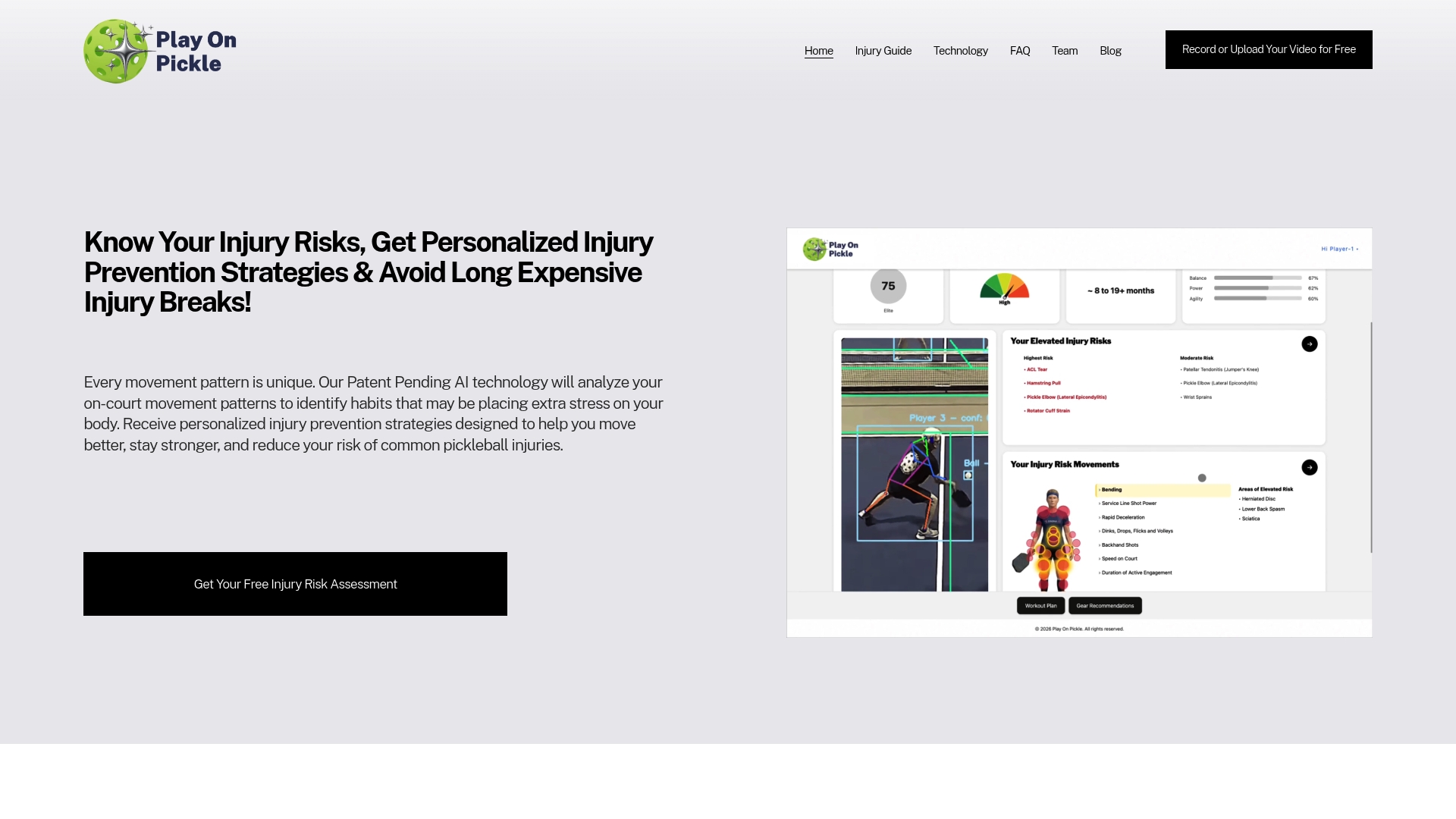
Getting started means uploading video of your play, letting the analysis flag biomechanical stress points, and receiving personalized exercises built around what it finds in your specific movement.
- Sign up for the Monthly subscription at $9.99 per month or the Annual subscription at $99 per year for ongoing access.
- New subscribers on the monthly plan can currently get a free tripod or selfie stick to make filming sessions easier.
- The analysis slots directly into the four-step monitoring system from earlier: flag a mechanical issue, get a targeted exercise, recheck your movement over time.
Read more about the technology behind the analysis or head straight to pricing to see which plan fits your season.
Key studies and reading
This article draws on peer-reviewed research into pickleball injury patterns, a multilevel meta-analysis on workload ratios, and applied guidance on session RPE and load monitoring. For more on injury data and applied routines, see Play On Pickle's injury statistics breakdown and injury prevention guidance.
Sources
- Understanding Injury Patterns and Predictors in Pickleball Players: A Nationwide Study of 1,758 Participants
- Risk of Upper Extremity Injury in Recreational Pickleball Players
- Acute:chronic workload ratio and load management for team sports: a multilevel meta-analysis
- Advancing and critical appraisal of an integrative load monitoring approach in microcycles in professional soccer
- Risk of Upper Extremity Injury in Recreational Pickleball Players
FAQ
Is 2 hours of pickleball good cardio?
Two hours of pickleball can provide solid moderate to vigorous activity, and accumulated weekly play often helps players meet general activity guidelines. That said, research on recreational players also found sessions longer than two hours carry meaningfully higher acute injury risk, so balance the cardio benefit against recovery needs.
What is the 10 second rule in pickleball?
The 10 second rule refers to a serving rule about timing between the score call and the serve, not a training load guideline. It is not something the injury or load research in this article addresses directly, so check current official rulebooks for the precise timing requirement.
How good is a 2.5 pickleball player?
A beginner generally understands basic rules and can sustain short rallies but is still developing consistency and shot control. Rating scales vary by organization, so exact skill descriptions can differ slightly between rating systems.
What is the best training regimen for pickleball?
There is no single regimen proven best, but the strongest available evidence points toward tracking session load with sRPE, capping routine sessions around two hours, avoiding consecutive high-intensity days, and building in off-court strength work for the hips, core, and forearms. Progressive weekly increases with periodic deloads, paired with attention to recovery signals like next-day stiffness, form the backbone of a sustainable plan.
How do I know if my pickleball training load is too high?
Watch for a jump in your weekly session load compared to your recent average, combined with new or persistent soreness, stiffness, or fatigue that doesn't resolve within a day. A modest but real association between elevated workload ratios and injury risk supports using sudden increases as a signal to scale back and reassess rather than push through.