
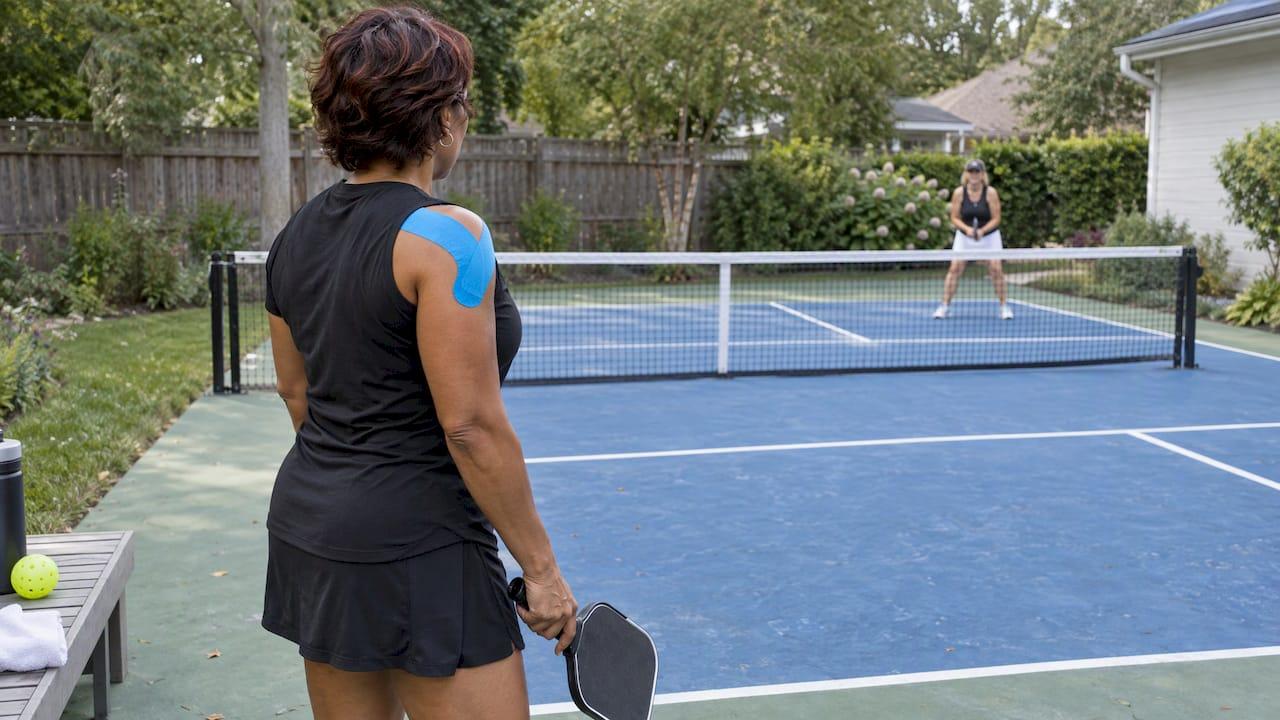
Shoulder tape can give a sore pickleball shoulder some support and confidence, but it works best as a short-term add-on to strengthening, not as the fix. Below you will find what the research says, a step-by-step application, how long to wear it, when to skip it, and the exercise habits that protect your shoulder for good. If you want your own movement and shoulder stress points assessed from a video, that is what we built Play On Pickle to do.
TL;DR
- Taping is most useful as a transitional aid during rehab, giving support while you return to play.
- Evidence is mixed: a Cochrane review rated it very low certainty, while a 2025 meta-analysis found modest pain and range-of-motion gains.
- Apply tape to clean, dry skin, with unstretched ends, and remove it at once if the skin itches or burns.
- Exercise does the heavy lifting: rotator cuff and shoulder-blade work, plus a short warm-up before play.
- Pain beyond 2 to 3 weeks, weakness, night pain or numbness means seeing a doctor, not adding more tape.
Table of Contents
- What shoulder tape actually does for a pickleball player
- What the research says
- When taping makes sense
- How to apply kinesiology tape to the shoulder
- How long can you wear it?
- Safety: when to skip the tape or see a clinician
- Pair the tape with what protects the shoulder
- Why we look at movement, not just the sore spot
- See your shoulder stress points from a video
- FAQ
- Sources
What shoulder tape actually does for a pickleball player
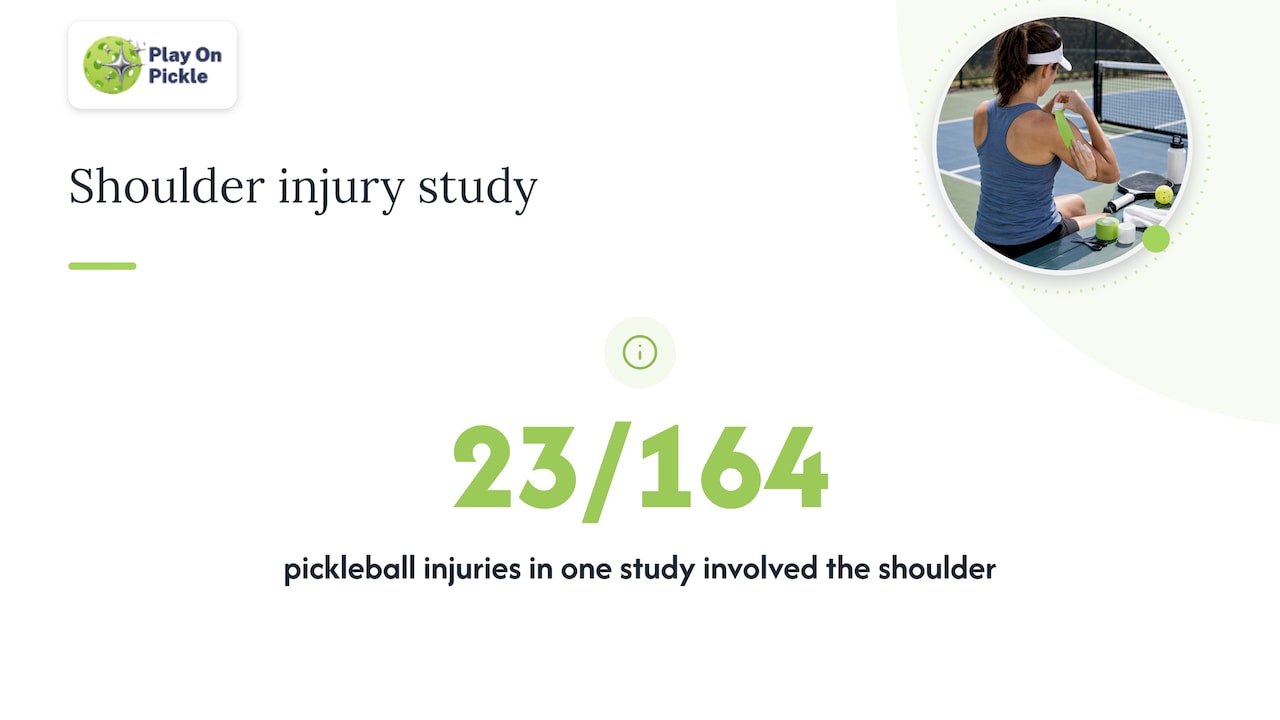
Pickleball asks the shoulder to do the same overhead and reaching motion hundreds of times per session: serves, overheads, defensive lifts at the kitchen line. At a US academic center, a study of 164 pickleball injuries found 23 were shoulder injuries, with rotator cuff problems the most common diagnosis and overhead hitting the most cited trigger.
Kinesiology tape (often called kinesio tape or K-tape) is a stretchy cotton-blend strip with adhesive backing. On the shoulder it is meant to add light support, cue better posture and make the joint feel steadier. It does not immobilize anything, which is why players can keep swinging.
A 2025 review of pickleball injuries describes taping and bracing as useful in the transitional phase of rehab, offering support and stability while an athlete returns to sport. That is the realistic role: a bridge, not a cure.
What the research says
The evidence points in different directions, so here is the plain version.
| Source | What it found |
|---|---|
| 2021 Cochrane review, 23 trials | Very low-certainty evidence; little or no clear benefit over sham taping for rotator cuff disease |
| 2020 randomized trial, 52 people | Adding tape to a 6-week PT program did not beat exercise alone |
| 2025 meta-analysis, 17 trials | Less shoulder pain and about 9 degrees more flexion and abduction, with a caution to interpret carefully |
| 2021 review of overhead athletes | Limited-to-moderate evidence for range of motion, proprioception and shoulder-blade movement, but no gain in strength or performance |
| 2026 tendinopathy review, 16 trials | Gains in motion when combined with other treatment; suggested as a short-term adjunct |
The common thread is useful. Tape may improve how the shoulder moves and feels (range of motion, position sense, shoulder-blade control) and can ease pain a little. It does not make you stronger or faster, and the overhead-athlete review advises against taping-only approaches. Treat tape as one piece of a plan.
When taping makes sense
Good moments to reach for tape:
- You are coming back from a shoulder irritation and want a confidence aid while rebuilding strength.
- Your shoulder feels cranky in overhead shots but you have no red-flag symptoms (see below).
- You are already doing a strengthening routine and want an extra cue for posture.
A 2026 orthopedic practice guide describes tape as most useful as an add-on to exercise rather than standalone. Cleveland Clinic's sports medicine physicians say the same in practice: for an irritated shoulder, the main treatment is time off the aggravating activity plus a prescribed exercise program, with tape at best a comfort aid.
How to apply kinesiology tape to the shoulder
The steps below follow Medical News Today's medically reviewed guide and the 2020 application guidelines. You need two precut strips and a partner makes this much easier, since you cannot see or reach your own shoulder blade well.
- Prepare the skin. Clean it so it is free of oil, lotion and sweat. Trim or remove dense hair. Do not tape over damaged skin. Where it goes wrong: oily or damp skin is the top reason tape peels in the first set.
- Round the corners. Cut the ends of each strip into a curve so the edges do not catch on your shirt and lift.
- Front strip. Measure from the top of the front shoulder down to the side of the upper arm. With your arm reaching behind your body, lay the first 2 to 3 cm of the strip down with no stretch.
- Stretch gently. Pull the tape lightly, press it along the arm to mid-upper arm, and finish the last 2 to 3 cm with no stretch. Where it goes wrong: over-stretching the tape or the skin. The guidelines warn against both, and a stretched end tugs on skin and causes irritation. A practice guide gives roughly 25 to 50% stretch in the middle with the anchors left unstretched.
- Back strip. Bring your arm across your body and apply the second strip so it overlaps the front strip slightly, again with unstretched ends. Rub each strip down so the adhesive activates.
- Protect bony spots. The 2020 guidelines note that hypoallergenic undertape can protect bony areas such as the front of the acromion, the bony tip of the shoulder.
- Wait before you play. Give the tape at least 10 minutes to settle and adapt before activity.
A 2025 review of biomechanical taping describes a three-strip method around the deltoid and over the AC joint (the joint at the top of the shoulder), with about 25% stretch in the body of the tape and 0% at the ends. A physical therapist can pick the layout that suits your shoulder; Medical News Today advises asking a physiotherapist about configuration.
How long can you wear it?
Advice varies, so be conservative. Medical News Today suggests not wearing it longer than one day. The 2020 guidelines recommend a maximum of 24 hours and removing tape after showering or heavy sweating, since sweat-soaked tape worn over a day can irritate skin. Some consumer guides allow several days, but for a sweaty sport like pickleball, one match day per application is the safest rule.
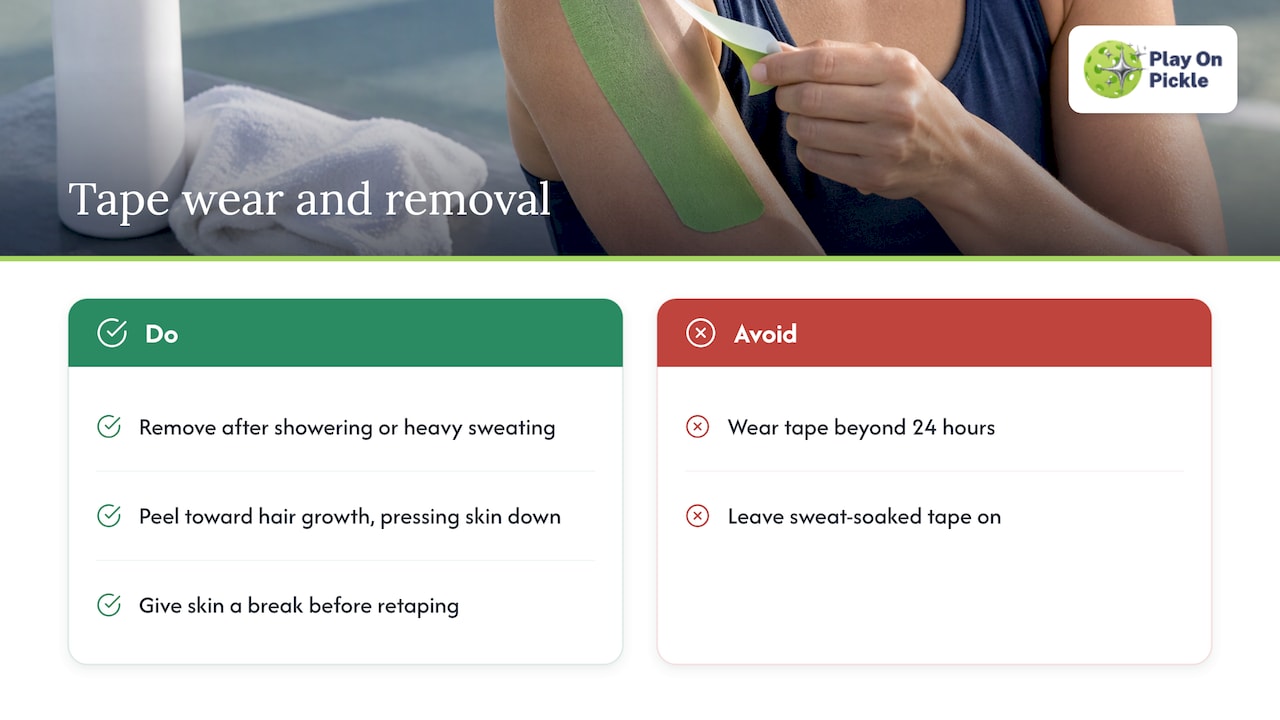
To remove it, peel slowly in the direction of hair growth while pressing the skin down. Give your skin a break before taping again.
Safety: when to skip the tape or see a clinician
Remove tape immediately if you notice itching, redness or any other irritation, and stop using it if side effects continue. Orthopedic guidance says not to tape over open wounds, rashes, sunburn or fragile skin, or if you have an adhesive allergy, active infection, a deep vein clot (DVT) or severe pain after an injury that nobody has diagnosed.
See a doctor if:
- Pain lasts more than 2 to 3 weeks.
- You notice weakness, night pain, worsening range of motion, a feeling the shoulder slips, or numbness down the arm.
- Pain followed a hard fall, you cannot identify the cause, or the shoulder looks a different shape. Medical News Today also lists sudden severe pain, fever, and one-sided weakness among reasons to call a doctor.
- You have chest pressure or chest pain with left shoulder or arm pain. Call 911, as it can signal a heart attack.
This matters because rotator cuff tears were the most common shoulder diagnosis in that academic center study, and 78% of cases were managed conservatively with physical therapy while 35% had surgery. A tear does not improve by being covered with tape.
Pair the tape with what protects the shoulder
Structured prevention programs have a stronger case than any strip of tape. A BJSM paper on shoulder injuries reported moderate-to-large effects of structured programs in reducing shoulder injury risk, with one program showing lower odds of all shoulder injuries (OR 0.72).
For pickleball, the 2025 review recommends combining:
- Rotator cuff strengthening such as empty can and external rotations.
- Shoulder-blade stabilizers (Y-T-W-L raises) and core work.
- Activity modification, then gradual return to play.
Cleveland Clinic physicians suggest a short pre-play warm-up of posture checks, shoulder-blade squeezes, overhead stretches and 10 to 15 reps of band external rotation. The academic center study also advises avoiding overhead shots until symptoms improve and adding balance and proprioception training to reduce falls.
We have built routines for each piece: a 20 to 30 minute rotator cuff routine, a three-move prehab routine, proprioception drills and an eight-week balance plan. If you are not sure whether your symptoms are normal soreness, read our guide to five shoulder pain clues older players shouldn't ignore.
Coaches and club operators can fold these routines into sessions and court schedules. Club teams that run lessons, leagues and bookings can keep that organized with pickleball club management software, leaving more time for warm-ups and coaching.
Why we look at movement, not just the sore spot
Tape treats the place that hurts. Most shoulder trouble in pickleball starts elsewhere: how you load your swing, how your shoulder blade moves, how you reach for the overhead. Two players with the same pain can have completely different causes.
That is why we built Play On Pickle around movement analysis. You upload a video, our patent-pending AI computer vision looks at your biomechanics, and you get an injury risk assessment with simple exercises and equipment recommendations matched to you. Our approach is designed to turn a generic warm-up into a plan that fits your body and fits in your routine.
Taping can be a helpful companion on a day your shoulder needs extra confidence. The lasting protection is a stronger, better-moving shoulder.
Drona
See your shoulder stress points from a video
Play On Pickle analyzes your movement from an uploaded video, identifies biomechanical stress points and delivers tailored exercises so you can keep playing. The plan is $9.99 per month or $99 per year, and we offer a free initial trial. See the plans and start your trial.

FAQ
Does kinesio tape help a sore pickleball shoulder?
It can help some players feel steadier and move with a bit less pain. A 2025 meta-analysis found modest gains in pain and range of motion, though reviewers rate the certainty of the evidence as low. Use it alongside strengthening exercises.
Can I play a full match with shoulder tape on?
Yes, tape is designed to allow normal movement. Apply it with clean, dry skin, let it settle for at least 10 minutes, and remove it if it itches or irritates. Plan on about one day of wear.
Where should the tape go for pickleball?
A common layout uses a front strip from the top of the front shoulder to the side of the arm and a back strip that slightly overlaps it, with unstretched ends. A physical therapist can adjust it for your shoulder and your swing.
Should I tape or rest a shoulder that hurts?
If pain is mild, cut back on overhead shots and follow a rotator cuff routine. If pain lasts beyond 2 to 3 weeks, or you have weakness, night pain or numbness, see a doctor.
Sources
- Diagnosis and Management of Common Musculoskeletal Injuries in Pickleball (Springer, 2025)
- Kinesio taping for rotator cuff disease (Cochrane, 2021)
- Kinesiotaping for the Rehabilitation of Rotator Cuff-Related Shoulder Pain (2020)
- The efficacy of kinesiology tape for rotator cuff injuries (Frontiers in Medicine, 2025)
- Evidence for taping in overhead athlete shoulders (2021)
- Effect of kinesio taping on shoulder tendinopathy (2026)
- KT tape for shoulder pain: How to use and more (Medical News Today, 2024)
- The Guidelines for Application of Kinesiology Tape (Healthcare, 2020)
- Applications for Biomechanical Taping and Kinesiotaping in Athletics (2025)
- KT Tape For Shoulder Pain: How To Apply It Correctly (2026)
- Pickleball-related injuries treated at a tertiary academic center
- Diagnosis, prevention and treatment of common shoulder injuries (BJSM, 2023)
- Preventing Overhead Shoulder Injuries (Cleveland Clinic, 2026)