
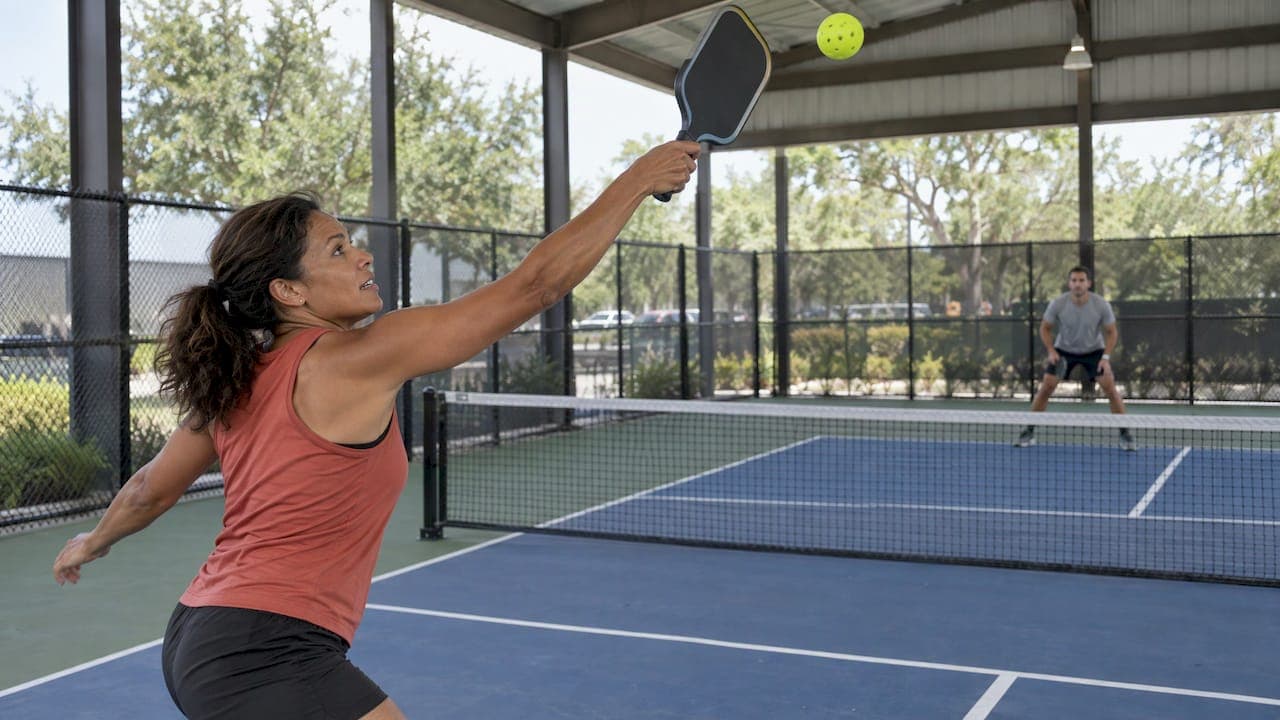
Scapular stability is your shoulder blade's ability to stay well placed on your ribcage and move smoothly while your arm serves, reaches, and swings. When it works, your shoulder has a steady base. When it doesn't, the joint and its tendons take stress they weren't built for. The good news: you can train it with a few simple, low-load exercises, two or three days a week, and no gym.
This guide explains what scapular control is, why pickleball asks so much of it, how to train it step by step, and when to stop and get your shoulder checked.
TL;DR
- Scapular stability means your shoulder blades sit well on your ribcage and move in sync with the muscles around them, so the shoulder joint has a steady base.
- Poor shoulder blade movement, called scapular dyskinesis, is linked to shoulder pain and dysfunction.
- Start with slow, light work such as scapula setting, then progress to controlled strength work and finally sport-specific swings.
- Train 2 to 3 days a week for 4 to 6 weeks, and stop and see a clinician if exercises cause pain.
- Pain that lingers after a few days of rest, or any sharp injury, needs professional care.
Table of Contents
- What scapular stability means on the court
- Why pickleball puts the shoulder blade to work
- Signs your shoulder blade may not be doing its job
- Four exercises to build scapular control
- Mobility and trunk work that support the shoulder blade
- A weekly plan and how to progress
- Adjusting for age, fitness, and level of play
- Our perspective: your shoulder blade is a movement problem, not just a strength problem
- Put your own movement under the microscope
- When to stop and get it checked
- FAQ
- Sources
What scapular stability means on the court
Your shoulder blade (scapula) is a flat, triangular bone that glides across the back of your ribcage. Your arm bone sits in a shallow socket on it. Because that socket is shallow, the shoulder has a very wide range of motion, and that range is the reason it can become unstable or pinched. Muscles and tendons work to keep the arm bone centered in the socket, as the American Academy of Orthopaedic Surgeons explains.
So what do players mean by scapular stability versus scapular control?
- Stability is the holding job. The muscles between and around your shoulder blades (the middle trapezius, serratus anterior, and others) keep the blade anchored so the arm has something solid to push from.
- Control is the moving job. As you raise your arm to reach a lob or finish a serve, the blade has to rotate and glide in the right order, at the right time.
In practice they are two halves of one skill. You need the blade to be steady when the arm is loaded and to move smoothly when the arm travels.
A 2019 review in a peer-reviewed journal describes four jobs the scapula performs: it is the center of rotation for the upper arm bone, it anchors that bone to the chest wall, it helps the arm move without impingement, and it transmits force from the core to the arm. That last one matters for pickleball. Power in a serve or a put-away should travel up from your legs and trunk through the shoulder blade, not get forced out of the shoulder joint alone.
Why pickleball puts the shoulder blade to work
Pickleball looks gentle, but a typical game includes hundreds of repetitive arm actions: serves, overhead smashes, volleys at the kitchen line, resets, and dinks. A 2025 academic review notes that pickleball rehabilitation may include scapular stabilizer exercises to build shoulder strength and stability for repeated overhead movements such as serves, smashes, and volleys, and that this may help prevent overuse injuries, particularly around the rotator cuff.
Three patterns tend to stress the area:
- High volume, low preparation. Many recreational players go from a desk job straight to three games in a row.
- Repeated overhead and reaching shots. Lobs, overheads, and wide volleys all ask the shoulder blade to rotate and stabilize under speed.
- Rushed mechanics. A serve or smash that is all arm, with little trunk rotation, pushes more demand onto the shoulder.
Research on shoulder pain in racket sports ties it to overuse, poor technique, or inadequate rehabilitation after earlier injuries, with mechanical stress on the shoulder a major factor in chronic overuse. The same work points out that pickleball-specific research on chronic overuse injuries is still limited, so tennis findings are often used to guide thinking. That is a reason to be sensible and consistent rather than to wait for perfect data.
When the shoulder blade moves poorly, clinicians call it scapular dyskinesis. The 2019 review above identifies it as a cause of shoulder pain and dysfunction because the scapula is a key link in the chain from the trunk to the hand.
Signs your shoulder blade may not be doing its job
You can't diagnose yourself, but certain patterns are worth noticing:
- Your shoulder feels tired or achy well before your legs or lungs do.
- One shoulder blade seems to stick out or sit differently from the other when you lower your arm slowly.
- Overhead shots feel pinchy at the top of the motion.
- You shrug or hike your shoulder toward your ear when you serve or reach.
- Pain sits near the shoulder blade or the top of the shoulder after a long session.
If any of these show up with sharp pain, weakness, or a feeling that the joint slips, skip the exercises below and see a clinician first. Our guide on pickleball shoulder pain clues for older players walks through what deserves attention, and this breakdown of normal versus warning-sign soreness can help you sort ordinary post-game fatigue from something more.
Four exercises to build scapular control
These are deliberately simple. The goal is clean, slow movement, not fatigue. Do them pain-free, and stop an exercise if it hurts.
1. Scapula setting
This is the base skill. The AAOS describes it as gently drawing the shoulder blades together and down the back, which works the middle trapezius and serratus.
- Stand or sit tall with your arms relaxed.
- Gently draw your shoulder blades back and down, as if sliding them into your back pockets.
- Hold for a few seconds without shrugging or arching your lower back.
- Release slowly and repeat.
Think about 30 to 40 percent effort. If your neck tightens, you are doing too much.
2. Prone scapular retraction
The same AAOS program describes a lying version: lie on your stomach with the working arm hanging over the edge of a table or bed, then lift a light weight slowly while squeezing the shoulder blade toward the opposite side. Start with no weight or a very light one. Lower with control, taking longer to come down than to go up.
3. Band pull-aparts
Hold a light resistance band at chest height with arms straight and pull your hands apart, leading with the shoulder blades rather than the arms. Pause briefly, then return slowly. This trains the muscles that hold the blades back during a long game of volleys.
4. Wall slides
Stand with your forearms on a wall and your elbows at shoulder height. Slide your arms up the wall while keeping your shoulder blades gliding smoothly around your ribcage, without shrugging. Stop before you feel pinching. This links stability to the overhead range you use in serves and smashes.

For a full routine that includes the rotator cuff, our 20 to 30 minute rotator cuff routine is a natural next step, and three prehab moves for recreational and senior players fit into a shorter warm-up.
Mobility and trunk work that support the shoulder blade
A stable shoulder blade needs something stable to sit on. Stiffness in the upper back can force the shoulder to make up the difference, so add a minute or two of gentle thoracic rotation, such as an open-book stretch lying on your side, before you play. Core and hip strength matter too, since force should travel up through the trunk to the arm.
Body-conditioning methods that train trunk control and breathing can help here. If you want to explore options, Pilates for athletes is one way to build the core control that takes repetitive overhead load off the shoulder.
A weekly plan and how to progress
The AAOS conditioning program recommends continuing exercises for 4 to 6 weeks, 2 to 3 days a week, and consulting a healthcare provider if pain occurs during exercise. A simple version:
| Day | What to do | Time |
|---|---|---|
| Day 1 | Scapula setting, prone retraction, band pull-aparts | 10 to 15 minutes |
| Day 2 | Rest or normal play | Whatever feels comfortable |
| Day 3 | Wall slides, band pull-aparts, thoracic rotation | 10 to 15 minutes |
| Day 4 | Rest or normal play | Whatever feels comfortable |
| Day 5 (optional) | Repeat Day 1 | 10 to 15 minutes |
The 2019 review describes scapular rehabilitation in three stages: active conscious control, strength and control for daily activities, and control in athletic performance. Translated for the court:
- Learn the feeling. Practice scapula setting slowly in front of a mirror until you can do it without shrugging.
- Add load. Use light bands or weights through everyday positions, such as reaching, carrying, and pushing.
- Bring it into the game. Shadow swings at half speed, then easy serves and overheads, then full-speed play. Our piece on biomechanics-first overhead mechanics and the serve sequencing guide show how the trunk and shoulder blade should work together during those shots.
Move to the next stage only when the current one feels easy and pain-free. Keeping track of how often and how hard you play is also a recognized prevention habit: ChoosePT recommends monitoring activity levels to avoid overuse injuries in athletes.
Adjusting for age, fitness, and level of play
Older players. Guidance from the American College of Sports Medicine for older adults is to start with light to medium effort and gradually increase the pace and time spent being active. For scapular work, that means no added weight at first, fewer repetitions, and more rest between sets. Stable positions, such as seated or lying, come before standing or unsteady ones.
Newer or returning players. The progression of physical therapy for shoulder impingement, according to ChoosePT, runs from gentle exercises lying down to standing work, aimed at better shoulder mechanics and pain-free movement. When returning to sport, therapists design functional training that retrains movements such as swinging a racket so the shoulder is under less stress.
Competitive players. You already tolerate volume, so the gains come from precision: slow tempo, pauses at the end of each rep, and sport-specific patterns, such as band-resisted serving motions. Check that your trunk rotation and shoulder blade timing hold up late in a match, when fatigue changes mechanics.
Coaches and facilities. A five-minute scapular block fits easily into a team warm-up. Our coach session templates and 5 to 10 minute warm-up give a ready structure.
The general principle for any beginner to resistance work, drawn from youth strength guidance by ACSM, applies to adults too: simple before complex, light before heavy, slow and controlled before explosive, and stable before unstable.
Our perspective: your shoulder blade is a movement problem, not just a strength problem
Most advice on scapular stability sounds the same: do some band work and hope. Our view is that shoulder blade control is personal. Two players with the same shoulder ache can have very different movement patterns behind it: one hikes the shoulder on every serve, another rushes the swing with the arm and leaves the trunk behind.
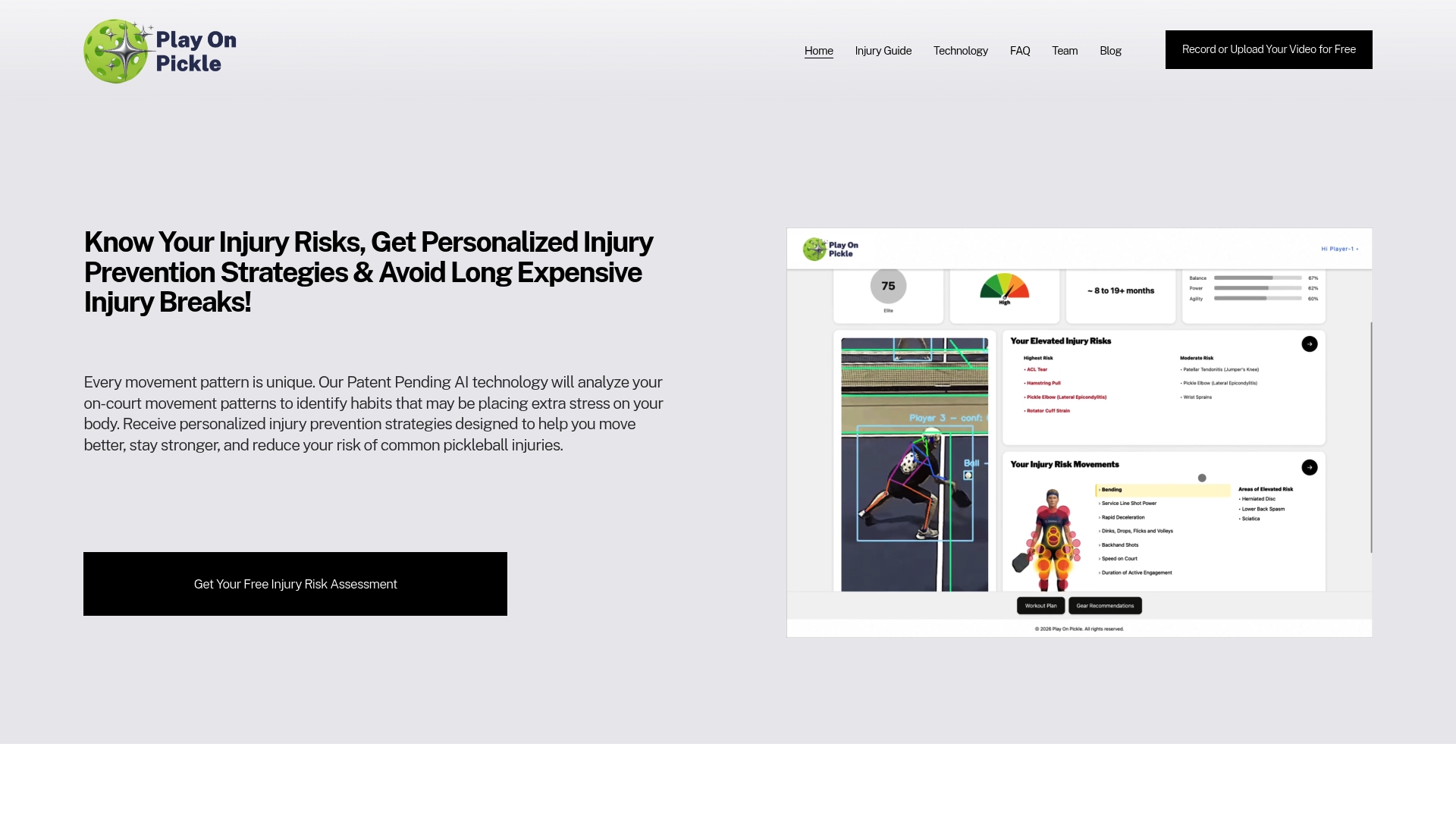
That is why we built Play On Pickle around movement analysis. You upload a video of your play, and our patent-pending computer vision looks at how your body actually moves, identifies likely stress points, and suggests simple exercises and equipment adjustments shaped to your biomechanics. We claim our approach is designed to be more specific than a generic workout app, and it asks for little equipment and little time.
For recreational players, who rarely have a physical therapist watching their serve, we think seeing your own mechanics is the missing step. Exercises such as scapula setting and band pull-aparts matter. Knowing which ones you need, and when your swing has changed, is what makes them stick.
Drona
Put your own movement under the microscope
If you would rather not guess where your stress points are, Play On Pickle analyzes video of your play and builds a personalized injury prevention plan around your biomechanics. Plans cost $9.99 per month or $99 per year, and we offer a free initial trial. You can see the details on our pricing page, learn how the computer vision technology works, or get a free tripod with the monthly plan so filming your game is easy.
For a broader plan beyond the shoulder, see our guide to pickleball injury prevention for recreational and older players, or visit Play On Pickle to get started.
When to stop and get it checked
Exercise helps a tired shoulder. It does not fix an injured one. The University of Rochester Medical Center advises seeking professional care for an acute injury with intense pain, or if symptoms persist after resting a few days. If rest isn't helping and you still have pain and loss of mobility, see your physician.
Practical triggers to stop playing and book an appointment with a physician or physical therapist:
- Sharp pain during a serve or overhead that doesn't ease with rest.
- Pain that wakes you at night or lasts beyond a few days of rest.
- A feeling that the shoulder slips or catches.
- Arm weakness, numbness, or tingling.
- Pain during the scapular exercises themselves. The AAOS program says to consult a healthcare provider if pain occurs during exercise.
Physical therapy for shoulder conditions often includes hands-on treatment to guide the region into less stressful movement patterns and improve motion, followed by the sport-specific retraining described above.
FAQ
Is scapular control the same as scapular stability?
They overlap. Stability is the shoulder blade's ability to stay well placed and anchored while your arm works. Control is how smoothly and correctly it moves as you reach, serve, or swing. Training one almost always trains the other.
How often should I do scapular exercises for pickleball?
The AAOS conditioning program suggests 2 to 3 days a week for 4 to 6 weeks. Keep the sessions short and pain-free, then keep one weekly session going during the season as maintenance.
Can scapular exercises prevent a rotator cuff injury?
They may help. Research on pickleball rehabilitation suggests scapular stabilizer work may help prevent overuse injuries, particularly around the rotator cuff, but no exercise guarantees protection. Pair it with sensible playing volume and good mechanics.
Should I play through shoulder blade pain?
Not if it is sharp, getting worse, or lasting beyond a few days of rest. Rest first, and if pain or lost mobility continues, see a physician or physical therapist before returning to full play.
Sources
- Shoulder Pain and Common Shoulder Problems, AAOS OrthoInfo
- Scapular Dyskinesia, the forgotten culprit of shoulder pain
- Diagnosis and Management of Common Musculoskeletal Injuries
- Shoulder pain in racket sports, California State University thesis
- Rotator Cuff and Shoulder Conditioning Program, AAOS
- Physical Therapy Guide to Multidirectional Instability of the Shoulder, ChoosePT
- Physical Therapy Guide to Shoulder Impingement, ChoosePT
- Being Active as We Get Older, ACSM
- Youth Resistance Training, ACSM
- How to Prevent Pickleball Injuries, University of Rochester Medical Center